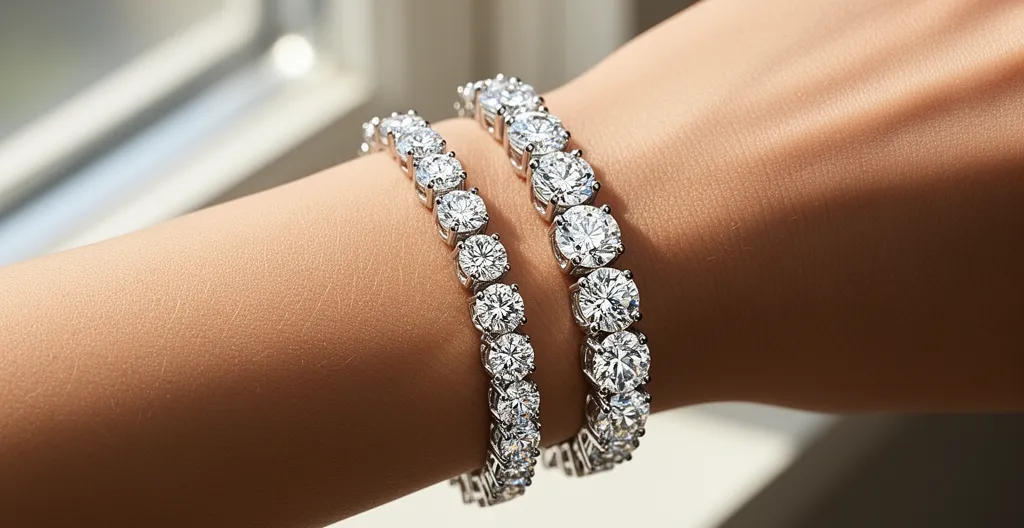
A tennis bracelet’s tendency to flip is not a random flaw, but a predictable outcome of its mechanical design—specifically the relationship between each link’s center of gravity and its pivot points.
- 4-prong settings, while often perceived as more secure, can raise the center of gravity more than 3-prong designs, increasing torsional instability (the tendency to flip).
- True on-wrist stability comes from superior architecture, like a double-gallery structure, and a proper fit, which have more impact than prong count alone.
Recommendation: When purchasing, prioritize the bracelet’s overall construction and articulation dynamics over simply counting the number of prongs on each diamond.
It’s a frustration familiar to any lover of fine jewelry: the exquisite line of diamonds you invested in spends half its time showing its less glamorous metal underside. The constant, annoying flip of a tennis bracelet can make even the most stunning piece feel like a design failure. Common advice often points to simple solutions like getting a tighter fit or choosing a lighter carat weight. While these factors play a role, they only scratch the surface of a much deeper engineering principle.
The real reason your bracelet rotates lies not just in its size, but in its fundamental mechanical design. As a technical designer, I view this not as a flaw, but as a question of articulation dynamics and torsional stability. The debate between 3-prong and 4-prong settings is less about which is “better” and more about understanding the trade-offs in how each style affects a link’s center of gravity relative to its pivot points. It’s a subtle but crucial distinction that separates a well-behaved bracelet from a perpetually flipping one.
This guide will dissect the hidden mechanics of fine jewelry. We will explore everything from the structural integrity of clasps and links to the physics that keep a pendant straight. By understanding these principles, you can move beyond surface-level specifications and learn to select pieces that are not only beautiful but are masterfully engineered to perform flawlessly during daily wear.
Summary: A Technical Guide to Choosing High-Performance Jewelry
- Why Should You Never Buy a Tennis Bracelet Without a Figure-8 Safety Catch?
- Can You Shorten a Tennis Bracelet Without Ruining the Pattern?
- Do Gold Tennis Bracelets Stretch and Become Loose Over Time?
- The Risk of Wearing a Prong-Set Bracelet with Delicate Knitwear
- 2ct or 5ct: What Size Tennis Bracelet is Practical for Daily Wear?
- Why Do Oval Bangles Rotate Less on the Wrist Than Round Ones?
- Why a Sliding Bezel Protects Your Diamond Chain Better Than a Fixed Bale?
- How to Choose a Diamond Pendant That Doesn’t Flip Over?
Why Should You Never Buy a Tennis Bracelet Without a Figure-8 Safety Catch?
The clasp is the single most critical point of failure on a tennis bracelet. While a primary box clasp provides the main closure, it is the secondary safety catch that offers true peace of mind. The most robust and trusted of these is the “figure-8” safety. This small, hinged latch swings over a post on the main clasp and snaps shut, acting as a redundant locking mechanism. Its sole purpose is to keep the bracelet on your wrist even if the primary clasp is accidentally opened or fails entirely.
The importance of this feature cannot be overstated. Given the value and sentimental attachment associated with diamond bracelets, relying on a single point of closure is an unnecessary risk. In fact, industry data reflects this concern; safety authorities highlight that clasp failures are a significant cause of jewelry loss. The figure-8 is a simple, time-tested piece of mechanical engineering designed to prevent just that.
When you invest in a piece of this caliber, you are also investing in its security. A bracelet without a secondary safety catch, particularly a figure-8, signals a potential shortcut in manufacturing quality. It suggests that the design prioritizes cost-saving over the long-term security of the piece. Therefore, the absence of a figure-8 safety should be considered a non-negotiable dealbreaker.
Can You Shorten a Tennis Bracelet Without Ruining the Pattern?
Yes, a tennis bracelet can almost always be shortened, but doing so correctly requires a jeweler with a deep understanding of the piece’s construction to preserve its pattern and structural integrity. Simply removing links from one end will offset the clasp, causing the bracelet to sit unevenly and look unbalanced. The professional approach is to maintain the bracelet’s symmetry at all costs.
This involves removing an equal number of links from both sides of the clasp. This meticulous process ensures the clasp remains perfectly centered on the underside of the wrist, maintaining the bracelet’s intended balance and flow. The key to a successful resizing lies in understanding the bracelet’s link structure. Many high-quality bracelets feature a “double gallery” construction, which adds structural support and helps the bracelet lie flat. This more complex architecture must be respected during resizing.
As seen in the comparison above, the difference in link architecture is significant. A skilled jeweler will ensure that the removal of links doesn’t compromise this internal structure. This principle is confirmed by professionals in real-world applications.
Case Study: Professional Symmetrical Resizing
A discussion among jewelers highlighted the standard procedure for resizing high-value pieces. One expert detailed successfully shortening a 10-carat total weight tennis bracelet for a client by removing matched pairs of links from each side of the clasp. This method preserved the visual continuity of the diamond pattern and, crucially, the bracelet’s balance and articulation on the wrist. The removed links were returned to the client for insurance purposes or potential future lengthening, demonstrating a best-practice approach that respects both the jewelry and the investment.
Do Gold Tennis Bracelets Stretch and Become Loose Over Time?
It’s a common misconception that the gold in a tennis bracelet physically “stretches” like a rubber band. In reality, the perceived loosening is the result of mechanical wear. A tennis bracelet is a complex chain of interconnected links, each with its own tiny hinge or pivot point. Over years of wear, the friction at these pivot points gradually wears away microscopic amounts of metal, increasing the tolerance or “play” between each link.
When this minute wear is multiplied across the 50 or 60 links in a typical bracelet, the cumulative effect is a noticeable increase in overall length and flexibility, which users perceive as “stretching.” This is not a failure of the gold itself but an expected outcome of mechanical articulation. As an industry analysis in the GemJewelers Technical Guide notes:
The perceived ‘loosening’ is not due to the metal elongating, but to mechanical wear at the pivot points of the links.
– Industry Analysis, GemJewelers Technical Guide
The rate of this wear is influenced by several factors. Heavier bracelets naturally exert more force on their links. Furthermore, jewelry experts confirm that heavier diamonds, often found in chunkier 4-prong settings, can accelerate this process by increasing the mass and inertia of each individual link. Regular cleaning is essential, as accumulated dirt and oils can form an abrasive paste that grinds away at these delicate pivot points, hastening the loosening process.
The Risk of Wearing a Prong-Set Bracelet with Delicate Knitwear
One of the primary practical concerns with any prong-set jewelry is its potential to snag on delicate fabrics like cashmere, silk, or fine-gauge knits. Both 3-prong and 4-prong settings present this risk, but the nature of the risk differs slightly. A 3-prong setting has fewer points to catch but the prongs themselves can sometimes have a sharper angle. A 4-prong setting has more potential snag points, but they are often more rounded and lower-profile.
Ultimately, the tendency to snag is less about the number of prongs and far more about the quality of the craftsmanship. In a well-made bracelet, each prong is meticulously finished, rounded, and polished so that it sits smoothly against the diamond with no sharp or raised edges. In a lower-quality piece, prongs may be rough, uneven, or improperly set, creating tiny hooks that will inevitably catch on clothing. As forum discussions among experienced owners often conclude, a masterfully crafted 4-prong bracelet can be far safer for knitwear than a poorly finished 3-prong one.
Because you cannot judge this quality with the naked eye, the best way to assess the risk is through a simple, practical test before you buy. This hands-on evaluation empowers you to make a decision based on the actual performance of the piece, not just its specifications on paper.
Your Action Plan: The In-Store Sweater Test
- Bring a piece of delicate knit fabric (like a scarf) or wear a fine-knit sweater to your appointment.
- Gently brush the top and sides of the bracelet against the fabric, moving it in multiple directions.
- Pay close attention to any sensation of catching, pulling, or resistance, no matter how slight.
- Ask the jeweler to examine the prongs under a loupe (magnifying glass) with you, looking for any sharp or unfinished edges.
- Test multiple styles, including both 3-prong and 4-prong options, to directly compare their smoothness and finishing quality.
2ct or 5ct: What Size Tennis Bracelet is Practical for Daily Wear?
The practicality of a tennis bracelet for daily wear is a balance between visual impact and mechanical reality. While a 5ct or larger bracelet makes a stunning statement, the increased mass has direct consequences for both durability and on-wrist stability. The core issue, as it relates to the bracelet flipping, is inertia. A heavier bracelet has more momentum as you move your arm, making it more prone to twisting and rotating.
A smaller bracelet, such as one with a 2-carat total weight (TCW), is inherently lighter and more agile. It has less mass and therefore less inertia, allowing it to sit more discreetly and securely on the wrist during daily activities. It is generally a more “wearable” option for those with an active lifestyle or who want to wear their jewelry without constant awareness of it. As a technical analysis in the Gem Jewelers Setting Guide points out:
Heavier bracelets (5ct+) have more inertia and are more prone to flipping. For higher TCW, a setting that intrinsically sits flatter becomes more critical.
– Technical Analysis, Gem Jewelers Setting Guide
This brings us back to the bracelet’s construction. For a higher TCW bracelet to be practical for daily wear, its engineering must be superior. Features like a double-gallery construction become essential to provide the structural rigidity needed to counteract the increased torsional forces. A snug fit—typically allowing just one finger to slide comfortably underneath—is also non-negotiable for heavier pieces to minimize the room they have to rotate. In summary, a 2ct bracelet is inherently practical, while a 5ct bracelet can be, provided its design and fit are optimized to manage its weight.
Why Do Oval Bangles Rotate Less on the Wrist Than Round Ones?
The superior stability of an oval bangle is a simple yet brilliant lesson in physics, directly related to the anatomy of the human wrist. A wrist is not perfectly round; it has a distinct oval cross-section, being wider than it is thick. A traditional round bangle sits on this oval shape at a single point of contact on the top and bottom. This creates an unstable system where the bangle is free to spin around this single pivot axis with the slightest movement.
An oval bangle, by contrast, is engineered to conform to the wrist’s natural shape. Instead of one unstable pivot point, it makes contact at two wider, more stable points along the sides of the wrist. This creates a much more secure fit, significantly restricting its ability to rotate. The bangle is essentially “locked” in place by the shape of your own arm. It’s the same principle that explains why a car is more stable on four wheels than a unicycle is on one.
This inherent stability is why oval bangles are often preferred for designs that have a distinct “top,” such as those with pave-set diamonds or a specific centerpiece. The design ensures the decorative element remains visible and correctly oriented, rather than spinning to the underside of the wrist. Just as with a tennis bracelet, achieving stability is about understanding and managing the points of contact and pivot, but here the bracelet’s shape does the work automatically.
Why a Sliding Bezel Protects Your Diamond Chain Better Than a Fixed Bale?
The way a pendant is attached to its chain has a profound impact on the chain’s long-term durability. A traditional fixed bale—the small loop at the top of a pendant—forces the pendant to hang from the exact same two links of the chain every day. This concentrates all the stress, friction, and movement onto those two specific points, creating significant wear over time.
A sliding bezel, on the other hand, is a design where the chain passes directly through the pendant itself. This allows the pendant to move freely along the length of the chain. This simple change in articulation dynamics distributes the wear and tear across a much larger section of the chain rather than concentrating it on two sacrificial links. As a result, the chain wears more evenly and its lifespan is dramatically increased. This is not just a theoretical benefit; it is clearly demonstrated in repair data.
Case Study: Chain Wear Analysis
An analysis of jewelry repair data reveals a stark difference in durability. Chains with fixed bale pendants are shown to fail at their wear points up to 3 times more frequently than those with sliding designs. One jeweler documented a case where a customer’s chain broke after just 18 months, precisely at the two links where a fixed bale sat. In contrast, an identical chain worn for 3 years with a sliding bezel showed only minimal, evenly distributed wear and remained perfectly intact.
Furthermore, the sliding design often helps with the very issue of stability. As a design expert from the Frank Darling Jewelry Guide explains, “A sliding bezel allows the pendant to self-center and sit lower, which often helps it lie flat against the chest and prevents it from flipping.” This makes it superior in terms of both longevity and presentation.
Key Takeaways
- Stability Is Physics: A bracelet or pendant’s tendency to flip is governed by its center of gravity relative to its pivot points, not just its weight.
- Architecture Trumps Specs: A well-engineered structure (like a double-gallery or sliding bezel) provides more stability and durability than can be inferred from prong count or carat weight alone.
- Maintenance Is Mechanical: “Stretching” is actually wear at the pivot points. Regular cleaning and professional inspection are crucial for preserving the mechanical integrity of any linked piece.
How to Choose a Diamond Pendant That Doesn’t Flip Over?
The principles of balance and stability that apply to a tennis bracelet are just as crucial for a diamond pendant. A pendant that constantly flips forward or sideways suffers from the same core issue: a poorly positioned center of gravity relative to its pivot point (the bale). As a fundamental rule of jewelry physics demonstrates that, a pendant will flip when its center of gravity is higher than, or sits in front of, the point where it hangs from the chain.
To choose a pendant that lies flat, you must learn to assess its design from a mechanical perspective. The goal is to select a piece where the weight is distributed low and to the back. A low-set bale is the most important feature to look for. If the bale is positioned near the top of the pendant, it creates a high pivot point, making the pendant top-heavy and prone to flipping. A bale set lower on the pendant’s body helps keep the center of gravity below the pivot point, ensuring it hangs straight.
The pendant’s overall shape and weight distribution also play a critical role. Pendants that are heavier at the bottom are naturally more stable. Additionally, a thicker or more substantial piece often has a better-balanced weight distribution than a very thin, flat one. When evaluating a pendant, you can perform a simple “dangle test”: hold the chain and let the pendant hang freely. If it immediately tilts or leans forward, it is likely to be a problem on the neck. Look for designs that hang perfectly vertical in this test.
Now, equipped with an understanding of mechanical integrity, you can apply these principles to your next jewelry purchase, ensuring your investment is not only beautiful but also perfectly engineered for a lifetime of wear.