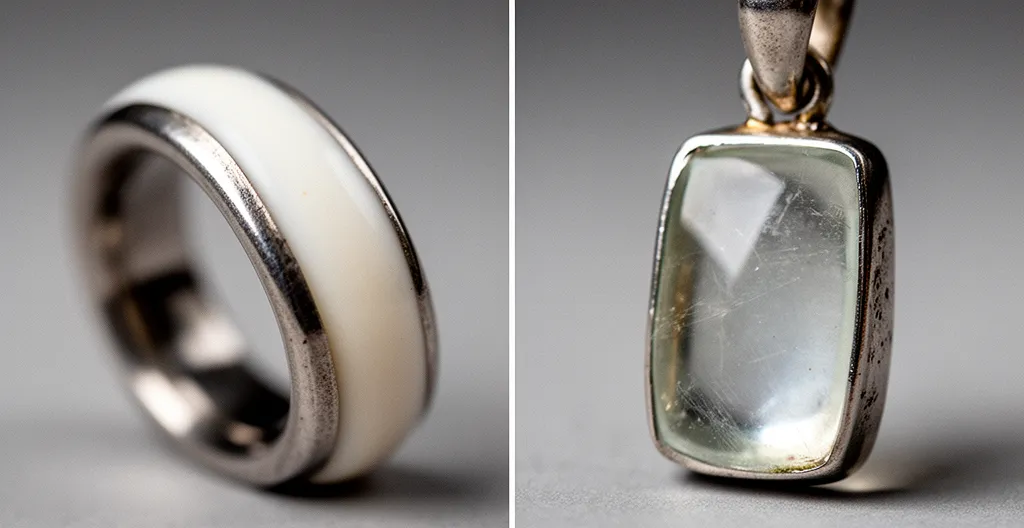
The durability of an enamel piece isn’t about its glossy finish; it’s about a fundamental difference in creation: true vitreous fusion versus a simple surface coating.
- Hot Enamel (Vitreous Enamel) is powdered glass fused to metal at over 800°C, creating a permanent, deep, and resilient molecular bond.
- Cold Enamel (Epoxy Resin) is a plastic-based paint that glues to the metal’s surface, making it vulnerable to chipping, peeling, and discoloration.
Recommendation: To invest in a piece that lasts generations, learn to spot the signs of hand-finishing required for hot enamel versus the mass-production shortcuts hidden by cold enamel.
It’s a moment of pure horror for any jewellery lover. The sickening little *click* as your beautiful enamel ring slips from your fingers and hits the tiled floor. You pick it up, and your heart sinks. A piece of the vibrant colour has flaked off, revealing the dull metal beneath. This single event is often the first, harsh lesson in the world of enamel. As an enamellist, I see this heartbreak often, and it almost always stems from a misunderstanding of what “enamel” truly is. People often believe it’s just a type of coloured paint, but the reality is far more complex and beautiful.
The market is filled with pieces labelled “enamel,” yet they represent two completely different materials, two philosophies of craft. On one side, you have inexpensive, brightly coloured pieces that seem like a bargain. On the other, you have heirloom-quality works that carry a significant price tag. The distinction isn’t just about cost; it’s about the very soul of the material. Is the colour a mere surface application, or is it an inseparable part of the object’s being, forged in fire?
But if the real secret to durability isn’t the price, but the process, how can you, the buyer, tell the difference? The key is to move beyond the surface and understand the fundamental conflict between vitreous fusion and surface adhesion. This guide will take you into the heart of the craft, revealing why one chips and the other endures. We will explore the physics of a chip, the art of repair, the secrets of masterworks, and the practical signs you can look for to distinguish a seasonal trinket from a timeless treasure.
This article provides a detailed comparison to help you understand the value and durability behind each type of enamel. Follow along to become a more discerning and confident buyer.
Summary: Cold Enamel vs Hot Enamel: Which is More Durable for Daily Wear?
- Why Did Your Enamel Ring Chip When You Dropped It on Tiles?
- Can You Repair Chipped Enamel Without Re-Firing the Whole Piece?
- What is Guilloché Enamel and Why is it So Expensive?
- The Risk of Putting Enamel Jewellery in an Ultrasonic Cleaner
- How to Store Enamel Pieces so They Don’t Scratch Each Other?
- Where to Look for “Casting Lines” on a Ring to Spot Mass Production?
- Restoring vs Preserving: Which Maintains the Value of Antique Jewellery?
- How to Spot the Difference Between Hand-Finished and Mass-Cast Jewellery?
Why Did Your Enamel Ring Chip When You Dropped It on Tiles?
The tragic chip on your ring happened because of a clash of hardness and a failure of bonding. True vitreous enamel is essentially a thin layer of glass fused to metal. While glass is hard, it is also brittle. It has a hardness of around 5.5 on the Mohs scale, which is quite durable for daily wear—for context, research from the gemstone durability experts shows that tooth enamel rates 5 on the Mohs scale. However, a ceramic tile is much harder, around a 7. When the ring was dropped, the force of the impact on a harder surface was enough to create a fracture.
With hot enamel, this is a clean fracture of the glass itself. The bond with the metal is a true vitreous fusion, a molecular intermingling created at over 800°C. The glass doesn’t ‘peel’ off; it shatters at the point of impact like a tiny windscreen.
With cold enamel, the failure is different and more total. Cold enamel is not glass; it’s an epoxy resin or plastic paint. It is not fused to the metal but merely glued on. This surface adhesion is the weak link. When a cold enamel piece is dropped, the impact doesn’t just chip the resin; it often breaks the adhesive bond, causing the “enamel” to flake or peel away in a larger section. The material itself is softer and more prone to deep scratches, but its failure mode upon impact is often more catastrophic because the entire layer can delaminate from the metal base.
Can You Repair Chipped Enamel Without Re-Firing the Whole Piece?
This question gets to the heart of the difference between the two materials. Repairing a chipped piece of hot enamel is a highly skilled and delicate process. Re-firing the entire piece to melt new glass into the chip is incredibly risky. The intense heat could alter the adjacent colours, warp the metal setting, or destroy any gemstones set in the piece. Because of this, true enamel restoration specialists rarely re-fire. Instead, they adopt a conservator’s approach.
As detailed by enamel restoration experts, professionals use “cold techniques” to preserve the original, valuable work. This involves meticulously cleaning the chip, colour-matching special conservation-grade resins, and carefully filling the void. This is not a simple repair; it’s an act of preservation designed to stabilize the piece while respecting its original integrity. The goal is an invisible mend that protects the value of an antique or fine jewel.
In stark contrast, repairing cold enamel is much more straightforward because you are simply replacing a plastic coating with more of the same. The process involves basic materials and can often be done at home. The steps generally include:
- Cleaning the damaged area to remove loose debris.
- Abrading the exposed metal to create a better grip for the new resin.
- Colour-matching new epoxy resin to the existing colour.
- Applying the new resin into the chip and allowing it to cure.
While this makes cold enamel seem more “fixable,” it highlights its nature as a decorative surface layer rather than an integral part of the jewellery. The ease of repair reflects the disposability of the material itself.
What is Guilloché Enamel and Why is it So Expensive?
Guilloché is the pinnacle of the enamellist’s art, a technique that is simply impossible to replicate with cold enamel. It perfectly demonstrates why true vitreous enamel is so prized. The process begins not with colour, but with the metal itself. The metal surface is engraved with incredibly intricate, repetitive patterns using a special machine called a rose engine lathe. This “engine turning” creates a mesmerizing, geometric base that plays with light.
Then, the true magic happens. The artist applies layers of translucent hot enamel over this engraved surface. When the piece is fired, the powdered glass melts into a crystal-clear, liquid pool that flows into every tiny groove of the pattern. After cooling and polishing, the transparent but richly coloured glass acts like a lens. It magnifies the intricate design beneath, creating an illusion of shimmering depth and movement that changes with the light. The pattern seems to float within the colour.
This effect relies entirely on the properties of true glass. As noted in the study of historical techniques, this was a favoured method of masters like Peter Carl Fabergé. The transparent enamel lets the intricate design peek through, creating a depth that is the signature of the guilloché style. Opaque cold enamel, being a plastic paint, would simply cover and hide the delicate engraving. It cannot achieve this interaction between light, pattern, and colour because light reflects off its surface rather than refracting through it. The expense of guilloché comes from this union of two demanding crafts: precision engine-turning and masterful translucent enamelling.
The Risk of Putting Enamel Jewellery in an Ultrasonic Cleaner
An ultrasonic cleaner seems like a magical solution for sparkling jewellery, but for enamel, it can be a death sentence, especially for cold enamel. These devices work by using high-frequency sound waves to create microscopic cavitation bubbles in a cleaning solution. When these bubbles collapse, they generate tiny but intense jets of liquid that scrub dirt from surfaces. The problem is, these forces don’t distinguish between dirt and delicate materials.
For hot enamel, the risk is moderate but real. While the vitreous fusion is strong, intense vibrations can potentially stress a piece that has existing microscopic fractures, causing a chip to worsen or appear. It’s generally advised to avoid it for valuable or antique vitreous enamel pieces.
For cold enamel, the risk is severe. The machine’s vibrations directly attack the weakest point: the adhesive bond between the resin and the metal. As one jewellery expert warns, the pressure from ultrasonic cavitation can cause cold enamel to crack or flake. The vibrations can work their way into the seam where resin meets metal, causing it to delaminate and peel away at the edges. Furthermore, some chemical solvents used in ultrasonic cleaning solutions can degrade the polymer resin itself, causing it to soften, cloud, or become brittle over time. The result can be a piece that goes in dirty and comes out ruined.
This vulnerability underscores the core weakness of cold enamel. It is a surface application that is susceptible to being physically dislodged. True hot enamel, being fused glass, is far more resistant to this kind of mechanical attack because it has no “edge” to peel from—it is one with the metal.
How to Store Enamel Pieces so They Don’t Scratch Each Other?
Proper storage is critical for preserving the pristine surface of any enamel piece, but the reasons are slightly different for hot and cold varieties. The common advice is to prevent pieces from knocking against each other, which is true, but the biggest unseen enemy is often household dust.
This might sound surprising, but the danger is very real. Common household dust is not soft fluff; it is largely composed of tiny, sharp particles of silica (quartz) from airborne dirt and sand. According to gemstone experts, common household dust contains silica particles rating a 7 on the Mohs scale. This is significantly harder than both hot enamel (around 5.5) and especially cold enamel (around 2-3). Wiping a dusty enamel surface with a dry cloth can be like rubbing it with very fine sandpaper, creating a web of microscopic scratches that dulls the finish over time.
For hot enamel, the main goal of storage is to prevent two things: high-impact chipping and abrasive scratching. Its glass surface is very resistant to chemical damage and discoloration, so the focus is purely physical protection. Storing each piece in a separate soft pouch or a lined compartment is ideal. This prevents it from being scratched by harder gemstones (like diamonds or sapphires) or chipped by impact with other metal pieces.
For cold enamel, the concerns are broader. Its soft, plastic-like surface is extremely susceptible to scratching from almost anything, including dust, metal, and harder plastics. On top of that, the resin can be sensitive to environmental factors. Prolonged exposure to sunlight can cause colours to fade or yellow, and contact with chemicals (like perfumes or lotions) can degrade the resin. Therefore, ideal storage for cold enamel is not just soft and separate, but also dark and airtight to protect it from both physical and chemical degradation.
Where to Look for “Casting Lines” on a Ring to Spot Mass Production?
Casting lines are one of the most reliable tell-tales of mass production, and their presence—or absence—is directly linked to the type of enamel used. When a piece of jewellery is mass-produced, it’s typically made by pouring molten metal into a mould. Where the two halves of the mould meet, a faint seam or “casting line” is left on the metal. In high-quality craftsmanship, this line is meticulously filed and polished away by hand until it is completely invisible.
This finishing step is non-negotiable for hot enamelling. A surface destined for true vitreous enamel must be perfectly smooth and clean. Any flaw, scratch, or trace of a casting line will not be hidden by the enamel; it will be magnified under the transparent, glossy layer of fired glass. The intense heat would also react unpredictably with any imperfections. Therefore, the presence of a perfectly finished surface is a prerequisite for the hot enamelling process.
Conversely, cold enamel is often used specifically to hide the sins of mass production. Because it is an opaque, thick paint applied at the end of the process, it can be slathered over a poorly finished surface, concealing casting lines, pits, and other defects. It reduces the time and skill needed for hand-finishing, dramatically lowering the cost of production. If you can see or feel a casting line near an enamelled area, it’s a double indictment: it signals a mass-cast piece where finishing was rushed, and it virtually guarantees the “enamel” is a cold resin applied as a cover-up. To find them, check the less visible areas where a manufacturer might cut corners: the inside of a ring band, the back of a pendant, or along the edges of a setting.
Restoring vs Preserving: Which Maintains the Value of Antique Jewellery?
When an antique enamelled piece is damaged, the owner faces a critical decision that directly impacts its historical and monetary value. The choice is not simply about repair; it’s about the philosophy of intervention. Do you restore it to look brand new, or do you preserve it in its current, historical state? For collectors and connoisseurs, the answer is almost always preservation.
Restoration, in the context of hot enamel, would mean a full re-firing to mend a chip with new glass. While this might make a piece more wearable for personal use, it is anathema to the antique market. As enamel restoration specialist Dean Schulefand states, this invasive approach can be destructive:
A full restoration, like re-firing a Lalique or Fabergé piece, would almost certainly destroy its collector value. A well-documented, professional ‘preservation’ using stable, reversible resins is the preferred method to maintain value.
– Dean Schulefand, Enamel Restoration Specialist
Preservation, or conservation, is a far more delicate and respectful approach. It involves stabilizing the piece to prevent further damage while doing the absolute minimum to alter its original state. This is the “cold technique” mentioned earlier, where a stable, reversible resin is used to fill a chip. The key here is “reversible”—a future conservator could, in theory, remove the repair without harming the original enamel. This maintains the piece’s authenticity and history, which is where its true value lies.
The financial implications of this choice are significant, as shown by experts in antique jewellery care. An invasive restoration can dramatically decrease market value, while a professional preservation can maintain or even increase it by making the piece stable and presentable.
| Approach | Method | Market Value Impact | Best For |
|---|---|---|---|
| Preservation | Stabilizing with reversible resins | Maintains or increases | Signed/historical pieces |
| Restoration | Re-firing or complete re-enameling | Significantly decreases | Personal heirlooms for wear |
| Conservation | Cold technique preservation | Maintains authenticity | Museum pieces |
| Repair | Minimal intervention | Slight decrease | Functional daily wear items |
Key Takeaways
- True durability in enamel comes from the manufacturing process (vitreous fusion), not just the material.
- Hot enamel is glass fused to metal, offering depth and resilience, while cold enamel is a surface-level plastic coating.
- Signs of mass production, like casting lines, often indicate the use of cold enamel to hide imperfections.
How to Spot the Difference Between Hand-Finished and Mass-Cast Jewellery?
Now that you understand the philosophies behind hot and cold enamel, you can train your eye to spot the physical evidence. The difference between a hand-finished piece destined for true vitreous enamel and a mass-cast item coated in resin is night and day, if you know where to look. It’s about looking for signs of care, precision, and the inherent qualities of the materials themselves. Forget the price tag for a moment and become an art historian, examining the object for clues.
A hand-finished piece feels different. The edges are crisp but not sharp, the surfaces are flawlessly polished, and there is a sense of unity to the object. A mass-produced piece often feels lighter, and you can find tell-tale signs of its quick creation in the overlooked corners. Use a jeweller’s loupe if you can, and conduct a thorough examination. With practice, these differences will become immediately apparent, allowing you to distinguish a piece with an artistic soul from one with a simple plastic skin.
Your Action Plan: Visual Inspection Guide for Enamel Quality
- Examine the ‘Shoreline’: Look closely at the line where enamel meets metal. Hand-finished hot enamel shows crisp, clean, and very defined lines. Cold enamel often has softer, slightly rounded, or ‘puddled’ edges from where the liquid resin cured.
- Look for Surface Uniformity: Under magnification, hand-applied hot enamel reveals beautiful, subtle variations in thickness and depth, a sign of human touch. Mass-produced cold enamel often appears perfectly flat, uniform, and plastic-like.
- Check for Trapped Air Bubbles: Tiny, pinprick-sized bubbles trapped within the colour are a telltale sign of cold enamel resin that was mixed and poured quickly in a mass-production environment. Firing hot enamel is a much slower process that eliminates bubbles.
- Inspect the Metal Quality and Finish: Hand-finished pieces are typically made of higher-quality metals like fine silver or high-karat gold, as these are necessary to withstand the kiln’s heat. Also, check the back and inside—on a quality piece, these surfaces will be as beautifully finished as the front.
- Assess the Light and Depth: Hold the piece to the light. Does the colour have a tangible depth, as if you are looking *into* it? That’s the light refracting through the glass of hot enamel. Or does it have a flat, superficial shine, like light bouncing *off* a coat of paint? That is the surface reflection of cold enamel.
By empowering yourself with this knowledge, you transform from a simple consumer into a discerning collector. You are no longer just buying a colour; you are investing in a craft, a history, and a piece of art that, if cared for, will truly last forever.
Frequently Asked Questions About Enamel Jewellery
Where exactly should I look for casting lines?
Check the inside of ring bands, areas near stone settings, and the backs of pendants where finishing might be rushed in mass production. These are the areas where manufacturers are most likely to cut corners on hand-polishing to save costs.
What does imperfect casting line removal indicate?
Visible or feelable casting lines are a strong indicator of mass-production methods. It means that the time-consuming and skilled process of hand-finishing was minimized to reduce costs, a practice incompatible with high-quality hot enamelling.
Can I feel casting lines near enameled areas?
Yes, and if you can, it’s a major red flag. If you can feel a raised seam or an imperfectly polished line adjacent to an enamelled area, it strongly suggests both a mass-produced casting and the use of cold enamel as a thick coating to hide these surface flaws, rather than as an integrated, high-quality finish.