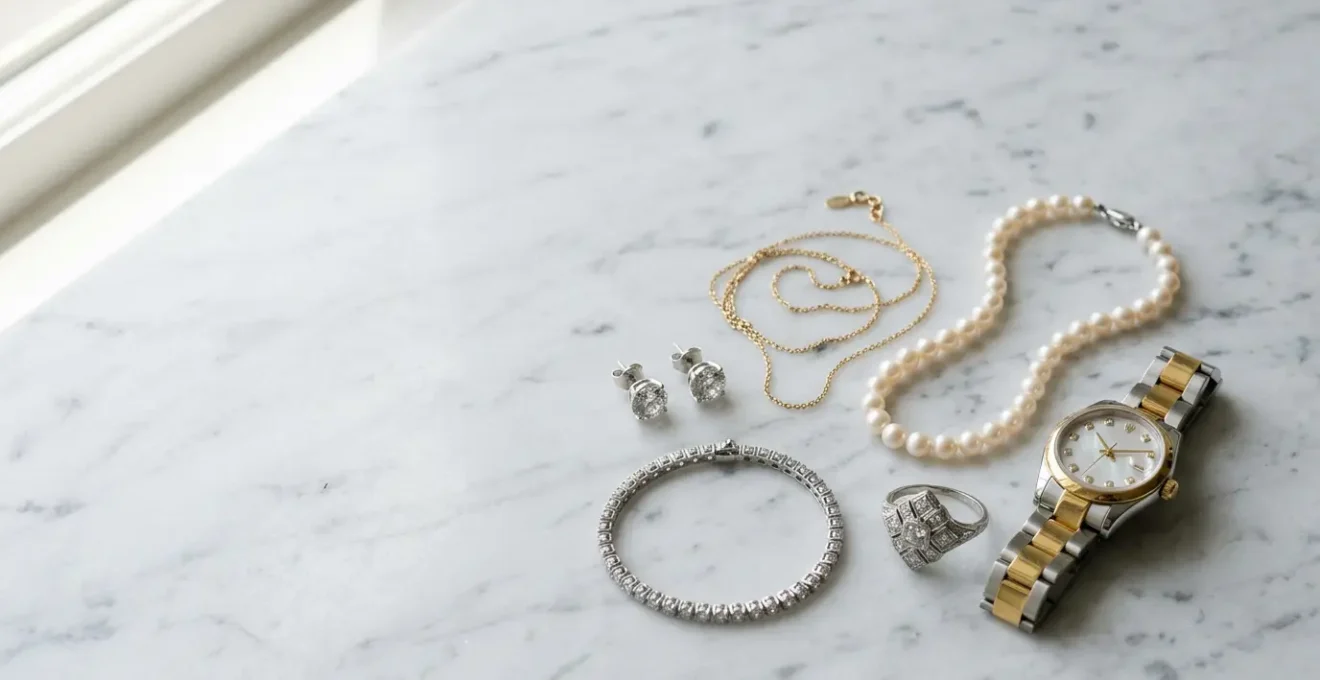
True, enduring style is not achieved by following a checklist of ‘classic’ items, but by mastering the foundational principles of visual permanence that make a piece of jewellery timeless.
- Focus on how a piece interacts with light (the science of the cut) and its geometric form (the legacy of Art Deco).
- Prioritise adaptability and practicality—how an item transitions from day to night and withstands the rigours of daily life.
Recommendation: Stop chasing trends and begin curating a collection based on the immutable laws of design, proportion, and personal context.
One opens a jewellery box to find a graveyard of past affections: the flimsy, tarnished necklace from a forgotten holiday, the chunky ring that defined a single season, the earrings that now feel like a costume. It is the great paradox of modern accessorising—a drawer full of pieces, yet a persistent feeling of having nothing truly meaningful to wear. For the discerning woman, tired of the relentless cycle of disposable fashion, the desire is not for more, but for better. It is a desire for a collection that is both an extension of self and an heirloom in the making.
The common advice is a predictable litany: acquire a pair of diamond studs, a simple gold chain, a classic watch. This checklist approach, while well-intentioned, misses the essential point. It treats timelessness as a formula to be copied rather than a principle to be understood. It results in a collection that is correct, but not necessarily compelling; classic, but devoid of personal narrative. The secret to building a jewellery capsule that will not only last for 20 years but will evolve with you, is to look beyond the items themselves.
The real key is to grasp the concept of visual permanence. Why does one design feel dated in a year, while another retains its power for a century? The answer lies not in fashion, but in the foundational principles of physics, geometry, and proportion. It is about understanding how a gemstone commands light, how a design’s structure speaks to a universal aesthetic, and how an object’s scale relates to the human form. This is the difference between buying jewellery and curating a legacy.
This guide deconstructs these core tenets. We will move past the what and into the why, exploring the science behind a diamond’s fire, the enduring appeal of specific stylistic eras, and the practical considerations that separate a showpiece from a daily companion. By mastering these principles, you will be equipped to build a capsule collection that is not merely timeless, but eternally yours.
To navigate this exploration of enduring style, we will delve into the specific principles that govern a truly timeless jewellery collection. The following sections break down everything from the science of a perfect cut to the art of mixing metals with intention, providing a complete framework for your curation.
Contents: The Art of Building a Timeless Jewellery Capsule
- Why the Round Brilliant Cut Has Dominated Style for Over 100 Years
- How to Style the Same Gemstone Necklace for the Office and a Gala
- Art Deco or Contemporary: Which Style Holds Its Visual Appeal Longer?
- The Cleaning Habit That Strips the Lustre Off Your Daily Gemstones
- Which Gemstone Colour Will Suit Your Skin Tone Even as You Age?
- How to Use a Two-Tone Watch to Anchor a Mixed Metal Look?
- 2ct or 5ct: What Size Tennis Bracelet is Practical for Daily Wear?
- How to Mix Gold and Silver Jewellery Without It Looking Messy?
Why the Round Brilliant Cut Has Dominated Style for Over 100 Years
The enduring reign of the round brilliant cut is not a matter of fashion or marketing; it is a triumph of physics. Its timelessness is rooted in a precise, scientific understanding of light. Before 1919, diamonds were cut to preserve carat weight, often resulting in stones that were deep, dark, and lacking fire. The revolution came when the gemologist Marcel Tolkowsky approached the diamond not as a rock to be conserved, but as a prism to be perfected. He sought to codify the journey of light, and in doing so, created the blueprint for visual perfection.
His work was a pure expression of mathematics. As his descendant Gabi Tolkowsky noted, “He figured out how to get the greatest amount of light to shine out of a diamond.” This was achieved through a rigorous formula, a feat of engineering that dictates how light enters the stone, reflects internally, and returns to the observer’s eye as brilliant sparkle. This precision is defined by Tolkowsky’s 58-facet mathematical model, with exact angles for the crown (34.5°) and pavilion (40.75°). Any deviation from this geometric ideal compromises the stone’s ability to handle light, diminishing its fire and brilliance.
This is the essence of visual permanence. The round brilliant cut’s appeal is not subjective. It is an objective measure of maximum light-return. It has dominated for over a century because no other shape has surpassed its ability to transform ambient light into a captivating display. When choosing a cornerstone for a 20-year capsule, selecting a piece based on its scientifically optimised light performance, rather than a transient shape, is the most intelligent investment in lasting style.
How to Style the Same Gemstone Necklace for the Office and a Gala
The true measure of a capsule piece is not its inherent beauty, but its versatility. A single, well-chosen gemstone necklace should not be confined to one context; it must be a chameleon, capable of whispering professionalism by day and commanding attention by night. The transformation has little to do with the piece itself and everything to do with the styling architecture built around it. It is an exercise in deliberate manipulation of length, layering, and focal points.
For a professional setting, the necklace must act as a subtle anchor, not a distraction. Tucked inside the collar of a buttoned shirt at a 16-inch choker length, it offers a flash of colour and quality without overwhelming the silhouette. Paired with minimalist studs, the look is polished, intentional, and respects the decorum of the workplace. Here, the necklace is an accent piece, a supporting character in a narrative of quiet confidence.
The evening, however, demands a shift in hierarchy. To transition the same piece for a gala, one must re-cast it as the star. By adding a simple 2-inch extender, the necklace drops to an 18-inch princess length, allowing it to frame the décolletage of an evening gown. This is the moment to create a ‘suite’ effect by adding dramatic drop earrings and a coordinating bracelet. The supporting jewellery now amplifies the necklace, turning a simple stone into the focal point of a cohesive, dramatic ensemble. The following table breaks down this strategic transformation.
| Styling Element | Office Look | Gala Look |
|---|---|---|
| Necklace Length | 16 inches (choker) | 18 inches (princess) |
| Function | Accent piece | Focal point |
| Supporting Jewelry | Minimalist studs | Statement earrings & bracelet |
| Visual Effect | Subtle sophistication | Dramatic ensemble |
| Neckline Pairing | Inside collar | Open décolletage |
Art Deco or Contemporary: Which Style Holds Its Visual Appeal Longer?
When curating for longevity, one must distinguish between a fleeting trend and an enduring stylistic movement. The debate between a period style like Art Deco and a fluid contemporary aesthetic is central to this decision. While contemporary design offers novelty, it is Art Deco that provides the superior blueprint for visual permanence. Its endurance comes from a reliance on the foundational elements of design: bold geometry, clean lines, and unapologetic symmetry. These are shapes that resonate on a primal level, independent of era.
Contemporary jewellery often embraces organic, irregular, and asymmetrical forms. While beautiful, these styles are frequently tied to a specific moment in design history, their novelty fading as aesthetics evolve. Art Deco, born in the 1920s, drew its power from universal shapes—circles, triangles, and straight lines—that are hardwired into human perception of balance and order. This is why, a century later, its influence remains potent, with some reports showing a 25% annual growth in custom Art Deco pieces, a testament to its persistent appeal.
The a-temporal power of this style lies in its structured confidence. The Hatton Garden Jewellers Research Team articulated this perfectly in their analysis:
Art Deco’s longevity comes from its reliance on universal, fundamental shapes that are hardwired into human aesthetics, unlike fleeting contemporary styles based on overly organic forms.
– Hatton Garden Jewellers Research Team, 2024 Timeless Jewelry Trends Report
Choosing an Art Deco-inspired piece is an investment in proven design theory. Its geometric integrity ensures it will not feel dated in five, ten, or twenty years. It possesses a structural logic that transcends fashion, making it a cornerstone of any serious capsule collection.
The Cleaning Habit That Strips the Lustre Off Your Daily Gemstones
A twenty-year capsule is not only curated but also meticulously maintained. The most significant threat to a piece’s longevity often comes not from wear, but from well-intentioned but misguided cleaning habits. The single most destructive practice is the use of common household abrasives, particularly toothpaste, to polish jewellery. This seemingly innocuous habit is responsible for inflicting irreversible damage, slowly stripping away the very lustre you aim to restore.
The issue is a simple matter of material science, governed by the Mohs scale of hardness. Precious metals are surprisingly soft; 18k gold, for instance, has a hardness of around 2.5 Mohs. The abrasive agents in most toothpastes, like silica, have a hardness of 3-4 Mohs or higher. This means that every time you scrub your jewellery with toothpaste, you are essentially sanding it with a harder material. While invisible to the naked eye initially, these countless microscopic scratches accumulate over time, dulling the metal’s surface and reducing its ability to reflect light. Scientific measurements reveal how this seemingly harmless act causes permanent damage, as common toothpaste has an abrasive hardness of 3-4 on the Mohs scale, enough to permanently scratch gold.
Preserving your investment requires a protocol rooted in gentle chemistry, not aggressive mechanics. Abandoning abrasive substances is the first and most critical step. The correct approach involves regular, gentle cleaning that removes oils and grime without compromising the integrity of the metal or the security of the gemstone settings. Adhering to a professional-grade cleaning regimen is non-negotiable for ensuring your pieces retain their brilliance for decades to come.
Your Five-Step Protocol for Preserving Lustre
- Assess your materials: Never use toothpaste or baking soda on any jewellery; the abrasive particles cause permanent micro-scratching on metals and soft gems.
- Control the temperature: Avoid thermal shock by using only room-temperature water. Sudden heat or cold can cause internal fractures in stones like emeralds.
- Rethink ultrasonic cleaning: Limit ultrasonic cleaner use to professional services. Overuse at home can vibrate prongs loose, especially in delicate pavé settings.
- Establish a weekly ritual: Clean your daily-wear pieces once a week with a soft, designated jewellery cloth and a simple solution of mild, phosphate-free soap and water.
- Practise protective storage: Store each piece separately in a soft pouch or lined box to prevent harder gemstones from scratching softer ones.
Which Gemstone Colour Will Suit Your Skin Tone Even as You Age?
Choosing a signature gemstone for a 20-year capsule requires looking beyond current colour trends and understanding which hues possess an inherent ability to flatter a wide range of skin tones, even as those tones subtly change with time. Skin luminosity, undertones, and texture evolve over decades. A colour that is merely ‘good’ today may be unflattering tomorrow. The key is to select what gemologists refer to as ‘universal donor’ gemstones.
These are stones whose appeal is not dependent on complementing a specific warm or cool undertone. Instead, they create their own light and glow. Analysis consistently points to three primary choices: blue sapphires, green emeralds, and diamonds. Unlike stones with a strong colour bias, such as the warm-yellow citrine or the cool-green peridot, these primary gems possess a high saturation and clarity that allows them to stand apart from the skin, generating their own vibrant colour narrative. Their brilliance is self-contained, making them remarkably adaptable.
As the experts at Blue Nile confirm, the principle lies in the quality of the gem itself:
A highly saturated, clear gem like a top-quality sapphire or emerald creates its own light and glow, making it more adaptable to changes in skin luminosity over time.
– Blue Nile Gemstone Experts, 17 Timeless Jewelry Pieces Guide
Pearls also belong in this exclusive category. Their gentle, diffused lustre flatters every complexion by reflecting soft light onto the skin, minimising the appearance of fine lines and creating a universally pleasing effect. When building a forever capsule, opting for one of these universal donors is a strategic decision. It ensures that your investment piece will remain a flattering and integral part of your personal style, regardless of the subtle shifts that come with age.
How to Use a Two-Tone Watch to Anchor a Mixed Metal Look
The old rule forbidding the mixture of gold and silver is decisively obsolete. The modern, sophisticated approach embraces mixed metals, but it requires a deft hand to avoid looking accidental or chaotic. The most effective tool for this task is a two-tone watch, which serves not merely as a bridge, but as a stylistic anchor for the entire look. It is the foundational piece that grants permission for gold and silver to coexist harmoniously.
The strategy is one of ‘Bridge and Echo’. The watch, with its inherent blend of both metals, acts as the central ‘bridge’. From this anchor, you consciously ‘echo’ each metal elsewhere on your body. This creates intentional zones of colour, rather than a haphazard salt-and-pepper mix. The result is a look that feels curated, confident, and complex. This technique is about creating balance and repetition, proving the mixture was a deliberate choice.
To execute this with precision, follow these steps:
- Establish the Bridge: Your two-tone watch is the anchor. Let it be the most substantial piece in your metallic arrangement.
- Echo the Tones: Echo the watch’s gold element with a pair of gold earrings. Then, echo its silver or steel element with a silver bracelet worn on the opposite wrist.
- Match the Finishes: For a truly elevated look, match the finish as well as the colour. Pair a watch with brushed steel to other brushed silver pieces, and polished gold to other polished gold pieces.
- Create Intentional Zones: Instead of alternating gold-silver-gold on one hand, stack gold rings on one finger and silver on another. This ‘zoning’ is bolder and looks more intentional than a simple alternation.
By using the two-tone watch as your starting point and applying the Bridge and Echo principle, you transform a potentially messy combination into a testament to your styling prowess. It’s a declaration that you understand the rules well enough to break them with intelligence.
2ct or 5ct: What Size Tennis Bracelet is Practical for Daily Wear?
The question of carat weight in a daily-wear piece like a tennis bracelet is often misconstrued as a matter of budget or boldness. For a 20-year capsule, the correct lens is one of practicality and proportional integrity. A piece intended for daily life must withstand the rigours of that life. Here, a more modest carat weight often proves to be the more intelligent, durable, and ultimately more stylish choice.
Larger carat weights, such as in a 5ct bracelet, necessitate higher and more prominent prong settings to secure the stones. These settings are inherently more prone to snagging on clothing and catching on surfaces. Over years of daily activity, this repeated mechanical stress can weaken the settings and lead to lost stones. Durability studies confirm that, due to their lower profile and more secure settings, 2ct bracelets have a 60% lower failure rate over two decades compared to their 5ct counterparts. The lighter weight also reduces constant stress on the clasp, a common point of failure.
The optimal choice is deeply connected to lifestyle, as the following analysis demonstrates.
Case Study: Lifestyle-Based Tennis Bracelet Selection
A comprehensive analysis of daily wear patterns reveals that professionals in desk-based roles experience significantly fewer snags and less surface contact with lower-profile 2ct, bezel-set tennis bracelets. The lighter weight reduces clasp stress during activities like typing. Conversely, individuals with more social or retired lifestyles can more successfully wear larger 5ct bracelets daily, as their activities involve less repetitive motion and surface impact. The decisive factor is less about carat weight alone and more about setting height; a well-designed 3ct bezel-set bracelet often proves more practical for daily wear than a high-prong 2ct version.
For a piece to be worn for 20 years, it must integrate seamlessly into your life. This means prioritising robust, low-profile settings and a carat weight that offers brilliance without becoming a liability. The most elegant choice is the one that you can wear with confidence and without constant worry, proving that in the world of enduring style, practicality is the ultimate luxury.
Key Takeaways
- Enduring style is rooted in geometric principles and light performance, not trend-driven checklists.
- A single, high-quality piece can serve multiple roles when styled with intention by adjusting its length, layering, and context.
- Practicality is paramount: choose sizes and settings that align with your daily life to ensure longevity and prevent damage.
How to Mix Gold and Silver Jewellery Without It Looking Messy
The final layer of mastery in curating a personal collection is the art of mixing metals. Doing so successfully is a powerful statement of stylistic confidence. The secret to avoiding a chaotic, messy look is to ensure the mix appears intentional, curated, and governed by an underlying logic. This logic is found not in alternating colours, but in grouping them and unifying them through a shared aesthetic language, or design DNA.
As the Missoma Design Team expertly advises, the approach must be deliberate:
The most sophisticated way to mix metals is to ensure pieces share a common design DNA – the stylistic repetition makes the metal difference look intentional and curated.
– Missoma Design Team, How to Build a Jewellery Capsule Wardrobe Guide
This means if you are mixing a spiky gold ring with a spiky silver ring, the shared ‘spikiness’ becomes the unifying theme that makes the colour difference irrelevant. The style connects them, not the metal. The most effective method for achieving this is ‘clustering’ or ‘zoning’.
- Create Bold Zones: Rather than alternating a gold ring, then a silver ring, then a gold one on the same hand, create bold blocks of colour. Stack three gold rings on one hand and two silver rings on the other. Group gold bangles together next to silver ones on the same wrist.
- Unify with Design DNA: Combine pieces that share a common stylistic element. Mix vintage filigree gold with vintage filigree silver. The shared heritage makes the pairing look thoughtful and historic.
- Use a ‘Third Element’ Buffer: If you feel the contrast is too stark, introduce a third material like a string of pearls or a leather wrap bracelet between the gold and silver pieces. This acts as a neutral buffer zone that helps the two metals coexist peacefully.
By following these principles, you move from a tentative mixer of metals to an assured curator. You are creating a conversation between pieces, where their shared design language speaks louder than their metallic differences.
Your journey towards a truly timeless collection begins now. Cease collecting and begin curating with the decisive intelligence of an editor. Build a narrative that will not only shine today, but will resonate with brilliance for the next twenty years.