In summary:
- Understanding your brooch’s true value (probate vs. insurance vs. market) is the first step to making informed, emotion-free decisions.
- Creating a detailed visual brief is the most critical action to ensure your jeweller perfectly captures your modern vision.
- Never melt down a piece without checking for signatures and hallmarks; its artistic value can far exceed its material worth.
- A redesign is a creative project, not a quick fix. Plan the transformation months in advance, especially for a key event like a wedding.
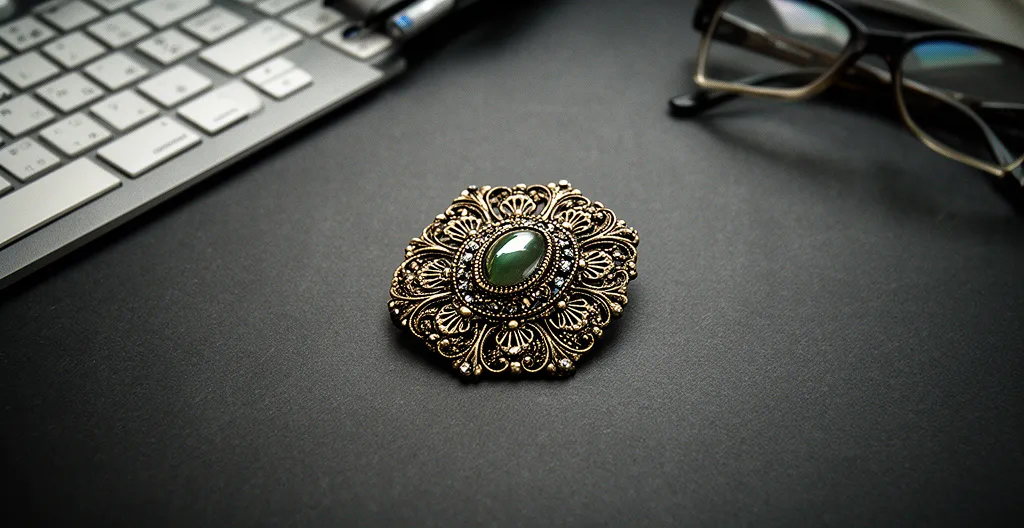
That beautiful but unwearable brooch sitting in a velvet box. It’s a familiar story: a piece steeped in love and history, passed down from a grandmother or great-aunt, yet its style feels worlds away from your own. The emotional weight makes you hesitant to part with it, but the outdated design means you’ll never actually wear it. It’s a sentimental treasure trapped in time. Many people assume the only options are to convert it into a simple pendant or, worse, let it gather dust forever.
The conventional advice often stops at “take it to a jeweller,” but this overlooks the most crucial element of a successful transformation. The challenge isn’t just technical; it’s about communication and vision. How do you translate the deep-seated affection for the person who gave it to you into a piece that reflects who you are today? The process can feel intimidating, fraught with the fear of “ruining” something precious or not being understood by the artisan.
But what if the key wasn’t simply altering a piece of metal, but embarking on a creative partnership? This guide reframes the process of modernizing an heirloom. It’s not about erasing the past, but about translating its sentimental history into a wearable future. Success hinges not on the jeweller’s skill alone, but on your ability to become an informed co-creator, armed with a clear, actionable vision. We’ll show you how to evaluate what you have, articulate what you want, and collaborate with an artisan to craft a new story for your family’s treasure.
This article provides a complete roadmap for this creative journey. You will discover how to correctly assess the value of your piece, what to look for in its components, and how to build a powerful visual brief that guarantees your vision is perfectly understood, transforming a forgotten object into a modern icon.
Summary: From Dated Brooch to Modern Masterpiece
- Why is Probate Valuation Lower Than Insurance Replacement Value?
- How to Check if the Diamonds in an Old Ring Are Worth Reusing?
- Restoring vs Preserving: Which Maintains the Value of Antique Jewellery?
- The Error of Melting Down Signed Vintage Pieces for Scrap Gold
- When to Schedule Heirloom Restoration Before a Wedding Date?
- How to Create a Mood Board That Guarantees Your Jeweller Understands You?
- How to Clean Hand-Finished Filigree Without bending the Fine Wires?
- How to Spot the Difference Between Hand-Finished and Mass-Cast Jewellery?
Why is Probate Valuation Lower Than Insurance Replacement Value?
Before you can decide on a new future for your brooch, you must understand its present value. This is the most common point of confusion and can lead to major disappointment. The “value” a piece has for insurance purposes is vastly different from what it’s worth for probate or resale. The insurance replacement value is the highest figure, representing the full retail cost to create a brand-new, identical piece, including materials, labour, and retail markup. In contrast, the probate value (or estate liquid value) reflects a much lower, immediate cash value—what a dealer would pay to acquire it for wholesale resale. This is based on the pre-owned market and aims for quick liquidation.
Failing to grasp this distinction is a critical error. You might feel your brooch is “worth” thousands based on an old insurance appraisal, but its actual market worth could be a fraction of that. As jewelry valuation experts explain, insurance appraisal values can be five to ten times higher than the simple value of the materials. Understanding this from the start is the first step in a successful creative partnership with your jeweller, as it sets realistic expectations about the budget and scope of your project.
To make an informed decision, you must know which valuation you’re dealing with. Here are the four key types:
- Insurance Replacement Price: The cost to replace the item at full retail with a new piece, including all markups and craftsmanship costs.
- Estate Retail Value: The pre-owned market price a retailer would charge for your piece in its current condition.
- Estate Liquid Value: The wholesale resale price for immediate liquidation to dealers, often used for probate.
- Intrinsic Value: The base worth of the raw materials only, meaning the scrap value of precious metals and the wholesale value of the gemstones.
How to Check if the Diamonds in an Old Ring Are Worth Reusing?
Once you understand the financial value, the next step is to assess the physical components. Are the gems in your grandmother’s brooch worth carrying into a new design? Not all old stones are created equal. The quality, cut, and condition of a diamond or gemstone are crucial factors. A professional jeweller should inspect the stones for clarity (inclusions), colour, and any damage like chips or abrasions that could affect their durability in a new setting. An old European cut diamond, for instance, has a unique charm and fire that differs from a modern brilliant cut, making it a desirable feature to preserve.
This professional assessment is non-negotiable. A jeweller’s loupe reveals the stone’s true story—its unique characteristics and potential for a new life. It’s a critical part of understanding the “Design DNA” of your piece.
However, some historical manufacturing techniques can make reusing gems impossible or unwise. It’s a mistake to assume all elements can be salvaged. The materials themselves might carry limitations that dictate the path of your redesign.
Case Study: The Hidden Limits of Heirloom Gems
Some historical jewellery poses significant challenges for reuse. For example, Art Deco jewellery was often soldered with lead, making the metal itself unsafe and impossible to reuse for health reasons. In other cases, the stones themselves are the issue. Gems from the Georgian era frequently used a foil-backing to enhance their colour and brilliance in candlelight. Once these stones are removed from their original closed-back setting, they lose the foil and their enhanced appearance, revealing a much less vibrant stone that may not be suitable for a modern open-back design.
Restoring vs Preserving: Which Maintains the Value of Antique Jewellery?
With a clear understanding of your brooch’s value and materials, you face a philosophical choice: do you restore it or preserve it? Preservation aims to keep the piece as close to its original state as possible, focusing on cleaning, minor repairs, and reinforcing settings. This approach is ideal for signed pieces or historically significant antiques where the original craftsmanship is the primary source of value. Restoration, or redesign, is a more transformative process. It involves altering the piece to create something new and wearable for you, potentially changing its function from a brooch to a pendant, ring, or even a pair of earrings.
There is no single right answer; the choice depends on the piece itself and your goals. If the brooch is a rare example from a famous house like Cartier or Van Cleef & Arpels, preservation is almost always the correct path to maintain its high market value. If it’s a sentimental but unsigned piece, a creative restoration that honors its spirit while fitting your lifestyle is a beautiful way to continue its story. The key is to find the balance between honouring the past and embracing the future.
As the experts at The Jewelry Clinic note in their Jewelry Design Transformation Guide, a thoughtful redesign can do both:
Incorporating vintage elements, such as ornate details or filigree work, can honor the original era of the piece while updating its overall appearance.
– The Jewelry Clinic
This approach allows you to carry forward the most beautiful parts of the original “Design DNA” into a new form. This is the heart of a successful creative partnership: finding a jeweller who understands this delicate balance.
The Error of Melting Down Signed Vintage Pieces for Scrap Gold
Perhaps the most tragic and irreversible mistake in handling inherited jewellery is melting a piece for its “scrap” value without proper identification. Many heirlooms, especially those from the early to mid-20th century, may carry a tiny, almost invisible maker’s mark or signature. This signature can elevate a piece’s value from the mere worth of its gold and gems to that of a collectible work of art. A signed Art Deco brooch isn’t just gold and diamonds; it’s a historical artifact with a provenance that collectors will pay a premium for.
The difference in value can be astronomical. Thinking only of the material worth is a costly error. For instance, jewelry experts have documented cases where a signed Art Deco piece with a scrap value of around $400 ultimately sold for $15,000 at auction. Melting it down would have been a loss of over 97% of its true market value. Before any alteration, a thorough inspection for hallmarks is not just recommended—it’s essential.
Your Action Plan: Uncovering Hidden Value Before You Act
- Points of Contact: Using a jeweller’s loupe, thoroughly inspect all potential locations for marks: the clasp, the pin stem, and the entire reverse side of the brooch.
- Collecte: Carefully photograph any marks you find. Verify hallmarks for metal authenticity, as it’s common for inherited pieces marked as “18k” to actually be 9k gold.
- Coherence: Research these marks using online hallmark databases to identify the maker, country of origin, and approximate date.
- Mémorabilité/Emotion: Compare the intrinsic scrap value to auction results for similar signed pieces to understand the potential financial loss of melting it down.
- Plan d’intégration: Get a professional valuation from an appraiser specializing in antique jewellery and consider consignment with a reputable vintage dealer as an alternative to alteration.
When to Schedule Heirloom Restoration Before a Wedding Date?
Transforming an heirloom, especially for a significant event like a wedding, is a project that requires patience and foresight. It is not a last-minute task. The process of consultation, design, sourcing materials, and expert craftsmanship takes time. Rushing the process is a recipe for disappointment and puts undue pressure on you and the jeweller. A realistic timeline is the bedrock of a successful and joyful creative partnership. As a general rule, you should begin the process at least six to twelve months before the date you need the finished piece.
This generous timeframe allows for thoughtful design discussions, the creation of CAD models or sketches for your approval, the sourcing of any additional stones if needed, and the meticulous work of the artisan. It also builds in a crucial buffer for any unexpected delays or minor adjustments after the first fitting. Starting early transforms the experience from a stressful rush into an exciting creative journey.
As bespoke jewellery expert Sophie Breitmeyer explains, even standard transformations require a significant lead time:
The majority of our Jewellery Transformations are delivered within 6-8 weeks. However, as with the cost, this is reliant on the type of transformation, with complex remodels and redesigns taking longer.
– Sophie Breitmeyer, SB Transformations Service
For a truly custom project starting from scratch, a reverse timeline is the best tool to ensure your piece is ready without any stress:
- 12 months out: Initial consultations with multiple jewellers to find the right creative partner.
- 9 months out: Jeweller selection and design deposit.
- 8 months out: Approval of the CAD model or 3D rendering.
- 6 months out: Sourcing of any additional stones or materials.
- 4 months out: Production and craftsmanship phase begins.
- 3 months out: First fitting and request for any minor adjustments.
- 2 months out: Final appraisal for insurance and documentation.
- 1-month out: The “emotional buffer zone” — the piece is complete and ready, with no more changes allowed.
How to Create a Mood Board That Guarantees Your Jeweller Understands You?
This is the single most important step in the entire process. A successful redesign lives or dies on the quality of your communication with the jeweller. Words are often inadequate to describe a visual feeling. What you mean by “modern,” “delicate,” or “bold” can be completely different from your jeweller’s interpretation. The solution is to create a comprehensive visual brief—a mood board that goes far beyond a few pictures of rings you like.
A powerful visual brief acts as a contract of vision. It removes ambiguity and ensures you and your artisan are speaking the same creative language. It should not just be a collection of other jewellery, but a curated collage of textures, colours, shapes, and even architectural or natural elements that capture the specific *feeling* you want the final piece to evoke. This is where you move from being a passive client to an active creative partner.
As one design expert points out, a visual is worth a thousand words. It is difficult to understand scale and style from verbal descriptions alone. A good jeweller will always provide at least a sketch or mock-up to confirm their understanding of your vision, but the quality of that sketch depends on the quality of your initial input.
To build a truly effective visual brief, structure it in distinct sections:
- The Heritage Section: Include clear, well-lit photos of the original brooch from multiple angles. This is the starting point.
- The Vibe Section: This is for non-jewellery inspiration. Add images of architecture, nature, textures, or art that capture the desired feeling.
- The Function Section: Show photos of your personal style—your hands, your neckline, outfits you love. This helps the jeweller understand the scale and context in which the piece will be worn.
- The Details Section: Provide close-ups of specific design elements you admire, such as particular metal finishes, prong styles, or chain types.
- The Red Flags Section: Just as important, include examples of styles you actively dislike. Annotate them with brief notes explaining why they don’t appeal to you (e.g., “too bulky,” “too ornate”).
How to Clean Hand-Finished Filigree Without bending the Fine Wires?
Whether you choose to preserve your brooch or transform it, proper care is essential, especially for delicate features like filigree. Filigree consists of fine, twisted threads of metal that are soldered together to create an ornate, lace-like pattern. These wires are incredibly fragile and can easily be bent or broken by aggressive cleaning methods like scrubbing with a brush. Using harsh chemicals or ultrasonic cleaners can also damage the delicate solder points or harm porous gemstones often found in vintage pieces.
The safest method is a gentle soak and swish. This process lifts dirt and oils without applying any physical pressure to the fragile metalwork. Patience is key. For a piece with extremely delicate work, professional cleaning is always the safest bet, but for regular maintenance at home, a gentle touch is paramount. The goal is to dislodge grime, not to scrub it away.
Follow the soak, swish, and air-dry method for the best results:
- Mix lukewarm water with a single drop of clear, gentle dish soap. Never use hot water, as it can cause thermal shock to gemstones.
- Soak the filigree piece for a maximum of 5 minutes if it contains gemstones, or up to 10 minutes for metal-only designs.
- Gently swish the piece in the solution. Do not touch or scrub the delicate wires.
- Rinse under a gentle stream of clean, lukewarm water.
- To dry, use compressed air to gently blow away moisture. As one jewelry care expert advises, you can securely hold the jewelry and spray away excess moisture, which is much faster and safer than air-drying alone.
- Once completely dry, store the piece in an anti-tarnish pouch to protect it.
Key takeaways
- The first step to a successful redesign is objective assessment: understand your piece’s true market value and the physical limitations of its materials.
- The most critical part of the process is creating a detailed visual brief; it is the bridge between your sentimental vision and the jeweller’s technical execution.
- Patience is a strategic asset. A well-planned timeline of 6-12 months is essential for a complex redesign, especially for a major life event.
How to Spot the Difference Between Hand-Finished and Mass-Cast Jewellery?
As you embark on this journey, developing an eye for craftsmanship will deepen your appreciation for both your original heirloom and the new piece you create. It will also empower you in your conversations with jewellers. The primary distinction to understand is between hand-finished and mass-cast jewellery. A cast piece is created by pouring molten metal into a mold, a process that can be easily replicated for mass production. Hand-finishing, by contrast, involves a skilled artisan working the metal directly—shaping, setting stones, and polishing by hand.
The difference lies in the details. Hand-finished pieces possess a unique character and a level of refinement that machines cannot replicate. They have a subtle “perfect imperfection” that speaks to the human touch. The prongs holding a stone will be individually shaped to fit it perfectly, not uniform and identical. The interior of the piece will be as beautifully polished as the exterior, a detail often overlooked in mass-produced items. Learning to spot these signs of quality will not only help you appreciate the artistry in your heirloom but also allow you to better assess the quality of the new work you commission.
Use this connoisseur’s checklist to train your eye:
- Look for ‘Perfect Imperfection’: Slight asymmetries in a design are often a hallmark of the human touch, compared to the perfect symmetry of a CAD-designed, cast piece.
- Examine the Interior: Hand-finished pieces are typically beautifully polished on the inside and back, whereas mass-cast items may feel rough or unfinished in areas that aren’t visible.
- Check Each Prong: In a hand-set piece, each prong is uniquely shaped and pushed to fit the specific contours of the stone. Cast prongs are often uniform, thick, and less refined.
- Feel the Weight: Hand-worked metal, which has been hammered and drawn, often has a surprising density and heft compared to a lighter cast piece of the same size.
- Search for Tool Marks: Under a loupe, you might find subtle file marks or textures from a hammer, providing clear evidence of handcraftsmanship.
You are now ready to begin this rewarding journey. By approaching the project as a creative partnership—armed with knowledge, a clear vision, and a realistic plan—you can transform that forgotten brooch into a modern icon that you will wear with joy. The next logical step is to start building your visual brief and initiate conversations with artisans who share your passion for storytelling through jewellery.