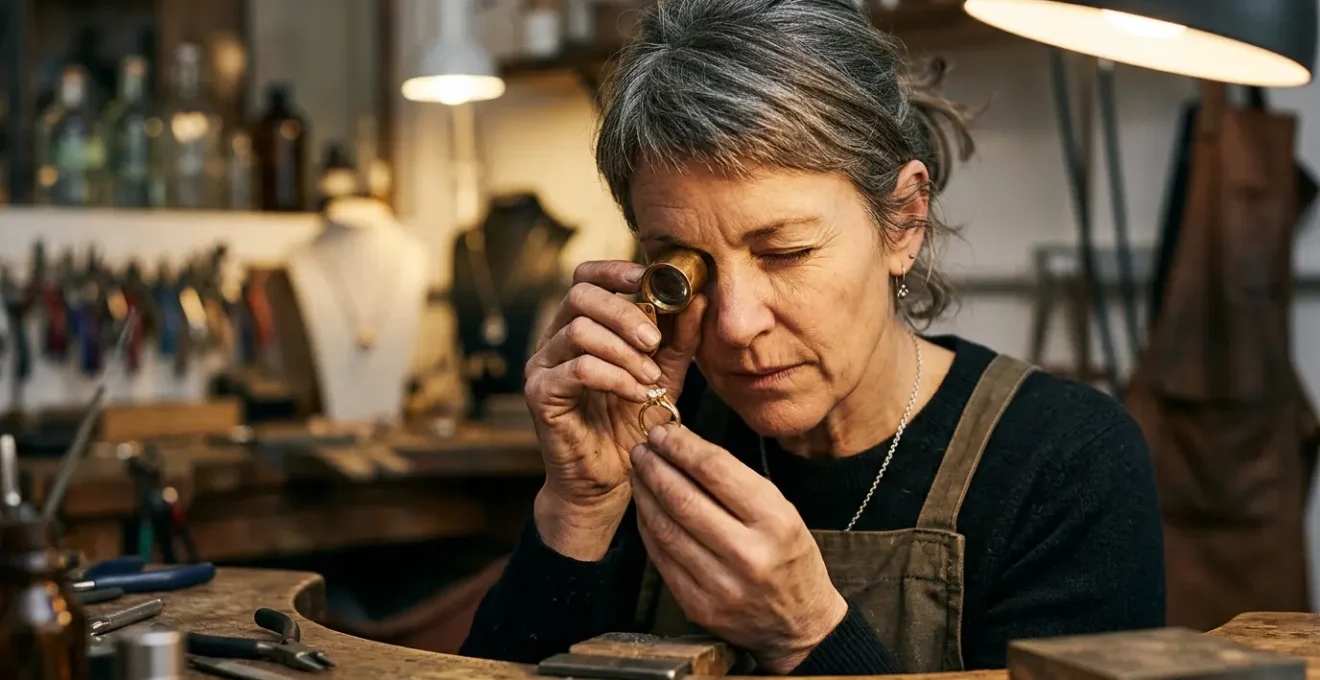
The true value of a ring lies in microscopic finishing details that separate artisan quality from mass-production shortcuts.
- Tiny pin-holes (porosity) on the surface are not decorative; they are a direct sign of rushed, low-quality casting.
- A hallmark of quality is a “holistic polish”—the inside of the ring must be as flawlessly smooth as the outside.
Recommendation: Train your eye to inspect for crisp, defined edges and uniform polish even in hidden areas like the undergallery. These manufacturing tells are the most reliable indicators of genuine craftsmanship.
When you hold a ring, you feel its weight, admire its design, and check the security of its stones. Most buyers stop there, trusting that a shiny surface equates to a quality piece. This is a common and costly assumption. The standard advice—check for a hallmark, ask about the metal—is merely the first step. It confirms the material, not the craftsmanship. The real story of a ring’s quality is written in a language of microscopic details, a language often overlooked by consumers but meticulously scrutinized by quality control inspectors at luxury houses.
The distinction between a ring that will last a lifetime and one that reveals its poor origins after a few months of wear is not always obvious. It’s found in the subtle evidence of its creation process. Was it cast with care, allowing gases to escape properly, or was it rushed, leaving behind a porous, weakened structure? Was it painstakingly polished by hand, preserving every sharp detail, or was it thrown in a tumbler with thousands of others, its edges softened and its character erased? These are the manufacturing tells that separate true artistry from high-volume production.
This guide departs from conventional advice. We will not be looking at the ring as a buyer, but as an inspector. You will learn to decode the signs of its making—to see the difference between a deliberate, flawless polish and a superficial gloss that hides imperfections. Forget what you think you know about judging jewelry by its sparkle. It’s time to train your eye to see the truth hidden in the metal’s micro-topography.
To help you develop this expert eye, this article breaks down the critical inspection points. We will explore the tell-tale signs of production quality, from the integrity of the metal itself to the durability and application of its final finish, allowing you to assess any piece with confidence.
Summary: The Inspector’s Guide to Ring Finishing
- Why Does Your Ring Have Tiny Pin-Holes on the Surface?
- Why Should the Inside of a Ring Be as Polished as the Outside?
- How Long Will the Rhodium Finish Last on Your White Gold Ring?
- The Risk of Over-Polishing a Ring to Remove Deep Scratches
- How to Keep a Matte Satin Finish from Becoming Shiny?
- Where to Look for “Casting Lines” on a Ring to Spot Mass Production?
- Matte or Polished: Which Finish Hides Scratches Better on Men’s Rings?
- How to Spot the Difference Between Hand-Finished and Mass-Cast Jewellery?
Why Does Your Ring Have Tiny Pin-Holes on the Surface?
The appearance of tiny, pin-prick-sized holes on the surface of your ring is one of the most definitive signs of a flawed manufacturing process. These are not a design feature; they are a defect known as gas porosity. This occurs during the casting process when molten metal is poured into a mold. If gases are trapped within the metal as it cools and solidifies, they form microscopic bubbles. When the ring is later polished, the surface layer is removed, exposing these voids as pin-holes.
While a few microscopic pores may be unavoidable even in good casting, a surface riddled with them is a major red flag. It indicates that the casting was likely rushed, with inadequate temperature controls or improper “spruing” (the channels that allow metal to flow and gas to escape). This defect is more than cosmetic; it signifies a compromised structural integrity. A porous ring is inherently weaker and more susceptible to cracking or breaking under stress over time. Research shows that porosity defects are responsible for up to 60% of issues in cast jewelry, making it a primary concern for quality control.
As an inspector, you must treat porosity as a direct indicator of the manufacturer’s standards. High-end workshops invest heavily in vacuum casting technology and rigorous protocols to eliminate these defects. The presence of visible pin-holes suggests a focus on volume over quality, a tell-tale sign of mass production where shortcuts are common. A truly well-made piece will have a dense, uniform surface, even under magnification.
Why Should the Inside of a Ring Be as Polished as the Outside?
A common cost-cutting measure in mass-produced jewelry is to focus finishing efforts only on the visible exterior of a piece. Turn a lower-quality ring over, and you will often find the “undergallery”—the area beneath the setting—and the inside of the band are left rough, with a grainy texture or even visible tool marks. This is a critical manufacturing tell. The principle of a “holistic polish” dictates that every surface of a ring, whether seen or unseen, should be finished to the same high standard. It is a non-negotiable hallmark of luxury craftsmanship.
A polished interior is not just about aesthetics; it is about comfort and hygiene. A rough inner surface can irritate the skin and trap dirt, soap, and lotion, potentially leading to contact dermatitis. A mirror-smooth interior, often called a “comfort fit,” glides easily over the knuckle and sits comfortably on the finger. The effort required to achieve this finish is significant. It involves meticulous hand-sanding and polishing in a hard-to-reach area, a time-consuming step that factories focused on speed and volume will almost always skip.
This macro comparison shows the stark contrast. The unpolished interior reveals a raw, textured surface, while the professionally finished ring has a flawless, reflective interior. This is a direct reflection of the time and care invested in its creation.
According to professional jewelry inspection standards, a high-quality ring’s shank must be perfectly round and smooth, with a size tolerance of no more than ±1/4 of a size. This level of precision is impossible without careful interior finishing. Therefore, when you inspect a ring, the very first place to check after the main setting is the inside. A rough, unfinished interior is an immediate signal that you are holding a mass-produced item, not a piece of fine, artisan jewelry.
How Long Will the Rhodium Finish Last on Your White Gold Ring?
Many buyers are unaware that most white gold jewelry is not naturally bright white. Gold alloys used for “white gold” are typically a pale, yellowish-grey. To achieve the brilliant, silvery-white sheen consumers expect, these pieces are electroplated with a thin layer of rhodium, a rare and precious metal from the platinum group. This rhodium plating is a sacrificial surface; it is designed to wear away over time, and its longevity is directly proportional to its thickness.
The lifespan of a rhodium finish depends almost entirely on the thickness of the plating and the wear it endures. For a ring worn daily, such as an engagement ring, a standard, high-quality plating is essential. Professional rhodium plating for fine jewelry typically ranges from 0.75-1.0 microns thick. Anything less, often called “flash plating,” is a purely decorative measure used on cheap fashion jewelry and may wear off in just a few months. When the rhodium erodes, the warmer tone of the white gold beneath will start to show through, often unevenly on high-contact areas like the base of the shank.
When purchasing a white gold ring, it is crucial to understand what level of plating has been applied. While it’s impossible to measure without specialized equipment, asking the jeweler about their standard plating thickness can be revealing. A reputable seller should be able to confirm they use a standard or heavy plate suitable for daily wear. The following table, based on data from plating specialists, illustrates the expected durability.
| Plating Thickness | Typical Lifespan | Best For |
|---|---|---|
| Flash plating (~0.1 microns) | 3-6 months | Fashion jewelry, occasional wear |
| Standard (0.75-1.0 microns) | 12-18 months | Engagement rings, daily wear |
| Heavy (1.5-2.0 microns) | 2-3 years | Premium pieces, high-wear items |
Ultimately, all rhodium plating will require periodic re-application. A quality initial plating ensures this maintenance is an infrequent inconvenience, not a constant necessity. A finish that wears off in under a year is a clear sign that a manufacturer has cut corners on one of the final and most critical steps.
The Risk of Over-Polishing a Ring to Remove Deep Scratches
When a beloved ring suffers a deep scratch, the instinctive reaction is to have it polished until it looks brand new. However, aggressive polishing is a subtractive process—it removes metal to level the surface. While effective for minor scuffs, using it to eliminate deep gouges poses a significant risk to the ring’s structural integrity and design details. This is where the difference between a skilled goldsmith and a generic repair service becomes starkly apparent.
Over-polishing is a common form of damage. Each time a ring is aggressively buffed, a small amount of precious metal is permanently lost. Over years of repeated polishing, this can dangerously thin the band (shank), weaken prongs holding gemstones, and soften or completely erase intricate details. As the experts at Sobling Jewelry Manufacturing note, this can have disastrous consequences. This is why preserving the original metal is a top priority in high-end restoration.
Over-polishing can blur sharp edges, thin out prongs (making them less secure), and soften or erase delicate engraving or milgrain details
– Jewelry Quality Inspection Experts, Sobling Jewelry Manufacturing Guide
A true craftsman will almost never opt for aggressive polishing as a first resort for deep damage. Instead, they employ additive or targeted techniques that preserve the ring’s form and weight. These methods prioritize the long-term health of the piece over a quick fix. Before resorting to a simple polish for significant damage, consider these professional alternatives:
- Laser welding: This precise technique adds metal directly into the scratch or gouge. The area is then carefully sanded and polished flush, restoring the surface without removing surrounding material.
- Re-shanking: If the bottom of the band is heavily worn or damaged, the entire lower portion can be replaced with a new, solid piece of metal while preserving the original settings and top of the ring.
- Selective refinishing: A skilled artisan can target their polishing to only the affected area, blending it seamlessly with the surrounding finish while maintaining the overall thickness and edge definition of the piece.
Before authorizing any repair, always ask for a professional assessment of the ring’s structural integrity. A quick polish might restore the shine, but it could come at the cost of the ring’s longevity.
How to Keep a Matte Satin Finish from Becoming Shiny?
A matte or satin finish is chosen for its soft, non-reflective elegance. However, this beautiful texture is, by its nature, less durable than a traditional high polish. The process that creates a matte finish involves creating microscopic abrasions on the metal’s surface to diffuse light. Through daily wear, these tiny peaks and valleys are gradually smoothed and compressed, a process called “burnishing.” Over time, this causes the matte ring to develop shiny spots, eventually taking on a semi-polished appearance that negates its original aesthetic.
The key to managing this is understanding that not all matte finishes are created equal. Their longevity varies dramatically based on the technique used to create them. A sandblasted finish, which creates a very fine, uniform texture, is often the most delicate and can begin to burnish within months. A “brushed” finish, with visible directional lines, is moderately more resilient. The most durable option is often a “hammered” finish. Its inherent, larger-scale texture of facets and indentations is far better at absorbing the minor impacts of daily wear without losing its overall character.
This image showcases the distinct textures of different matte finishes. Each one will wear differently over time, with the more complex textures like hammered finishes retaining their look the longest.
While no matte finish is permanent, you can take steps to preserve it. The most important is to remove your ring during activities that cause friction, such as working out, gardening, or handling rough materials. For cleaning, avoid polish cloths, which are designed to create shine. Instead, use a soft toothbrush with mild soap and water. When the finish inevitably burnishes, a jeweler can easily re-apply the matte texture. A simple re-brushing or re-blasting is a quick and inexpensive service that will restore your ring to its original understated beauty.
Where to Look for “Casting Lines” on a Ring to Spot Mass Production?
One of the clearest manufacturing tells that separates a hand-finished piece from a mass-cast one is the presence of casting lines or seams. When a ring is created using a mold (a process known as casting), the mold is typically made of two or more parts. A faint line or seam can be left on the ring where these parts meet. In mass production, rings are cast by the thousands, and removing these seams perfectly is a time-consuming, manual process that cuts into profit margins.
Therefore, manufacturers often settle for “good enough.” The ring is typically tumble-polished in a machine with abrasive media, which smooths the surface but doesn’t completely erase the seam. Instead, it softens and rounds it, leaving a subtle but detectable trace. To find it, you need to know where to look. The most common locations for casting lines are on the sides of the shank (the band) or, more subtly, along the delicate contours of the setting itself. Use a 10x loupe and angled light to inspect these areas for any interruption in the surface texture.
In a truly high-quality, hand-finished piece, this seam is considered an unacceptable flaw. As professional inspectors emphasize, its removal is a mark of true craftsmanship.
In a hand-finished piece, the jeweler meticulously files and polishes these areas until the seam is completely undetectable, even under magnification. The presence of a seam line is a direct trade-off of time vs. cost.
– Professional Jewelry Inspectors, Quality Control Standards Manual
The complete absence of a casting line is a powerful indicator that a skilled artisan has invested significant time in the piece. They have painstakingly filed, sanded, and polished the area by hand to create a single, seamless object. When you are inspecting a ring, running your fingernail along the side of the shank can sometimes reveal a subtle ridge that your eye might miss. If you can see or feel a seam, you are looking at evidence of a manufacturing shortcut.
Matte or Polished: Which Finish Hides Scratches Better on Men’s Rings?
The choice between a matte and a polished finish is a primary consideration, especially for men’s rings which often face more rigorous daily wear. While a high-polish finish offers a classic, mirror-like shine when new, its perfection is its greatest weakness. Every single scratch, scuff, and hairline mark is immediately visible against the flawless, reflective surface. Within a year of daily wear, a high-polish ring will be covered in a patina of micro-scratches, losing its initial pristine look.
On the other hand, matte finishes are far more forgiving. A satin or brushed finish starts with an existing texture, so new, minor scratches tend to blend in with the original pattern rather than standing out. While a satin finish will burnish and become shinier over time, this gradual evolution is often seen as more graceful than the stark scratching on a polished band. Textured finishes, such as hammered or heavily brushed styles, are the most practical of all. Their complex surfaces are designed to absorb wear and tear, and new marks become part of the ring’s evolving character.
This comparison, based on wear data from specialists at TitaniumRings.com, clearly shows the practical differences in how finishes age. The choice is a trade-off between initial perfection and long-term appearance.
| Finish Type | Initial Appearance | After 1 Year | Scratch Visibility |
|---|---|---|---|
| High Polish | Mirror-like perfection | Shows every scratch | Very High |
| Matte/Satin | Uniform texture | Burnishes to semi-polish | Low |
| Hammered | Faceted texture | Maintains appearance | Minimal |
| Brushed | Directional lines | Blends with wear | Moderate |
For someone seeking a low-maintenance ring that will look good for years without constant re-polishing, a matte, brushed, or hammered finish is the superior choice. A high-polish finish is for those who are either prepared to embrace the patina of wear as part of the ring’s story or are willing to have it professionally re-polished regularly to maintain its original look.
Key takeaways
- Porosity, or tiny pin-holes, is a clear sign of a rushed, low-quality casting process and compromises the ring’s structural integrity.
- A hallmark of superior craftsmanship is a “holistic polish,” where every surface, including the hidden interior and undergallery, is as flawlessly finished as the outside.
- Matte and textured finishes are significantly better at hiding the scratches and scuffs of daily wear compared to a high-polish finish, which reveals every mark.
How to Spot the Difference Between Hand-Finished and Mass-Cast Jewellery?
Distinguishing a meticulously hand-finished piece from a mass-cast one requires looking beyond the overall design and focusing on the subtle yet telling details of its construction. The difference lies in the evidence of time, precision, and the human hand versus the sterile uniformity of a machine. By training your eye to see what an inspector sees, you can confidently identify true craftsmanship.
The first area to examine is the edge definition. Hand-finishing involves careful filing and polishing that preserves the crisp, sharp lines of the design. Mass production, conversely, often relies on tumble polishing, where thousands of rings are processed at once in a machine with abrasive media. This process inevitably rounds and softens all the edges, resulting in a less defined, “blurry” appearance. Compare the sharp junction where a prong meets the band on a high-end ring to the soft curve on a cheaper one.
Another crucial tell is the quality of the undergallery—the area beneath the main setting. In mass-cast rings, this hidden zone is almost always neglected. You will find it rough, unpolished, and may even see casting lines. A master jeweler, however, believes in a holistic finish; they will polish these unseen surfaces to the same standard as the rest of the ring. Finally, inspect the prongs. In hand-finished work, each prong is individually shaped and finished, showing subtle character. In mass-cast pieces, the prongs are often identical, a sign they came straight from a uniform mold with minimal subsequent work.
Your 5-Point Quality Inspection Plan: Distinguishing Craft from Cast
- Points of Contact: Systematically inspect all surfaces with a 10x loupe, paying special attention to junctions where parts meet (e.g., prong bases) and hidden areas like the undergallery.
- Collecte: Inventory the manufacturing tells. Look for evidence of pin-hole porosity, visible casting seams on the shank, and rough, unpolished textures on the interior.
- Cohérence: Confront the piece with the “holistic polish” standard. Is the quality of the finish consistent across every single surface, both visible and concealed?
- Mémorabilité/Emotion: Assess the details. Are the edges crisp and defined, or soft and rounded? Do the prongs show the subtle character of being hand-shaped, or are they perfectly identical and sterile?
- Plan d’intégration: Based on your findings, make an informed decision. The absence of these flaws indicates a high-quality, hand-finished piece worthy of investment. Their presence signals a mass-produced item.
Armed with this knowledge, you can now approach your next jewelry purchase not just as a buyer, but as a connoisseur. Apply this inspection framework to every piece you consider, and you will be able to confidently discern the pieces that are a true testament to craftsmanship from those that merely offer a surface-level shine.