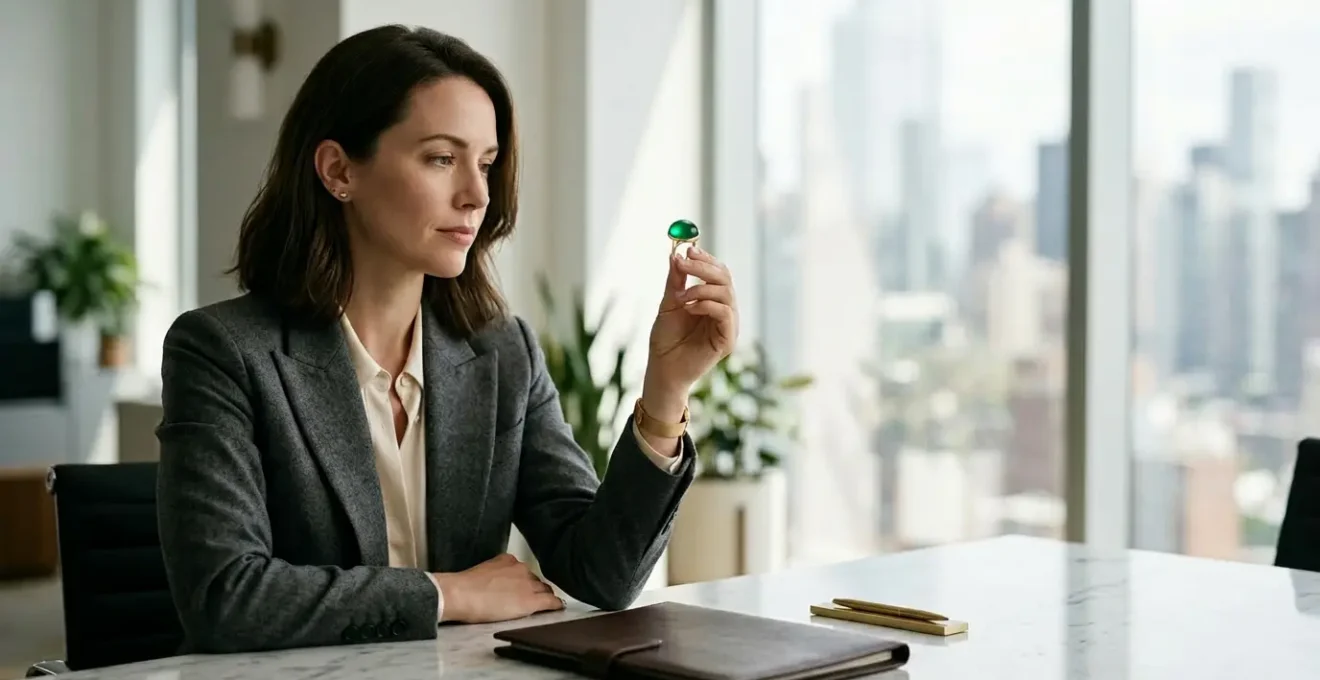
The secret to wearing natural stones professionally isn’t about their spiritual meaning, but mastering their material science and design language.
- A polished finish (cabochon) and a protective setting are more critical for a corporate look than the stone’s type.
- Durability is non-negotiable; understanding a stone’s hardness (Mohs scale), porosity, and light sensitivity prevents daily wear disasters.
Recommendation: Prioritize stones with a Mohs hardness of 7 or higher and choose smooth, polished finishes in bezel or flush settings for a sophisticated and durable result.
You feel a connection to the grounding energy and organic beauty of natural stones, but the thought of wearing them in a corporate environment brings to mind images of chunky, unrefined “boho” accessories. It’s a common dilemma for the modern professional: how do you integrate a piece of the natural world into a polished, high-stakes wardrobe without sacrificing an ounce of credibility? The standard advice—to simply choose small, discreet pieces—misses the point entirely. It suggests hiding the very nature of what makes these gems special.
The conversation often veers toward the metaphysical, but what if the true key to elegance lies not in the spiritual, but in the physical? What if the secret to transforming an earthy crystal into an emblem of sophisticated power was a matter of design, material science, and strategic choice? This isn’t about diminishing their personal significance; it’s about amplifying their aesthetic impact through an educated approach. It’s the difference between a random rock on a string and a curated gem that complements a tailored suit.
This guide reframes the challenge. We will move beyond generic styling tips to explore the tangible properties that define a stone’s professional potential. By understanding the language of durability, finish, and function, you can select and wear natural stone jewellery that projects quiet confidence and impeccable taste. Forget looking “boho”—it’s time to look brilliant.
To navigate this effectively, we will deconstruct the essential factors that separate amateur attempts from masterful integration. This structured approach will provide a clear roadmap for building a professional and beautiful natural stone jewellery collection.
Summary: How to Incorporate Natural Stones into Professional Attire Without Looking Boho?
- Why Wearing Malachite Every Day Ruins Its Surface Within 6 Months?
- How to Clean Turquoise and Opal Without Causing Permanent Discolouration?
- Raw Crystal or Cabochon: Which Finish Fits a Minimalist Wardrobe?
- The Danger of Relying Solely on Lithotherapy for Physical Ailments
- When to Remove Amethyst Jewellery to Prevent Colour Fading in Summer?
- Why Did Your Amethyst Ring Turn Clear After a Summer Holiday?
- Why Are Cufflinks the Only Acceptable Jewellery in Conservative Law Firms?
- Which Semi-Precious Stone Offers the Best Hardness for Daily Rings?
Why Wearing Malachite Every Day Ruins Its Surface Within 6 Months?
Malachite, with its deep green bands, is visually captivating, but it’s a trap for the uninformed professional. Its beauty belies a profound vulnerability that makes it entirely unsuitable for daily wear, especially in an office environment. The primary issue is its composition and softness. Malachite is a copper carbonate hydroxide mineral, meaning it’s highly reactive to acids and even water. In fact, some specimens can contain up to 70% copper oxide, making the stone prone to chemical reactions.
Furthermore, its extreme softness, rating only 3.5 to 4.5 on the Mohs hardness scale, means it can be scratched by something as common as household dust (which contains quartz). The daily hazards of a corporate setting—hand sanitizers, acidic coffee spills, lotions, and cleaning sprays—will actively corrode its surface, leaving a once-glossy stone dull and pitted. As one Van Cleef & Arpels owner noted, their daily-worn malachite bracelet “lost its shine and is dull” from constant exposure, particularly to hand washing, while a less-exposed necklace remained pristine. This is the essence of material integrity: a stone must be chosen for its resilience in its intended environment.
To preserve malachite, it must be treated as a special occasion piece. For daily professional wear, it’s a liability. Exposure to the following common office substances can cause irreversible damage:
- Alcohol-based hand sanitizers that attack copper carbonate
- Acidic beverages like coffee or citrus juice
- Hand lotions, cosmetics, and perfumes that penetrate the porous surface
- Ammonia-based cleaning sprays used on office surfaces
- Harder objects like desk edges, staples, or even other gemstones
How to Clean Turquoise and Opal Without Causing Permanent Discolouration?
Like malachite, both turquoise and opal are highly porous stones, a characteristic that demands a cleaning method focused on gentleness and minimal exposure to liquids. Aggressive cleaning is the fastest way to cause permanent damage. These stones can absorb oils, chemicals, and even water, leading to discolouration or loss of the opal’s signature “play-of-colour.” Ultrasonic cleaners, steam, and commercial jewellery solutions are strictly forbidden; their vibrations and chemicals can cause these delicate stones to crack or become cloudy.
The only professionally approved method is a simple, controlled wipe-down. This respects the stone’s porous nature and prevents oversaturation. The goal is to clean the surface without allowing any liquid to penetrate the stone’s structure. The image below illustrates the precise, gentle technique required.
As you can see, the process is about control. A soft, lint-free cloth, barely dampened, is all that is required. For a safe and effective clean, follow these jeweller-grade steps precisely:
- Use only a bowl of lukewarm water. Never use hot water or hold the stone under a running tap, which can cause thermal shock.
- If absolutely necessary, add a single, tiny drop of a very mild, chemical-free soap.
- Dampen a soft microfiber cloth with the water. The cloth should be damp, not wet.
- Gently wipe the surface of the stone. Do not scrub or soak the jewellery.
- Immediately pat the stone and setting dry with a separate, clean, soft cloth to prevent water spots and absorption.
- Store the piece in a soft pouch, away from harder gemstones that could cause scratches.
Raw Crystal or Cabochon: Which Finish Fits a Minimalist Wardrobe?
The finish of a stone is as important as the stone itself in conveying a professional message. This choice directly influences the piece’s “visual polish.” A raw, uncut crystal with its sharp facets and natural inclusions sends a message of organic, intellectual edge. A cabochon—a stone that has been shaped and polished to a smooth, convex surface—communicates quiet confidence and refined simplicity. For a minimalist, corporate wardrobe, the cabochon is almost always the superior choice.
A raw crystal interacts with light by creating multiple, sharp glints, drawing significant attention to its complexity and unrefined nature. This can read as “busy” or “boho.” A cabochon, by contrast, offers a single, soft reflection of light, a gentle gleam that is elegant and understated. This controlled interaction with light is the cornerstone of minimalist aesthetics. Furthermore, as the Jewelry Shopping Guide’s editorial team notes, softer stones require more protection. The smooth, rounded surface of a cabochon is inherently less vulnerable to chipping than the sharp edges of a raw crystal. As they state:
Malachite can be made into most types of jewelry but care must be taken when wearing malachite rings and bracelets as these are high exposure areas and damage to the gemstone is more probable
– Jewelry Shopping Guide Editorial Team, Complete Guide to Malachite Gemstone
This consideration of durability and visual messaging is critical for selecting a piece that will integrate seamlessly into a professional environment. The following matrix breaks down the key differences:
| Aspect | Raw Crystal | Cabochon |
|---|---|---|
| Visual Message | Intellectual Edge, Complex | Quiet Confidence, Smooth |
| Light Interaction | Multiple sharp glints | Single soft reflection |
| Setting Style | Architectural bezel | Classic prong or bezel |
| Durability | More vulnerable edges | Protected smooth surface |
| Professional Context | Creative industries | Traditional corporate |
The Danger of Relying Solely on Lithotherapy for Physical Ailments
While the personal, psychological, or spiritual benefits one might feel from wearing natural stones are valid on an individual level, it is critically dangerous to substitute lithotherapy for professional medical advice. No gemstone can cure a physical ailment, and relying on one to do so can lead to delaying or forgoing essential medical treatment. This must be the first and most important understanding. However, in a corporate context, another, more subtle danger exists: reputational risk.
The modern professional landscape is increasingly conscious of ethics and social responsibility. While a colleague might be indifferent to your belief in a crystal’s calming properties, they will not be indifferent to the possibility that your jewellery is tied to conflict minerals, unethical mining practices, or child labour. In client-facing roles, the provenance of your accessories can become a reflection of your personal—and by extension, your company’s—values. The true “danger” in a professional setting is not the association with holistic wellness, but the association with unethical sourcing.
Case Study: The Shift from Metaphysical to Ethical Scrutiny
Industry professionals now emphasize that the reputational danger of wearing unethically sourced stones is far greater than any perceived “unprofessionalism” from lithotherapy. As highlighted in an analysis of office jewellery, the ability to verify the ethical provenance of your jewelry is becoming crucial. Companies increasingly expect employees to align their personal choices with corporate social responsibility (CSR) values. Being able to speak to a stone’s ethical origin story is a far more powerful and professional statement than discussing its purported energy.
Therefore, the sophisticated professional redirects their focus. Instead of asking “What does this stone do for me?”, they ask, “Where did this stone come from?”. This shift demonstrates a global awareness and ethical maturity that is far more valuable in the workplace than any metaphysical claim.
When to Remove Amethyst Jewellery to Prevent Colour Fading in Summer?
Amethyst, a variety of quartz, owes its regal purple hue to natural irradiation and iron impurities within its crystal structure. Unfortunately, this colour is not always stable. Prolonged exposure to ultraviolet (UV) light—found in direct sunlight and even some forms of artificial lighting—can cause the colour to fade, a process known as chromatic instability. A vibrant purple ring can become a pale, washed-out lavender, or even turn nearly clear, after just one summer of careless wear.
This fading is permanent and irreversible. For a professional, whose appearance is a form of non-verbal communication, having a faded, tired-looking gemstone is a detail that subtly undermines a polished image. The damage is cumulative, meaning many small exposures add up over time. It’s essential to be mindful of specific high-risk scenarios, many of which are part of a typical corporate workday.
The contrast shown above is not an exaggeration; it is the reality of UV exposure on photosensitive stones. To protect your investment and maintain a sharp aesthetic, you must proactively remove your amethyst jewellery during these critical moments:
- Before any outdoor lunch meetings or breaks lasting more than 30 minutes.
- During a commute in a convertible or if you rest your hand on a sun-drenched car window.
- If your desk is positioned next to a large, untreated window that receives direct sunlight.
- When working under high-intensity halogen or certain types of desk lamps for extended periods.
- For any work-related events held outdoors, such as at a beach or poolside venue.
Why Did Your Amethyst Ring Turn Clear After a Summer Holiday?
The heartbreaking discovery of a faded amethyst ring after a vacation is a lesson in gemological science. As discussed previously, amethyst is a photosensitive gemstone. The energy from UV rays in sunlight effectively “reverses” the natural process that created its purple colour. The electrons that were shifted by natural irradiation in the earth are knocked back out of place by the sun’s energy, causing the iron impurities to lose their colour-centering ability. A summer holiday, with its extended periods of intense, direct sun exposure at the beach or by the pool, is the ultimate accelerator for this process.
What makes this particularly devastating is that the change is permanent. While some gemstones can have their colour altered or restored through professional treatments like heat or irradiation, UV-induced fading in amethyst is irreversible. There is no process to “re-purple” a faded stone. Furthermore, many affordable amethysts on the market are heat-treated to enhance their colour. This treatment makes the stone’s colour even more unstable and prone to fading much faster than a natural, untreated specimen.
This risk is not unique to amethyst. Other popular stones, such as rose quartz, citrine (especially heat-treated amethyst sold as citrine), kunzite, and fluorite, are also susceptible to fading in the sun. For the professional who invests in fine jewellery, understanding a stone’s chromatic stability is just as important as knowing its hardness. It ensures the piece you buy today is the piece you will proudly wear for years to come, without it literally fading away.
Why Are Cufflinks the Only Acceptable Jewellery in Conservative Law Firms?
In the most conservative corporate environments, such as traditional law firms or financial institutions, the rules of adornment are governed by an unspoken principle: function over fashion. Jewellery is often viewed with suspicion unless it serves a practical purpose. This is the secret behind the acceptance of cufflinks, tie bars, and high-quality watches. They are not seen merely as decoration, but as tools that have a historical and practical role in a professional’s attire.
This concept of “functional elegance” provides a powerful framework for introducing other pieces. As one professional styling expert explains, the historical context is everything:
Cufflinks, tie bars, and watches are tolerated because they have a historical, practical function. This creates a framework for what other pieces might be accepted if they can be framed as ‘functional’
– Professional Styling Expert, Guide to Business Professional Jewelry
This principle can be strategically applied. A signet ring, for example, isn’t just a ring; it has a centuries-long history as a tool for sealing documents in law and commerce. A lapel pin can be framed as holding a functional place, historically used for affiliations or honors. By selecting pieces with a story rooted in function rather than pure aesthetics, a professional can navigate even the strictest dress codes.
Case Study: Gradual Introduction Through Historical Precedent
A senior partner at a major law firm successfully integrated subtle stone elements over 15 years by adhering to this principle. They began with a classic onyx signet ring, framing it within the context of Roman contract law. This was followed by a bloodstone tie tack (securing neckwear) and later a small lapel pin. Each new piece was justified by its historical or functional precedent. Over time, this educated approach influenced the firm’s culture, and its dress code committee now explicitly permits “traditional men’s jewelry with historical professional precedent.”
Key Takeaways
- Material science is paramount: A stone’s hardness, porosity, and stability are more important than its look for daily professional wear.
- Visual polish dictates perception: A smooth cabochon finish in a protective setting reads as more sophisticated and minimalist than a raw crystal.
- Durability must be calculated: Choosing a gem for a daily-wear ring requires a Mohs hardness of 7+ to withstand the rigors of the workplace.
Which Semi-Precious Stone Offers the Best Hardness for Daily Rings?
For a piece of jewellery worn as frequently as a daily ring, calculated durability is the single most important factor. A ring is exposed to constant knocks, abrasion, and chemicals. Choosing a soft or brittle stone is a recipe for scratches, chips, and disappointment. The Mohs scale of hardness is the primary tool for this assessment, with 10 (diamond) being the hardest. For a ring intended for daily professional wear, a minimum hardness of 7 is strongly recommended, as this is the hardness of quartz, a component of common dust and a primary cause of microscopic scratches.
However, hardness is only part of the equation. Toughness—a stone’s resistance to chipping and breaking when struck—is also crucial. Jade, for example, is not exceptionally hard (6-7 Mohs), but its internal structure makes it incredibly tough and resistant to fracture, earning it an “Excellent” rating for daily wear. The ideal stone offers a balance of high hardness, good toughness, and chemical stability.
The following matrix provides a clear guide to durable choices for the discerning professional, moving beyond the obvious “big four” precious gems (diamond, sapphire, ruby, emerald).
| Stone | Mohs Hardness | Toughness | Chemical Stability | Daily Wear Rating |
|---|---|---|---|---|
| Spinel | 8 | Excellent | Stable | Excellent |
| Tourmaline | 7-7.5 | Good | Stable | Very Good |
| Garnet | 6.5-7.5 | Good | Stable | Good |
| Jade | 6-7 | Exceptional | Stable | Excellent |
| Agate | 7 | Good | Stable | Very Good |
Once you’ve selected a durable stone, the setting itself is the final layer of protection. A thoughtful setting not only enhances the stone’s beauty but also shields it from impact. This is not an afterthought but a crucial part of the design process.
Your Action Plan: Choosing a Protective Setting for Your Stone
- Assess the stone: Identify the Mohs hardness. For anything under 7, prioritize bezel or flush settings.
- Evaluate your lifestyle: For active professionals, choose low-profile flush or gypsy settings to minimize snagging and impact.
- Consider the cut: For stones with more vulnerable edges, a full bezel setting that encases the entire perimeter offers maximum protection.
- Buffer from impact: Select a cathedral or halo setting, where the metalwork rises above the girdle of the stone, acting as a buffer.
- Reserve delicate settings: Use tension settings or high-profile prong settings only for the hardest stones (8+ Mohs) and for less frequent wear.
By applying these principles of material science and strategic design, you can confidently build a collection of natural stone jewellery that enhances your professional image, expresses your personal style, and endures for years to come.
Frequently Asked Questions About How to Incorporate Natural Stones into Professional Attire Without Looking Boho?
Can UV-faded amethyst color be restored?
While some heat-induced color change can sometimes be reversed through professional irradiation, UV light fading is permanent and irreversible.
Which other stones fade like amethyst?
Rose quartz, citrine (especially heat-treated amethyst sold as citrine), kunzite, and fluorite are also photosensitive.
How can I tell if my amethyst is heat-treated?
Heat-treated amethyst often shows more uniform color and is far more unstable, prone to fading faster than natural specimens.