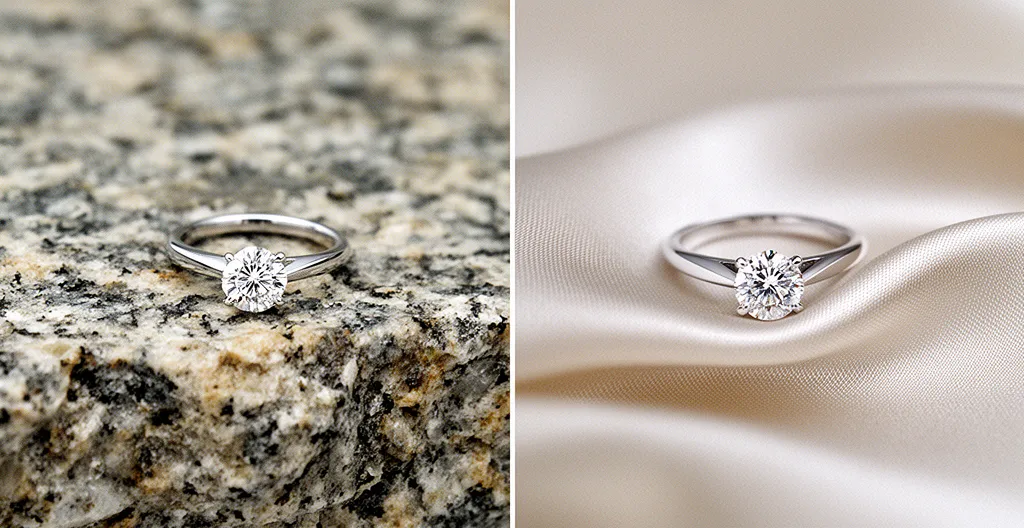
A secure ring isn’t about choosing ‘strong’ over ‘weak’ settings; it’s about understanding the engineering trade-offs between different designs.
- The perceived weakness of a “peg head” is often a solder joint issue, not a fundamental design flaw.
- An “integrated” or “cathedral” setting mitigates risk by distributing forces, but can add bulk.
Recommendation: Instead of fearing a specific style, learn to assess the quality of the solder joint and the prong work, which are the true indicators of a secure minimalist ring.
The fear is visceral for any solitaire ring owner: a sharp snag on a sweater, a careless knock against a countertop, followed by a sickening glance downward to find an empty setting. This anxiety drives many buyers toward bulky, fortress-like designs, believing that security and minimalist beauty are mutually exclusive. The common advice is to simply “get a stronger setting,” often pushing buyers towards integrated or cathedral styles while demonizing the sleek “peg head” as inherently fragile. This advice, however, overlooks the fundamental mechanics of jewelry construction.
A ring’s durability isn’t a simple matter of one style being better than another. It’s an engineering system. The real key to security lies not in avoiding certain designs, but in understanding the principles of force distribution, solder joint integrity, and material properties. A well-made peg head can be more secure than a poorly executed integrated setting. The true failure point is rarely the design itself, but the quality of its execution—specifically, the solder point where the head meets the shank.
This guide will move beyond the simplistic “strong vs. weak” debate. We will approach your ring like a mechanic, dissecting the forces at play and examining the critical components that ensure your diamond stays put. By understanding the ‘why’ behind ring construction, you can confidently choose a design you love, armed with the knowledge to assess its structural integrity, not just its aesthetic appeal.
To navigate this technical landscape, we’ve broken down the core concepts that determine a ring’s true security. This overview will guide you from the common problems to the engineering solutions, enabling you to make an informed choice for your forever piece.
Summary: A Mechanic’s Guide to Solitaire Security
- Why Does Your High-Set Solitaire Keep Snagging on Your Pockets?
- How Does a Bezel Setting Protect the Diamond Girdle from Chipping?
- Does a 4-Prong Setting Make a Round Diamond Look Square?
- The Error of Not Cleaning the “Pavilion” Side of Your Solitaire
- How Does a Tapered Band Make Your Solitaire Diamond Look Bigger?
- True Tension or Tension-Style: Which Setting is Actually Secure?
- How to Fit a Wedding Band Flush Against a Low-Set Engagement Ring?
- How to Choose a Minimalist Setting That Won’t Drop the Diamond?
Why Does Your High-Set Solitaire Keep Snagging on Your Pockets?
A high-set solitaire that constantly snags isn’t just an annoyance; it’s a symptom of a fundamental engineering principle: leverage. When a diamond is set high off the finger, as is common with many peg head designs, it creates a longer lever arm. Every time it catches on a pocket, a door frame, or even a thick sweater, the force applied to the very top of the diamond is magnified at its base—the critical solder joint connecting the head to the band. This repeated stress, known as material fatigue, can weaken the connection over time, even if no single impact seems significant.
Think of it like trying to loosen a stubborn bolt. A short wrench requires immense effort, but a long wrench makes it easy. Your high-set diamond is the long wrench. The problem isn’t necessarily that the setting is “weak,” but that its height multiplies the force of everyday bumps and snags, putting enormous torsional stress on a very small area. This is the primary mechanical risk associated with high-profile settings, and it’s a crucial factor to consider for anyone with an active lifestyle or who works with their hands.
The solution, from a structural standpoint, is to either reduce the height of the lever arm (a lower setting) or to buttress the connection point. This is where integrated designs like cathedral settings come into play. According to jewelry design experts, cathedral settings distribute weight across the band by adding supportive “shoulders” that rise from the shank to meet the head. These supports effectively brace the head against lateral forces, reducing the leverage effect and transferring stress away from the single solder point and into the body of the ring itself. This doesn’t make a peg head “bad,” but it highlights the mechanical trade-off: a floating, high-profile look versus a reinforced, integrated structure.
This engineering choice directly impacts how the ring withstands daily wear, shifting the focus from a single point of failure to a more robust, distributed system of support.
How Does a Bezel Setting Protect the Diamond Girdle from Chipping?
While prongs are the most common method for securing a gemstone, they leave the most vulnerable part of the diamond exposed: the girdle. The girdle is the thin edge that forms the diamond’s perimeter. A hard knock from the side can easily cause a chip, which is considered significant damage. A bezel setting is the engineer’s solution to this problem, offering the highest degree of protection possible. Instead of using prongs to grip the stone, a bezel encases the diamond’s girdle with a continuous rim of metal.
This design functions like a helmet for your diamond. When the ring takes a direct impact from the side, the force is absorbed and distributed by the metal rim, not the gemstone itself. The metal, being far more malleable than the diamond, may dent, but the diamond’s girdle remains shielded from the sharp, concentrated force that causes chipping. This makes it an ideal choice for individuals with very active lifestyles or those who work with their hands, as it offers maximum durability.
The trade-off for this superior protection is a slight reduction in the amount of light that enters the diamond from the sides. However, modern cutting techniques ensure that most of the stone’s brilliance comes from light entering through the top (the table), so the visual impact is often minimal. For those seeking a compromise, the “half-bezel” or “semi-bezel” setting offers a hybrid solution, protecting the most exposed parts of the girdle while leaving other areas open for more light entry. This choice allows for a balance between maximum security and optimized sparkle.
This comparative analysis from Brilliant Earth shows the clear trade-offs between full and partial bezel settings, allowing a buyer to choose based on their personal balance of security and aesthetics.
| Feature | Full Bezel | Half Bezel |
|---|---|---|
| Girdle Protection | 100% coverage | 60-70% coverage |
| Light Entry | Reduced from sides | Optimized balance |
| Security Level | Maximum | High |
| Visual Impact | Modern, sleek | Hybrid classic-modern |
Ultimately, choosing a bezel is a deliberate decision to prioritize the physical integrity of the stone above all else, representing a shift from a “holding” mechanism (prongs) to a “shielding” one.
Does a 4-Prong Setting Make a Round Diamond Look Square?
This is a persistent aesthetic concern that has its roots in visual mechanics. The answer is: it can, but it depends entirely on the placement of the prongs. A 4-prong setting can create a subtle squaring effect on a round diamond if the prongs are positioned at the 12, 3, 6, and 9 o’clock positions. This arrangement creates four distinct points that the eye connects, forming a “box-like” outline around the circular stone. This is often referred to as a “compass” setting.
As the Brilliant Earth Design Team notes, this effect happens when prongs are positioned at cardinal points around the center stone, resembling a compass. To avoid this, jewelers can simply rotate the head by 45 degrees, placing the prongs at the northeast, northwest, southeast, and southwest corners. This “kite” or “X” orientation breaks up the square illusion, allowing the prongs to follow the natural curve of the diamond and enhance its roundness. For buyers who are particularly sensitive to this visual effect, a 6-prong setting is an excellent alternative. The six points of contact naturally create a more hexagonal or circular frame, reinforcing the diamond’s shape while also offering an extra layer of security.
The prevalence of this concern is tied to the overwhelming popularity of the round brilliant cut. With 50% of engagement rings sold featuring round cut diamonds, the nuances of how they are set become a major topic of discussion. The choice between 4 and 6 prongs is not merely about security; it’s a decision that sculpts the final look of the most popular diamond shape in the world. A 4-prong setting provides a more “open” look, showing more of the diamond’s surface, while a 6-prong setting offers a more secure and shape-defining frame. Neither is inherently better, but understanding the visual impact of prong placement is crucial for achieving your desired aesthetic.
Ultimately, the “squaring” effect is a real but easily mitigated phenomenon, giving the buyer control over the final visual outcome through a simple conversation with their jeweler about prong orientation.
The Error of Not Cleaning the “Pavilion” Side of Your Solitaire
One of the most common and detrimental errors in ring care is focusing only on the top of the diamond while neglecting what’s underneath. The sparkle of a diamond is not just about a clean surface; it’s about light performance. Light enters the top of the stone (the table), refracts off the internal facets of the lower portion (the pavilion), and returns to the viewer’s eye. If the pavilion is caked in a film of lotion, soap, oils, and dust, light cannot exit properly. It gets trapped or deflected, resulting in a dull, lifeless stone, no matter how clean the top is.
This buildup is an unavoidable consequence of daily wear. A recent study highlighted the issue, revealing that a staggering 60% of respondents do not remove their engagement ring when washing hands. While washing, soap and minerals from the water get trapped in the intricate spaces under the diamond, creating a cloudy film that is very difficult to remove without dedicated cleaning. This accumulation not only kills the stone’s fire and brilliance but can also create a breeding ground for bacteria and cause skin irritation.
Effectively cleaning the pavilion requires more than a quick scrub. For open-basket or peg head settings, you can often access the pavilion from the side with a very soft-bristled brush (a baby toothbrush is ideal) and a solution of warm water and a few drops of mild dish soap. Soaking the ring for 15-20 minutes beforehand can help loosen the grime. For closed-basket or bezel settings, access is more limited, making professional cleaning even more critical. An ultrasonic cleaner, used by jewelers, uses high-frequency sound waves to create microscopic bubbles that safely and effectively dislodge dirt from even the most inaccessible crevices, restoring the diamond’s light performance completely.
Ignoring the underside of your setting is like washing only the outside of a window and expecting a clear view. True brilliance requires a 360-degree approach to cleanliness.
How Does a Tapered Band Make Your Solitaire Diamond Look Bigger?
A tapered band is a masterclass in optical illusion, a design technique that leverages forced perspective to enhance the visual size of the center stone. The principle is simple: the band is wider at the base of the finger and gradually narrows as it approaches the diamond. This creates strong visual lines that draw the eye inward and upward directly to the diamond, making it the undeniable focal point. By making the band appear more delicate near the center setting, the diamond itself appears larger and more prominent by comparison.
This is a powerful tool in ring design, especially when working with minimalist aesthetics or stones of a modest carat weight. It’s a way to maximize visual impact without increasing the cost or carat size of the diamond. The human brain interprets size relatively; an object looks larger when it’s surrounded by smaller elements. The tapering band creates this exact effect. It’s a subtle but highly effective trick of proportion that jewelers have used for centuries to flatter a gemstone.
There are two main types of taper: a standard taper (narrowing toward the diamond) and a reverse taper (widening toward the diamond). While a reverse taper can create a bold, modern look, it is the standard taper that is used to achieve the size-enhancing effect. This design choice is not just about aesthetics; it speaks to a fundamental desire in the market. This focus on maximizing the stone’s appearance through clever design is a direct response to consumer priorities, allowing them to achieve a high-impact look that feels both significant and elegant.
By understanding this principle, a buyer can opt for a design that punches well above its weight, achieving a grander look through smart, proportional design rather than sheer carat size alone.
True Tension or Tension-Style: Which Setting is Actually Secure?
The tension setting is the ultimate expression of minimalist engineering, creating the breathtaking illusion of a diamond floating in mid-air, held only by the two sides of the ring shank. A true tension setting is a marvel of metallurgy. The ring is custom-made, and the metal is calibrated and hardened, exerting upwards of 12,000 pounds of pressure on the diamond’s girdle. Tiny grooves are cut into the metal to seat the stone, and it is this immense compressive force alone that holds it in place. It is incredibly secure against being pulled out, but it has a critical vulnerability: a sharp, direct blow from the side can potentially compromise the setting’s integrity.
Recognizing this perceived risk and the high cost of manufacturing true tension settings, jewelers developed the tension-style setting. This is where the crucial distinction lies for buyers. A tension-style ring mimics the aesthetic of a true tension setting but adds a hidden security feature. The diamond isn’t held by pressure alone; it is discreetly secured within a small bezel or a set of prongs that are connected to the shank below the stone. The band sweeps up to the diamond and may not even touch it, but the stone is safely anchored in a more traditional mounting. This provides the floating appearance with a much lower risk profile.
For a buyer concerned with security, the tension-style is almost always the more practical choice. It delivers the desired minimalist, “floating” aesthetic without relying on the specialized alloys and extreme pressures of a true tension setting. The table below breaks down the key mechanical differences.
| Feature | True Tension | Tension-Style |
|---|---|---|
| Holding Method | Compression force only | Hidden bezel or prongs |
| Metal Requirements | Specialized alloys (titanium, platinum) | Standard precious metals |
| Risk Level | Higher if struck | Lower overall |
| Visual Effect | Floating appearance | Similar floating look |
While a true tension setting is a testament to engineering prowess, the tension-style setting is a testament to pragmatic design, offering a beautiful illusion with a robust safety net.
How to Fit a Wedding Band Flush Against a Low-Set Engagement Ring?
The “gap” is a common frustration for brides-to-be: the space between a low-set engagement ring and a straight wedding band. This issue arises when the basket or head of the engagement ring is wider than the band and sits low on the finger, preventing another ring from sitting flush against it. From a mechanical perspective, a low-set head is often more secure as it reduces leverage, but it creates this aesthetic and practical challenge. Achieving a flush fit without sacrificing the low-profile design requires intentional engineering from the outset.
As one expert on the Wedding Bee forums explains, the default for most low-set solitaires is a gap, and achieving a no-gap look often requires a higher “peg head” style. However, there are more elegant solutions. A skilled jeweler can create a “notched” or “curved” wedding band, custom-shaped to curve perfectly around the profile of the engagement ring’s basket. This creates the illusion of a seamless set. Another sophisticated approach is to design the engagement ring with a “gallery rail” or “bridge” that is slightly elevated, creating a tunnel just high enough for the wedding band to slide underneath the head and sit flush against the shank.
For those planning ahead, the options are broader. You can choose an engagement ring setting that is specifically designed for a flush fit, such as a true peg head that sits entirely on top of the band, or a cathedral setting where the shoulders lift the head sufficiently. Alternatively, you can choose the wedding band first and have the engagement ring’s height and basket design dictated by its dimensions. This reverses the traditional process but guarantees a perfect fit. The key is communication with your jeweler about your priorities: is a low profile or a flush fit more important? You can often have both, but it requires a more thoughtful and customized design process.
Ultimately, closing the gap is a solvable geometry problem. With careful planning and custom work, you can achieve the integrated look of a perfectly matched set without compromising the security of a lower-profile engagement ring.
Key Takeaways
- A ring’s security is a system; a peg head’s weak point is the solder joint, not the design itself.
- Force distribution is key. Cathedral and basket settings brace the head against impacts, reducing stress on single connection points.
- Proactive maintenance, especially cleaning the underside (pavilion) of your diamond and regular prong checks, is as important as the initial design.
How to Choose a Minimalist Setting That Won’t Drop the Diamond?
Choosing a minimalist setting does not mean you have to compromise on security. The key is to shift your focus from “minimalist vs. secure” to “well-engineered minimalism.” The most critical component in a peg head’s security is the quality of the solder joint. It should be clean, complete, and create a seamless bond between the head and the shank. A poorly executed solder joint, no matter how robust the head, is the primary point of failure. This is why the choice of jeweler is paramount.
As one experienced jeweler noted in a Pricescope forum discussion, quality is everything. It’s not about the peg head being inherently weak, but about the craftsmanship of its attachment.
As with most things, quality counts, so your most important decision as a customer is having a good jeweler who can help you pick out the best settings and then assemble them so they’ll last a lifetime. The key steps with a peg head mount are to make sure that the solder flows completely between the mounting and the shank for a secure fit, and to have the stone properly set into the prongs.
– Jeweler’s perspective, Pricescope Community
Beyond the solder joint, look for subtle engineering reinforcements. For prong settings, a “basket” is a crucial feature. An analysis from Robinson’s Jewelers highlights that basket settings provide added durability through horizontal bands that connect the prongs below the girdle. This simple addition creates a rigid cage, preventing prongs from spreading apart or bending outward upon impact. A minimalist setting with a discreet basket is significantly more secure than one without. Similarly, opting for platinum prongs, even on a gold ring, adds a layer of security. Platinum is denser and more durable than gold, making it more resistant to bending and wear over time, ensuring a tighter grip on your diamond.
Your Minimalist Ring Security Checklist
- Solder Joint Inspection: Ask the jeweler to show you the point where the head joins the band. Look for a clean, seamless connection with no visible gaps or pitting.
- Prong Integrity Check: Ensure prongs are substantial, evenly spaced, and fully contact the diamond. Gently tap the ring near your ear; a rattle indicates a loose stone requiring immediate attention.
- Basket & Gallery Rail Assessment: Look for a discreet wire (basket) connecting the prongs or a rail beneath the setting. These are crucial structural reinforcements for a minimalist design.
- Prong-Tip Finish: Rub your finger over the prong tips. They should be smooth and rounded. Rough or sharp prongs will snag fabrics, increasing the risk of bending the prong.
- Long-Term Plan: Commit to professional inspections twice a year. A jeweler can spot material fatigue or minor prong wear long before it becomes a critical failure.
By focusing on these mechanical details—the quality of the solder, the presence of a basket, the material of the prongs—you can confidently select a beautifully minimalist ring that is engineered for a lifetime of wear.
Frequently Asked Questions on Solitaire Ring Care
How often should I have my solitaire professionally cleaned?
Well cared for jewelry can last for generations. Visiting your trusted jeweler for a professional jewelry inspection and cleaning at least twice a year will help uncover potential damage that may not be noticeable to the untrained eye. They’ll be able to catch a loose diamond before you lose it from your setting completely.
Should I remove my ring when showering?
While your favorite body wash or shampoo may seem harmless, they can cause grimy buildup on or even contribute to deterioration of your ring.
What happens if I notice a bent prong?
If you do notice a missing or bent prong, a prong that may be too short or a stone that shifted, Jewelers Mutual recommends taking your ring to your jeweler immediately.