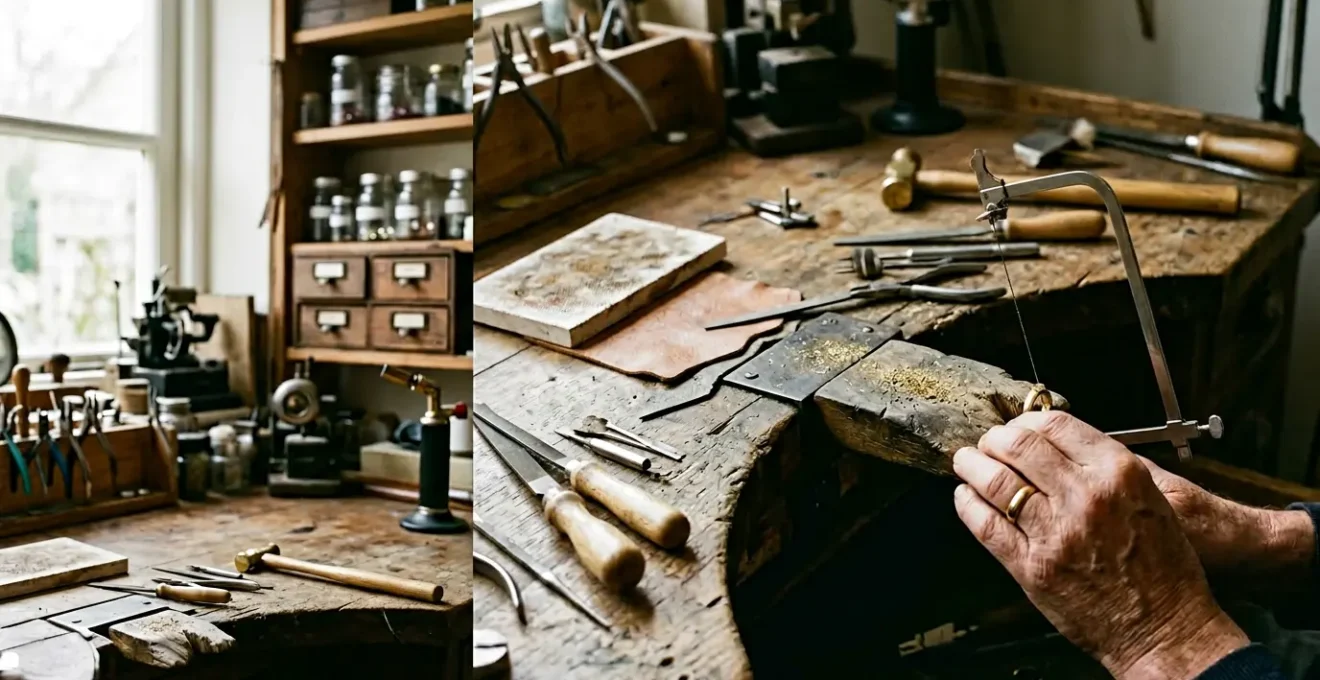
The higher price of UK-made jewellery reflects a legally-mandated ecosystem of accountability, material integrity, and consumer protection that most imported items simply bypass.
- True “handmade” involves creation from raw materials, not just assembling imported parts—a crucial legal distinction impacting value.
- The final price includes mandatory hallmarking, specialist ‘goods in trust’ insurance, and direct access to skilled artisans, not just transparent labour costs.
Recommendation: When comparing prices, always ask about the creation process, the metal’s origin, and the official UK hallmark to understand the true, lasting value you are paying for.
You’ve seen it happen. You walk past a local jeweller’s workshop and spot a stunning, unique ring glinting under the light. You admire the craftsmanship, the weight of it, the story it seems to tell. Then, a few clicks online or a trip to the high street reveals a visually similar piece for a third of the price. The immediate question arises: why the huge difference? Is the local artisan simply charging an enormous premium?
The common answers—”you’re paying for UK labour costs” or “it’s the artisan’s touch”—are true, but they are a fraction of the real story. They fail to capture the fundamental differences in process, accountability, and legal standards that separate a workshop-made piece from a mass-produced import. The price gap isn’t just about paying for a person’s time; it’s about paying for an entire infrastructure of quality control and consumer protection that is built into the British system.
But what if the key to understanding the cost wasn’t in the visible design, but in the invisible processes? The real value lies in a framework of structural integrity, a documented chain of custody, and a level of direct accountability that mass-market jewellery cannot offer. The price difference reflects a different class of product entirely, one built for generations, not just for a season.
This article will deconstruct that hidden value. We will explore the tangible benefits of direct access to a bench jeweller, the critical safety and insurance protocols of a UK workshop, the science behind metal density, and the legal definitions that protect you as a consumer. By the end, you’ll see the price not as an expense, but as an investment in authentic, legislated craftsmanship.
To navigate this complex world, this guide breaks down the key factors that contribute to the cost and value of a piece of British workshop-made jewellery. Explore the sections below to gain a complete understanding of what your investment truly covers.
Summary: Unpacking the Value of British Workshop Jewellery
- Why is Direct Access to the Bench Jeweller Critical for Custom Work?
- What Safety Protocols Should You Expect When Visiting a Jeweller’s Workshop?
- Hand-Forged or Cast: Which Technique Produces a Denser Metal Structure?
- The Risk of Taking a Workshop-Made Piece to a Mall Kiosk for Repair
- When Should You Book a Workshop Slot for Christmas Commissions?
- The Difference Between “Handmade” and “Hand-Assembled” in UK Law
- Why Does Custom Jewellery Production Take 8 Weeks Before Delivery?
- How to Commission a Bespoke Piece of Jewellery Without Blowing the Budget?
Why is Direct Access to the Bench Jeweller Critical for Custom Work?
When you commission a piece from a UK workshop, you are not simply placing an order; you are entering a collaborative partnership. Unlike a retail environment where you communicate through a salesperson, direct access to the bench jeweller—the person who will physically shape the metal and set the stones—is a cornerstone of the bespoke experience. This direct line of communication is where true value is created, translating your vision into a piece that is not only beautiful but also structurally sound and perfectly suited to you. The artisan can provide real-time feedback on design limitations, suggest modifications for durability, and explain the nuanced feel of different metal alloys.
This hands-on consultation process is vital for ensuring the longevity of your jewellery. A bench jeweller thinks in terms of wearability and structural integrity, not just sales targets. They can foresee potential issues a salesperson might miss, such as a prong setting that’s too delicate for an everyday ring or a design that will be difficult to clean and maintain. As the London-based jewellery courses from ClassBento demonstrate, when participants work directly with expert jewellers, they receive insider tips on material selection and structure that are impossible to convey through an intermediary, resulting in superior, durable pieces.
technical accuracy > environmental detail.”/>
This collaborative dialogue, often taking place right at the workbench surrounded by tools and sketches, ensures there are no misinterpretations. You can see and feel material samples, review sketches together, and make informed decisions. It transforms the process from a simple transaction into a memorable creative journey. To get the most out of this unique opportunity, it is essential to ask the right questions that go beyond aesthetics and delve into the practical craftsmanship of your piece.
Your Pre-Commission Checklist: Key Questions for Your Jeweller
- What are the structural limitations of my design idea given the chosen metal and stone?
- How will different metal alloys affect the final weight and feel of my piece?
- What modifications would you suggest to ensure my jewelry lasts for generations?
- Can you show me samples of different finishes and textures before we proceed?
- What maintenance will this design require based on how I plan to wear it?
What Safety Protocols Should You Expect When Visiting a Jeweller’s Workshop?
A professional jeweller’s workshop is a world away from a brightly lit retail store. It’s a place of controlled risk, involving intense heat, powerful tools, and hazardous chemicals. The higher operational cost of a UK workshop is partly due to the stringent safety and security protocols required by law and by insurers. These are not optional extras; they are non-negotiable overheads that protect the client, the artisan, and the valuable materials on site. When you visit a workshop, you will likely notice it is by appointment only, and you may be asked for identification. This isn’t poor customer service; it’s a critical security measure.
Furthermore, the insurance carried by a genuine workshop is far more comprehensive than standard retail coverage. It must include ‘Goods in Trust’ liability, which specifically covers client-owned materials (like heirlooms for remodelling) and deposits against theft, loss, or damage while in the jeweller’s care. This specialised insurance is a significant business expense passed into the final cost, but it provides you with a level of financial protection that a simple mall kiosk cannot offer. This commitment to integrity is the bedrock of the UK’s hallmarking institutions.
Our hallmark and our trade depend on integrity and trust, which underpin all our work and what we stand for.
– Goldsmiths’ Company Assay Office, Official Statement on Workshop Standards
The table below highlights the stark differences in the operational standards between a professional workshop and a typical retail outlet. These differences in security, chemical handling, and insurance are not just technical details; they are a direct reflection of the professionalism and accountability you are paying for.
| Safety Aspect | Professional Workshop | Retail Store/Mall Kiosk |
|---|---|---|
| Insurance Coverage | ‘Goods in Trust’ liability + Workshop insurance | Basic retail insurance only |
| Security Measures | Appointment-only, ID verification, secure areas | Open access during business hours |
| Chemical Safety | Licensed acid handling, ventilated areas | Limited chemical use |
| Tool Safety | Professional-grade equipment, safety protocols | Basic hand tools only |
| Client Protection | Comprehensive coverage for materials and deposits | Standard retail protection |
Hand-Forged or Cast: Which Technique Produces a Denser Metal Structure?
When discussing the cost of workshop-made jewellery, the conversation often turns to the manufacturing technique. The two primary methods are casting and hand-forging. Casting involves pouring molten metal into a mould, which is excellent for creating intricate and complex shapes. Hand-forging, however, is the process of shaping metal using hammers, heat, and pressure. While both can produce beautiful results, hand-forging creates a significantly denser metal structure. This is because the repeated hammering compresses the metal’s crystalline grain structure, eliminating microscopic porosity and increasing its overall strength and durability.
This difference in density isn’t just an abstract scientific concept; it has real-world implications for the longevity of your jewellery. A hand-forged ring is more resistant to bending and scratching than a cast equivalent of the same design. It has a tangible feeling of substance and weight. This superior structural integrity is even recognised during the hallmarking process. As the Edinburgh Assay Office’s use of high-tech presses shows, forged pieces can withstand higher hallmarking pressures due to their compressed grain, while cast pieces require more delicate handling. This is a clear, institutional acknowledgement of the physical difference. With a significant 127 tons of jewelry produced domestically in UK workshops in 2024, these traditional techniques remain a vital part of the nation’s craft.
While high-quality vacuum casting can achieve stunning detail, the inherent durability of a forged piece is often why artisans choose this more labour-intensive method for simpler, classic designs like wedding bands. The premium you pay for a hand-forged item is a direct investment in its future as a multi-generational heirloom. Learning to spot the differences can help you appreciate the craftsmanship involved.
- Check for a consistent surface finish; forged pieces may show subtle, organic flow patterns from the hammer work.
- Examine thin areas like prong tips; cast pieces are more likely to exhibit porosity (tiny holes) under magnification.
- Feel the weight distribution; a forged piece often feels more substantial and denser for its size.
- Ask the maker about the technique used; a reputable jeweller will proudly explain why they chose a specific method for your design.
The Risk of Taking a Workshop-Made Piece to a Mall Kiosk for Repair
A bespoke piece of jewellery from a UK workshop has a documented history—a “chain of custody” that begins with its creator. This provenance is physically stamped into the metal through the UK’s rigorous hallmarking system. When that piece needs resizing, cleaning, or repair, returning to the original maker or another professional workshop is not just a preference; it is crucial for maintaining its integrity. Taking a complex, workshop-made item to a mall kiosk or a generalist repair shop introduces significant risks. These establishments often lack the specific tools, understanding of the original construction, and—most importantly—the legal authority to handle the piece correctly.
The primary risk involves the hallmark itself. If a repair involves adding new metal (for example, to resize a ring), that new component must also be hallmarked to remain compliant with the Hallmarking Act 1973. A kiosk cannot do this. As the Sheffield Assay Office guidelines state, every component must be tested. Taking a piece elsewhere can invalidate its documented provenance and potentially break the law if unmarked metal is added.
Make sure that all parts of your items are submitted to us, as we must test every component to ensure they comply with the requirements of the Hallmarking Act.
– Sheffield Assay Office, Official Hallmarking Guidelines
The importance of this continuity is perfectly illustrated by the approach to commemorative marks, such as the King’s Coronation mark. According to the Birmingham Assay Office, these special marks link a piece to a specific moment in time and to its original maker. This documented history adds to its value and story. A repair by an outside party breaks this chain. The original workshop understands the piece’s construction, has access to the same alloys, and can ensure any work done is seamless and respects the original craftsmanship. The small saving offered by a kiosk is a false economy when weighed against the potential damage to the piece’s structural and historical integrity.
When Should You Book a Workshop Slot for Christmas Commissions?
The seemingly long lead times for custom jewellery are one of the most misunderstood aspects of the process, especially during peak seasons like Christmas. While an imported ring can be bought off the shelf, a bespoke piece is born from a multi-stage process that cannot be rushed. If you are considering a commission for a Christmas gift, you should be starting the conversation in late summer, typically early September at the latest. This is not an arbitrary deadline; it is a realistic timeline dictated by the sequential nature of design, sourcing, manufacturing, and mandatory hallmarking.
Independent workshops are not factories; they are small operations, often run by a single artisan or a very small team. Their capacity is finite. The design phase alone can take several weeks of consultation and revisions to perfect. Once the design is frozen, materials and stones must be sourced from trusted suppliers. Then, the physical making of the piece begins. The most significant bottleneck, however, is one that is entirely outside the jeweller’s control: the Assay Office.
All four UK Assay Offices experience a massive influx of items from October onwards. The standard 3-5 day turnaround for hallmarking can easily stretch to 10-15 days during this pre-Christmas rush. Since hallmarking is a legal requirement for precious metals over a certain weight, this step is non-negotiable. A wise jeweller will build this potential delay into their schedule. The cost of their business also includes fixed fees like the £80 + VAT for a 10-year Sponsor Mark registration, another invisible overhead. To ensure a stress-free process and guaranteed delivery for Christmas, follow a structured timeline.
- Early September: Initial design consultation and material selection.
- Mid-September: Finalise design and approve CAD renders or sketches.
- End September: Design freeze date—no further changes accepted.
- October: Manufacturing and initial finishing work.
- Early November: Submit to Assay Office before the main rush.
- Late November: Final polishing and quality control.
- Early December: Collection or delivery.
The Difference Between “Handmade” and “Hand-Assembled” in UK Law
The term “handmade” is one of the most misused in the jewellery industry. For many consumers, it evokes images of an artisan meticulously crafting a piece from a lump of raw metal. However, the term is often applied to items that are merely “hand-assembled” in the UK from a collection of pre-manufactured, imported components. This distinction is not just semantic; it is a critical factor in the cost and value of a piece, and it is recognised by UK Trading Standards. The stark reality is that the UK market is flooded with imports, with data showing 271 tons of jewelry imported versus just 127 tons domestically produced in a single year.
Truly “handmade” jewellery, in the eyes of UK law and craft purists, involves a significant and substantial contribution from an artisan starting with raw materials. This means melting, rolling, forging, and shaping metal; cutting seats for stones; and fabricating settings from scratch. The labour cost is high because it reflects hours of skilled work at UK wage levels.
Conversely, “hand-assembled” jewellery involves taking mass-produced parts—such as shanks, settings, and clasps often made cheaply overseas—and simply soldering them together in the UK. While this final assembly is done by hand, the creative and formative work has been outsourced. The cost structure is completely different: low component costs and minimal UK labour. While both items legally require hallmarking if they meet the weight thresholds, the premium for a truly handmade piece is justified by the immense difference in skill, time, and craftsmanship invested.
The following table, based on UK Trading Standards interpretations, clarifies the fundamental differences. Understanding this can empower you to ask pointed questions about an item’s origin and creation process.
| Aspect | Truly Handmade | Hand-Assembled |
|---|---|---|
| Component Origin | Made from raw materials in-house | Pre-manufactured parts imported |
| UK Trading Standards View | Significant hand work from scratch | Assembly of ready-made components |
| Typical Cost Structure | High labor cost, UK wages throughout | Low component cost, minimal UK labor |
| Hallmarking Requirements | Same legal requirements apply | Same legal requirements apply |
| Price Premium | Justified by skilled UK craftsmanship | Lower due to mass-produced parts |
Why Does Custom Jewellery Production Take 8 Weeks Before Delivery?
An eight-week production timeline for a bespoke piece can seem excessive to those accustomed to next-day delivery. However, this timeframe is a realistic reflection of a meticulous, multi-stage process where quality and precision cannot be sacrificed for speed. Each week is allocated to a critical phase of creation, from initial ideation to the final polish. Unlike mass production where thousands of identical items are made on an assembly line, a custom piece is a project of one, requiring the full attention of the artisan and coordination with external partners like suppliers and the Assay Office.
The journey begins with you. The first few weeks are dedicated entirely to design, involving consultations, sketching or CAD (Computer-Aided Design) modelling, and client revisions. This collaborative phase is vital and should not be rushed. Once you give final approval—the “design freeze”—the practical work begins. Sourcing the specific grade of metal and the perfect gemstone can itself take a week or more. The actual manufacturing, where the metal is shaped and the piece is constructed, is the most labour-intensive part, often spanning two weeks.
One of the most significant and immovable stages is mandatory hallmarking. The UK’s four Assay Offices in London, Birmingham, Sheffield, and Edinburgh are central hubs that process thousands of items weekly. This creates a natural queue. While a standard service might take a few days, this can easily extend during busy periods, accounting for up to 20% of the entire production timeline. A bespoke jeweller has no control over this legal step. The eight-week schedule is not a sign of inefficiency; it is a hallmark of a thorough, professional process that respects every stage of creation.
- Week 1: Initial consultation and design brief development.
- Week 2: CAD design creation and initial renders for client review.
- Week 3: Client feedback and implementing design revisions.
- Week 4: Final design approval and sourcing of metals and stones begins.
- Week 5: Stone sourcing is completed and physical manufacturing starts.
- Week 6: Primary manufacturing, construction, and initial finishing.
- Week 7: Submission to the Assay Office for hallmarking and processing.
- Week 8: Final polishing, quality control checks, and preparation for delivery.
Key takeaways
- UK jewellery cost includes non-negotiable legal standards like hallmarking and specific insurance, not just labour.
- “Handmade” legally means made from raw materials, unlike “hand-assembled” imported components, which directly impacts value.
- Manufacturing choices like hand-forging vs. casting create a denser, more durable piece, justifying a higher price for longevity.
How to Commission a Bespoke Piece of Jewellery Without Blowing the Budget?
Understanding the value behind a workshop-made piece is the first step. The second is realising that “bespoke” does not have to mean “unaffordable.” While the craftsmanship and legal standards come at a premium, a good jeweller will work with you to create a beautiful, meaningful piece within your budget. The key is intelligent design and material choices. By being flexible on certain specifications, you can significantly manage the final cost without compromising on the quality of the craftsmanship or the integrity of the design.
One of the most effective strategies is to be smart about the metal. The cost of precious metal is determined by its weight and karat. Opting for 9ct gold instead of 18ct gold can reduce material costs by nearly half, with only a subtle difference in colour. Furthermore, skilled design techniques like a tapered or hollowed-out shank can reduce the total metal weight by 20-30% without any visible impact on the ring’s appearance. An even more powerful option is upcycling. Using the gold from old, unworn, or inherited jewellery can cut costs dramatically while adding immense sentimental value to the new piece.
The choice of gemstone is another major factor. The rise of high-quality lab-grown diamonds offers a fantastic opportunity for savings. They are chemically and visually identical to natural diamonds but can be 40-70% less expensive, allowing you to get a larger or higher-quality stone for your budget. As market analysis points out, sustainability is increasingly important to consumers. According to a recent report on the UK jewellery industry, “Lab-grown diamonds, recycled precious metals, and transparent supply chains are increasingly important. Brands emphasising sustainability achieve higher customer loyalty.” A good jeweller will present all these options transparently.
The table below outlines some of the most effective strategies for managing the cost of a bespoke commission. Discussing these with your jeweller can open up possibilities you may not have considered.
| Strategy | Potential Savings | Impact on Design |
|---|---|---|
| Tapered/Hollow Shank Design | 20-30% metal weight reduction | No visual impact |
| 9ct Gold vs 18ct Gold | 40-50% material cost saving | Slightly different color tone |
| Upcycling Existing Gold | 30-60% total cost reduction | Adds sentimental value |
| Lab-Grown Diamonds | 40-70% stone cost saving | Identical appearance to natural |
| Gallery Hollowing Technique | 15-25% weight reduction | Actually improves light play |
The next time you commission a piece, you are not just buying an object; you are becoming a patron of true British craft, supporting a system of quality, and investing in an heirloom. Start the conversation with a local jeweller today and discover the value that lasts a lifetime.