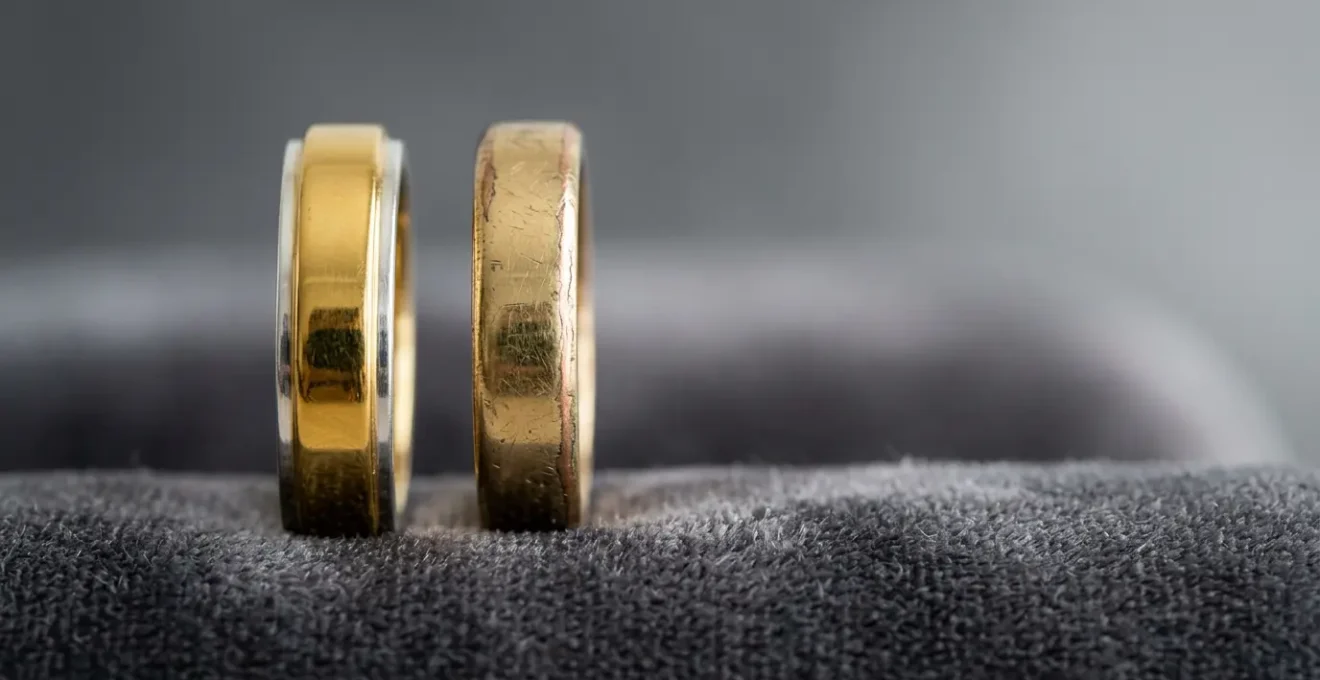
The key legal difference is that “Gold Vermeil” is a legally protected term in the UK requiring a thick gold layer over solid sterling silver, while “Gold Plated” has no such legal minimums.
- True Gold Vermeil must have a sterling silver (92.5% pure) base.
- The gold plating on vermeil must be at least 2.5 microns thick.
Recommendation: For durability and long-term value, verify an item is genuine Gold Vermeil by checking for a ‘925’ stamp, which signifies a sterling silver base as required by UK law.
As a consumer, navigating the world of jewellery can be perplexing. You see two seemingly identical gold rings, yet one is labelled “18k Gold Plated” and costs a fraction of the other, marked “18k Gold Vermeil.” This price gap isn’t just arbitrary marketing; it reflects a significant legal and material distinction enforced in the United Kingdom to protect buyers. Many believe the terms are interchangeable or simply denote different quality levels, but the reality is rooted in specific, non-negotiable standards set out by UK law and hallmarking practices.
The common advice to simply “choose what you can afford” overlooks the crucial factors of durability, long-term value, and even your rights as a consumer. The confusion is understandable, as both items are, on the surface, not solid gold. However, if the fundamental difference wasn’t the marketing term but a legally binding definition of composition and quality, your purchasing decision would change entirely. The true key lies not in the shine of the gold, but in the integrity of what lies beneath and the thickness of the layer you see.
This article will explain these differences from a UK consumer protection perspective. We will examine the statutory requirements for an item to be called “vermeil,” discuss the practical implications for durability and care, and provide you with the knowledge to identify genuine quality and understand the true value of your purchase. By understanding these legal standards, you can make informed decisions and ensure you are getting exactly what you pay for.
To help you navigate these important distinctions, this guide is structured to answer your most pressing questions. The following sections will break down everything from plating thickness and base metal requirements to long-term value and care, ensuring you become a more confident and informed jewellery buyer.
Summary: Understanding the Legal Nuances of Gold Jewellery in the UK
- Why Does 2.5 Micron Vermeil Last Years While 0.5 Micron Fades in Weeks?
- Is It Cost-Effective to Re-Plate a Vermeil Ring When the Silver Shows Through?
- Why Must True Vermeil Have a Sterling Silver Base?
- The Error of Using a Polishing Cloth on Vermeil Jewellery
- Can You Shower in Gold Vermeil Without Ruining the Plating?
- How to Spot the Difference Between “18k Gold Plated” and Solid Gold?
- The Difference Between “Handmade” and “Hand-Assembled” in UK Law
- Why Choose 18-Carat Gold Instead of 9-Carat for Heirloom Pieces?
Why Does 2.5 Micron Vermeil Last Years While 0.5 Micron Fades in Weeks?
The single most important factor determining the lifespan of gold-layered jewellery is the thickness of the gold itself, measured in microns (one-millionth of a metre). UK law and international standards provide a clear definition here: for a piece to be legally sold as “gold vermeil,” it must have a gold layer of at least 2.5 microns thick. In contrast, standard “gold plated” jewellery has no such legal minimum. It typically features a layer of just 0.5 microns, sometimes even less. This is not a minor difference; it means vermeil is at least five times thicker.
This substantial difference in thickness directly translates to durability. A 0.5-micron layer is so thin that it can be worn away by simple friction, exposure to skin oils, and contact with cosmetics or perfumes, often revealing the base metal underneath in a matter of months or even weeks with regular wear. A 2.5-micron layer, however, provides a robust barrier that can withstand daily use for many years with proper care. It offers the look and feel of solid gold because the surface is a substantial layer of genuine gold, not a fleeting “flash” of colour.
This table clearly illustrates the disparity in durability and expected lifespan based on the thickness of the gold layer, highlighting why vermeil is considered a fine jewellery standard while standard plating is often categorized as costume jewellery.
| Type | Gold Thickness | Durability | Typical Lifespan |
|---|---|---|---|
| Gold Vermeil | 2.5+ microns | 5x thicker than standard | Years with proper care |
| Gold Plated | 0.5 microns | Thin layer | Months to 1 year |
| Gold Filled | 5% of total weight | 100x thicker than plated | 10-30 years |
Ultimately, the micron measurement is a direct indicator of quality and longevity. Choosing a piece with a 2.5-micron layer is an investment in an item designed to last, whereas a 0.5-micron piece should be considered a short-term fashion accessory. Understanding this distinction is the first step toward making a smarter purchase.
Is It Cost-Effective to Re-Plate a Vermeil Ring When the Silver Shows Through?
When a cherished gold vermeil piece eventually shows signs of wear, with the underlying silver peeking through, the question of restoration arises. Is it worth the cost to re-plate it? The answer depends on a cost-benefit analysis of the piece’s original value, its sentimental worth, and the available re-plating options. In the UK, high-street jewellers typically charge between £40 and £60 for professional re-plating of a single item like a ring. This service ensures the piece is restored to the legal 2.5-micron standard, effectively renewing its lifespan.
For a piece that originally cost £150 or more, a £50 re-plating fee can be a very cost-effective way to bring it back to life, especially compared to buying a replacement. For hobbyists or those with multiple pieces to restore, another option exists. A UK specialist like G.S.P offers DIY vermeil plating kits for around £150. While a larger upfront investment, these kits can plate up to 20 rings, bringing the per-item cost down to approximately £7.50 for the initial batch. This makes financial sense for lower-value items or for someone looking to restore a whole collection. The trade-off is the skill and time required versus the guaranteed professional finish.
As this decision-making process shows, the choice is not always straightforward. For high-value or sentimentally important pieces, professional re-plating is almost always the superior choice. For a collection of less expensive items, a DIY approach might offer better long-term value. A useful tool to aid this decision is a “cost-per-wear” calculation, which helps to put the initial and ongoing costs into perspective.
Your Action Plan: Calculating the Cost-Per-Wear of Your Jewellery
- Record the initial purchase price of your jewellery piece.
- Track how many times you wear it over a significant period, for instance, six months.
- Divide the total cost by the number of wears to get the cost-per-wear (e.g., £100 vermeil ring ÷ 300 wears = £0.33/wear).
- Compare this with a cheaper alternative (e.g., £30 plated ring ÷ 30 wears = £1.00/wear).
- Factor in the potential re-plating cost to your long-term value assessment of the vermeil piece.
Why Must True Vermeil Have a Sterling Silver Base?
The second non-negotiable legal requirement for gold vermeil in the UK, beyond micron thickness, concerns its core. The base metal must be sterling silver. This is not a simple guideline but a statutory requirement under UK law, which protects consumers from misleading descriptions. Sterling silver itself is a legally defined alloy, and the Hallmarking Act 1973 is clear on its composition.
This legal standard is crucial because it guarantees the inherent value and quality of the piece. As the UK Government’s guidelines on precious metals state, this standard is what allows an item to be officially recognised and hallmarked by a UK Assay Office.
Sterling Silver is a legally protected standard in the UK, verified by an Assay Office mark (the ‘925’).
– UK Government, Hallmarking Act 1973 Guidelines
To earn the ‘925’ stamp, an item must have a statutory requirement of 92.5% pure silver content, with the remaining 7.5% typically being copper to add strength. This contrasts sharply with standard gold-plated jewellery, which usually uses a base metal of brass, copper, or zinc. These metals are cheaper, can cause skin irritation, and may tarnish to a green or black colour when the thin gold layer wears off. A sterling silver base will not turn your skin green and will tarnish to a darker grey that can be polished. This ensures that even if the gold layer fades over many years, the item underneath remains a piece of solid precious metal with its own inherent material value.
When the gold on a vermeil piece eventually wears thin, the owner is still left with a solid sterling silver item that has inherent material value. A faded brass ring has a residual value of zero.
– Jeweller’s Perspective via Goldsell.co.uk
Therefore, the sterling silver requirement is a hallmark of quality and a form of consumer protection. It guarantees that a vermeil piece is precious metal through and through, fundamentally separating it from costume jewellery.
The Error of Using a Polishing Cloth on Vermeil Jewellery
A common and costly mistake owners of gold vermeil make is treating it like solid gold. Specifically, many reach for a standard jewellery polishing cloth to restore its shine. This is a critical error. These cloths are impregnated with micro-abrasives designed to remove a fine layer of tarnish from solid sterling silver or solid gold. When used on a plated item, they do not distinguish between tarnish and the gold layer itself. Each wipe with an abrasive cloth physically removes a fraction of the gold plating, accelerating wear and drastically shortening the life of the piece.
As confirmed by London-based certified goldsmiths, these cloths should be strictly avoided for any plated jewellery. Instead, proper care for gold vermeil requires a much gentler approach focused on cleaning, not polishing. The goal is to remove dirt, oils, and residues without abrading the surface. Using the wrong cleaning method is one of the fastest ways to damage a vermeil piece and expose the sterling silver underneath.
To maintain the lustre and longevity of your gold vermeil, it is essential to follow a safe cleaning protocol. This method avoids all abrasive materials and harsh chemicals, preserving the delicate 2.5-micron layer of gold for as long as possible. The correct technique involves simple, non-abrasive materials that most people already have at home.
- Use a soft, non-abrasive microfiber cloth, such as one intended for eyeglasses.
- Prepare a solution of lukewarm water with a single drop of pH-neutral soap.
- Gently wipe the jewellery with the damp cloth, applying only light pressure. Do not rub vigorously.
- Rinse the piece with clean water to ensure all soap residue is removed.
- Pat the jewellery dry thoroughly with a separate clean, soft cloth. Never let it air dry, as this can leave mineral spots.
- Store it in a soft pouch, separate from other jewellery, to prevent scratching.
By adhering to this gentle cleaning regimen, you protect your investment and ensure the gold layer remains intact and lustrous for years, avoiding the premature wear caused by abrasive polishing.
Can You Shower in Gold Vermeil Without Ruining the Plating?
The simple, official advice is no. While gold vermeil is water-resistant, it is not waterproof. Regular exposure to water, soap, and steam will degrade the gold layer over time. The issue is not just the water itself, but the chemicals and minerals within it. Tap water, especially in certain areas, contains chlorine and other minerals that can react with the gold and cause it to lose its lustre. In fact, it is a known issue that because many UK regions have hard water, the resulting mineral deposits can cause vermeil to dull significantly faster than in soft water areas.
Soaps, shampoos, and conditioners also contain chemicals and surfactants that can build up on the jewellery, creating a film that dulls the shine and can become trapped in intricate details. Over time, this repeated exposure chemically and physically wears down the 2.5-micron gold layer. The same principle applies with even greater force to swimming pools and hot tubs, where chlorine is a major threat, and to the sea, where salt is highly corrosive.
Chemicals like chlorine can be very damaging to your vermeil, so make sure you remove any jewellery before you go swimming.
– Astley Clarke London, Gold Vermeil Care Guide
To preserve your gold vermeil jewellery, it is essential to adopt the “last on, first off” rule. It should be the last thing you put on after applying lotions, makeup, and perfume, and the first thing you take off before showering, exercising, cleaning, or sleeping. This simple habit minimizes contact with moisture and chemicals, and is the single most effective way to protect the plating.
While an accidental, brief exposure to water is unlikely to cause immediate harm, making it a regular habit will undoubtedly shorten the life of your jewellery. Protecting it from moisture is a cornerstone of responsible ownership, ensuring the piece remains vibrant for as long as possible.
How to Spot the Difference Between “18k Gold Plated” and Solid Gold?
Distinguishing between solid gold and a plated item is a key skill for any discerning buyer. While a hallmark is the definitive legal proof, there are several physical tests recommended by jewellers that can provide strong clues. These tests rely on the inherent physical properties of gold, which are difficult for plated items to replicate. As a consumer, you can perform some of these checks yourself before making a purchase.
The most accessible method is the “heft test.” Gold is an incredibly dense metal. A solid gold ring will feel noticeably heavier in your hand than a gold-plated ring of the exact same size and shape, which typically has a much lighter base metal like brass or silver. This difference in weight, or density, is often immediately apparent. Another test is the thermal conductivity test. Gold conducts heat very efficiently. A solid gold piece will quickly warm up to your body temperature when you hold it, while a plated piece with a base metal core will often feel colder to the touch for a longer period.
Finally, a careful visual inspection can reveal telling signs. Look closely at areas of high friction, such as:
- The edges of a ring band
- The clasp on a necklace or bracelet
- The points where charms or pendants rub against a chain
On a plated piece, these areas are often the first to show wear. You may see a different-coloured metal peeking through the gold layer. On a solid gold piece, the colour will be consistent throughout, even with surface scratches. While only an Assay Office can provide a definitive verification, these physical clues are powerful indicators of an item’s true composition.
The Difference Between “Handmade” and “Hand-Assembled” in UK Law
The terms “handmade” and “hand-assembled” are often used interchangeably in marketing, but from a UK consumer protection standpoint, they mean very different things. The Advertising Standards Authority (ASA) has clear guidelines to prevent consumers from being misled. Understanding this distinction is vital when assessing the true craftsmanship and value of a piece of jewellery.
As a rule, “handmade” legally implies that an artisan has created the item from raw materials. This involves processes like forging metal, carving wax models for casting, and setting stones entirely by hand. “Hand-assembled,” on the other hand, can simply mean putting together pre-fabricated, mass-produced components by hand. For example, attaching a mass-produced charm to a mass-produced chain is hand-assembly, not hand-making.
Handmade legally implies a product made from raw materials by an artisan, while hand-assembled can mean simply putting together mass-produced components.
– UK Advertising Standards Authority, Consumer Protection Guidelines
This distinction is critical for any buyer who values unique craftsmanship. A truly handmade piece carries the mark and skill of an individual maker, whereas a hand-assembled item may be identical to thousands of others. To protect yourself and verify a seller’s claims, especially on online marketplaces, you have the right to ask specific questions about their process.
- Could you describe your complete making process, starting from raw materials?
- Where are your metal components sourced from?
- Is this design created entirely in your UK workshop, or are parts imported for assembly?
- Can you provide photos of your workshop or work-in-progress pieces?
- Do you offer custom modifications, which would indicate a true handmade process?
An honest artisan will be happy to answer these questions and share their process. Hesitation or vague answers should be a red flag. Being an informed consumer means looking past marketing buzzwords and asking for the details that confirm true artisanal quality.
Key Takeaways
- Gold Vermeil is a legally defined term in the UK requiring a sterling silver base and a minimum gold plating of 2.5 microns.
- Standard “gold plated” has no legal minimum for thickness or base metal, making it far less durable.
- The inherent value of vermeil lies in its precious metal core (sterling silver), which remains even if the gold plating wears over many years.
Why Choose 18-Carat Gold Instead of 9-Carat for Heirloom Pieces?
When selecting a piece of jewellery intended to last for generations—an heirloom—the choice of metal is paramount. While both 9-carat and 18-carat gold are popular in the UK, 18-carat gold is widely considered the superior choice for pieces of significant long-term and sentimental value. The reason lies in its purity, international recognition, and long-term structural integrity.
The primary difference is gold content. 18-carat gold contains 75% pure gold (hallmarked as ‘750’), mixed with 25% other alloys for strength. In contrast, 9-carat gold contains only 37.5% pure gold (‘375’), with the majority (62.5%) being other metals like copper, silver, and zinc. This high alloy content in 9-carat gold has significant implications. Its rich, deep yellow hue is the globally recognised standard for fine jewellery. The lower gold content in 9-carat gives it a paler, less vibrant colour. Crucially, 9-carat gold is not even legally recognised as “gold” in some countries, including the USA and Italy, which can significantly impact its international resale value.
While it is true that the higher alloy content makes 9-carat gold harder and more resistant to scratching initially, it also makes it more brittle over time. For an heirloom piece that may need to be resized or repaired by future generations, this is a major drawback. 18-carat gold’s higher gold content makes it more malleable, allowing future jewellers to work on it more easily without risk of the metal cracking. This repairability is essential for a piece intended to be passed down through a family. Therefore, for an engagement ring, a wedding band, or any piece meant to signify a lasting legacy, investing in 18-carat gold ensures its beauty, value, and integrity for decades to come.
As a final piece of advice, always look for the hallmark. A legally compliant piece of gold vermeil sold in the UK must be stamped with ‘925’ to certify its sterling silver base. This mark, applied by an independent Assay Office, is your guarantee of quality and your best protection against misleading descriptions. Be an informed consumer, ask questions, and check for this vital mark of authenticity.