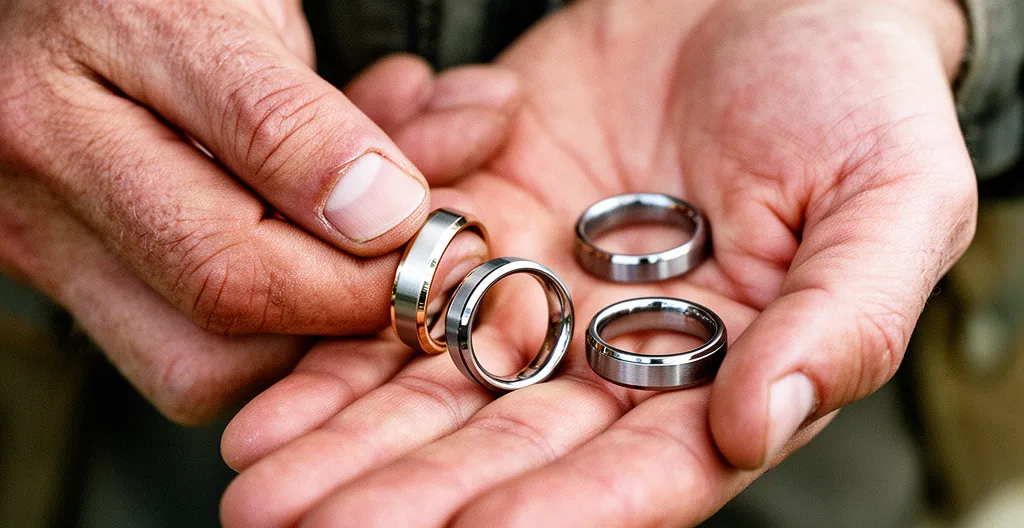
The true comfort of a wedding band for manual work is an engineering problem, not a style choice, where the ring’s cross-sectional profile is more critical than the metal itself.
- A “Court” profile, rounded on the inside and outside, distributes pressure evenly when gripping tools, making it superior to a flat band.
- Finishes like matte or hammered are not just aesthetic; they are functional choices that camouflage wear and tear from daily work.
Recommendation: Prioritize a comfort-fit “Court” profile in a durable metal like palladium, and choose a matte or brushed finish to maintain the ring’s appearance over time.
For anyone who works with their hands, choosing a wedding band presents a unique challenge. The ring isn’t just a symbol; it’s a piece of equipment you’ll wear every single day. The common advice is often to pick a tough metal like titanium or simply buy a cheap silicone band for workdays. While practical, this approach overlooks a more fundamental truth: long-term comfort and durability are engineered, not just chosen. The secret lies in the subtle geometry of the ring itself—details that prevent pinching, reduce pressure, and gracefully absorb the realities of an active life.
The conversation shouldn’t start and end with metal. It should be about ring ergonomics. This involves understanding how the ring’s cross-sectional shape (its profile), its width relative to your finger, and its surface finish all interact under the stress of gripping a hammer, turning a wrench, or even typing at a desk. A poorly designed ring, no matter how strong the material, will become a constant annoyance, digging into your skin or deforming over time. A well-engineered ring becomes a part of you, so comfortable you forget it’s there.
This guide moves beyond the surface-level discussion. We will deconstruct the anatomy of a wedding band to reveal why some designs are inherently superior for manual work. We will explore the physics of comfort, the science of scratch resistance, and the structural integrity of different settings. By the end, you won’t just be choosing a ring; you’ll be selecting a perfectly designed tool for a lifetime of wear, whether you’re on a construction site or in a corporate office.
In this article, we will examine the critical factors that define a truly comfortable and durable wedding band. Follow this guide to make an informed decision based on practical engineering rather than just aesthetics.
Summary: Which Wedding Band Profile is Most Comfortable for Manual Work?
- Why Does a Traditional Court Ring Cost More Than a Flat Band?
- How to Fit a Wedding Band Flush Against a Low-Set Engagement Ring?
- Palladium or White Gold: Which Grey Metal requires Less Maintenance?
- The Error of Choosing a 6mm Band for Short Fingers
- Matte or Polished: Which Finish Hides Scratches Better on Men’s Rings?
- Channel Set or Pave Set: Which is More Secure for Active Hands?
- Which Metal Finish Hides Desk Scratches Best on Men’s Rings?
- How to Wear Men’s Jewellery in a Corporate Office Without Breaking Protocol?
Why Does a Traditional Court Ring Cost More Than a Flat Band?
At first glance, a court ring and a flat band of the same width look similar. Yet, the court profile—curved on the inside and outside—consistently carries a higher price tag. This isn’t a matter of style inflation; it’s a direct result of a more complex and resource-intensive manufacturing process. While a flat band is essentially a simple slice of metal tubing, a court ring is sculpted for superior ergonomics, and that engineering requires more material, more time, and more specialized skill.
The primary cost driver is the sheer volume of raw material. A court ring requires 15-20% more precious metal than a flat band to achieve the same visual width and necessary thickness for its domed profile. Furthermore, the process of lathing both the interior and exterior surfaces to create the perfect curve is intricate. This precision work generates significant material waste—up to 30% of the initial block—which, although recycled, adds to the overall production cost. The final stage, polishing, also takes considerably longer; the curved surfaces require about 40% more finishing time to achieve a flawless, uniform sheen compared to a simple flat surface.
However, this extra cost translates directly into tangible benefits. The primary advantage is comfort, especially when gripping or making a fist. The rounded interior eliminates the sharp edges of a flat band that can dig into the skin. In fact, ergonomic research demonstrates that court rings reduce pressure points by up to 35% compared to flat bands during grip-intensive activities. This superior pressure distribution is why the court profile is often called a “comfort-fit.” The investment is not in aesthetics, but in a fundamentally more comfortable and wearable design for active hands.
How to Fit a Wedding Band Flush Against a Low-Set Engagement Ring?
For those pairing a wedding band with a low-set engagement ring, achieving a seamless, flush fit without a gap can be a significant design challenge. This is especially critical for anyone in a manual profession, as a gap between rings can pinch the skin, trap dirt, and create a snag point. Several solutions exist, but not all are suitable for active hands due to compromises in structural integrity.
The most common approach is a “notched” or curved wedding band, designed to wrap around the engagement ring’s setting. While visually appealing, this is often the worst option for durability. The notch creates a significant weak point where the metal is thinnest, making it prone to bending or breaking under pressure. Another option is to solder the two rings together. This creates the strongest, most unified piece, eliminating any pinching or movement, but it sacrifices the ability to wear the rings separately.
The image below highlights the inherent weakness in a notched design, showing where the metal is thinned out to accommodate the engagement ring, creating a point of failure.
For manual workers, a different strategy is often the most practical. As this comparative analysis of flush-fit solutions shows, the “Two-Ring Strategy” provides the best balance of safety, durability, and sentimentality.
Case Study: The Two-Ring Strategy for Manual Workers
An increasing number of mechanics, construction workers, and other tradespeople are adopting a two-ring approach. They wear a simple, highly durable, and inexpensive band made of titanium or silicone during work hours. This “work ring,” typically costing between $20 and $150, prioritizes finger safety and withstands harsh conditions. Their fine jewelry wedding set is reserved for non-work hours, preserving the precious and often more delicate pieces from damage.
Palladium or White Gold: Which Grey Metal requires Less Maintenance?
For those desiring a white metal look, white gold and palladium are two popular choices. However, for anyone working with their hands, their maintenance requirements are worlds apart. White gold is an alloy of yellow gold mixed with white metals like nickel or silver. To achieve its bright white sheen, it is almost always plated with rhodium. This plating is thin and wears away over time, especially with friction, revealing the slightly yellowish tint of the gold beneath.
For office workers, this means replating every one to two years. But for manual laborers, the increased abrasion can wear the rhodium away much faster. In fact, jewelry maintenance data shows that manual workers may need to replate their white gold rings every 6 to 12 months to maintain their color. This not only incurs a regular maintenance cost but also means the ring spends time at the jeweler instead of on your finger. Furthermore, white gold alloys often contain nickel, a common allergen that can cause skin irritation, particularly with the friction and sweat associated with physical work.
Palladium is highly resistant to corrosion, meaning it won’t oxidize or lose its shine over time. It’s also highly resistant to scratches, which helps preserve its appearance even after years of everyday wear. It’s one of the most low-maintenance precious metals you can choose.
– BriteCo Jewelry Insurance, Palladium Tarnish and Maintenance Guide
Palladium, on the other hand, is a platinum-group metal that is naturally white. It does not require any plating, so its color will never fade or change. It is also hypoallergenic, making it a safer choice for sensitive skin. While it can still scratch, its “set it and forget it” nature makes it a far superior choice for low-maintenance durability. The following table breaks down the key differences for someone in an active profession.
| Maintenance Aspect | Palladium | White Gold |
|---|---|---|
| Rhodium Replating | Never needed | Every 6-12 months for manual work |
| Nickel Allergy Risk | Hypoallergenic | Common allergen (worse with sweat/friction) |
| Natural Color | White throughout | Yellowish tint shows when plating wears |
| Annual Maintenance Cost | $0-50 (cleaning only) | $75-150 (replating + cleaning) |
The Error of Choosing a 6mm Band for Short Fingers
While the title singles out short fingers, the principle applies to everyone, especially those in manual trades: choosing a wedding band width based on aesthetics alone is a significant mistake. A wide band (anything from 6mm to 10mm) might look bold and substantial in the jeweler’s display, but it can severely compromise comfort and dexterity during physical work. The issue lies in how the band interacts with your finger’s natural movement and swelling.
A wider band covers more surface area, which can create a “suction” effect on the skin, trapping moisture and restricting breathability. This often requires sizing up by a quarter or half size to maintain comfort, which can then make the ring feel loose at other times. More importantly for manual work, a wide band can interfere with the natural fold of skin at the base of the finger when you make a fist or grip a tool. If the ring sits over this fold, it will pinch and cause constant irritation. A narrower band (typically 4-5mm) provides ample room for your finger to bend and flex without obstruction.
For those who still prefer the look of a wider band, a tapered profile can offer a compromise. This design features a wider top (e.g., 6mm) that narrows to a more comfortable width (e.g., 4mm) on the palm side of the hand, combining a bold appearance with practical ergonomics. The ultimate test is to simulate real-world conditions before committing.
Your Action Plan: Testing Band Width for Manual Work Compatibility
- The Bend Test: Bend your finger completely. The band should sit comfortably above the skin fold at the base of your finger, not on top of it.
- The Fist Test: Make a tight fist while wearing the ring. Check for any uncomfortable pressure, pinching, or restricted movement at the knuckle joint.
- The Grip Test: Firmly grip a tool handle (like a hammer or screwdriver) for at least 30 seconds. Monitor for any circulation issues or a “muffin top” effect where the skin bulges around the ring.
- The Swelling Test: If possible, try on different widths at the end of a workday when your fingers are naturally more swollen to get a true sense of fit under stress.
- The Taper Test: Ask to try a tapered profile ring. This option often provides the best of both worlds: a substantial look with an ergonomic palm-side fit.
Matte or Polished: Which Finish Hides Scratches Better on Men’s Rings?
The finish of a wedding band is more than just a style choice; it’s a functional decision that determines how the ring will age with wear. For anyone in a manual profession, a high-polish finish is often the least practical option. Its mirror-like surface acts as a blank canvas, highlighting every single scratch, scuff, and ding. Within weeks, a polished ring worn on a job site can look heavily damaged, requiring constant re-polishing to restore its original appearance.
The solution is to choose a finish that is designed to camouflage or absorb wear. Finishes like matte, brushed, or hammered are not only aesthetically different but also far more forgiving. A brushed or matte finish features fine, non-directional lines that effectively hide the minor scratches that accumulate from daily work. These small abrasions blend into the existing texture, maintaining the ring’s overall look for much longer. In many cases, a simple refresh with a Scotch-Brite pad at home can restore a brushed finish.
For the most demanding environments, a hammered or distressed finish is the ultimate choice. With this style, the “damage” is part of the design. Each new dent or scratch simply adds to the ring’s rugged character, creating a unique patina over time. There is no maintenance required because the ring is intended to evolve with its wearer. The illustration below shows how different finishes display wear, from the obvious marks on a polished surface to the integrated texture of a hammered one.
This hierarchy demonstrates a clear trade-off between shine and practicality. For an active individual, a finish that embraces wear is always superior to one that fights it.
| Finish Type | Scratch Visibility | Home Maintenance | Best For |
|---|---|---|---|
| Polished | Shows everything | Professional tools required | Office work only |
| Satin | Moderate hiding | Possible with care | Mixed use |
| Matte/Brushed | Good hiding | Scotch-Brite pad refresh | Regular manual work |
| Hammered/Distressed | Best – adds character | No maintenance needed | Heavy manual labor |
Channel Set or Pave Set: Which is More Secure for Active Hands?
For those who want diamonds or other gemstones in their wedding band, the security of the setting is the single most important factor, especially for an active lifestyle. While many setting styles exist, the two most common for bands are channel and pavé. From a structural standpoint, one is vastly superior for manual work.
Pavé settings feature small stones set very close together, held in place by tiny beads or prongs of metal. While this creates a brilliant, continuous sparkle, it is also incredibly delicate. The small prongs are highly susceptible to damage from impacts or abrasion. A hard knock can easily dislodge a prong, and the constant friction from wearing gloves or handling tools can wear them down over time, leading to stone loss. Pavé-set rings are beautiful but are fundamentally designed for occasional, careful wear—not for a workshop or construction site.
Channel settings, by contrast, are engineered for durability. In this style, a row of stones is set into a groove or “channel” carved into the band, with two walls of metal holding them securely in place on either side. There are no exposed prongs to snag or wear down. The stones are protected from side impacts by the sturdy metal walls, making this the most secure way to incorporate gemstones into a ring intended for daily, active wear.
Channel settings protect stones on two sides with walls of metal, shielding them from side impacts. Pave settings rely on tiny prongs or beads, which are easily damaged or worn down by abrasion, leading to stone loss – making channel settings the clear winner for manual work.
– Jordan Jack Jewelry, Wedding Bands for Manual Workers Guide
The choice is clear: while pavé offers maximum sparkle, it comes at the cost of security. For anyone working with their hands, the robust, protective design of a channel setting is the only logical choice to ensure the longevity of your investment and prevent the heartbreak of a lost stone.
Key Takeaways
- Comfort is Engineered: The “Court” or “Comfort-Fit” profile, rounded on the inside, is ergonomically superior for active hands as it prevents digging and distributes pressure.
- Width is Critical: A band’s width should be chosen for dexterity, not just looks. A 4-5mm band is often more comfortable for gripping than a wider 6mm+ band.
- Finish is Functional: Matte, brushed, or hammered finishes are not just stylistic; they are practical choices that camouflage scratches and wear far better than a high-polish finish.
Which Metal Finish Hides Desk Scratches Best on Men’s Rings?
The hazards for a wedding band aren’t limited to heavy-duty manual labor. The modern office environment presents its own unique challenge: the constant, fine-grained abrasion known as “desk diving.” The repetitive motion of a hand resting on a desk, using a keyboard, or moving a mouse creates a pattern of micro-scratches that can quickly dull a ring’s finish. For this specific type of wear, not all finishes perform equally.
While a hammered finish is great for heavy impacts, its deep texture can be less effective against the uniform, surface-level wear of an office. A high-polish finish, as discussed, shows these fine scratches immediately. The surprising winner in the corporate arena is often a satin finish. This finish is smoother than a coarse matte or brushed texture but not as reflective as a high polish. Its subtle, lustrous texture is exceptionally good at diffusing light and masking the fine, repetitive abrasions that come from desk work.
Desk Worker Ring Wear Patterns Study
An analysis of office workers’ rings after one year of wear revealed that satin finishes maintained their original appearance best against desk-related abrasions. Interestingly, the study also found that two-tone designs with recessed, polished centers and brushed or satin-finished edges showed 60% less visible wear than single-finish rings. The raised, textured edges effectively protected the more delicate polished section from contact with desk surfaces, offering a clever and stylish solution to the problem of desk diving.
This suggests that for the office-bound professional, the ideal choice is not just about a single finish, but about a smart design. A satin finish provides an excellent baseline for hiding wear, and incorporating it into a two-tone design where the more delicate finish is recessed can provide an even greater level of long-term protection and aesthetic appeal.
How to Wear Men’s Jewellery in a Corporate Office Without Breaking Protocol?
For the professional who splits time between the field and the office, or works entirely in a corporate setting, the rules of accessorizing shift from pure durability to professional etiquette. While a wedding band is universally accepted, its style can send subtle but powerful messages about professionalism and judgment. In conservative environments, understated elegance is always the safest and most effective approach.
The unwritten “Corporate Jewelry Protocol” centers on coherence and subtlety. A key guideline is the ‘Rule of Three’: a wedding band, a watch, and one other modest item (like a signet ring or a subtle bracelet) is the accepted maximum. Beyond quantity, cohesion is critical. Metals should be matched—a steel watch pairs best with white metals like platinum or palladium, while a gold watch calls for a gold band. The goal is a look that is put-together, not distracting. Jewelry should never be audible; if your ring or bracelet clanks against your watch when you move, it’s too much.
The ring itself is a signal. A classic, understated band, such as a 4-5mm court profile in platinum or gold, is perceived as traditional, stable, and professional. In contrast, an excessively wide, diamond-heavy, or unconventional design might be seen as flashy or misaligned with a conservative company culture. As one corporate image consultant notes, “A very wide, diamond-encrusted, or unconventional band might be perceived as flashy and could be misaligned with a conservative company culture. The ring itself sends a message.”
The following table illustrates how different styles are generally perceived in a traditional corporate context, highlighting the importance of choosing a ring that aligns with your professional environment.
| Ring Style | Corporate Perception | Suitability Score |
|---|---|---|
| 4-5mm Court Profile, Platinum | Traditional, Stable, Professional | 10/10 |
| 6mm Brushed Titanium | Modern, Practical | 8/10 |
| Wide Band with Diamonds | Flashy, Attention-seeking | 4/10 |
| Black Tungsten with Inlay | Edgy, Non-conformist | 3/10 |
| Simple Gold Band | Classic, Trustworthy | 9/10 |
By applying these principles of ring ergonomics and material science, you are equipped to choose a wedding band that is not only a beautiful symbol but also a perfectly engineered companion for a lifetime of work and wear. Use this guide as your checklist when you shop to ensure your choice is based on sound, practical knowledge.