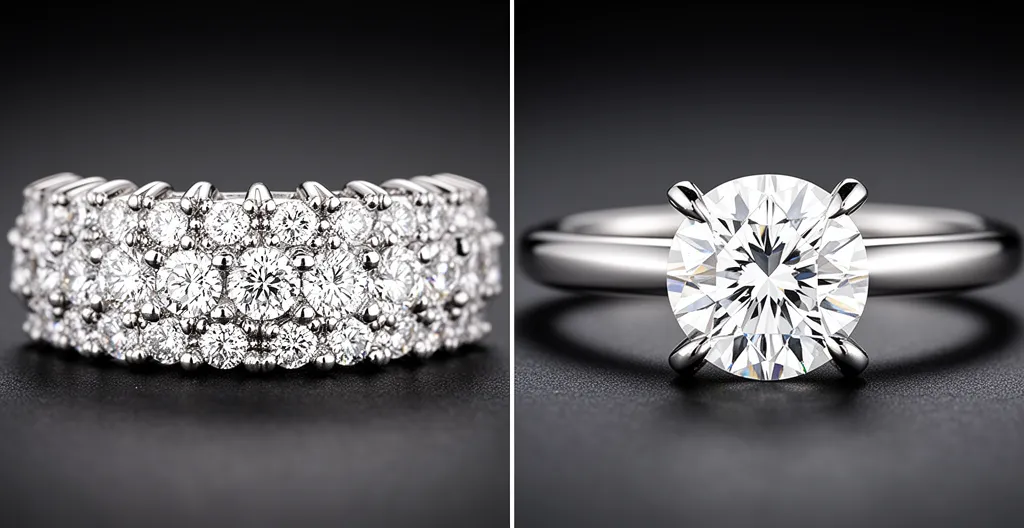
Contrary to common belief, micro-pavé jewellery isn’t simply “fragile”; it’s a feat of micro-engineering where achieving a continuous diamond surface requires pushing metal to its structural limits.
- The tiny metal beads holding each stone have minimal surface area and are susceptible to wear and force.
- Resizing or aggressive cleaning can compromise the ring’s entire structural integrity, not just one setting.
Recommendation: Treat pavé jewellery with an appreciation for its delicate architecture, prioritizing regular professional inspection over aggressive at-home cleaning.
There’s an undeniable magic to a micro-pavé ring. It’s not just a band with diamonds; it’s a river of light, a surface that seems crafted from pure sparkle. As a repair specialist, I see these pieces on my bench daily, and I admire the artistry. But I also see the other side: the disappointed owner who has lost a stone, the bent band, the dullness that has crept into the tiny crevices. The common advice you’ll hear is to simply “be careful,” but that’s not a real strategy. The instinct is often to blame the quality of the piece, but that’s rarely the full story.
The truth is more complex and fascinating. The comparison to a solitaire isn’t just about the number of stones; it’s a fundamental difference in structural philosophy. A solitaire is a fortress, built to elevate and protect a single gem. A pavé ring, especially micro-pavé, is an intricate suspension bridge. Its beauty is derived from making the supporting metal structure seem to disappear. This creates an inherent aesthetic-structural trade-off. To get that seamless, “all diamond” look, the engineering of the piece is pushed to its absolute limits.
This guide isn’t about discouraging you from choosing pavé. It’s about pulling back the curtain from a workshop perspective. Instead of seeing it as fragile, I want you to see it as a piece of sophisticated micro-engineering. Understanding the forces at play, the vulnerabilities of its design, and the logic behind its maintenance is the only way to preserve that magic you fell in love with. We will explore the hidden dangers of cleaning, the signs of quality craftsmanship to look for before you buy, the risks of resizing, and how to properly care for these miniature works of art.
This article provides a detailed look into the structural realities of pavé jewellery. The following sections break down the specific vulnerabilities and maintenance requirements from a specialist’s point of view.
Summary: The Engineer’s View on Pave Jewelry Maintenance
- Why Do Pave Diamonds Fall Out After Ultrasonic Cleaning?
- How to Spot Uneven Beads in a Pave Setting Before Buying?
- French Pave or Micropave: Which Style Minimizes Visible Metal?
- The Risk of Resizing a Full Eternity Pave Ring by More Than One Size
- How to Clean Gunk Out of Tiny Pave Holes Safely at Home?
- Why Do the Metal Beads in Pave Settings Wear Flat After 5 Years?
- Why Does Your High-Set Solitaire Keep Snagging on Your Pockets?
- How to Check Your Pave Setting for Loose Stones at Home?
Why Do Pave Diamonds Fall Out After Ultrasonic Cleaning?
An ultrasonic cleaner seems like the perfect solution for intricate jewellery. It promises to dislodge grime from impossible-to-reach places using just sound waves. However, for a micro-pavé piece, it’s one of the most hazardous things you can do. The danger doesn’t come from the cleaning solution, but from the physics of the process itself: a phenomenon called cavitation. The high-frequency sound waves create and violently collapse millions of microscopic bubbles in the water. Each collapse generates a tiny but powerful shockwave, like a microscopic pressure washer jet.
While this is great for blasting away dirt, it’s devastating to a delicate setting. Jewellery experts warn that micro-pavé and tension mounts are categorically vulnerable to this force. The shockwaves can vibrate a stone that is even slightly loose, widening its seat and eventually shaking it out completely. I’ve seen it happen firsthand; a client once described hearing a high-pitched noise from their cleaner, only to find a tiny diamond bouncing around on the bottom of the tank. The ultrasonic cleaner didn’t break the setting, but it exploited a pre-existing weakness with incredible efficiency.
Think of it this way: a single tap might not dislodge a stone, but an ultrasonic cleaner delivers millions of microscopic “taps” per second to every surface. It is the perfect tool for finding and removing any stone that isn’t 100% secure. This is why professional jewellers use them with extreme caution, often inspecting every stone on a piece before and after cleaning, or avoiding the method entirely for particularly delicate work. For the owner at home, the risk simply isn’t worth it.
How to Spot Uneven Beads in a Pave Setting Before Buying?
The long-term durability of a pavé ring is often decided before you even purchase it. It lies in the quality of the setting, and spotting superior craftsmanship requires knowing what to look for. Mass-produced pavé can look brilliant in the store, but tiny imperfections in the setting are what lead to stones falling out later. The key is to examine the piece not just as a whole, but as a collection of individual, meticulously crafted settings. A 10x jeweller’s loupe is your best friend here; don’t be shy about asking to use one.
Your primary focus should be on the metal beads (or prongs) holding the stones. In master craftsmanship, each bead is a perfect, polished sphere, raised from the base metal and carefully pushed over the stone’s girdle. In lower-quality work, you’ll see flat spots, irregular shapes, or even scratches left by the setting tools. These imperfections aren’t just cosmetic; a flat or weak bead has less surface area holding the stone, making it more likely to fail. Another critical sign is the uniformity of the stones. All the diamond girdles should be set at the exact same height, creating a smooth, consistent surface. If some stones sit higher or lower than their neighbors, it’s a sign of a rushed job and potential instability.
This table breaks down the key differences between a ring built to last and one that may cause problems down the line, a distinction best seen under magnification.
| Quality Indicator | Master Craftsmanship | Mass Production |
|---|---|---|
| Bead Shape | Perfectly round, polished | Flat spots, irregular shapes |
| Tool Marks | No visible scratches | Burrs, scratches from setting tools |
| Stone Height | All girdles at exact same level | Uneven heights, some too high/low |
| Metal Texture | Smooth, refined finish | Rough, unfinished areas |
| Prong Type | Individually sculpted from base | Simple beads pushed over stones |
Your 5-Point Pave Inspection Checklist
- Use a 10x loupe to examine the ‘negative space’ between beads; uniform spacing indicates quality craftsmanship.
- Rotate the ring while looking through the loupe; light and shadow patterns should be consistent, not jagged.
- Check if beads are perfectly round and polished versus showing flat spots, burrs, or tool scratches.
- Verify all diamond girdles are set at the exact same height, just below the bead surface.
- Distinguish between simple ‘beads’ pushed over stones versus individually sculpted ‘prongs’ raised from the base metal.
French Pave or Micropave: Which Style Minimizes Visible Metal?
When the goal is to create that breathtaking “diamond carpet” effect, the setting style plays a crucial role. While both micropavé and French pavé aim to maximize brilliance, they achieve it through different engineering approaches, directly impacting how much metal is visible. For the buyer whose primary desire is a continuous, uninterrupted surface of sparkle, French pavé is often the superior choice for minimizing the appearance of metal between the stones.
The secret lies in its unique structure. Instead of a simple row of beads, French pavé involves cutting V-shaped grooves directly into the ring’s band. The diamonds are then set into these grooves. This design has two brilliant effects: it allows light to enter the diamonds from the side (the pavilion), dramatically increasing their fire and sparkle, and it physically removes metal from the sightline between the stones. This creates a powerful illusion where the diamonds appear to be floating next to each other, making it look, as some describe it, “like the ring itself is made of them.”
Micropavé, by contrast, typically uses at least four tiny beads per stone, arranged in a honeycomb pattern to create a seamless surface. While incredibly beautiful and texturally fascinating, the very nature of this technique means there is more metal on the surface. As jewelry experts from Adiamor note, this can result in a more robust and substantial feel.
Pave is more metallic, while micro pave is more streamlined and subtle. If you appreciate a more robust ring, then it would be more to your liking. It has more visible prongs and can contain heftier diamonds within it.
– Adiamor jewelry experts, Engagement Ring Comparison: Pave vs. Micro Pave
The choice is a perfect example of the aesthetic-structural trade-off. French pavé offers a more “diamond-dominant” look by cutting away metal, while micropavé provides a different kind of seamlessness with a slightly more metallic presence.
The Risk of Resizing a Full Eternity Pave Ring by More Than One Size
A full eternity pavé band is a perfect circle of diamonds, a beautiful symbol of unending love. From a structural standpoint, it’s also a perfect, load-bearing arch. This is precisely why resizing one is a repair specialist’s nightmare. Attempting to change its size, especially by more than one full size, is not a simple adjustment; it is an act that fundamentally compromises the ring’s structural integrity.
When you size a ring up, you are stretching that perfect arch. The metal thins out, and the meticulously placed settings are pulled apart. The tiny beads holding each diamond are now under constant tension, desperately trying to hold on as the distance between them increases. This dramatically raises the risk of stones popping out, even with gentle wear. Conversely, sizing down compresses the arch. The settings are squeezed together, and with nowhere to go, they can buckle and warp, literally forcing stones up and out of their seats.
The damage isn’t just to the settings. The metal itself suffers. When a jeweller bends the ring into a new shape, the metal at the bend points becomes “work-hardened.” It loses its original flexibility and becomes brittle. Even if the stones seem secure immediately after the resize, the metal is now predisposed to cracking and failing at these stress points in the future. This is why most reputable jewellers will refuse to resize a full eternity band, or will only attempt a very minor change (a quarter or half size) with significant warnings. The risk of creating a piece that will continuously lose stones is simply too high. For this reason, a 3/4 or 1/2 eternity band, which provides a solid metal “sizing bar” at the bottom, is a far more practical choice for long-term ownership.
How to Clean Gunk Out of Tiny Pave Holes Safely at Home?
Over time, the tiny, intricate spaces that make pavé so beautiful also become perfect traps for lotions, soap, dust, and daily grime. This buildup can make the most brilliant diamonds look dull and cloudy. The temptation to use a pin or a sharp object to “dig out” the dirt is strong, but this is one of the fastest ways to damage your ring. Pushing a hard object into these crevices can easily scratch the metal, chip a diamond’s delicate girdle, or, worst of all, push a bead or prong away from a stone, instantly loosening it.
A safe and effective at-home cleaning requires a gentle approach. The goal is to dissolve and dislodge the grime without applying force to the settings. Your best tools are simple and soft. You will need a bowl of warm water, a few drops of a mild dish soap (like original Dawn, which is excellent at cutting through oils), and a very soft brush. An extra-soft baby toothbrush or a small, soft-bristled makeup brush (like one used for eyeshadow) is ideal. Harsh chemicals like bleach, chlorine, or acetone should never be used, as they can damage both the metal and the stones.
Here is the safe, workshop-approved method:
- Soak First: Let the ring soak in the warm, soapy water for 20-30 minutes. This will do most of the work for you, softening and dissolving the buildup of oils and lotions.
- Gentle Brushing: Take the ring out of the water and use your soft brush to gently scrub the surface and crevices. Pay attention to the underside of the ring as well, as a lot of dirt can accumulate there. The goal is to let the bristles do the work, not pressure.
- Rinse Thoroughly: Rinse the ring under warm running water. Be sure to plug the sink drain first! Continue rinsing until all soap residue is gone.
- Dry Carefully: Pat the ring dry with a soft, lint-free cloth. Avoid paper towels, which can leave fibers behind. You can also use a hairdryer on a cool, low setting to blow water out of the hard-to-reach spots.
This gentle process, performed every few weeks, will keep your pavé looking brilliant without compromising its delicate structure. For deep, stubborn buildup, always bring it to a professional jeweller who has the proper tools and expertise.
Why Do the Metal Beads in Pave Settings Wear Flat After 5 Years?
One of the most common long-term issues I see with pavé rings is the gradual flattening of the metal beads. A client will bring in a ring they’ve worn daily for years, concerned that the surface feels “rough” or has lost its sparkle. Upon inspection under a loupe, the problem is clear: the once-perfectly-round beads have been worn down into flat, dull spots. This isn’t a sign of a manufacturing defect; it’s an inevitable result of a material science principle known as abrasion and metal fatigue.
Think about the scale we are working with. Each tiny bead holding a diamond is a minuscule piece of metal, often less than a millimeter wide. While precious metals like gold and platinum are durable, they are not invincible. Every time your ring comes into contact with another surface—a coffee mug, a steering wheel, the fabric of your clothes, even your own skin—a microscopic amount of friction occurs. On its own, one of these interactions is meaningless. But accumulated over millions of interactions over several years, this gentle but persistent abrasion literally wears away the metal.
Because the beads are so small and have a rounded shape, the pressure from any impact or friction is concentrated on a very small point. This accelerates the wear process. Over time, the highest point of the bead is worn down, creating a flat facet. This flattened surface doesn’t reflect light in the same way, contributing to a duller overall appearance. More importantly, as the bead flattens, it loses mass and its grip on the diamond’s girdle becomes less secure. A bead that has lost 30% of its original height has significantly less strength to hold a stone in place during an accidental knock. This slow, steady process of wear is the primary reason why daily-worn pavé rings require periodic professional inspection and, eventually, restoration work to rebuild the worn beads.
Why Does Your High-Set Solitaire Keep Snagging on Your Pockets?
While this guide focuses on the intricate challenges of pavé, it’s useful to contrast them with the very different vulnerability of its classic counterpart: the high-set solitaire. If you own one, you know the feeling—reaching into your pocket or pulling on a sweater, only to be stopped by a sharp snag. This issue isn’t one of multiple tiny parts, but of simple physics: leverage and a high point of contact. It demonstrates that every ring design has its own unique set of structural considerations.
A high-set solitaire, like a classic Tiffany-style ring, is designed to lift the diamond up, allowing maximum light to enter and create sparkle. This creates a profile that stands proud of the finger. The parts that most often snag are the prongs holding the diamond. When you slide your hand past a fabric, the top of a prong can catch on a thread. Because the setting is elevated, it creates a powerful lever. The force of your hand’s movement is concentrated on that one tiny point of contact, pulling the prong away from the diamond.
Unlike the distributed, complex system of a pavé ring, the solitaire’s weakness is singular and focused. It’s a trade-off: to achieve that majestic, elevated look, you create a higher risk of snagging. This is why lower-profile settings, like bezel or flush settings, are often recommended for very active lifestyles. The solitaire isn’t “weaker” than pavé, its mode of failure is simply different. Pavé is vulnerable to vibration and abrasion across its entire surface, while a high-set solitaire is vulnerable to being bent or pulled at a single, exposed point. Understanding this contrast helps you choose a design that aligns not just with your aesthetic taste, but with the realities of your daily life.
Key takeaways
- Pavé’s delicacy comes from its micro-engineering, not necessarily poor quality; it’s an aesthetic-structural trade-off.
- Ultrasonic cleaners are a major risk due to cavitation, which can easily dislodge stones that are even slightly loose.
- Long-term durability depends on the quality of the initial setting; inspect for uniform, round beads and consistent stone height before buying.
How to Check Your Pave Setting for Loose Stones at Home?
The most effective way to prevent losing a stone from your pavé ring is early detection. Regular professional check-ups are essential, but you can and should perform simple, non-invasive checks at home to catch a problem before it becomes a loss. These quick sensory tests can alert you that a trip to the jeweller is needed. You are listening and feeling for any tiny movement, which indicates a bead has loosened its grip.
First is the fingernail test. Gently and slowly run the edge of your fingernail across the entire pavé surface. A properly set ring should feel perfectly smooth. If your nail catches on the edge of a stone, it’s a sign that the stone is sitting too high or has started to lift out of its setting. Don’t force it, just note the location of the snag. This is a clear indicator that the setting needs professional attention.
Second, and a classic jeweller’s trick, is the tooth test. Hold the ring shank firmly and tap it gently against your front tooth. Your teeth are incredibly sensitive to vibrations. A ring with all its stones secure will produce a dull, solid “thud.” A ring with a loose stone will create a faint, high-pitched buzzing or rattling sound as the loose stone vibrates in its setting. It’s a subtle but distinct difference once you know what to listen for. Finally, you can simply hold the ring very close to your ear and shake it gently. In a quiet room, you might be able to hear the tiny rattle of a loose stone.
These at-home checks are your first line of defense. They are not a replacement for a jeweller’s microscope and tools, but they empower you to be proactive about your ring’s health. If you detect any snag, buzz, or rattle, stop wearing the ring and bring it to a trusted professional. Catching a loose stone is a simple tightening job; replacing a lost one is far more costly and upsetting.
Embracing the beauty of micro-pavé jewellery means embracing its nature as a piece of high-performance engineering. Your role as its owner is one of stewardship. By understanding its structure and performing these regular checks, you move from being a passive wearer to an informed custodian, ensuring your river of light continues to sparkle for years to come. For a comprehensive check-up and professional cleaning, schedule an appointment with your local workshop specialist.
Frequently Asked Questions About Why Does Micro-Pave Jewellery Require More Maintenance Than Solitaires?
Why can’t full eternity pave rings be resized easily?
The ring forms a perfect load-bearing arch. Sizing up stretches this arch, pulling settings apart. Sizing down compresses it, forcing settings to buckle and pop stones out.
What happens to the metal during resizing?
The metal becomes ‘work-hardened’ and brittle at bend points, losing flexibility and making settings more likely to crack and fail later, even with gentle wear.
What’s the best alternative to full eternity pave?
Consider a 3/4 or 1/2 eternity band instead. This provides a solid metal ‘sizing bar’ at the bottom, offering the eternity look with crucial flexibility for future resizing.