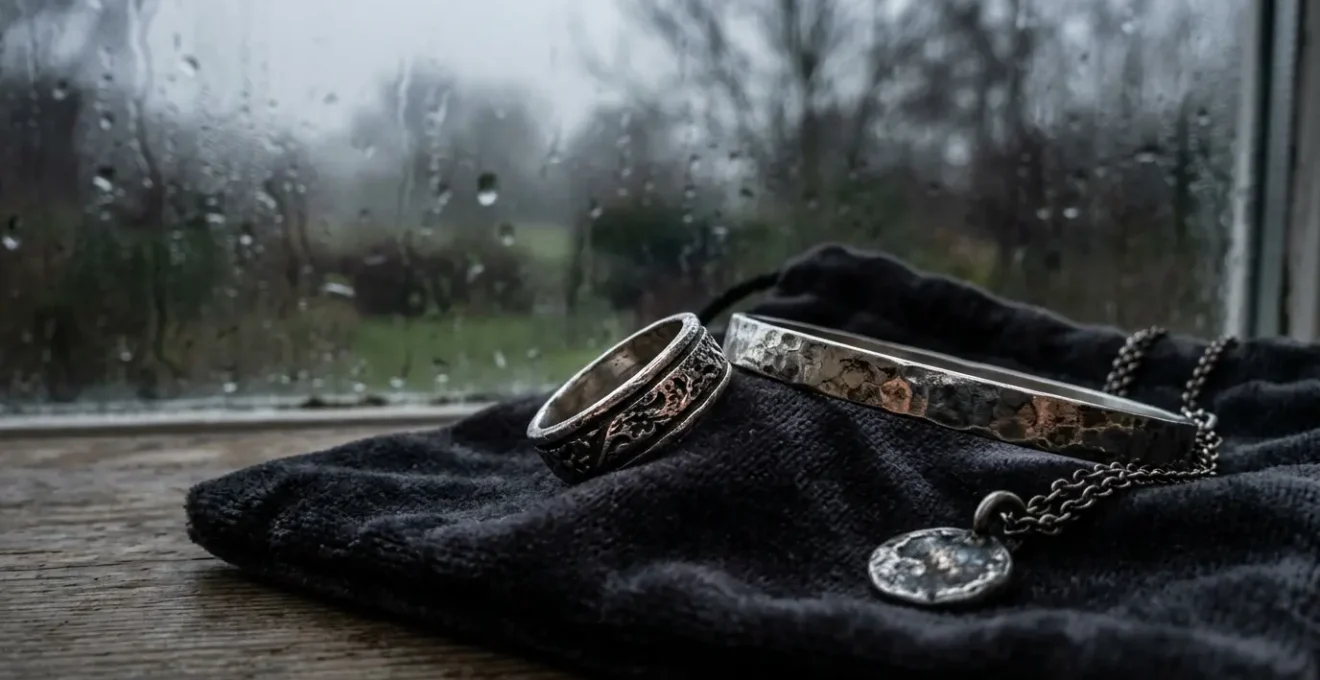
If you’ve noticed your sterling silver jewellery turning black with alarming speed during a British winter, you’re not just imagining it. The problem isn’t merely the damp air; it’s a perfect storm of atmospheric chemistry unique to this season. The combination of indoor central heating, reduced ventilation, and increased exposure to household chemicals creates a concentrated environment of sulphur compounds that aggressively attacks the copper in your silver, accelerating the formation of black tarnish. Understanding these specific winter catalysts is the key to effectively preventing it.
It’s a familiar frustration for any jewellery owner in the United Kingdom. As the days shorten and the heating clicks on, sterling silver pieces that remained bright all summer suddenly develop a stubborn, dark patina. You might find yourself polishing a favourite necklace one week, only to see it dulled and blackened the next. The common wisdom points a finger at the UK’s notoriously damp climate, and while humidity is a factor, it is far from the whole story. Many people resort to constant polishing or simply stop wearing their silver until spring, believing this accelerated tarnishing is an unavoidable seasonal curse.
The conventional advice—regularly use a polishing cloth, store items in airtight bags—only treats the symptom, not the cause. But what if the true culprits are lurking inside your warm, cosy home? The key to managing winter tarnish lies not in more vigorous cleaning, but in understanding the specific atmospheric and domestic chemistry at play. This isn’t just about air; it’s about a concentration of specific chemical triggers that flourish in our winter environments. From the fumes released by heating systems to the very materials we use for storage, a series of invisible chemical interactions is taking place on the surface of your jewellery.
This article will move beyond the simple explanation of “humidity” and delve into the precise metallurgical reasons for accelerated winter tarnish. We will dissect the composition of sterling silver to pinpoint its inherent vulnerability. We will then explore the specific household and environmental “sulphur vectors” that become more potent during a UK winter, explaining how to identify and neutralise them. By approaching this as a chemical management issue rather than a cleaning chore, you can develop a practical strategy to keep your silver bright all year round.
To navigate this complex topic, we will break down the science and solutions into manageable parts. This guide explores the fundamental chemistry of sterling silver, provides precise cleaning instructions, analyses the costs and benefits of protective coatings, and identifies the surprising everyday items that are sabotaging your storage efforts.
Summary: A Metallurgist’s Guide to Winter Silver Tarnish
- What is the Other 7.5% in Sterling Silver and Why Does It React?
- How Long Should You Leave Silver in a Dip Cleaner to Avoid Damage?
- Rhodium Plated Silver: Is It Worth the Extra Cost to Stop Tarnish?
- The Error of Storing Silver with Rubber Bands That Causes Black Marks
- Why Does Silver Turn Black on Your Skin but Not on Your Friend’s?
- The Damage Chlorine Pools Cause to the Alloys in 18k Gold Rings
- The Error of Typing on a Laptop While Wearing a Chunky Metal Cuff
- How to Identify Truly Ethical Jewellery Beyond the “Recycled” Label?
What is the Other 7.5% in Sterling Silver and Why Does It React?
To understand why sterling silver tarnishes, we must first look at its fundamental composition. The term “sterling silver” or “925 silver” is a legal standard that defines its purity. By definition, it is an alloy made of 92.5% pure silver and 7.5% other metals. Pure silver (99.9% fine silver) is beautiful but extremely soft and malleable, making it unsuitable for most functional jewellery as it would easily bend and scratch. To provide necessary hardness and durability, this 7.5% of other metals—most commonly copper—is added.
This addition of copper is the source of both strength and susceptibility. Tarnish is not a reaction with the silver itself, but primarily with the copper alloy. Airborne sulphur compounds, particularly hydrogen sulphide (H₂S), react with the copper to form copper sulphide, which is black. In the humid, often poorly ventilated environment of a UK winter home, this reaction accelerates dramatically. The moisture in the air acts as a catalyst, facilitating the chemical exchange between the sulphur and the copper alloy.
Recognising this inherent vulnerability has led metallurgists to develop alternative alloys designed to resist tarnish. While traditional sterling is the standard, understanding the options can inform purchasing decisions for pieces intended for daily wear in a challenging climate.
- Traditional Sterling Silver (925): Contains 92.5% pure silver and 7.5% copper. This provides excellent hardness but has the highest susceptibility to tarnishing.
- Argentium Silver: Replaces some of the copper with the metalloid germanium. Germanium forms a transparent, self-healing oxide layer that acts as a barrier, significantly inhibiting tarnish.
- 950 Silver: A higher purity alloy with 95% silver. While it offers a brighter, whiter base for coatings like rhodium, its higher copper ratio (relative to other potential alloys) can sometimes mean it tarnishes even faster than 925 if left uncoated.
- Rhodium-Plated Sterling: This involves coating a standard sterling silver piece with a thin layer of rhodium, a hard, inert metal from the platinum family, which we will discuss in more detail later.
How Long Should You Leave Silver in a Dip Cleaner to Avoid Damage?
When faced with heavy winter tarnish, it’s tempting to turn to a chemical dip cleaner for a quick fix. These solutions are highly effective because they use an acid (often thiourea-based) to rapidly dissolve the silver sulphide (tarnish) from the surface. However, this effectiveness comes with a significant risk: the same chemical that removes tarnish can also etch and damage the silver itself if left for too long. Over-dipping can lead to a dull, pitted surface that is more prone to future tarnishing and can only be repaired by professional repolishing.
The key to using a dip cleaner safely is to be ruthlessly disciplined with timing. The rule is to dip for the absolute minimum time necessary to remove the tarnish, which is often a matter of seconds, not minutes. It is always better to under-dip, rinse, and repeat than to over-dip once. Before cleaning, it’s helpful to assess the level of tarnish to determine a safe starting point.
detail > educational value.”/>
The visual appearance of the tarnish is your best guide for timing. A light yellowing requires only a brief moment in the solution, whereas deep black patina needs a more controlled approach. The following table provides a safe guideline for using commercial dip cleaners, but always read and follow the specific manufacturer’s instructions, as formulations can vary.
| Tarnish Level | Visual Appearance | Maximum Dip Time | Follow-up Action |
|---|---|---|---|
| Light | Slight yellowing | 5 seconds | Rinse and polish |
| Moderate | Brown/purple hues | 10 seconds | Rinse and buff |
| Heavy | Deep black | 10 seconds + repeat | Gentle buffing required |
After any chemical dip, immediate and thorough rinsing under running water is non-negotiable. This neutralises the chemical reaction and removes any residual acid. Following the rinse, gently pat the piece dry with a soft, lint-free cloth. Never use a dip cleaner on jewellery with pearls, opals, turquoise, or other porous stones, as the chemicals will cause irreparable damage. For such pieces, a manual polishing cloth is the only safe option.
Rhodium Plated Silver: Is It Worth the Extra Cost to Stop Tarnish?
One of the most effective ways to combat tarnish is to prevent the silver from ever coming into contact with airborne sulphur. This is the principle behind rhodium plating. Rhodium is a noble metal from the platinum group that is exceptionally hard, reflective, and, most importantly, chemically inert. When a thin layer of rhodium is electroplated onto a piece of sterling silver, it creates a protective shield that is immune to the reactions that cause tarnish.
The result is a piece of jewellery that maintains a bright, white, mirror-like finish, closely resembling platinum, without the need for regular polishing. However, this protection is not permanent. The plating is a microscopic layer that will inevitably wear away with friction. The lifespan of the plating depends entirely on the type of jewellery and how it is worn. For instance, rhodium plating typically lasts from 6-12 months on a daily-wear ring that is subject to constant contact, but can last for 18 months or more on a pendant or earrings.
The question of whether it is “worth it” becomes a long-term cost-benefit analysis. The initial purchase price of a rhodium-plated item is higher, and the plating must be periodically reapplied by a jeweller, which incurs a recurring cost. For a British homeowner frustrated by constant winter polishing, this may be a price worth paying for convenience and a consistently pristine appearance. The following analysis compares the estimated five-year cost of maintaining a plated versus unplated ring and pendant in the UK.
| Item Type | Rhodium Plating Costs (5 years) | Sterling Silver Maintenance | Cost Difference |
|---|---|---|---|
| Ring (daily wear) | Initial: £20-50 extra Re-plating: £60 × 4 = £240 Total: £260-290 |
Polishing cloth: £15 Cleaning products: £25 Total: £40 |
+£220-250 |
| Pendant (occasional) | Initial: £20-50 extra Re-plating: £60 × 1 = £60 Total: £80-110 |
Same: £40 | +£40-70 |
As the data shows, for a high-friction item like a daily-wear ring, the long-term cost of rhodium plating is substantial. It becomes a luxury service. For an occasional-wear item like a pendant, however, the cost is far more manageable and could be seen as a worthwhile investment to eliminate the hassle of cleaning. Ultimately, the value is subjective and depends on the wearer’s budget and tolerance for maintenance.
The Error of Storing Silver with Rubber Bands That Causes Black Marks
Perhaps the most insidious source of severe tarnish comes from improper storage. Many people, in an attempt to keep jewellery organised, will bundle pieces with a common household item: the rubber band. This is a catastrophic error. Rubber bands are a concentrated source of sulphur, which is used in the vulcanisation process to make the rubber stable and durable. When a rubber band is in direct contact with or even stored in the same enclosed space as silver, it continuously off-gasses sulphur compounds, leading to aggressive, deep black tarnish that is very difficult to remove.
This is not a slow, gentle process; it is a direct chemical assault. The black marks often appear as distinct stripes or patches where the band made contact. This highlights a critical principle of silver care: creating a chemically inert micro-environment for storage is just as important as protecting it from air. The advice to store silver in an airtight bag or box is only effective if you don’t introduce a sulphur source inside it. As the experts at Gabriel & Co. note, the list of culprits extends beyond the obvious.
Rubber bands, exhaust, leather, and cellophane can all speed up the process of tarnishing
– Gabriel & Co. Jewelry Experts, Reasons Why Your Silver Jewelry is Tarnishing
The problem is that many everyday materials contain sulphur. Building a “blacklist” of items to keep away from your silver is a crucial preventative step. The enclosed, warm environment of a home during a UK winter can accelerate the rate at which these materials release their sulphur compounds, making careful storage even more critical.
- Rubber bands and latex gloves: Contain high levels of sulphur from the vulcanisation process.
- Wool fabrics: The natural proteins in wool contain sulphur-based amino acids.
- Leather goods: Many leathers are tanned using sulphur compounds.
- Printed paper and newspaper: Certain inks use sulphur-based dyes.
- Food items: Foods like eggs, onions, garlic, and mustard are rich in sulphur. Always remove jewellery during food preparation.
- Safe Alternatives: For storage, use archival-quality anti-tarnish bags, or add a piece of chalk or a silica gel packet to a sealed container to absorb moisture and sulphur.
Why Does Silver Turn Black on Your Skin but Not on Your Friend’s?
One of the most perplexing aspects of silver tarnish is its variability from person to person. You may wear a silver ring that stays bright, while your friend wears the identical ring and it turns their skin—and the ring itself—black within hours. This phenomenon is not a sign of poor quality silver; it is a direct result of individual body chemistry. The surface of our skin is not a neutral environment. Perspiration contains salts and amino acids, and the specific pH and chemical makeup of your sweat can dramatically accelerate the tarnishing process.
If a person’s sweat is particularly acidic or contains higher concentrations of sulphur compounds (which can be influenced by diet and certain medications), it will react with the copper alloy in the sterling silver much more aggressively. This creates a rapid formation of copper sulphide right on the skin, causing the characteristic black or green marking. The same effect can be caused by topical products. Lotions, perfumes, and soaps can leave a chemical residue on the skin that acts as a potent accelerant for tarnish.
comparison clarity > natural realism.”/>
Because these triggers are so personal, identifying the specific cause requires a systematic process of elimination. If you are someone whose chemistry reacts strongly with silver, you can become your own detective to pinpoint the trigger. This allows you to make small lifestyle adjustments that can have a big impact on how your jewellery wears. The following checklist provides a simple, month-long diagnostic test to help you isolate the cause.
Your Action Plan: Personal Tarnish Trigger Diagnostic Test
- Assess points of contact: Wear a silver ring on a different finger for one week to test if the reaction is location-specific (e.g., related to a product used on one hand).
- Inventory your products: For one week, stop using any hand lotions, perfumes, or soaps near your jewellery and observe any changes in the tarnish rate.
- Analyse for coherence: Does the tarnishing lessen? If so, reintroduce products one by one each day to identify the specific culprit.
- Check external factors: For one week, keep a simple log of sulphur-rich foods you eat (like eggs, garlic, onions) and note any correlation with increased tarnishing.
- Create your integration plan: Once you identify a trigger—be it a lotion, a food, or natural perspiration—you can create a plan to mitigate it, such as removing rings before applying products or adjusting your diet.
The Damage Chlorine Pools Cause to the Alloys in 18k Gold Rings
While this article focuses on silver, the title’s mention of 18k gold highlights a universal principle: harsh chemicals are the enemy of all precious metal alloys. In the case of an 18k gold ring, chlorine from a swimming pool can attack the alloy metals (like copper and nickel) that are mixed with the pure gold, leading to brittleness and stress corrosion cracking over time. This principle of chemical attack is even more visible and immediate with sterling silver, and the culprits extend far beyond the swimming pool, especially during a UK winter.
We spend more time indoors, and a study on cleaning habits has shown that increased indoor cleaning during winter means a higher concentration of airborne chemicals in our homes. The most significant threat is chlorine bleach, a common ingredient in many household cleaning products. Even the vapour from cleaning a bathroom can be enough to cause rapid and severe corrosion on silver. Unlike sulphur tarnish, which is a surface-level sulphide, chlorine damage often involves the formation of silver chloride, a compound that can pit and permanently damage the metal’s structure.
Understanding the hierarchy of chemical threats in a typical home is essential for protecting your jewellery. While we might be mindful of taking rings off for a swim, we are often less cautious about exposure to everyday cleaning agents. The following table ranks common household chemicals by the level of risk they pose to sterling silver, with a focus on exposure risks that are elevated during winter months.
| Hazard Level | Chemical/Substance | Damage Type | Exposure Risk in UK Winter |
|---|---|---|---|
| Extreme | Chlorine bleach | Corrodes silver & copper alloy | High (winter cleaning) |
| High | Pool/hot tub chlorine | Forms silver chloride | Moderate (indoor pools) |
| Medium | Sulphur compounds | Creates black tarnish | High (indoor heating) |
| Low | Vinegar/lemon juice | Surface etching only | Low (occasional) |
The clear takeaway is that the single most damaging substance your silver is likely to encounter is not from a hobby but from a household chore. The best practice is to remove all jewellery—gold or silver—before using any cleaning products containing bleach. This simple habit prevents irreversible damage and is a cornerstone of responsible jewellery care.
The Error of Typing on a Laptop While Wearing a Chunky Metal Cuff
Beyond chemical reactions, the physical environment of modern life presents its own set of challenges to jewellery, particularly bracelets and rings. The act of typing on a metal-cased laptop while wearing a chunky cuff or a stack of silver bangles creates thousands of micro-impacts between the jewellery and the laptop’s surface. This constant, repetitive contact does more than just cause surface scratches; it can lead to a phenomenon called work hardening. As the metal is repeatedly struck, its crystalline structure becomes compressed and brittle, making it more prone to cracking.
This physical wear becomes a chemical issue when dealing with plated jewellery. For a rhodium-plated piece, which is designed to prevent tarnish, this constant friction is its Achilles’ heel. The hard, protective rhodium layer is worn away far more quickly at points of high contact, exposing the reactive sterling silver underneath. What was a tarnish-proof piece can develop perplexing patches of tarnish that correspond directly to where it rests on a desk or laptop.
Case Study: Accelerated Wear on Bracelets from Desk Work
An analysis of plating longevity found that rhodium-plated bracelets worn daily by office workers required re-plating every 6-12 months. In contrast, necklaces worn by the same individuals retained their plating for over 18 months. The study concluded that the repetitive micro-impacts and friction from typing and resting wrists on a desk were the primary factors in accelerating the wear of the protective layer. This transforms rhodium plating from a long-term protective solution into a short-term aesthetic fix that requires frequent and costly maintenance.
The modern world is filled with materials that are harder than precious metals and can cause significant wear. Awareness of these everyday hazards is key to preserving both the structure and the finish of your silver jewellery. The habit of removing certain pieces before specific tasks can dramatically extend their life.
- Laptops and Smartphones: Metal laptop cases and sapphire glass camera lenses are abrasive and will scratch and wear down silver and plated coatings.
- Ceramic Mugs and Countertops: Hard, abrasive surfaces like ceramic and granite can instantly cause deep scratches or strip plating.
- Gym Equipment: Textured metal and rubber grips on weights and machines act like sandpaper on rings and bracelets.
The solution is simple but requires mindfulness: remove chunky or precious jewellery before typing for extended periods, working out, or performing household tasks like cooking or cleaning. Treat your jewellery as the last thing you put on and the first thing you take off.
Key Takeaways
- The primary cause of tarnish is the reaction of airborne sulphur with the 7.5% copper alloy in sterling silver, not the silver itself.
- UK winters create a “perfect storm” for tarnish: indoor heating, reduced ventilation, and damp air concentrate sulphur compounds and accelerate the chemical reaction.
- Improper storage with items like rubber bands or leather introduces high concentrations of sulphur, causing aggressive tarnishing that is far worse than ambient air.
How to Identify Truly Ethical Jewellery Beyond the “Recycled” Label?
After understanding the science of caring for silver, the final step in responsible ownership is making an informed choice at the point of purchase. In recent years, “recycled silver” has become a popular marketing term used to denote an ethical choice. However, in the context of precious metals, this label can be misleading. Silver has been efficiently recycled for centuries due to its high value, making it one of the most circular materials in existence. The “recycled” claim is often simply describing the industry standard, not a special ethical effort.
Sterling silver is already one of the most recycled materials in jewelry. The ‘recycled’ label is often the industry standard, not a special ethical feature
– Luke Zion Jewelry, Sterling Silver Industry Standards
True ethical sourcing goes much deeper than the metal itself. It involves ensuring fair labour practices, transparent supply chains, and responsible environmental management from mine to workshop. A truly ethical piece of jewellery is one where the well-being of the people and the planet has been considered at every step, not just in the final melting and casting of the metal. For a consumer, this means looking beyond simple marketing claims and seeking out tangible certifications and verifiable information.
When you are ready to invest in a new piece, asking the right questions and looking for the right credentials can help you support brands that are genuinely committed to ethical practices. The following checklist provides a guide to what constitutes a superior standard of ethical sourcing, moving far beyond the baseline “recycled” tag.
- Look for Fairmined or Fairtrade Silver certification: These are independent, third-party standards that guarantee miners receive fair wages and work in safer conditions.
- Check for Responsible Jewellery Council (RJC) certification: This ensures the business adheres to strict standards for business ethics, human rights, and environmental performance throughout their supply chain.
- Verify gemstone sourcing: If the piece includes stones, ask for verification through programs like the Kimberley Process for diamonds or other transparent sourcing documents.
- Ask about packaging and production: Is the packaging made from recycled/biodegradable materials? Is production done locally by artisans who can verify their entire process?
- Request supply chain transparency: A truly ethical brand should be able to provide documentation or clear information about their entire supply chain, not just the metal’s origin.
Armed with a deeper chemical and ethical understanding, you are now equipped to not only protect the jewellery you own but also to make more conscious and informed decisions for your future collection. Applying these principles transforms jewellery care from a reactive chore into a proactive and rewarding practice.