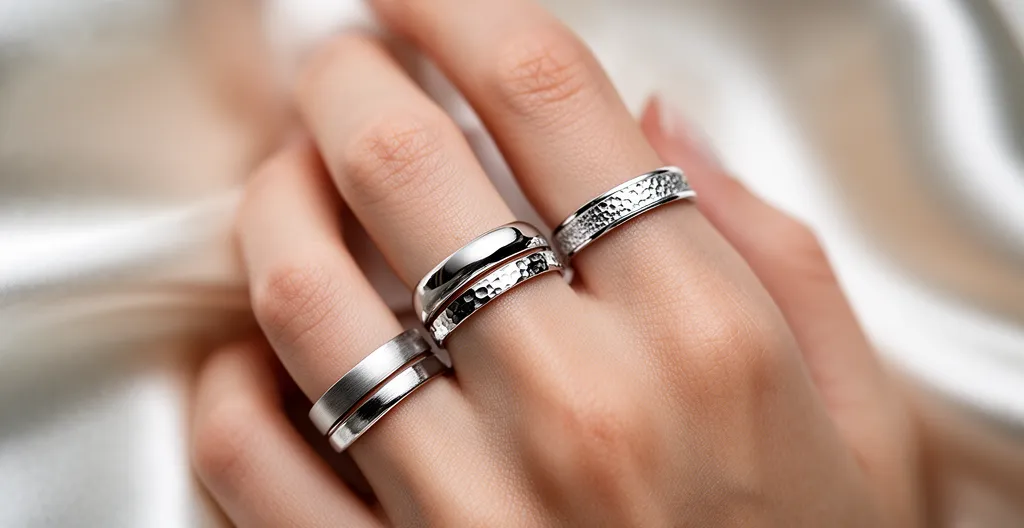
For those with sensitive skin, platinum isn’t just a luxury choice; it’s a scientific solution rooted in its unique metallurgical properties that gold alloys cannot replicate.
- Its 95% purity and chemical inertness make it the safest metal, virtually eliminating the risk of nickel-related allergic reactions.
- Platinum’s superior density means it doesn’t lose material when scratched and provides unmatched security for gemstones in delicate settings.
Recommendation: When choosing a lifelong piece like a wedding ring, prioritize 950 platinum to ensure comfort, durability, and peace of mind against skin sensitivity.
For anyone who has experienced the frustrating itch and redness of a nickel allergy, choosing jewelry is a process fraught with anxiety. The search for a wedding ring—a piece meant to be worn daily, forever—amplifies this concern. Many are drawn to white gold as an alternative, only to discover its bright finish is often a temporary layer of rhodium plating over a nickel-containing alloy. Once that plating wears away, the problem returns.
This cycle of irritation and re-plating leads many to wonder if there is a permanent, worry-free solution. The answer lies not in surface treatments, but in the fundamental nature of the metal itself. While many articles simply label platinum as “hypoallergenic,” they rarely explain the science that makes it the definitive choice for sensitive skin. The key is to look beyond the marketing and understand the metal from a metallurgist’s perspective.
The superiority of platinum is based on a trio of core properties: its exceptional purity, its remarkable density, and its unique reaction to wear, known as work-hardening. Unlike gold, which must be alloyed with other metals that can cause reactions, platinum’s inherent strength allows it to be used in an almost pure state. This article will deconstruct these properties, explaining the science behind why platinum is not just a better choice, but the most logical and secure investment for anyone with sensitive skin.
To help you make an informed decision, this guide breaks down the essential factors, from understanding its unique aging process to calculating its long-term value. Explore the sections below to gain a complete understanding of this exceptional metal.
Summary: A Metallurgist’s Analysis of Platinum for Jewelry
- Why Does Your Platinum Ring Develop a Matte Patina Over Time?
- How to Calculate if the £400 Premium for Platinum is Worth It for You?
- What is the Difference Between 950 and 600 Platinum Hallmarks?
- The Risk of Resizing Platinum Rings with Laser Welding Techniques
- How to Restore the High Polish on Platinum at Home Between Professional Cleans?
- Grade 23 Titanium or 18k Gold: Which is Better for Reacting Ears?
- Why Must You Use Platinum for Ultra-Thin 1.5mm Diamond Bands?
- How to Choose a Minimalist Setting That Won’t Drop the Diamond?
Why Does Your Platinum Ring Develop a Matte Patina Over Time?
One of the most misunderstood characteristics of platinum is its aging process. While gold jewelry loses microscopic bits of metal with every scratch, eventually thinning over decades, platinum behaves in a fundamentally different way. When a platinum surface is scratched, the metal is merely displaced, moving from one area to another on the surface, much like shaping a piece of clay. There is no loss of volume or weight. This displacement creates a distinctive, soft, matte finish known as a patina.
This isn’t a sign of weakness; it’s a process called work-hardening. According to an analysis by Platinum Jewelry, each scratch causes the surface atoms to condense, which actually makes the metal in that area stronger and more durable. As Platinum Guild International notes, this unique property means that a platinum ring becomes a living record of its journey with you, with its patina adding character while its structural integrity remains intact.
For the wearer, this means two things. First, the ring’s security is never compromised by wear; prongs holding a diamond, for instance, don’t thin out and weaken. Second, this patina is a matter of aesthetic preference. While many cherish the soft glow it develops, the original high polish can always be restored by a professional jeweler, returning it to a like-new state without any material loss.
How to Calculate if the £400 Premium for Platinum is Worth It for You?
The higher upfront cost of platinum, often cited as a £400 or more premium over a similar 18k white gold ring, can be a point of hesitation. However, viewing this as a simple price tag is misleading. A more accurate assessment requires calculating the Total Cost of Ownership (TCO) over the lifetime of the ring, especially for someone with sensitive skin.
White gold owes its silvery-white appearance to rhodium plating. This ultra-thin layer is what provides the initial hypoallergenic barrier. However, it wears off with daily use, typically requiring re-plating every 12 to 24 months. At a cost of £50-£80 per service, this maintenance fee accumulates significantly. Over a decade, you could spend an additional £250 to £800 just to maintain the ring’s appearance and hypoallergenic properties. This recurring cost can quickly erode, and even surpass, the initial savings of choosing white gold.
Furthermore, this calculation doesn’t account for the intangible values. For someone with a nickel allergy, the peace of mind that comes from zero risk of an allergic reaction is priceless. There’s no need to monitor for plating wear or schedule maintenance appointments. Platinum’s natural white color is permanent and will never fade or change. Finally, because platinum does not lose material over time, it retains its asset value more effectively than gold, which gradually wears away.
What is the Difference Between 950 and 600 Platinum Hallmarks?
For individuals with sensitive skin, understanding platinum hallmarks is non-negotiable. The number stamped on the jewelry, such as 950 or 600, indicates the purity of the platinum. This directly correlates to its hypoallergenic quality. The “gold standard” for jewelry, and the only grade recommended for those with severe sensitivities, is 950 platinum. This signifies that the item is 95% pure platinum, with the remaining 5% composed of other platinum-group metals like ruthenium, iridium, or cobalt. These alloys are also inert and do not cause allergic reactions.
In contrast, 600 platinum contains only 60% pure platinum. The other 40% is a mix of other metals, which can include potential irritants like copper or other non-platinum group alloys. While it is harder and more budget-friendly, its lower purity introduces a risk of skin reaction and it often has a slightly grayer tone compared to the bright white of 950 platinum. For a wedding ring intended for constant wear against the skin, the risk is not worth the savings.
The following table, based on an in-depth alloy comparison, clarifies the critical distinctions:
| Property | 950 Platinum | 600 Platinum |
|---|---|---|
| Purity | 95% pure platinum | 60% pure platinum |
| Common Alloys | Ruthenium, Iridium, Cobalt (5%) | Palladium, Copper (40%) |
| Hypoallergenic Rating | Excellent – Gold standard | Good – Potential irritants possible |
| Hardness | 120-220 HV (varies by alloy) | Higher hardness, more brittle |
| Color | Natural bright white | Slightly grayer tone |
| Best For | Sensitive skin, daily wear | Budget-conscious buyers |
Ultimately, when purchasing a platinum ring for its hypoallergenic properties, always look for the “950” or “PLAT” hallmark. This stamp is your guarantee of purity and safety.
The Risk of Resizing Platinum Rings with Laser Welding Techniques
A ring you wear for life will likely need resizing at some point. For platinum, this process is more demanding than for gold and requires a jeweler with specialized skills and equipment. The primary challenge is the metal’s incredibly high melting point. A fact sheet from Garfield Refining highlights the challenge posed by platinum’s 3,215°F (1,768°C) melting point, which is significantly higher than gold’s. This extreme heat can easily damage gemstones and requires precise tools like a laser welder.
However, even with a laser welder, improper technique can introduce major problems. If the weld is not shielded with argon gas, it can become porous and brittle, creating a weak point in the ring. Another common error is using white gold solder to join the platinum ends—a shortcut that creates a discolored, weaker seam that will eventually cause a structural failure. A master jeweler must use 950 platinum wire that perfectly matches the ring’s alloy to create a seamless, strong, and color-matched join.
Entrusting your valuable ring to an inexperienced jeweler carries a significant risk of irreparable damage. Before committing to a resizing, it’s crucial to vet the jeweler’s expertise with platinum specifically.
Your Action Plan: Pre-Resizing Safety Checklist for a Platinum Ring
- Ask the Jeweler: “Do you use a laser welder with argon gas shielding to prevent porosity in the weld?”
- Verify the Material: “Will you be using matching 950 platinum wire for the join, not white gold solder?”
- Confirm Stone Protection: “How will you protect my gemstones from the extreme heat required for platinum work?”
- Check Experience: “Can you describe your experience working with platinum’s unique displacement properties compared to gold?”
- Request Proof: “Could you show me examples of previous platinum resizing work you have completed?”
Asking these specific questions will help you gauge their proficiency and ensure your ring is handled with the care it demands.
How to Restore the High Polish on Platinum at Home Between Professional Cleans?
While the developing patina is a cherished feature for many, you may prefer to maintain the bright, high-polish finish of your platinum ring. Although a professional buffing is the only way to achieve a perfect mirror shine, a simple and consistent at-home cleaning routine can keep your ring looking brilliant between professional services. The key is gentle but regular maintenance to remove the daily buildup of oils, lotions, and dirt that can dull the surface.
Unlike plated jewelry, you don’t need to worry about wearing away a surface layer. You can clean platinum with confidence. However, it’s important to use soft materials to avoid creating excessive micro-scratches that accelerate the formation of a matte patina. A tiered approach to cleaning ensures your ring receives the right level of care at the right time.
For a complete at-home care regimen, follow these steps:
- Daily Luster: After each day of wear, simply wipe the ring with a soft, non-abrasive microfiber cloth. This removes fingerprints and surface oils, maintaining its daily sparkle.
- Weekly Deep Clean: Once a week, soak your ring in a bowl of warm water with a few drops of chemical-free, mild dish soap for about 15 minutes. Then, gently scrub it with a very soft-bristled brush (a baby toothbrush is ideal) to clean behind the setting and in any crevices. Rinse thoroughly and pat dry.
- Monthly Shine Boost: For an extra boost of shine, you can sparingly use a polishing cream specifically approved for platinum. Apply a small amount to a cloth and gently rub the ring, then wipe clean with a fresh cloth.
- Quarterly Check: Every few months, carefully inspect the prongs and settings to ensure they haven’t shifted. While platinum is secure, it’s a good habit to practice.
This routine, combined with an annual professional ultrasonic cleaning and polishing, will keep your platinum ring in pristine condition for a lifetime.
Grade 23 Titanium or 18k Gold: Which is Better for Reacting Ears?
When it comes to new piercings or extremely sensitive ears, the debate often extends beyond platinum to other metals like titanium and gold. While 18k gold is 75% pure gold, the other 25% is an alloy that can contain nickel, making it a potential trigger for reactions. “Nickel-free” 18k gold alloys exist but can be hard to verify. For this reason, for initial or easily irritated piercings, medical-grade titanium is often the superior choice.
Grade 23 titanium (Ti-6Al-4V ELI) is an implant-grade metal that meets ASTM F136 standards, meaning it’s certified for biocompatibility to be used inside the human body. It is completely nickel-free, extremely lightweight, and has an allergy risk of less than 1%. Its only downside is aesthetic; its natural color is a darker gray, though it can be anodized to various colors. It is the safest option for healing piercings.
For healed piercings, the choice becomes more about preference, but the risk with gold remains tied to its alloy. The following table, based on information from jewelry experts at a Blue Nile hypoallergenic metals guide, provides a clear comparison:
| Factor | Grade 23 Titanium | 18k Gold |
|---|---|---|
| Biocompatibility | ASTM F136 implant-grade | Good if nickel-free alloy |
| Weight | Extremely lightweight | Heavier, noticeable |
| Color Options | Gray, can be anodized | Yellow, white, rose |
| Best For | New/healing piercings | Healed piercings, luxury preference |
| Allergy Risk | Less than 1% | Depends on alloy (avoid nickel) |
| Price Point | Moderate | Premium |
In summary, for new or problematic piercings, Grade 23 titanium is the safest bet. For healed piercings where a luxury look is desired, 950 platinum remains the most reliable precious metal, followed by verified nickel-free 18k gold.
Why Must You Use Platinum for Ultra-Thin 1.5mm Diamond Bands?
The trend towards delicate, ultra-thin pavé diamond bands presents a significant engineering challenge. A band that is only 1.5mm wide has very little material to provide structural support and secure dozens of tiny diamonds. In this context, the metal choice is not an aesthetic preference; it is a structural necessity. Platinum is the only precious metal with the properties required to make such a design viable for long-term wear.
The reason lies in its superior density and hardness. Platinum is about 60% denser than gold. This means a 1.5mm platinum band contains significantly more metal mass than a 1.5mm gold band. This inherent density makes it far more resistant to warping, bending, or breaking from the pressures of daily life. As experts in jewelry engineering state, this added structural integrity is crucial in minimalist designs.
This strength is most critical at the micro-prong level. A compelling Stuller analysis of micro-prong security reveals that platinum prongs, after being work-hardened during the setting process, achieve a hardness of 360 HV. In contrast, 18k gold prongs only reach 180-200 HV. This doubled hardness gives platinum prongs superior “memory,” allowing them to hold diamonds securely without shifting. The study found that over a 10-year wear period, comparable platinum pavé bands showed zero stone loss, while the gold bands had a 12% stone loss rate. For a delicate design, platinum isn’t just better—it’s essential for durability and stone security.
Key Takeaways
- Purity is paramount: Only 950 platinum guarantees a virtually zero-risk hypoallergenic experience for daily wear.
- Durability is a feature, not a flaw: Platinum’s patina is a sign of work-hardening, where the metal gets stronger without losing material, unlike gold.
- Cost is a long-term equation: The initial premium for platinum is often offset by avoiding the recurring costs of rhodium re-plating required for white gold.
How to Choose a Minimalist Setting That Won’t Drop the Diamond?
Beyond the band, the setting that holds your main diamond is the most critical component for security. In minimalist designs, where the goal is to use as little metal as possible to maximize the diamond’s visibility, the choice of setting style and metal becomes even more important. Some settings are inherently more secure than others due to the physics of how they protect the stone.
The most secure setting is the full bezel, where a complete collar of metal wraps around the diamond’s girdle. This provides 360-degree protection against impact and makes it virtually impossible for the stone to fall out. A half-bezel offers a good compromise, providing strong vertical security while leaving two sides of the diamond open. Prong settings offer less protection, with their security depending on the number and thickness of the prongs. A six-prong setting is more secure than a four-prong setting because it distributes force more evenly and provides redundancy—if one prong is damaged, five remain to hold the stone. Tension settings, which hold the diamond only by pressure, are the riskiest for daily wear.
For any of these settings, but especially for delicate prong or bezel styles, 950 platinum is the superior metal choice. As Blue Nile experts emphasize, its density and strength allow for thinner, yet stronger, prongs and bezels compared to gold. This means you can achieve a truly minimalist look without compromising the security of your diamond. A thin platinum prong will hold a stone more securely than a thicker gold one, simply because the metal itself is tougher and more resistant to being bent or worn down.
Now that you understand the science behind the metal and the engineering behind the setting, you can choose your ring with the confidence that it is a beautiful, safe, and lasting investment. Evaluate your options not just on initial price, but on a lifetime of worry-free wear.