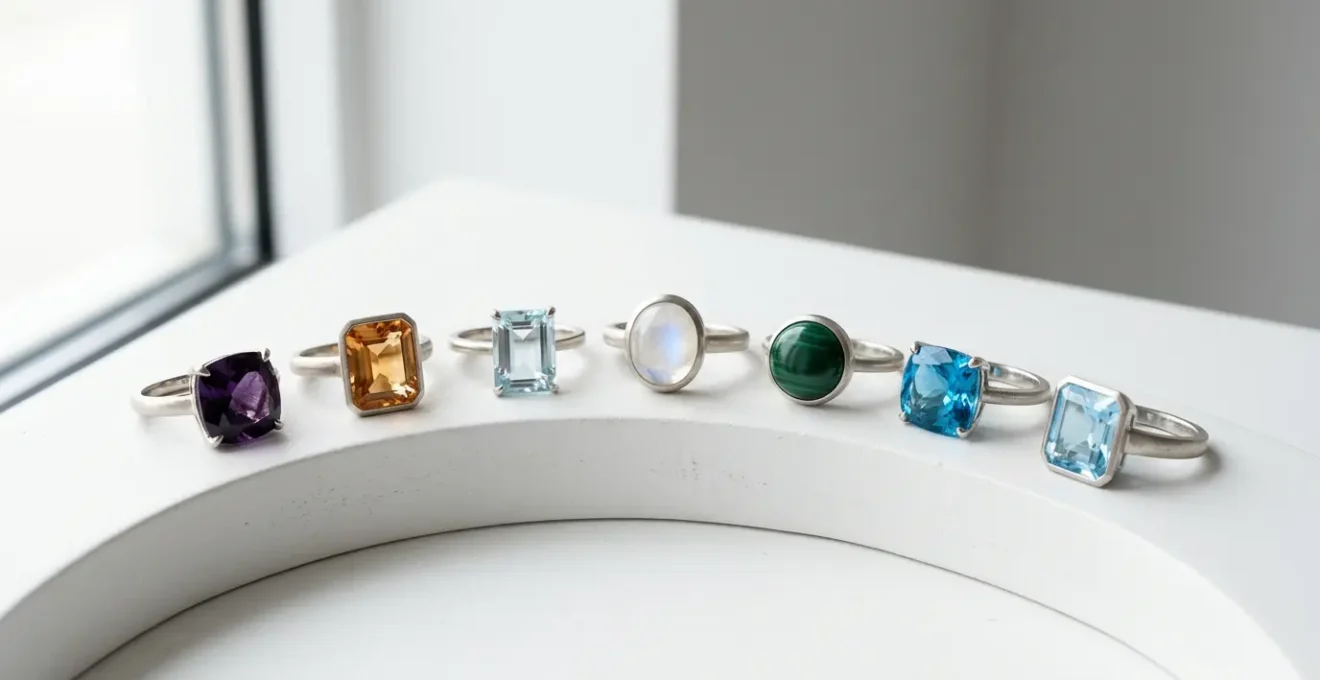
The Mohs hardness scale is a poor indicator of a gemstone’s suitability for daily wear; a stone’s toughness (resistance to chipping) and stability (resistance to light and heat) are far more critical.
- A “hard” stone like Topaz (8 on the Mohs scale) can be more fragile than a “softer” stone like Aquamarine (7.5-8) due to its internal cleavage planes.
- A stone’s color can be unstable, with gems like Amethyst fading in sunlight or changing color with heat exposure.
Recommendation: Evaluate a gemstone based on its toughness rating and stability first, then consider its hardness. For daily wear, prioritize stones with “Good” to “Excellent” toughness, like sapphires and aquamarines, over those with “Poor” toughness, like topaz and moonstone.
You’ve found it: a ring with a stunning, vibrant gemstone that perfectly captures your personality. Maybe it’s the deep purple of an amethyst or the sky blue of a topaz. But a nagging question holds you back: will it last? You want a ring for everyday life, not one that has to be hidden in a jewelry box. You’ve probably heard the common advice to “just check the Mohs scale” and make sure the stone is a “7 or higher.” This seems simple enough, but this well-meaning tip is one of the most misleading in jewelry.
This oversimplification is why so many people are disappointed when their “hard” gemstone ring chips, breaks, or even loses its color. The truth that gemologists and jewelers know is that scratch resistance—which is all the Mohs scale measures—is only one small part of a much larger picture. A stone’s real-world durability depends on a trio of properties: its hardness, yes, but more importantly, its toughness (resistance to breaking) and its stability (resistance to environmental damage).
But what if the key to finding a durable ring wasn’t about picking the highest number, but about understanding a stone’s hidden weaknesses? This guide will dismantle the myth of the Mohs scale. We will explore the crucial concepts of toughness and stability, using real-world examples of popular gemstones. By the end, you won’t just be choosing a stone based on a single number; you’ll be able to assess its true wearability like a professional.
This article will break down the real factors that determine a gem’s durability, exploring why some stones fail while others endure. Let’s delve into the science behind a truly resilient gemstone.
Contents: Beyond the Mohs Scale: A Guide to Gemstone Durability
- Why Did Your Amethyst Ring Turn Clear After a Summer Holiday?
- Natural Citrine or Burnt Amethyst: How to Spot the Fake?
- Aquamarine or Blue Topaz: Which Stone Is Worth the Investment?
- The Risk of Setting Moonstone in Exposed Prongs for a Ring
- How Does a Checkerboard Cut Hide Flaws in Large Quartz Stones?
- Why Wearing Malachite Every Day Ruins Its Surface Within 6 Months?
- What Does a ‘Hardness of 7’ Really Mean for Daily Wear?
- How to Use a 10x Loupe to Spot Fakes Like a Pro?
Why Did Your Amethyst Ring Turn Clear After a Summer Holiday?
One of the most common and heartbreaking stories involves amethyst, a beloved member of the quartz family. A person wears their vibrant purple ring on vacation, enjoying the sun, only to notice weeks later that its color seems washed out or has even turned clear in spots. This isn’t damage from a knock or a scratch; it’s a failure of the stone’s stability. Stability refers to a gemstone’s ability to resist environmental factors like light, heat, and chemicals.
Amethyst’s purple color is created by iron impurities and natural irradiation deep within the Earth. Unfortunately, this color can be unstable. Prolonged exposure to UV radiation—like direct, intense sunlight—can reverse this process, causing the color to fade. While it might take months or years of consistent sun exposure, a single summer of leaving it on the beach towel day after day can be enough to start the process. This isn’t limited to amethyst; other stones like rose quartz, kunzite, and certain types of tourmaline are also known to be “photosensitive.”
Heat is another critical factor. In fact, some gemstones’ stability is so sensitive that scientific research published in Nature demonstrates that amethyst begins significant color loss at a critical temperature of 420°C. While you’re unlikely to expose your ring to such extremes, it illustrates the inherent instability of its color. Interestingly, stability can vary based on a stone’s origin. An anecdotal case study mentions two amethyst clusters: one from Brazil that fades in sunlight and another from North Carolina that remains stable, showcasing that a gem’s provenance can be a clue to its durability.
Natural Citrine or Burnt Amethyst: How to Spot the Fake?
The issue of gemstone stability extends directly into the world of fakes and treatments, and nowhere is this more prevalent than with citrine. Natural citrine, a golden-yellow variety of quartz, is quite rare. The vast majority of “citrine” on the market is actually amethyst that has been heat-treated. By heating amethyst to high temperatures (often around 440°C or more), jewelers can transform its purple hue into a range of yellow, orange, or reddish-brown tones. While this “burnt amethyst” is still quartz, it is not natural citrine and should be priced accordingly.
So, how can you tell the difference? A few key indicators can be spotted, sometimes even without a loupe. Natural citrine typically has a more subtle, smoky yellow-brown color with gentle, uneven color distribution known as zoning. Heat-treated amethyst often displays a much more intense, uniform, and sometimes slightly reddish-orange tint. Another powerful tell is dichroism—the property of showing different colors or shades when viewed from different angles. Natural citrine is dichroic; heat-treated amethyst is not. If you rotate a stone and see its color shift, you’re likely looking at the real deal.
The image above illustrates the dichroism effect, where controlled light reveals different hues within the crystal as it’s rotated. This physical property is a dead giveaway for authenticity. For a more detailed breakdown, the following table summarizes the key differences to look for when trying to distinguish natural citrine from its heat-treated counterpart. An analysis of amethyst’s color changes under heat provides further context for these transformations.
| Characteristic | Natural Citrine | Heat-Treated Amethyst |
|---|---|---|
| Color Pattern | Subtle smoky yellow-brown with gentle color zoning | Intense reddish-orange tint with uniform color |
| Dichroism | Shows different shades from different angles | No dichroism present |
| Temperature Created | Natural formation | 440°C+ heat treatment |
| Inclusions | Natural mineral inclusions | Reddish-brown hematite inclusions possible |
Aquamarine or Blue Topaz: Which Stone Is Worth the Investment?
This is where the Mohs scale truly starts to deceive us. On paper, blue topaz looks like a winner for durability. It has a Mohs hardness of 8, putting it comfortably above quartz (7) and seemingly in the “very durable” category. Aquamarine, a member of the beryl family, hovers between 7.5 and 8. Based on hardness alone, they seem comparable, with topaz having a slight edge. Yet, any experienced jeweler will tell you that aquamarine is a far more reliable stone for a daily-wear ring. Why?
The answer is toughness and, more specifically, a property called cleavage. Toughness is a stone’s resistance to chipping, cracking, or breaking. Cleavage is an internal structural weakness, a tendency for a mineral to split cleanly along flat planes, much like wood splits along its grain. Topaz has “perfect basal cleavage,” meaning it has a natural fault line running parallel to its base. A single, sharp knock at the right angle can split the stone in two. Aquamarine, on the other hand, has “indistinct” cleavage, making it far more resistant to fracturing. It is a much tougher stone overall.
This isn’t just theory; it’s a core principle of gemology. In fact, gemological assessments confirm that despite its 8 on the Mohs scale, topaz has a ‘poor’ toughness rating because of this very issue. This makes it a risky choice for a ring that might be subjected to accidental bumps. As the GIA Gem Reference Guide, quoted by John Dyer Gems Educational Resources, points out:
Topaz and spinel have the same Mohs hardness of 8. However, the GIA Gem Reference Guide rates the toughness of spinel as good but that of topaz as poor because of its perfect cleavage.
– GIA Gem Reference Guide, John Dyer Gems Educational Resources
This is the ultimate lesson: a higher hardness number does not equal better durability. For a true investment in a piece you want to wear without worry, a tougher stone like aquamarine will almost always outperform a harder but more brittle stone like blue topaz.
The Risk of Setting Moonstone in Exposed Prongs for a Ring
Moonstone, with its ethereal adularescence (the floating blue or white sheen), is an incredibly popular choice for rings. However, it’s a perfect example of a stone that requires a deep understanding of its vulnerabilities to be worn successfully. On the Mohs scale, moonstone sits at 6 to 6.5, which is already on the softer side and vulnerable to scratches from everyday dust (which contains quartz, a 7). But its real weakness, much like topaz, lies in its cleavage.
Moonstone, a member of the feldspar group, has two distinct cleavage directions. This means it has two internal planes along which it can easily split. This structural flaw, combined with its relatively low hardness, makes it particularly susceptible to damage from impact. As gemological studies indicate, moonstone’s 6-6.5 Mohs hardness combined with its two-directional cleavage creates a high fracture risk in settings that leave it exposed.
This is why setting choice is paramount for fragile stones. An exposed prong setting, where thin metal claws hold the stone at its corners or edges, is one of the riskiest choices for moonstone. A knock from the side can easily hit the unprotected girdle of the stone directly on one of its cleavage planes, causing it to chip or even split. A much safer choice is a bezel or half-bezel setting, where a continuous band of metal wraps around the stone’s perimeter, acting like a protective bumper against impacts. This shields the stone’s most vulnerable areas.
The image above clearly contrasts a vulnerable prong setting with a secure bezel setting, highlighting how the right design can mitigate a stone’s inherent weaknesses. For a stone like moonstone, the setting isn’t just a style choice; it’s a functional necessity for its survival.
How Does a Checkerboard Cut Hide Flaws in Large Quartz Stones?
While durability often focuses on a gem’s physical properties, the way a stone is cut can play a significant role in its final appearance and perceived quality. The “checkerboard” cut is a perfect example of how lapidaries (gem cutters) use their craft to solve problems. This cut features a crown covered in square or diamond-shaped facets, resembling a chessboard. While it can be used on many gems, it is particularly effective on large quartz stones like amethyst, citrine, or smoky quartz.
Why is it so effective? First, it brilliantly enhances the stone’s luster and sparkle. Unlike a traditional brilliant cut designed for maximum fire, the checkerboard’s broad, flat facets act like a series of small mirrors. This creates a lively, rolling flash across the surface of the stone as it moves, which is especially beautiful on gems with high clarity and vibrant color. This play of light is excellent at drawing the eye and adding visual interest to stones that might otherwise look a bit “sleepy” or glassy.
More strategically, this busy pattern of reflections can help mask minor internal flaws. Large quartz crystals are often not perfectly “clean” and may contain small inclusions, faint color zoning, or other imperfections. The multiple, sharp reflections of a checkerboard cut break up the viewer’s line of sight into the stone. This makes it much harder to spot these minor internal characteristics, effectively improving the stone’s “eye-clean” appearance. It’s a clever way to maximize the beauty of a gem that might have been less desirable with a simpler cut that would leave its interior more exposed to scrutiny.
Why Wearing Malachite Every Day Ruins Its Surface Within 6 Months?
If topaz demonstrates the weakness of cleavage, malachite is the ultimate poster child for the importance of pure scratch resistance, or hardness. With its mesmerizing deep green bands and patterns, malachite is a visually stunning stone. However, it is an exceptionally poor choice for a ring meant for any kind of regular wear. The reason is simple: it is incredibly soft.
Malachite has a Mohs hardness of only 3.5 to 4. To put that in perspective, a copper penny is about a 3.5, and your fingernail is a 2.5. This low hardness makes it vulnerable to scratches from almost everything it might encounter in a normal day. We’ve already discussed that common household and airborne dust contains particles of quartz, which has a hardness of 7. As mineralogical data confirms, at 3.5-4 Mohs hardness, malachite is softer than common dust particles.
This means that simply by existing in a normal environment, a malachite ring will accumulate microscopic scratches that dull its polished surface. Wiping it with a cloth that has dust on it will scratch it. Brushing it against a painted wall, a metal zipper, or even a ceramic mug will leave a mark. Within a few months of daily wear, the high-gloss polish will be gone, replaced by a hazy, scuffed finish. While this can be re-polished by a jeweler, it’s a losing battle. Malachite is best reserved for pieces that won’t see any impact or abrasion, such as earrings or pendants, and should be considered an “occasional wear” stone at best.
Key Takeaways
- The Mohs scale only measures scratch resistance, not a stone’s overall durability for daily wear.
- Toughness (resistance to chipping/breaking) is more critical than hardness. A stone with cleavage (like Topaz) can be fragile despite a high Mohs number.
- Stability is a gem’s resistance to fading from sunlight or damage from heat and chemicals. Some stones, like Amethyst, are not stable.
What Does a ‘Hardness of 7’ Really Mean for Daily Wear?
For decades, the “rule of 7” has been the go-to advice for choosing a durable gemstone. The logic is that any gem with a Mohs hardness of 7 or higher will be durable enough for a ring. But now that we understand the roles of toughness and stability, we can look at this rule with more nuance. What does a hardness of 7 actually protect you from? The answer, as we’ve touched upon, is dust.
This might sound trivial, but it’s the most pervasive abrasive agent your jewelry will ever face. It’s in the air, on your clothes, on every surface you touch. This isn’t just soft lint; it’s composed of fine particles of various minerals, with the most common and hardest component being quartz. As the educational team at Sosnagems explains:
Dust in the air often contains quartz (Mohs 7). Any gemstone softer than 7 will eventually show scratches just from daily exposure.
– Sosnagems Educational Team, Understanding Gemstone Hardness Guide
This is the true meaning of the “rule of 7”: it is the minimum hardness required to resist scratches from the most common abrasive in our environment. A stone softer than 7, like moonstone (6-6.5), opal (5.5-6.5), or malachite (3.5-4), will inevitably become dull and abraded over time, just from cleaning and normal contact. A stone at 7 or above—like quartz, tourmaline, or garnet—will maintain its polish much longer. However, this says nothing about whether it will chip or break, which is a function of its toughness. Therefore, a better approach is to match a stone’s properties to your lifestyle.
- The Desk Professional: A person with a relatively low-impact lifestyle can comfortably wear stones with a Mohs hardness of 6+ in protective settings for occasional wear.
- The Social Butterfly: For regular evening wear, a stone of Mohs 7+ is recommended to resist scratches from general exposure.
- The Active Parent: For those with a high-impact daily routine, a stone of Mohs 8+ (with good toughness, like spinel or chrysoberyl) set in a protective bezel is essential.
- The Outdoor Enthusiast: For constant exposure to unpredictable environments, only the toughest and hardest stones, like sapphire or ruby (Mohs 9), are strongly advised.
How to Use a 10x Loupe to Spot Fakes Like a Pro?
Armed with a theoretical understanding of gem properties, the next step is developing a practical eye. The single most important tool for any jewelry buyer is a 10x jeweler’s loupe. This simple magnifier allows you to move beyond a stone’s surface beauty and inspect its internal world, revealing clues about its identity, quality, and durability. You don’t need to be a certified gemologist to spot major red flags.
Learning to use a loupe is a skill. Hold the loupe close to your eye and bring the jewelry piece up towards it until it comes into focus. What are you looking for? You’re hunting for the tell-tale signs that distinguish a natural stone from a synthetic one, or a solid gem from one that’s been treated. For example, understanding how to identify stress fractures and growth patterns under magnification is key to distinguishing natural from synthetic stones. Even a diamond, the hardest material, can be cleaved or fractured by a hard blow, and a loupe can reveal these hidden weaknesses.
Your inspection should be systematic. Start with the surface, looking for scratches and the quality of the polish. Then, examine the girdle (the edge of the stone) to ensure it isn’t a razor-thin “knife-edge” that’s prone to chipping. Finally, focus your way through the stone’s interior, looking for inclusions. Natural stones have characteristic inclusions (sometimes called “flaws,” but more accurately “birthmarks”), while many synthetic stones are perfectly clean or have giveaways like curved growth lines (striae) or tiny gas bubbles. Mastering a basic loupe inspection gives you the confidence to assess a potential purchase on your own terms.
Your 5-Point Loupe Inspection Checklist: From Surface to Core
- Surface Scan: Examine the table facet and crown under bright light. List all visible scratches, nicks, or abrasions which can indicate a stone’s softness.
- Girdle & Prongs: Inspect the girdle (the stone’s edge) and how the prongs hold it. Note any chips, dangerously thin “knife-edges,” or loose settings that pose a risk.
- Inclusion Mapping: Look *through* the stone. Systematically scan from top to bottom, identifying the type and location of internal features (crystals, feathers, clouds) which can be clues to its natural origin.
- Color & Cut Quality: Assess the evenness of the color. Check for color zoning or windowing (a washed-out area in the center). Note the symmetry and polish of the facets.
- Red Flag Check: Specifically look for tell-tale signs of fakes or treatments: curved striae (in flame fusion synthetics), gas bubbles (in glass), or the “flash effect” of glass-filled fractures.
Armed with this knowledge of hardness, toughness, and stability, you are now equipped to look beyond the price tag and the simple Mohs number. Choose your next ring not just for its fleeting beauty, but for its resilience, ensuring it becomes a lasting and cherished part of your story.
Frequently Asked Questions About Which Semi-Precious Stone Offers the Best Hardness for Daily Rings?
What magnification is best for identifying synthetic gemstones?
A 10x loupe is the industry standard, providing sufficient magnification to see curved striae in flame-fusion synthetics and chevron patterns in hydrothermal synthetics.
Can a loupe detect glass-filled fractures?
Yes, look for the ‘flash effect’ – blue or yellow flashes when rotating the stone indicate glass filling in fractures.
How do I identify a knife-edge girdle that might chip?
Examine the widest part of the stone’s outline under 10x magnification – if the edge appears as a sharp line rather than a visible surface, it’s too thin for durability.