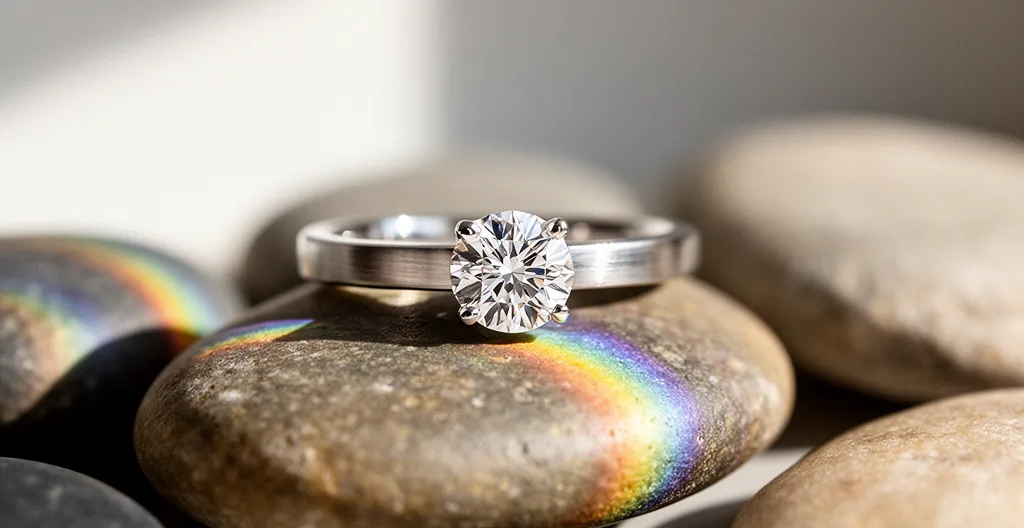
The security of a minimalist ring isn’t about the amount of metal you see, but the invisible engineering principles—compressive force, material density, and structural design—that hold the diamond in place.
- True tension settings rely on thousands of pounds of pressure, making them secure but impossible to resize.
- Bezel settings offer maximum protection against chipping but require specific cleaning methods to maintain brilliance.
- For ultra-thin bands (1.5mm), platinum isn’t just a luxury; its superior density is a structural necessity.
Recommendation: Prioritize the underlying engineering (true tension, bezel, platinum) over purely aesthetic imitations (tension-style, thin gold bands) to achieve the floating look without compromising on safety.
The allure of a minimalist engagement ring is undeniable. It promises a “floating stone,” a diamond that seems to hover on the finger, unbound by heavy metal. For a bride-to-be, this aesthetic is the dream. But it’s a dream immediately followed by a nightmare: what if it falls out? The fear is valid, and the common advice to simply “be careful” or choose a setting with more prongs often misses the point entirely. The prevailing wisdom focuses on what is visible—the number of prongs, the thickness of the band—while ignoring the powerful, invisible forces at play.
The conversation around ring security is often superficial. It treats settings as simple metal containers rather than sophisticated structural systems. This article reframes the problem from an engineer’s perspective. We will move beyond aesthetics to analyze the physics of diamond settings. The key to a secure minimalist ring isn’t about adding more metal; it’s about understanding the concepts of compressive force, material density, and the precise geometry that creates structural integrity. It’s about choosing smarter engineering, not just less metal.
By dissecting the mechanics of each setting, we will demonstrate that you can achieve that coveted “floating” look without constant anxiety. We will explore why some designs fail, why others succeed, and how material science is the ultimate guarantor of your precious stone. This guide will equip you with the knowledge to assess a ring not just as a piece of jewellery, but as a marvel of micro-engineering designed to last a lifetime.
This guide breaks down the critical engineering questions you should be asking. We will explore the structural differences between setting types, the non-negotiable material choices for delicate designs, and the maintenance protocols required to ensure long-term stability.
Summary: An Engineer’s Analysis of Minimalist Setting Security
- Why is a 3-Prong “Martini” Setting Riskier Than a 4-Prong Basket?
- How Does a Bezel Setting Protect the Diamond Girdle from Chipping?
- How to Remove Dirt Trapped Under a Bezel Set Ring Without Tools?
- True Tension or Tension-Style: Which Setting is Actually Secure?
- The Error of Trying to Resize a Tension-Set Ring After Purchase
- Why Must You Use Platinum for Ultra-Thin 1.5mm Diamond Bands?
- French Pave or Micropave: Which Style Minimizes Visible Metal?
- Why Does Micro-Pave Jewellery Require More Maintenance Than Solitaires?
Why is a 3-Prong “Martini” Setting Riskier Than a 4-Prong Basket?
From a structural engineering standpoint, the stability of any object depends on its base of support. A 4-prong setting creates a stable, square foundation, much like a four-legged chair. If one leg (prong) is compromised, the other three can often maintain temporary stability. A 3-prong setting, however, forms a triangle. The loss of a single prong immediately leads to catastrophic failure, as there is no longer a stable plane to hold the stone. The “Martini” style, which tapers to a point, further concentrates stress at the base, making it inherently less stable than a “basket” setting that provides lateral support underneath the diamond.
The risk isn’t just about the number of prongs, but their geometric arrangement. In a 4-prong setting, forces are distributed evenly across two axes. A 3-prong setting distributes force at 120-degree intervals. While stable when perfect, any impact or wear on one prong transfers a much greater percentage of stress to the remaining two. This is why a 4-prong setting is the minimum engineering standard for balancing visibility and security.
Think of it as a system of redundancies. A 4-prong setting has a 25% redundancy factor per prong, while a 3-prong has 0%. Regular inspection is therefore non-negotiable for any prong setting, but it is especially critical for a 3-prong design. You must be vigilant for any signs of wear or damage. To do this effectively, a systematic check is required:
- Check for misalignment: View your ring from all angles on a weekly basis. Any prong that appears bent or not perfectly flush with the stone is a red flag.
- Listen for movement: Gently tap the diamond with your fingernail. If you hear a slight clicking sound or feel any movement, the diamond is loose in its setting.
- Test for snags: Carefully run a piece of fine fabric, like a silk scarf or microfiber cloth, over the prongs. If the material catches or snags, it indicates a prong is lifted or damaged and needs immediate professional attention.
Ultimately, choosing a 3-prong setting is an aesthetic decision that accepts a significantly lower margin of engineering safety. While beautiful, it demands a higher level of user diligence to prevent stone loss.
How Does a Bezel Setting Protect the Diamond Girdle from Chipping?
A bezel setting is the engineering equivalent of a fortress. Unlike prong settings that expose the majority of the diamond’s edge, a bezel encases the entire circumference of the stone’s “girdle” with a continuous metal rim. The girdle is the widest part of the diamond and its most vulnerable edge. It is thin, unpolished on older cuts, and susceptible to chipping from an oblique impact. The bezel acts as a protective bumper, absorbing and distributing the force of any accidental knock that would otherwise strike the girdle directly.
This complete encasement offers unparalleled security. According to industry analysis, bezel settings reduce girdle chipping risk by 95% compared to traditional prong settings. This is because the force of an impact is transferred to the metal housing rather than the crystalline structure of the diamond itself. For a bride with an active lifestyle or one who is simply risk-averse, this design offers the highest degree of confidence. The metal rim not only prevents chips but also makes it virtually impossible for the stone to become loose and fall out, as there are no prongs to bend or catch.
The trade-off, of course, is in light performance. The metal collar blocks some light from entering the side of the diamond, which can slightly reduce its sparkle compared to an open prong setting. However, for those prioritizing durability and peace of mind, the bezel provides the most robust structural solution. It is the definitive choice for protecting the diamond’s girdle vulnerability against the hazards of daily wear, transforming a delicate gemstone into a durable, wearable piece of engineering.
In essence, choosing a bezel setting is a decision to prioritize structural integrity and asset protection over the maximum possible light return—a trade-off many find sensible for a lifetime investment.
How to Remove Dirt Trapped Under a Bezel Set Ring Without Tools?
The primary engineering trade-off for a bezel setting’s superior security is its propensity to trap dirt, lotions, and oils. The very lip of metal that protects the diamond’s girdle also creates a crevice where residue can accumulate underneath the stone, dulling its brilliance from below. Unlike a prong setting, you can’t easily access this area. Trying to dislodge debris with a sharp object is a critical error that can scratch the metal or even the diamond’s pavilion. A safe, effective cleaning method relies on chemistry and gentle agitation, not force.
Professional At-Home Cleaning Method
Jewellery experts at Frank Darling have perfected a simple, tool-free technique. They recommend creating a solution of warm water and a few drops of mild dish soap. The soap acts as a surfactant, breaking down the oils that bind dirt to the ring. By letting the ring soak for several minutes, the solution can penetrate the tight space behind the setting. Following the soak, a very soft-bristled toothbrush is used to gently scrub the nooks and crannies, focusing on the back opening of the bezel where light enters. This method is reported to effectively remove 95% of built-up residue without any risk of damage.
This process highlights a key principle: cleaning is about dissolving and dislodging, not scraping. The warm water helps to loosen debris, while the soft bristles provide just enough mechanical action to sweep it away without abrading the platinum or gold. It’s a method that respects the integrity of the setting while restoring the diamond’s optical performance.
As you can see in the demonstration, the focus is on gentle, methodical cleaning. Rinsing the ring thoroughly under clean, warm water after scrubbing is a crucial final step to remove any remaining soap film, which can also appear as a cloudy layer. For a minimalist design to look its best, it must be impeccably clean, and this engineering-approved method ensures you can maintain that “floating” brilliance safely.
Regularly performing this gentle cleaning ritual will keep your bezel-set diamond as radiant as the day you received it, proving that security does not have to come at the permanent expense of sparkle.
True Tension or Tension-Style: Which Setting is Actually Secure?
The tension setting is the ultimate expression of minimalist engineering, making a diamond appear to float in mid-air, held only by the two ends of the shank. However, a critical distinction exists between a “true tension” setting and a “tension-style” setting, and the difference in security is monumental. A true tension setting is a feat of material science and calibration. The metal of the ring is work-hardened and spring-loaded, creating a precise amount of inward pressure to hold the diamond. As one expert puts it:
True tension settings hold the diamond using thousands of pounds per square inch of compressive force exerted by the shank itself.
– Beverly’s Jewelry Expert, Diamond Ring Settings Explained Guide
This immense compressive force grips the diamond in specially cut grooves in the metal. It’s an incredibly secure method if, and only if, it is perfectly engineered. Conversely, a “tension-style” setting is an aesthetic imitation. It creates the illusion of a tension setting but secretly holds the diamond with a hidden bezel or nearly invisible micro-prongs underneath. While it may look the same from above, its security relies on traditional methods, not on calibrated pressure.
The engineering requirements for each are worlds apart. A true tension setting demands specialized, hardened alloys or platinum, while a tension-style ring can be made from standard gold. The security of a true tension setting is absolute—until it’s compromised. A significant impact could theoretically alter the calibration, but the primary risk is in its creation and sizing. A tension-style ring offers the high security of a bezel or prong setting while providing the “floating” look. This table clarifies the structural differences based on an in-depth analysis of setting types.
| Feature | True Tension | Tension-Style |
|---|---|---|
| Holding Method | Thousands of PSI compression | Hidden bezel or micro-prongs |
| Metal Requirements | Work-hardened platinum or special alloys | Standard gold or platinum |
| Stone Security | High if properly calibrated | Very high with hidden support |
| Resizing Possibility | Impossible without remanufacturing | Limited but possible |
| Visual Effect | Stone appears floating | Similar floating appearance |
For the bride seeking the floating look with maximum peace of mind, a tension-style setting is often the more pragmatic and secure engineering choice. It delivers the desired aesthetic with a proven, reliable support system hidden from view.
The Error of Trying to Resize a Tension-Set Ring After Purchase
The most significant and costly mistake a buyer can make with a true tension-set ring is assuming it can be resized like a conventional band. From an engineering perspective, a tension setting is not merely a ring holding a stone; it is a calibrated spring system. The entire shank is designed to exert a specific, immense pressure on the diamond. Cutting the band to resize it permanently breaks this calibrated system. It is impossible to simply solder it back together and restore the original compressive force.
Attempting to do so would eliminate the very force holding the diamond, causing it to fall out instantly. This is not a matter of skill; it’s a matter of physics. As a result, jewellery engineering experts confirm that 100% of true tension settings require complete remanufacturing to resize. This involves melting down the metal, recasting the entire ring to the new size, and recalibrating the spring-loading process from scratch—a costly and time-consuming procedure.
This structural limitation means that the initial finger sizing is the most critical step in the purchasing process. An inaccurate size is not a minor inconvenience; it’s a fundamental design flaw that necessitates a complete rebuild. Therefore, a rigorous sizing protocol must be followed before ever committing to a tension-set ring.
Action Plan: Pre-Purchase Protocol for a Tension-Set Ring
- Get professionally sized at least 3 times at different times of the day to account for natural finger swelling and contraction.
- Consider seasonal size variations. Your fingers can change by up to half a size between the heat of summer and the cold of winter. Size for the most common state.
- Ask the jeweller about their specific remanufacturing policy and costs upfront. Expect to pay a significant fee (often $800-$1500) for a “resize.”
- Consider purchasing temporary plastic ring size adjusters as a non-invasive solution for minor daily or seasonal fluctuations.
By treating the initial sizing with the seriousness of a final engineering specification, you avoid the common and expensive error of trying to alter a perfectly calibrated system after the fact.
Why Must You Use Platinum for Ultra-Thin 1.5mm Diamond Bands?
When designing an ultra-thin band, especially one at a delicate 1.5mm width, the choice of metal is not a matter of preference; it is a critical structural decision. While gold is a beautiful and traditional choice, it lacks the material properties required to provide adequate security at such a minimal dimension. The answer lies in density and strength. According to metallurgical analysis, platinum is 1.6 times denser than 14k gold, which provides approximately 60% more structural integrity in an identical 1.5mm band. This density means that for the same volume, a platinum band is significantly stronger and more resistant to bending and deformation.
A thin gold band is susceptible to warping under the pressures of daily wear. If the band warps, the settings attached to it (prongs, bezels) will also shift, immediately jeopardizing the security of the diamond. Platinum’s inherent strength mitigates this risk. Furthermore, platinum possesses a unique property known as work-hardening. When platinum is bent or scratched, the metal in that area actually becomes harder and stronger, unlike gold, which is simply displaced or worn away.
This has profound implications for the tiny prongs that hold a diamond, as explained by manufacturing experts.
Manufacturing Insights on Platinum Prongs
The manufacturing team at Nakassi reports using platinum specifically for prongs on even their gold rings because of its superior durability. Its work-hardening property means that if a prong gets hit, it tends to bend rather than break off. This “fail-safe” characteristic keeps the diamond securely in place, even after an impact. Their data from thousands of rings shows that platinum prongs in 1.5mm bands maintain their structural integrity 3 times longer than gold prongs of the same dimension, with virtually zero catastrophic failures over a 10-year period.
For a bride who desires the delicate, barely-there look of a 1.5mm band, choosing platinum is the only way to ensure the ring’s underlying structure is strong enough to protect her investment for a lifetime.
French Pave or Micropave: Which Style Minimizes Visible Metal?
When the goal is to create a surface that appears to be made entirely of diamond, both French pavé and micropavé are excellent engineering solutions, but they achieve the minimal-metal look through different structural techniques. The choice between them affects not just the top-down appearance but also the side profile and long-term maintenance. Micropavé creates the most seamless “sheet of diamond” effect by setting many tiny stones extremely close together, each held by four minuscule beads of metal. From a distance, the metal is virtually invisible, and the surface appears as a continuous carpet of sparkle.
French pavé, on the other hand, takes a different approach that is both an art and a science. A diamond setting specialist explains the unique structural method:
French pavé achieves its minimal-metal appearance by cutting V-shaped grooves directly into the shank, creating tiny triangular prongs out of the ring itself.
– Diamond Setting Specialist, All Diamond Setting Types Guide
This technique is ingenious because it uses the ring’s own body to form the prongs, eliminating the need for separate beads of metal to be added on top. This results in less metal visible between the stones and creates a distinctive, scalloped look from the side profile. While micropavé excels at the top-down illusion, French pavé often reveals less metal from more angles. The following table breaks down the key visual and structural differences.
| Aspect | French Pavé | Micropavé |
|---|---|---|
| Metal Visibility | V-cuts minimize metal per stone | 4 tiny beads per stone |
| Overall Effect | Clean lines between stones | Seamless ‘diamond sheet’ |
| Side Profile | V-shaped cuts visible | Built-up gallery underneath |
| Best Viewing Angle | Side profile shows craftsmanship | Top-down maximizes illusion |
| Maintenance Needs | Moderate – V-cuts can weaken band | High – multiple tiny prongs to check |
Ultimately, for the purist seeking the absolute minimum of visible metal from all angles, French pavé is often the superior engineering choice, though it requires a high level of craftsmanship to execute without compromising the band’s integrity.
Key Takeaways
- The security of a setting is determined by engineering principles (force distribution, material density), not just visible metal.
- True tension settings are secure but cannot be resized; tension-style settings offer a similar look with more practical, hidden support.
- For ultra-thin bands (under 2.0mm), platinum is a structural necessity due to its superior density and strength compared to gold.
Why Does Micro-Pave Jewellery Require More Maintenance Than Solitaires?
From a systems engineering perspective, complexity is the enemy of reliability. The more components a system has, the more potential points of failure exist. This principle directly applies when comparing a micro-pavé ring to a simple solitaire. A solitaire ring is a simple system: one stone, held by four or six relatively large prongs. The points of failure are limited and easy to inspect. A micro-pavé ring, conversely, is an incredibly complex system.
A single micro-pavé band can contain dozens or even hundreds of tiny diamonds, each held in place by its own set of minuscule prongs. According to jewellery maintenance data, the sheer number of components is the primary factor in its higher maintenance needs, as micro-pavé rings can have over 200 tiny prongs. This exponentially increases the statistical probability of a single prong snagging on fabric, getting bent during daily activities, or loosening over time due to micro-vibrations.
This heightened risk profile necessitates a much more rigorous and frequent maintenance schedule than a solitaire. While a solitaire might need an annual check-up, a micro-pavé piece requires quarterly professional inspections to ensure every one of those tiny prongs is secure. The cost and time commitment for this maintenance are significantly higher. Failure to adhere to this schedule dramatically increases the risk of losing small stones, leading to a “gapped” appearance and costly repairs.
Your Checklist: Essential Micropavé Ring Maintenance Schedule
- Self-Inspection: Inspect your micropavé settings monthly using a 10x jeweller’s loupe. Look for any stones that appear dull (indicating they are loose) or any prongs that seem lifted or broken.
- Professional Servicing: Schedule a professional cleaning and prong-tightening service every 3 to 4 months. This is preventative maintenance to address issues before a stone is lost.
- Environmental Control: Remove the ring before activities involving significant temperature extremes (like saunas or handling frozen items) to prevent issues from thermal expansion and contraction of the metal.
- Proper Storage: Always store your micro-pavé ring separately in a soft cloth pouch. The hundreds of tiny diamonds are abrasive and can easily scratch other jewellery (and be scratched in return).
- Financial Planning: Budget for higher maintenance costs. Expect to spend $200-$400 annually for professional upkeep on a complex pavé ring, compared to $50-$100 for a simple solitaire.
Choosing micro-pavé is to choose a high-performance system that delivers an unparalleled visual effect but demands a commitment to its equally high-maintenance engineering. For a bride who is prepared for this upkeep, the result is breathtaking; for one who is not, it can become a source of constant concern and expense.