In summary:
- Commissioning bespoke jewellery on a budget is about making informed decisions, not just cutting costs.
- Your preparation, especially a detailed mood board, is the most powerful tool for controlling the outcome and budget.
- Understanding the “why” behind timelines, design methods, and material costs empowers you to be a confident partner in the process.
- Quality is in the details; learning to spot structural flaws like poorly finished prongs ensures your piece is made to last.
- Locally made jewellery costs more due to higher labour standards and quality control, which translates to long-term value and service.
The idea of commissioning a piece of bespoke jewellery, perhaps a unique engagement ring or a landmark anniversary gift, is incredibly romantic. Yet for many, that dream is quickly followed by a wave of intimidation. The process can feel like a secret language spoken only by artisans in dusty workshops, with opaque pricing and endless choices. You want something deeply personal and beautiful, but you’re worried about miscommunication, hidden costs, and the daunting fear of “getting it wrong.”
Many will tell you to simply “set a budget” or “find a good jeweller.” While true, this advice misses the most crucial element: your own role in the journey. The common belief is that the client is a passive recipient of the jeweller’s magic. But what if the key to creating the perfect piece, without financial surprises, wasn’t about finding a cheaper jeweller, but about becoming a more informed and active partner in the creation?
This is where we shift the perspective. Think of me as your personal liaison, here to demystify the entire process. My guiding principle is that transparency empowers you. By understanding the levers you can pull at each stage—from your initial brief to the final polish—you transform from an intimidated customer into a confident collaborator. This guide is designed to give you that power.
We will walk through the critical stages of commissioning, focusing on the key decisions that impact both the final piece and your budget. We’ll explore timelines, design choices, material considerations, and the subtle markers of quality that ensure your investment is not just beautiful, but built to last. Let’s begin this creative journey together.
Contents: A Guide to Your Bespoke Journey
- Why Does Custom Jewellery Production Take 8 Weeks Before Delivery?
- How to Create a Mood Board That Guarantees Your Jeweller Understands You?
- 3D Rendering or Hand Sketch: Which Design Method Saves You Money?
- The Structural Mistake That Makes Bespoke Rings Snag on Clothing
- When to Start the Bespoke Process to Ensure Christmas Delivery?
- How to Calculate if the £400 Premium for Platinum is Worth It for You?
- Why is Direct Access to the Bench Jeweller Critical for Custom Work?
- Why Does UK Workshop Manufacturing Cost More Than Imported Jewellery?
Why Does Custom Jewellery Production Take 8 Weeks Before Delivery?
One of the first questions I hear is about the timeline. In a world of next-day delivery, waiting up to eight weeks can feel like an eternity. But this period isn’t empty waiting; it’s a carefully orchestrated dance of creativity, precision, and craftsmanship. Understanding these stages demystifies the process and helps you appreciate the care invested in your piece. A jeweller’s timeline isn’t arbitrary; it’s a commitment to quality. While some projects can be faster, a typical journey of 6-8 weeks for completion is a realistic benchmark for true artisan work.
The process is a meticulous sequence where each step builds upon the last. Rushing any stage, from sourcing the perfect gemstone to the final polish, compromises the integrity of the final piece. For instance, creating a 3D model allows for precise adjustments, but it requires both design time and your thoughtful approval. Similarly, casting the metal is a specialised process that can’t be hurried. The timeline is your assurance against a rushed job.
Here is a typical breakdown of what happens during those eight weeks, turning your idea into a tangible treasure:
- Weeks 1-2: Consultation and Conceptualisation. This is our initial creative dialogue. We discuss your ideas, review your inspiration, and produce initial sketches to establish a clear direction.
- Weeks 2-3: Design Refinement and CAD Rendering. Your chosen design is translated into a detailed Computer-Aided Design (CAD) model. This gives you a 360-degree view and allows for precise digital tweaks before any metal is cast.
- Weeks 4-5: Material Sourcing and Model Creation. Once the design is approved, we source the specific metal and gemstones. You may also have the option to bring your own stones. A wax or resin model is then 3D printed for you to see and feel the design’s proportions.
- Weeks 5-6: Casting and Initial Finishing. The piece is cast in your chosen precious metal. This is where the raw form of your jewellery emerges. The jeweller then begins the painstaking process of cleaning, filing, and preparing the piece for stone setting.
- Week 7: Stone Setting and Polishing. This is a highly skilled task where the gemstones are meticulously secured in the setting. Afterwards, the piece undergoes several stages of polishing to achieve its final lustre.
- Week 8: Hallmarking and Final Inspection. In the UK, most precious metal items must be sent to an Assay Office for hallmarking—a legal mark of quality. A final, rigorous quality check ensures every detail is perfect before it’s beautifully packaged for you.
So, while patience is required, it’s an investment in a process designed to eliminate mistakes and ensure the final piece is exactly what you envisioned—a future heirloom crafted with no compromises.
How to Create a Mood Board That Guarantees Your Jeweller Understands You?
If there is one piece of advice I can give to ensure you get the piece you’re dreaming of, it’s this: invest your time in creating a brilliant mood board. This isn’t just a collection of pretty pictures; it’s your most critical communication tool. It translates your feelings, tastes, and lifestyle into a visual language your jeweller can understand perfectly. A great mood board saves time, prevents misunderstandings, and is the single best way to keep your project on track and on budget. As one expert beautifully puts it, commissioning jewellery is akin to engaging with an artist for their unique vision, and your mood board is the brief you give that artist.
Your mood board should be a holistic representation of the person who will wear the piece. Don’t just include pictures of other rings. Think bigger. Include:
- Overall Style: Photos showing their typical clothing style (e.g., minimalist, bohemian, classic).
- Colour Palette: Swatches of their favourite colours. Do they gravitate towards warm or cool tones?
- Art & Architecture: Shapes and forms they find beautiful, from a building’s sharp lines to the organic curves of a sculpture.
- Lifestyle Clues: Images that reflect their hobbies or profession. Are they a gardener with their hands in the soil, or a city professional? This informs durability and design choices.
- Metal Preferences: Do they prefer silver tones like platinum and white gold, or the warmth of yellow or rose gold?
Crucially, don’t be afraid to include things you don’t like. A “No” pile is just as valuable as a “Yes” pile. Showing a jeweller a style of setting you actively dislike immediately sets clear boundaries and prevents them from going down the wrong creative path. This visual clarity is far more effective than trying to describe your abstract thoughts and ensures the initial sketches are already close to your vision, saving on redesign costs.
Ultimately, a well-curated mood board transforms the first consultation from a guessing game into a productive, creative partnership. It’s your story, told in images, and it’s the best guarantee that the jeweller will be able to tell that story back to you in gold and gemstones.
3D Rendering or Hand Sketch: Which Design Method Saves You Money?
Once your mood board has set the direction, the next step is to translate those ideas into a concrete design. Here, you’ll encounter a key decision that impacts both cost and clarity: should your design be developed through traditional hand sketches or modern 3D CAD (Computer-Aided Design) renderings? It’s a common misconception that traditional methods are always cheaper. The reality is more nuanced, and understanding the trade-offs is another lever you can use to manage your budget effectively.
A hand sketch offers an artistic, romantic interpretation of your piece. It’s fantastic for capturing the emotion and flow of organic designs. Some designers may require a nominal fee for this service; for instance, it’s not uncommon for a design fee of £75 per design to be requested to move forward with illustrations. However, the main drawback of sketching is that revisions can be time-consuming and costly, as each change may require a new drawing from scratch. It also leaves more room for artistic interpretation, which can sometimes lead to surprises in the final piece.
3D CAD rendering, on the other hand, offers unparalleled precision. It allows you to see your design from every angle with photorealistic detail before it’s even made. This digital approach makes revisions incredibly simple and fast—adjusting a band width or prong height is a matter of clicks, not a complete redraw. This precision significantly lowers the risk of production errors. Surprisingly, many modern jewellers offer the initial CAD design work at no charge, viewing it as a speculative investment to win your confidence and business.
The following table, based on insights from industry experts, breaks down the key differences to help you decide which method aligns best with your project and budget. As this comparative analysis shows, the “cheapest” option depends on your design’s complexity and your need for precision.
| Aspect | Hand Sketch | 3D CAD Rendering |
|---|---|---|
| Initial Design Fee | £75-150 | Often free (speculative investment) |
| Revision Capability | Limited, requires redrawing | Unlimited digital adjustments |
| Accuracy | Artistic interpretation | Precise to 1/10th millimeter |
| Best For | Organic, flowing designs | Geometric, technically complex pieces |
| Risk of Production Errors | Higher | Lower |
For most clients, especially those creating a precise piece like an engagement ring, the clarity and flexibility of CAD often provide better long-term value, even if a hand sketch seems more romantic upfront. It minimises the risk of costly misunderstandings and ensures the piece you approve on screen is the exact piece you’ll receive.
The Structural Mistake That Makes Bespoke Rings Snag on Clothing
When you receive your finished piece, your attention will naturally be drawn to the sparkle of the stone and the overall design. However, there is a critical, often overlooked detail that separates good craftsmanship from great craftsmanship: the finishing of the prongs and settings. A common structural mistake in rushed or less-than-perfect work is leaving the tiny metal claws (prongs) that hold your gemstone with sharp, unfinished edges. This small oversight is the primary reason why rings snag on delicate clothing like sweaters and scarves, a constant annoyance that can also damage your wardrobe and, over time, even compromise the security of your stone.
A master jeweller understands that the beauty of a piece is intrinsically linked to its functionality and comfort. They will spend considerable time meticulously rounding and polishing every single prong and the edges of each setting. The goal is to create a surface that is perfectly smooth to the touch, with no microscopic burrs or sharp points that can act like tiny hooks. This is not just an aesthetic choice; it’s a hallmark of structural integrity and thoughtful design. When you run your finger over a well-made ring, it should feel seamless.
As the client, you are empowered to check for this yourself. You don’t need a jeweller’s loupe, just a discerning touch and a simple test. Before you make your final payment, perform what I call “The Sweater Test.” It’s your final quality control check to ensure your investment is built for a lifetime of comfortable wear. This simple audit can save you a world of frustration down the line.
Your Quality Checklist: The Sweater Test
- Gently run the finished ring over a fine-knit fabric, like a cashmere sweater or silk scarf.
- Pay close attention to the prong tips. Do they glide smoothly over the fabric or do they catch or pull threads?
- Examine any pavé or channel settings. Ensure there are no sharp metal beads or rough edges along the channel walls.
- Feel the underside of the ring and inside the band. It should be perfectly smooth and polished for comfort.
- If you feel any catching, however minor, point it out and request a final re-polishing. A reputable jeweller will be happy to make it perfect.
Don’t be shy about performing this check. It’s a sign of an informed client who appreciates true quality, and it ensures your bespoke piece is as practical as it is beautiful.
When to Start the Bespoke Process to Ensure Christmas Delivery?
Special occasions wait for no one, and if you have your heart set on gifting a bespoke piece for a specific date like Christmas, anniversaries, or a birthday, timing is everything. Given the typical 8-week production timeline we discussed, working backwards is essential. Many people underestimate the lead time required, especially during peak seasons like the run-up to Christmas, when workshops are at their busiest. Starting the process too late is the surest way to face disappointment or rush charges.
As a guiding voice in this process, I must stress the importance of planning ahead. As artisan jeweller Kristen Baird notes, “Because I craft every commission myself, I can only take a limited number per quarter. If you have your heart set on receiving your piece by a specific deadline, please reach out right away.” This sentiment is shared by all dedicated craftspeople. Their capacity is finite, and their schedules fill up months in advance for key holidays. To avoid stress, you should add a buffer of at least two to four weeks to the standard production timeline.
This extra time accounts for potential delays in communication, design revisions, or sourcing a particularly rare gemstone. To make this concrete, let’s create a reverse countdown for a Christmas delivery. This timeline ensures a smooth, unhurried process where creativity can flourish without the pressure of a looming deadline.
- September 15th (Your Start Date): This is the latest I would comfortably recommend starting the process. You initiate your first consultation and begin developing the mood board and initial ideas.
- October 1st (Week 12 before Christmas): The design development is in full swing. You are reviewing initial sketches and providing feedback.
- October 15th (Week 10): You give final approval on the CAD design and submit your deposit. This is the green light for production to be scheduled.
- October 29th (Week 8): Production officially begins. The metal is cast, and the jeweller starts the initial finishing work.
- December 10th (Week 2): The piece is complete, has been hallmarked, and is undergoing its final, rigorous quality control checks.
- December 17th (Week 1): The item is ready. This week is a crucial buffer for any last-minute adjustments, shipping, or arranging a special collection.
- December 24th: Your beautiful, bespoke gift is in your hands, ready to be placed under the tree.
By starting in early autumn for a Christmas gift, you give yourself—and your jeweller—the most valuable resource of all: time. This ensures the process is a joy, not a race against the clock.
How to Calculate if the £400 Premium for Platinum is Worth It for You?
One of the most significant budget decisions you’ll make is the choice of metal. For a “white metal” look, the two premium contenders are platinum and white gold. On paper, platinum often comes with an initial premium of around £300-£500 for a typical ring, which can feel like a difficult expense to justify when you’re trying to manage a budget. However, this is a classic case where looking at the short-term cost can be misleading. To make a truly informed, budget-conscious decision, you need to think like an investor and consider the total cost of ownership over the lifetime of the piece.
White gold is an alloy of yellow gold mixed with white metals (like palladium or nickel) and then plated with a layer of rhodium to give it a brilliant, bright white finish. This rhodium plating is beautiful, but it’s not permanent. With daily wear, it will gradually rub off, revealing the slightly yellowish tint of the white gold underneath. To maintain its bright white appearance, a white gold ring needs to be re-plated with rhodium every 1-2 years, at a typical cost of £50-£100 per service.
Platinum, on the other hand, is a naturally white metal. It will never tarnish or change colour. While it can get scratched, the metal is simply displaced, not lost, and it develops a unique, soft finish called a patina over time, which many people love. It requires no plating and is also hypoallergenic, as it contains no nickel. When you factor in the recurring cost of replating white gold, the financial calculation changes dramatically.
Let’s break down the 20-year cost of a ring to see if that initial premium for platinum is truly an expense or a savvy investment.
| Cost Factor | Platinum | White Gold (18k) |
|---|---|---|
| Initial Premium | +£400 | Base price |
| Rhodium Replating (every 2 years) | £0 | £100 × 10 = £1,000 |
| Durability | No metal loss over time | Gradual wear |
| Hypoallergenic | Yes – no nickel | May contain nickel |
| 20-Year Total Additional Cost | £400 | £1,000+ |
As you can see, over two decades, the “cheaper” white gold option can end up costing more than double the initial premium of platinum, not to mention the inconvenience of having to take your ring in for regular servicing. For a piece meant to last a lifetime, like an engagement or wedding ring, that upfront investment in platinum often pays for itself in both money and peace of mind.
Why is Direct Access to the Bench Jeweller Critical for Custom Work?
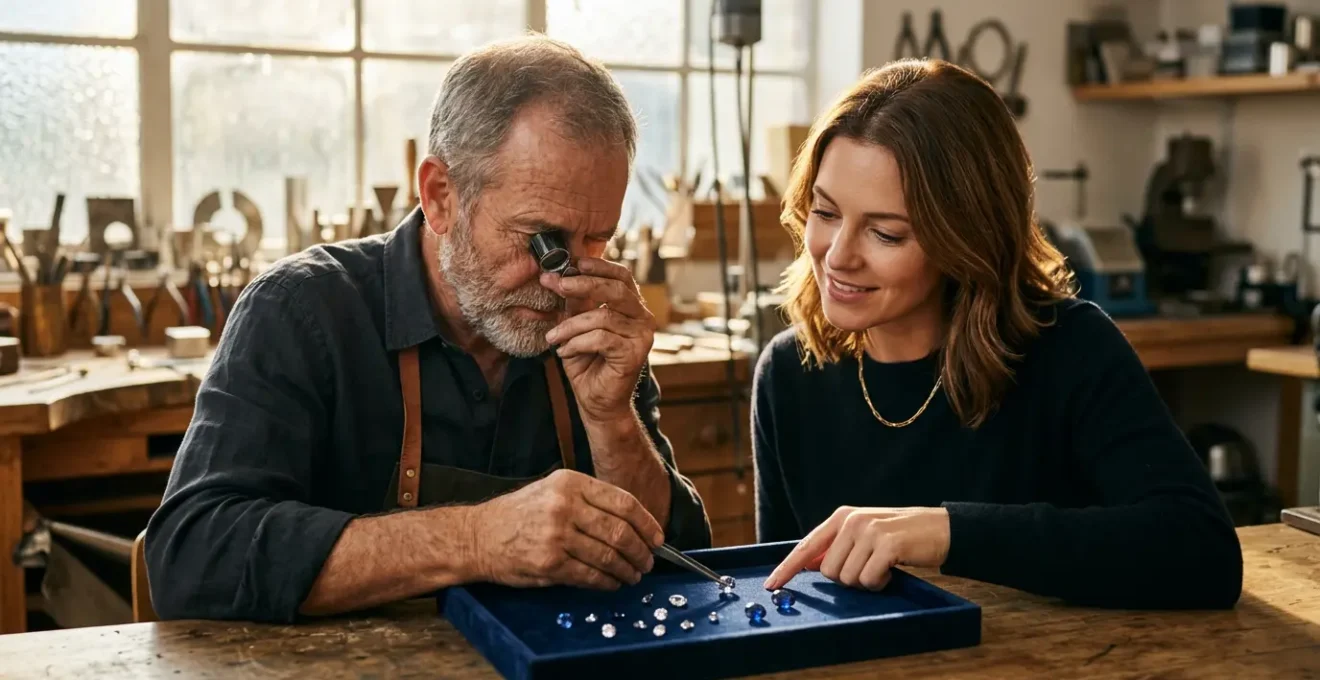
In many larger jewellery stores, the person you speak with is a salesperson. They are skilled at helping you choose a design, but they are not the person who will physically be making your ring. They act as an intermediary, relaying your wishes to the workshop, which might be in a different building or even a different country. This creates a classic “broken telephone” effect, where subtle nuances and emotional requests can get lost in translation. This is why, for truly bespoke work, direct access to the bench jeweller is not a luxury—it’s a necessity.
The bench jeweller is the artisan who translates your vision into metal and stone. They are a problem-solver who understands the technical constraints and creative possibilities of the materials. When you say, “I want it to feel delicate but strong,” a salesperson hears keywords. A bench jeweller hears a technical challenge. As jewellery designer Amanda Mansell expertly explains, “The bench jeweller translates emotional requests into technical solutions (‘We’ll use a tapered band with a reinforced bezel setting’).” This direct dialogue is where the magic happens and where costly mistakes are avoided.
Having a conversation with the maker allows for a level of collaboration that is impossible through an intermediary. You can ask practical questions and get immediate, expert answers. This dialogue builds trust and ensures that the final piece is not just an interpretation of your ideas, but a true co-creation. To make the most of this access, you should come prepared with specific questions.
- What specific finishing process will you use for the prongs to ensure they don’t snag?
- Can you show me examples of similar pieces you have personally crafted?
- Based on my budget, are there alternative design choices that could achieve 90% of my vision at a lower cost?
- How will you ensure the structural integrity of this design for daily, long-term wear?
- What is your policy on adjustments if I’m not 100% happy after seeing the wax model?
Insisting on a consultation that includes the bench jeweller is one of the most important things you can do to protect your investment. It guarantees that the person with the deepest understanding of the craft has a first-hand understanding of your heart’s desire.
Key Takeaways
- Effective communication through a detailed mood board is the client’s most powerful tool for controlling costs and ensuring a successful outcome.
- Understanding long-term value, such as the maintenance costs of white gold versus the one-time premium for platinum, leads to smarter budget decisions.
- The quality of a bespoke piece lies in its structural details; learning to check for things like smooth prong finishing ensures longevity and comfortable wear.
Why Does UK Workshop Manufacturing Cost More Than Imported Jewellery?
Finally, we arrive at the most direct budget question of all: why does a piece of jewellery made in a local UK workshop often cost more than a seemingly similar piece imported from overseas? It’s tempting to see the price difference and assume it’s just a “local premium,” but the higher cost is a direct reflection of tangible value in three key areas: labour standards, quality control, and accountability. Understanding this helps you see the price not as an expense, but as an investment in quality and peace of mind.
First and foremost, jewellers working in the UK are protected by fair labour laws, which ensure they are paid a living wage and work in safe, regulated conditions. This is a significant and justifiable part of the cost. When a piece is mass-produced overseas, the labour costs are often dramatically lower, but this can come at a human price. Choosing a UK-made piece is a vote for ethical and sustainable craftsmanship.
Second, the level of quality control is unparalleled. When the person who sold you the ring works in the same building as the person making it, there is a direct line of sight and communication. The bench jeweller has personal pride in their work and is accountable for every detail. With imported pieces, quality control is often done remotely or through spot-checks, which can lead to inconsistencies. As one expert in the field states, “The cost is not just for a product, but for access to a unique talent and a collaborative creative process.”
Finally, there’s the long-term value of local service and accountability. If your UK-made ring ever needs resizing, repair, or a deep clean, you can return to the very artisan who made it. This relationship and access are part of what you’re paying for. With an imported piece, service options can be limited or non-existent. The table below summarises the fundamental differences in the cost structure.
| Cost Factor | Local UK Workshop | Import |
|---|---|---|
| Labour Standards | Living wages, regulated hours | Variable standards |
| Material Traceability | Full certification available | Often limited |
| Quality Control | Direct, hands-on oversight | Remote monitoring |
| Repair & Service | Direct local availability | Limited or no options |
| Lead Time | 4-8 weeks typically | 8-12 weeks or more |
Ultimately, commissioning a piece from a local UK workshop is an investment in a person, a skill, and a guarantee of quality. While the initial ticket price may be higher, the value delivered through ethical craftsmanship, superior quality, and a lifetime of local service often makes it the more prudent and rewarding choice.