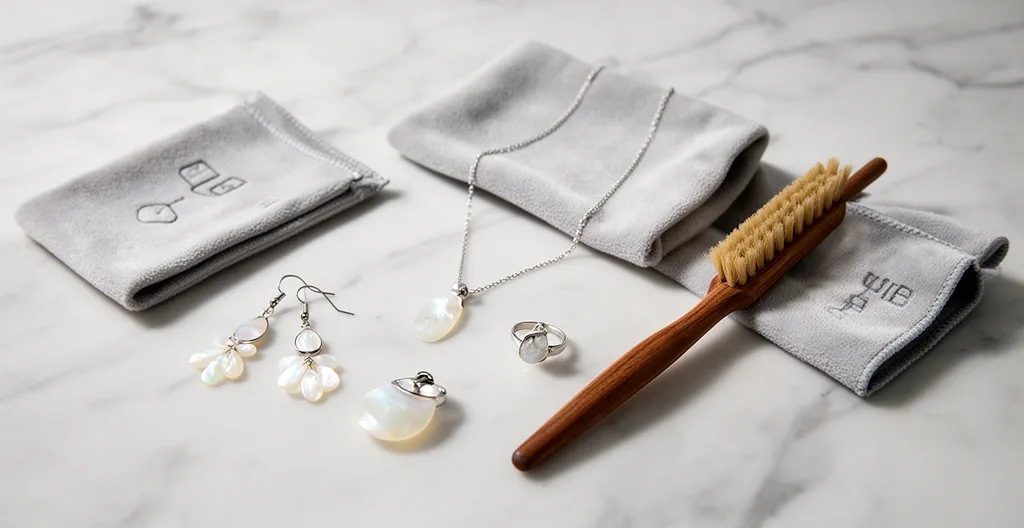
The key to preventing your mother-of-pearl inlay from peeling is to protect the underlying adhesive bond, not just the delicate surface.
- Its softness and organic composition make it exceptionally vulnerable to micro-abrasions from daily contact and chemical damage from cosmetics.
- Moisture and chemicals are the primary enemies, as they degrade the epoxy that secures the inlay, leading to lifting and eventual loss.
Recommendation: Adopt a strict “last on, first off” rule and never expose your jewellery to water during activities like showering, swimming, or washing dishes.
The ethereal, shifting lustre of a mother-of-pearl inlay, perhaps set in a classic clover motif, is a hallmark of refined jewellery. Yet, for many owners, this beauty is shadowed by a persistent anxiety. There is a tangible fear that a moment of carelessness—a splash of water, a spray of perfume, a bump against a hard surface—could irrevocably damage the piece. This concern is entirely justified. As a specialist in luxury jewellery repair, I have seen firsthand the consequences of improper care on these delicate organic gems.
The common advice to “avoid chemicals” or “wipe it with a soft cloth” is correct, but fundamentally incomplete. It treats the symptom—a potential surface blemish—without addressing the root cause of catastrophic failure. The most significant risk to an inlay piece is not a superficial scratch, but the complete structural failure of the bond holding the delicate mother-of-pearl in its metal setting. This is what leads to the dreaded peeling or the inlay falling out entirely.
To truly protect your investment, you must move beyond simple cleaning tips and adopt a preventative protocol grounded in the material science of mother-of-pearl. The key to its preservation lies in understanding its inherent vulnerabilities: its softness, its chemical composition, and, most critically, the fragility of the adhesive that binds it. This is not merely about maintaining its shine; it is about ensuring its structural integrity for a lifetime of wear.
This guide will deconstruct each risk, from the mechanics of a scratch to the chemical assault of a common perfume. By understanding precisely why and how mother-of-pearl fails, you will be equipped with a professional’s methodology to ensure your cherished pieces remain as intact and luminous as the day they were crafted.
Summary: A Jeweller’s Protocol for Mother-of-Pearl Inlay Care
- Why Does Mother-of-Pearl Scratch So Easily Against Keys?
- Why Must You Avoid Vinegar and Lemon When Cleaning Mother-of-Pearl?
- White or Black Mother-of-Pearl: Which Hides Scratches Better?
- The Risk of Showering with Glued Mother-of-Pearl Earrings
- Can You Replace a Broken Mother-of-Pearl Clover Inlay?
- Why Do Pearls Dehydrate and Crack If Left in a Safe for Years?
- Channel Set or Pave Set: Which is More Secure for Active Hands?
- How to Keep Cultured Pearls Lustrous When You Wear Perfume Daily?
Why Does Mother-of-Pearl Scratch So Easily Against Keys?
The primary reason your mother-of-pearl jewellery is so susceptible to damage from everyday objects like keys is its inherent softness. Unlike diamonds or sapphires, mother-of-pearl is not a mineral but an organic composite material. Its fragility is quantifiable; an analysis of its properties shows that mother-of-pearl’s softness is scientifically measured at just 3.5 on the Mohs scale of hardness. For context, most metals used in keys, like brass or nickel-silver, rank higher on the same scale. This means that a simple, accidental contact in a handbag or pocket will inevitably result in the harder metal gouging the softer nacre.
These incidents create what we call micro-abrasions. While a single scratch might be barely visible, their accumulation over time degrades the smooth, lustrous surface, causing a dull, hazy appearance that scatters light instead of reflecting it. The only effective defence is absolute prevention. Your mother-of-pearl pieces should never share a space with harder objects. This requires a disciplined approach to storage, both at home and when mobile. A dedicated, soft-lined pouch or a separate compartment in a jewellery box is not a luxury—it is a necessity for preserving the integrity of the surface.
Furthermore, it is critical to remove any inlay jewellery before engaging in physical activities. Any task that could bring the piece into contact with hard surfaces, from household chores to exercise, presents an unacceptable risk. Treating mother-of-pearl with the same caution as a fine silk garment is the correct mindset for long-term preservation.
Why Must You Avoid Vinegar and Lemon When Cleaning Mother-of-Pearl?
Using household cleaners like vinegar or lemon juice on mother-of-pearl is one of the most destructive mistakes an owner can make. These substances are acidic, and acid is the chemical enemy of nacre. Mother-of-pearl is primarily composed of calcium carbonate in the form of aragonite crystals, held together by an organic protein binder. When an acid comes into contact with calcium carbonate, it triggers a chemical reaction that dissolves the material. This damage is not a stain; it is an irreversible etching of the surface, which permanently dulls the lustre and can compromise the inlay’s structure.
Even mild, diluted acids can be harmful. Some guides might suggest a patch test, but from a professional repair perspective, the risk is never worth the potential for catastrophic damage. The effect is similar to how acid rain erodes marble statues—the material is literally eaten away. Therefore, any cleaning agent containing acids, including many commercial jewellery cleaners not specifically formulated for pearls, must be strictly avoided. The same applies to harsh chemicals like ammonia or bleach found in household products.
The only safe method for cleaning involves a pH-neutral approach. A gentle cleansing with a soft cloth, lukewarm water, and a drop of mild, non-detergent soap is sufficient for removing oils and grime without harming the nacre or the adhesive bond. Thorough rinsing and immediate drying are just as crucial to prevent water from seeping into the setting.
Your Action Plan: Safe Cleaning Protocol for Mother-of-Pearl
- Prepare a solution of lukewarm water with a single drop of mild, pH-neutral soap (e.g., Marseille soap).
- Dip a soft, lint-free cloth into the solution, wring it out thoroughly, and gently wipe the nacre surface. Never soak the jewellery.
- For stubborn stains, use an extra-soft toothbrush and scrub with exceptionally light pressure, moving in gentle circles.
- Rinse immediately with a separate cloth dampened with clean water to remove all soap residue.
- Dry the piece completely with a clean, soft cloth. To restore shine, apply a tiny drop of mineral or sweet almond oil on a cloth and gently buff the surface.
White or Black Mother-of-Pearl: Which Hides Scratches Better?
While both white and black mother-of-pearl share the same fundamental softness (3.5 on the Mohs scale), they interact with light and damage in different ways. From a practical, long-term wear perspective, white mother-of-pearl is generally more forgiving and tends to hide minor scratches more effectively. This is due to its complex and dynamic play-of-colour, known as orient. The iridescent flashes of pink, green, and blue on a white or light-coloured surface create a visually busy landscape where small abrasions can become lost in the shifting light.
In contrast, black mother-of-pearl, prized for its dramatic and deep peacock-like tones, presents a starker canvas. When scratched, the abrasion often appears as a fine, white line. This high contrast between the dark, lustrous surface and the lighter-coloured damage makes even minor scuffs significantly more apparent. While its beauty is undeniable, it is a less forgiving material for daily, active wear.
This does not mean black mother-of-pearl is inferior, but it does require an even higher degree of caution from its owner. The choice between the two often comes down to a balance of aesthetic preference and lifestyle. For a piece intended for frequent wear, white mother-of-pearl offers a slight advantage in masking the inevitable signs of a well-loved jewel. Below is a direct comparison of their key properties.
| Property | White Mother-of-Pearl | Black Mother-of-Pearl |
|---|---|---|
| Origin | Mainly from Australia | Various sources |
| Scratch Visibility | Less visible on complex, shifting orient | Stark white lines highly visible |
| Maintenance | Regular gentle cleaning needed | Same care requirements |
| Durability | 3.5 Mohs hardness | 3.5 Mohs hardness |
| Storage | Keep away from other stones | Separate storage essential |
The Risk of Showering with Glued Mother-of-Pearl Earrings
Exposing mother-of-pearl inlay jewellery to water, especially in a shower, is one of the most critical errors an owner can make. The danger is not just to the nacre itself, but to the adhesive bond that holds the inlay in place. Most high-end jewellery, including iconic clover designs, relies on a strong, specialized epoxy to secure the delicate, custom-cut mother-of-pearl into its metal bezel. This bond is the weak link in the system when moisture is introduced.
Water, particularly warm or hot water combined with soaps and shampoos, can slowly penetrate the microscopic gap between the inlay and the metal. Over time, this moisture works to soften and degrade the epoxy. The process is accelerated by temperature fluctuations that cause the metal and the inlay to expand and contract at different rates, further stressing the adhesive seal. The result is a progressive loss of adhesion, causing the inlay to become loose and eventually peel or fall out completely. A professional jeweller’s report confirms that even the body’s own chemistry can have this effect, noting that perspiration can break down the Epoxy which holds the inlay in place, compromising its guarantee.
This is not a theoretical risk; it is the most common cause of inlay failure I see in my workshop. The damage is often invisible until it is too late. The piece may look perfectly fine for months or even years, but the bond is slowly being compromised with each exposure. For this reason, the rule must be absolute: remove all inlay jewellery before showering, swimming, or immersing your hands in water. There is no such thing as “waterproof” when it comes to epoxied inlays.
Can You Replace a Broken Mother-of-Pearl Clover Inlay?
Yes, it is technically possible to replace a chipped, cracked, or lost mother-of-pearl inlay, but it is crucial for owners to understand that this is a highly specialized and delicate repair. It is not a simple matter of sourcing a pre-made shape and gluing it in. For high-quality jewellery, each inlay is meticulously custom-cut to fit its specific bezel with microscopic precision. This process is known as lapidary work, and it requires the skill of a master artisan.
A professional repair, such as one detailed in a case study of a damaged ring, involves several exacting steps. The lapidary must first source a piece of raw mother-of-pearl that matches the colour, orient, and quality of the original. Then, they must carefully carve the new piece to fit the exact dimensions of the empty setting, including its curvature and depth. As one repair expert noted when replacing a piece, the work required carving the mother-of-pearl on all sides to perfectly match the ring’s channel. During this process, it’s common to discover that adjacent inlays have also become loose due to the same initial trauma or bond degradation, requiring them to be re-secured as well.
This level of craftsmanship is rare and, consequently, can be costly. It is not a service offered by all jewellers. Therefore, while replacement is a viable option for a cherished piece, the best strategy is always prevention. The difficulty and expense of a proper repair underscore the importance of diligent daily care to avoid damage in the first place.
Why Do Pearls Dehydrate and Crack If Left in a Safe for Years?
Like pearls, mother-of-pearl is an organic gem, and a key part of its composition is water. While the exact percentage varies, its natural structure contains a small but vital amount of water that contributes to its lustre and resilience. When mother-of-pearl is stored for extended periods in an environment that is too dry, such as a heated home or a dehumidified bank vault, this essential moisture can slowly evaporate from its layers. This process of desiccation leads to fragility.
As the organic material dehydrates, it shrinks and becomes brittle. This can result in surface crazing, microscopic cracks, or even a complete fracture of the inlay. The lustre also suffers, as the smooth, hydrated layers that create the beautiful play-of-colour become dull and chalky. This is why jewellery that is worn regularly often looks better than pieces left forgotten in a box; the natural oils from your skin and exposure to ambient humidity help maintain the nacre’s moisture balance.
For long-term storage, the environment is critical. You must avoid extremes of both temperature and humidity. The ideal environment for pearls and mother-of-pearl mimics a stable indoor climate. Studies on gem preservation suggest that pearls require a storage environment with a relative humidity level between 40% and 60% to prevent dehydration. Storing a piece with a small glass of water in a safe or placing it in a room with a humidifier can help maintain this balance. Never store it near a heat source or in direct sunlight, which will accelerate moisture loss.
Channel Set or Pave Set: Which is More Secure for Active Hands?
The type of setting used to secure a mother-of-pearl inlay is the single most important factor in its physical durability. While all inlay jewellery is inherently delicate, some setting styles offer significantly more protection than others. For an owner with an active lifestyle or who desires a piece for daily wear, understanding these differences is crucial for assessing risk. The security of an inlay is determined by how much metal protects its vulnerable edges.
The most secure setting is the bezel setting, where a thin metal collar is pushed over the entire perimeter of the inlay, completely encasing its edge. This provides maximum protection against chipping and helps create a better seal against moisture. A close second is the channel setting, often seen in rings, where the inlay sits between two parallel walls of metal. This shields the sides very effectively, though the top edges may still be exposed.
In contrast, settings that rely purely on adhesive, with little to no metal protecting the edges, are the most fragile. This includes some flush-set styles where the inlay sits level with the metal surface. These are beautiful but should be reserved for occasional wear, as any impact to the edge can easily cause a chip or dislodge the piece. The table below outlines the hierarchy of security for common inlay settings.
| Setting Type | Security Level | Description | Best For |
|---|---|---|---|
| Bezel Setting | Maximum | Metal lip fully encases inlay edge | Active lifestyle, daily wear |
| Channel Setting | High | Metal walls on sides protect inlay | Regular wear, moderate activity |
| Flush Setting | Medium-Low | Inlay sits flush with metal surface | Occasional wear only |
| Epoxy Only | Low | Relies purely on adhesive bond | Light, careful wear |
Key Takeaways
- Mother-of-pearl is extremely soft (3.5 Mohs) and requires separate storage to prevent micro-abrasions from harder objects.
- The greatest threat is moisture and chemicals, which attack the epoxy bond, causing the inlay to lift or peel out over time.
- Proper care involves a preventative protocol: follow the “last on, first off” rule, avoid all water exposure, and clean only with mild soap and water.
How to Keep Cultured Pearls Lustrous When You Wear Perfume Daily?
The daily ritual of applying cosmetics, lotions, and perfumes poses a significant chemical threat to both pearls and mother-of-pearl. The delicate outer layers are highly susceptible to damage from the alcohol and oils found in these products. This is directly linked to the gem’s composition; research indicates that mother-of-pearl’s natural composition includes up to 13% organic substances, which are easily attacked and stained by foreign chemicals. This chemical assault can lead to discoloration, loss of lustre, and a breakdown of the surface integrity over time.
To mitigate this risk, the most effective strategy is the simple, unwavering rule of “last on, first off.” This means your mother-of-pearl jewellery should be the absolute last thing you put on after all your cosmetics, hairspray, and perfume have been applied and have had a moment to dry. The goal is to minimize direct contact. When applying perfume, target areas of your skin that will not be covered by your jewellery.
At the end of the day, your jewellery should be the first thing you take off. Before storing it, it is wise to gently wipe the piece with a soft, dry cloth to remove any residual skin oils or cosmetic traces that may have transferred during wear. This simple two-step protocol, practiced with diligence, forms the cornerstone of daily preventative care and is the most powerful habit you can adopt to protect the lustre and longevity of your organic gems.
By adopting this precise, preventative protocol, you are not merely cleaning a piece of jewellery; you are actively preserving its structural integrity and heirloom quality for years to come. Your diligence is the ultimate safeguard for its delicate beauty.