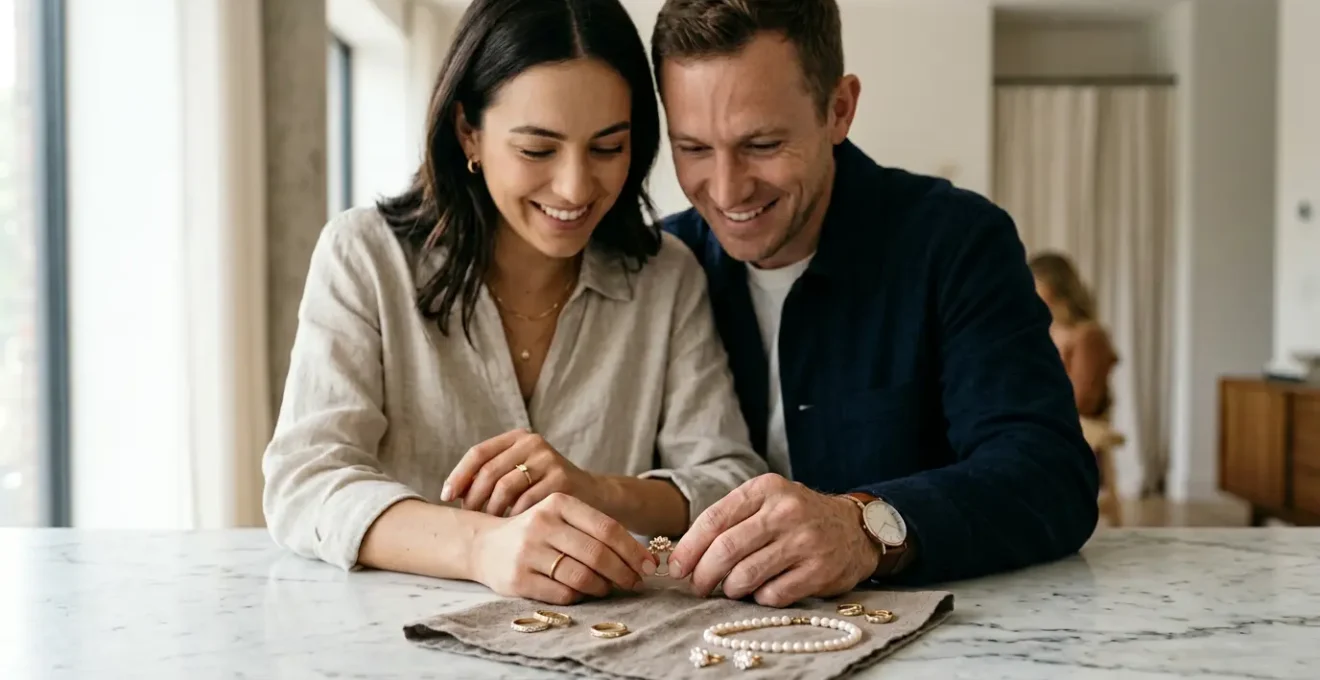
Building a shared jewellery collection is less about finding a neutral aesthetic and more about investing in strategic, interoperable assets.
- Focus on material science and finish durability over outdated gendered style cues.
- Prioritise pieces with high resale liquidity, like iconic unisex designs, which have a broader secondary market.
Recommendation: Begin by creating a ‘wear-and-tear profile’ for both partners to guide your selection of metals and finishes based on your actual lifestyles, not just your tastes.
The concept of a shared wardrobe has evolved from a borrowed hoodie to a curated collection of high-value, interchangeable pieces. Yet, when it comes to jewellery, many couples fall back on the traditional ‘his and hers’ model. The common advice is to compromise on minimalist designs or stick to ‘safe’ metals. This approach often leads to a collection that excites no one and ignores the true potential of shared luxury.
This outdated thinking overlooks a fundamental shift in how we view personal style and assets. The conversation is moving beyond aesthetics and into the realm of practicality, durability, and investment. We see trends like permanent jewellery and even tooth gems gaining traction, proving that adornment is deeply personal and ever-changing. But the smartest couples are looking at their jewellery box not just as a collection of beautiful objects, but as a portfolio of wearable, interoperable assets.
But what if the key to a successful shared jewellery wardrobe wasn’t about finding a bland middle ground, but about strategic selection? What if you could choose pieces that not only transcend gender but are also resilient enough for two different lifestyles and smart enough to hold their value over time? This guide reframes the selection process. We will move away from subjective taste and focus on the practical mechanics of fit, the science of materials, and the financial logic of investing in pieces that are built to be shared.
This article will provide a framework for building a truly functional and valuable shared collection. We will explore the technical barriers to sharing certain pieces, analyse which design elements offer true versatility, and outline how to protect your investment, ensuring your shared jewellery serves both your styles and your future.
Summary: A Strategic Guide to Selecting Shareable Jewellery
- Why Can’t You Share Rings Even If Your Fingers Look the Same Size?
- Box or Curb Chain: Which Link Style is Truly Gender-Neutral?
- Matte or High Polish: Which Finish Appeals More to Masculine Tastes?
- The Risk of One Partner’s Manual Job Ruining a Shared Fine Piece
- Do Unisex Cartier Bracelets Hold Value Better Than Gendered Pieces?
- Why Are Cufflinks the Only Acceptable Jewellery in Conservative Law Firms?
- How to Use a Two-Tone Watch to Anchor a Mixed Metal Look?
- How to Wear Men’s Jewellery in a Corporate Office Without Breaking Protocol?
Why Can’t You Share Rings Even If Your Fingers Look the Same Size?
The ring is the most intimate and symbolic piece of jewellery, but it’s also the least forgiving when it comes to sharing. While you might assume your fingers are “about the same size,” the reality is that fit is a game of millimetres. Factors like knuckle width, finger shape, and even daily fluctuations due to temperature and hydration create significant differences. A ring that is perfect for one partner may be impossible to put on for the other, or dangerously loose. This isn’t just a feeling; it’s a statistical reality. A study from The Knot reveals that for 28% of couples, the ring size difference is over 3 full sizes, making a single shared ring unfeasible.
Beyond simple circumference, the width of the band itself changes the fit. A wide band has more surface area in contact with the skin, creating more friction and requiring a larger size than a delicate, thin band for the same finger. Therefore, even if two partners have the same base ring size, their preference for a chunky versus a slim style could make a shared piece uncomfortable or unwearable for one. Resizing a ring, especially one with stones or intricate patterns, is often a complex and costly process that can compromise the piece’s integrity. It’s not a practical solution for daily swapping. For these reasons, rings are best considered personal, not shared, assets in a couple’s collection.
Box or Curb Chain: Which Link Style is Truly Gender-Neutral?
Unlike rings, necklaces and bracelets offer far more flexibility for sharing. The question of gender neutrality in chains, however, often gets stuck on outdated assumptions. A curb or Cuban link is traditionally coded as “masculine,” while a finer box or rope chain is seen as “feminine.” This perspective is increasingly irrelevant. As a fashion buyer, I can tell you that the industry is rapidly moving past these labels. The rise of genderless styling, particularly among Millennial and Gen Z consumers, prioritises the overall look and feel—the texture, weight, and drape—over archaic stereotypes. It’s no longer about a ‘men’s’ or ‘women’s’ style but about finding a link that complements both partners’ aesthetics.
A box chain is formed from square links, creating a smooth, sleek, and often shiny appearance. It’s minimalist and modern. A curb chain consists of twisted, interlocking links that lie flat, offering a more textured, classic, and substantial feel. The choice isn’t about which is more “unisex” in a vacuum; it’s about which textural quality works better as an interoperable asset for your specific styles. A high-shine box chain might feel too delicate for a partner who prefers rugged textures, while a heavy curb chain could overwhelm someone with a more minimalist aesthetic. A great starting point is a mid-weight Figaro or anchor chain, which incorporates both rounded and elongated links for a balanced, versatile look that reads as both classic and contemporary.
As this detailed comparison shows, the architectural difference between link styles is significant. Rather than asking which is gender-neutral, the strategic question is: which structure and texture will feel most authentic to both of us? The answer lies in trying them on and seeing how they interact with different necklines, skin tones, and personal styles. This hands-on approach discards outdated rules and focuses on what truly works for your shared collection.
Matte or High Polish: Which Finish Appeals More to Masculine Tastes?
The question of whether a matte or high-polish finish is more “masculine” is a trap. It forces a gendered lens onto a purely technical and aesthetic choice. Historically, jewellery was largely genderless, a signifier of status, not gender. As the editorial team at Country & Town House notes, “Jewelry has long sat on the line between genders, is a historically genderless accessory (if Shakespeare can wear a pearl earring, why can’t we?) that has only been fashioned for a gendered audience in the last few hundred years or so.” The progressive way to approach finishes is not by asking what appeals to “masculine tastes,” but by building a durability matrix based on lifestyle.
A high-polish finish is brilliant and reflective, offering a classic, luxurious look. Its downside is that it acts as a mirror for every single scratch and scuff. A matte or brushed finish diffuses light, providing a softer, more contemporary appearance that is exceptionally good at hiding minor daily wear. For a couple with different ‘wear-and-tear profiles’—one working at a desk, the other more hands-on—a matte finish is a far more strategic choice for a shared piece. It maintains its intended look for longer and requires less maintenance. Other options, like a hammered finish, are even more resilient, turning potential damage into part of their inherent texture.
This table from an analysis by Greenwich Jewelers provides a clear breakdown of how different finishes perform in the real world.
| Finish Type | Scratch Visibility | Maintenance Frequency | Lifestyle Match |
|---|---|---|---|
| High Polish | Very Visible | Monthly polishing | Formal occasions, careful wear |
| Matte/Brushed | Less Visible | Annual touch-up | Active lifestyle, daily wear |
| Hammered | Barely Visible | Minimal | Manual work compatible |
| Patina (Living Finish) | Adds character | None needed | All lifestyles |
Ultimately, choosing a finish should be a practical conversation about your combined daily lives. A shared piece with a matte finish is an intelligent investment in longevity and lower cost-of-wear, ensuring it looks good on both partners, no matter what their day entails.
The Risk of One Partner’s Manual Job Ruining a Shared Fine Piece
The single greatest threat to a shared fine jewellery collection is a mismatch in lifestyle-induced wear and tear. A gold bracelet or platinum ring can be a beautiful, lasting asset for someone with a desk job, but for a partner who is a mechanic, a chef, a personal trainer, or a carpenter, that same piece is an accident waiting to happen. Soft precious metals like gold and platinum will inevitably get scratched, dented, or deformed under the stress of manual labour. This isn’t just an aesthetic issue; it can lead to costly repairs and compromise the security of stone settings. Ignoring this reality is the fastest way to devalue your shared investment and create resentment.
The solution is not to avoid fine jewellery altogether. Instead, it requires a pragmatic, two-pronged strategy: duplication and material-specific selection. This means investing in a durable, inexpensive “work double” for the partner with the more demanding job. This allows the precious, shared piece to be reserved for evenings, weekends, and occasions where the risk of damage is minimal. This approach protects the core asset while still allowing for daily adornment that aligns with a professional or active environment. A well-thought-out strategy considers not just impact, but also chemical exposure and heat, matching the right material to the specific job hazard.
Your Action Plan: The Work-Safe Jewellery Strategy
- Assess job hazards: Make a list of daily physical risks (impact, abrasion, chemicals, heat) for the partner with the more manual job.
- Invest in a ‘work double’: Purchase a durable, inexpensive ring or bracelet in a material like tungsten, titanium, or silicone to be worn during work hours.
- Define ‘safe zones’: Agree on when the shared precious piece can be worn (e.g., evenings, weekends, formal events) and where it will be safely stored during work.
- Choose based on risk: If selecting a new piece, match the material to the job. Platinum resists chemicals well, while titanium is excellent for heat. Avoid brittle materials like tungsten for high-impact jobs.
- Create a ‘pendant protocol’: For rings, have a sturdy chain or carabiner available so the ring can be worn as a pendant during unsafe activities, keeping it close without risking damage.
By implementing this strategy, you transform a potential point of conflict into a non-issue. It’s a practical expression of protecting a shared asset, ensuring its beauty and value endure for years to come.
Do Unisex Cartier Bracelets Hold Value Better Than Gendered Pieces?
Investment value and resale potential are critical components of a strategic approach to shared jewellery. In this arena, iconic unisex pieces from heritage brands like Cartier have a distinct advantage. A piece like the Cartier Love or Juste un Clou bracelet isn’t just a piece of jewellery; it’s a globally recognised, liquid asset. Its value retention is driven by timeless design, brand prestige, and a broad, gender-neutral appeal. This is where the concept of “resale liquidity” becomes paramount. A piece that appeals to the entire market—not just a male or female segment—inherently has a larger pool of potential buyers.
The research team at Estate Diamond Jewelry confirms this logic, stating, “A truly unisex piece has a larger potential resale market (appealing to both male and female buyers), which can create a higher price floor compared to a highly stylized, gender-specific piece with a more limited audience.” This wider audience acts as a buffer against fluctuating trends. While a hyper-feminine, floral-motif piece might be in high demand one season and fall out of favour the next, the clean, industrial lines of a Cartier classic remain consistently desirable. This sustained demand helps the piece retain a significant portion of its original retail value, and in some cases, even appreciate over time.
A truly unisex piece has a larger potential resale market (appealing to both male and female buyers), which can create a higher price floor compared to a highly stylized, gender-specific piece with a more limited audience.
– Estate Diamond Jewelry Research Team, 2025 Engagement Ring Market Analysis
This isn’t to say that all unisex pieces are better investments. Brand power is crucial. However, when you combine an iconic brand with a design that has proven, decades-long appeal across genders, you are investing in an asset with superior market stability. For a couple building a shared collection, this means your investment is not only wearable and versatile but also financially sound.
Why Are Cufflinks the Only Acceptable Jewellery in Conservative Law Firms?
In the most conservative corporate environments—think traditional law, finance, or politics—the dress code is built on a foundation of quiet conformity. Here, jewellery is not primarily for self-expression but serves as a subtle signifier of status and attention to detail. Cufflinks have historically held a unique position as one of the few universally accepted forms of male adornment in these settings because they are fundamentally functional. They exist to fasten a shirt cuff. This functional pretext gives them a pass, allowing for a touch of personal flair—a flash of precious metal, a hint of enamel, or a discreet monogram—without being perceived as purely decorative or flamboyant.
This “function-first” principle is the key to understanding the old guard’s protocol. A tie bar is acceptable because it holds the tie in place. A watch is acceptable because it tells time. Anything else—bracelets, necklaces, or rings beyond a simple wedding band—risks being seen as a distraction or a violation of an unspoken code. For a couple navigating this world, the cufflink represents the most traditional and safest form of shared jewellery. A classic, well-made pair in silver or gold can be worn by either partner with a French cuff shirt, making it a truly interoperable and protocol-proof asset for formal professional settings.
How to Use a Two-Tone Watch to Anchor a Mixed Metal Look?
The old rule of “never mix your metals” is dead. Today’s style is about intentional, confident layering. For couples, this opens up a world of possibilities, but it can also feel chaotic. The single most effective tool for unifying a mixed-metal look across two people is a two-tone watch. This single piece, combining metals like steel and yellow gold or steel and rose gold, acts as an “anchor piece.” It gives you explicit permission to wear both metals elsewhere, creating a cohesive and deliberate look rather than an accidental clash.
The trend towards mixing metals is not just anecdotal; it’s backed by data. Recent studies show a near-even split in consumer preference, with Jewelers Mutual’s 2024 analysis indicating that among those buying rings, there’s a balanced preference for different metals, with 35% choosing white gold and 36% yellow gold. This signals that consumers are comfortable with and actively seeking variety. A two-tone watch is the perfect bridge. If one partner wears a steel and yellow gold watch, it creates a visual link that allows the other partner to confidently wear a simple yellow gold chain, even if their wedding band is platinum. The watch becomes the reference point that ties everything together.
To execute this successfully, follow a few simple principles:
- Create a Dominant/Accent Ratio: Use the watch to establish a primary and secondary metal. If the watch is mostly steel with gold accents, make steel the dominant metal in your other pieces (e.g., a steel bracelet) and add one or two smaller gold items (e.g., a ring).
- Match the Watch’s Dominant Metal: For maximum cohesion, match the dominant metal of the watch to your most significant other piece, typically a wedding band.
- Layer with Intention: When layering chains or bracelets, use a 2:1 ratio of the two metals to create a look that feels curated, not random.
By leveraging a two-tone watch as your anchor, you and your partner can break free from outdated rules and build a shared look that is dynamic, modern, and perfectly harmonised.
Key Takeaways
- Focus on durability and lifestyle compatibility (matte finishes, strategic metals) over subjective “masculine” or “feminine” aesthetics.
- Treat iconic, unisex designs from heritage brands as liquid assets with higher resale value due to a broader potential market.
- Use a two-tone watch as a strategic ‘anchor piece’ to unify a mixed-metal look across both partners, creating cohesion and stylistic permission.
How to Wear Men’s Jewellery in a Corporate Office Without Breaking Protocol?
Navigating jewellery in a corporate setting is no longer a niche concern. With a recent Grand View Research survey showing that 78% believe that men’s jewelry is becoming increasingly mainstream, the question is not *if* jewellery can be worn, but *how*. The key to wearing personal or shared pieces in an office without breaking protocol is to adhere to three principles: subtlety, scale, and context. The goal is for your jewellery to be a quiet complement to your professional attire, not the focal point. For shared pieces, this means selecting items that read as sophisticated and understated on both partners.
A minimalist watch, a simple band, or a thin chain worn under a shirt are universally safe bets. These items are classic and their presence is discreet. When it comes to more visible pieces like earrings or signet rings, scale is everything. A small diamond stud (4mm or less) or a discreet signet ring worn on the pinky finger is far less conspicuous than a larger, more ornate piece. The acceptability of each item is highly dependent on your specific industry and office culture, but a well-chosen, subtle piece can signal attention to detail and personal style without appearing unprofessional.
This table offers a clear guide to shared jewellery options and their general level of acceptance in a corporate environment, helping you and your partner make strategic choices.
| Jewelry Type | Corporate Acceptability | Sharing Potential | Styling Tips |
|---|---|---|---|
| Diamond Studs | High | Excellent | 4mm or smaller for conservative offices |
| Thin Chain | Medium (under shirt) | Excellent | Keep under 3mm width, 18-20 inches |
| Simple Band | High | Good | Plain metal or single stone accent |
| Minimalist Watch | High | Good | Leather or metal band under 42mm |
| Small Signet Ring | Medium-High | Moderate | Pinky finger placement less conspicuous |
By choosing wisely, you can integrate your shared jewellery into your work life seamlessly. The modern professional wardrobe has room for personal expression; success lies in executing it with sophistication and an awareness of your environment.
Start by assessing your current pieces against this new framework of durability, interoperability, and resale liquidity to identify the strongest assets in your shared collection.