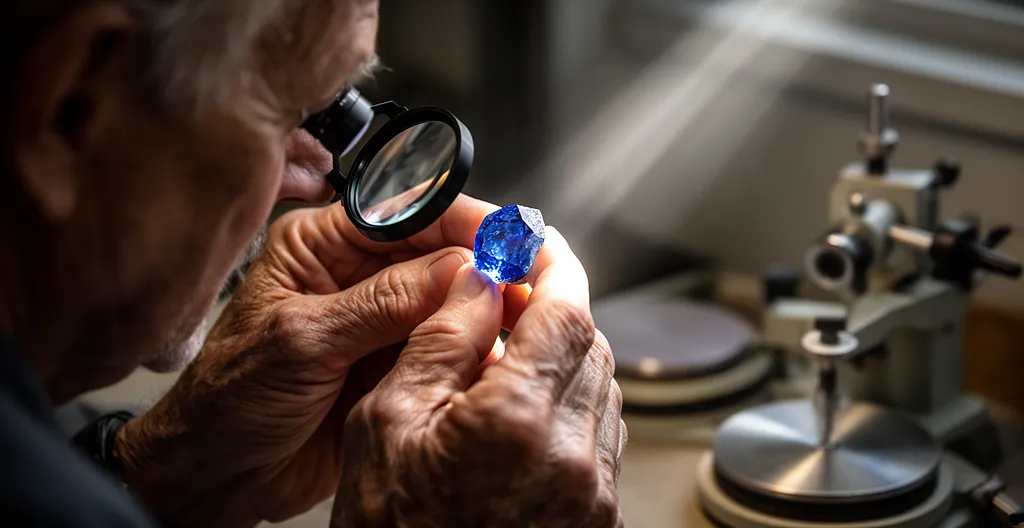
Deciding to recut a damaged gemstone is not a gamble, but a calculated analysis of risk versus reward.
- Weight loss is inevitable, but its extent depends entirely on the damage’s location and depth.
- Recutting offers the opportunity to dramatically improve a stone’s brilliance, colour, and even its market value by correcting original cutting flaws.
Recommendation: Before deciding, use a lapidary’s diagnostic framework to assess if the potential for optical and value enhancement outweighs the inherent loss of carat weight.
Holding a chipped sapphire or a scratched diamond is a uniquely disheartening experience. The stone, once a symbol of permanence, now bears a mark of imperfection. The immediate question that arises is not just “Can this be fixed?” but “Is it worth fixing?”. The internet offers a simple, yet unsatisfying answer: it depends. It depends on the stone’s value, the cost of repair, and the skill of the lapidary. While true, this advice leaves you, the owner, without a clear framework for making a sound decision. You are left to worry about the primary fear associated with recutting: the loss of carat weight and, by extension, value.
This guide offers a different perspective. We will step into the mind of a master lapidary to reframe the problem. The question isn’t merely about repairing damage, but about seizing an opportunity. A recut is a chance to re-evaluate the gem’s core potential—to correct flaws from its original cutting, to intensify its latent colour, and to maximize its interaction with light. Often, a well-executed recut can increase a stone’s beauty and market value, even as its carat weight decreases. The key is understanding the strategic trade-offs.
We will move beyond the simple fear of weight loss and delve into the technical realities of the process. We’ll explore the geometry of light performance, the specific cuts that enhance durability, and the delicate handling required for sensitive materials. This is not about getting a simple “yes” or “no” answer. It is about equipping you with the knowledge to perform a preliminary diagnosis of your stone and to have an intelligent, informed conversation with a professional cutter. The goal is to transform a moment of damage into a decision of strategic enhancement.
Summary: A Lapidary’s Guide to Gemstone Recutting
- How Much Weight Will Your Diamond Lose If You Repair a Chip on the Girdle?
- How to Close the “Window” in a Poorly Cut Gemstone to Improve Sparkle?
- Buff Top or Full Facet: Which Cut Hides Scratches Better?
- The Risk of Recutting Opal or Tanzanite Without Cooling Fluid
- Does Recutting an Old European Cut Diamond Increase its Value?
- How Does a Deep Belly Cut Enhance the Colour of a Pale Sapphire?
- How Does a Checkerboard Cut Hide Flaws in Large Quartz Stones?
- Which Semi-Precious Stone Offers the Best Hardness for Daily Rings?
How Much Weight Will Your Diamond Lose If You Repair a Chip on the Girdle?
The primary concern for any owner considering a recut is weight loss. There is no avoiding it; removing a chip means grinding away material. The amount lost, however, is not arbitrary. It is a direct function of the chip’s location and depth. A minor chip confined to the girdle (the stone’s widest edge) may require only a slight reshaping, resulting in a minimal loss of 5-10%. However, a deeper fracture that extends into the crown or pavilion forces a more aggressive approach, potentially requiring a complete recut of that section of the stone.
The potential for loss can be severe. For instance, a documented sapphire recut case showed a 70% weight loss, transforming a poorly cut 1.7-carat stone into a brilliant 0.52-carat gem. This represents a worst-case scenario where the original cut was so inefficient that salvaging the stone required drastic measures. Conversely, the outcome can be far more favourable. In a documented repair, a tanzanite that was abraded and windowed underwent repairs with a minimal weight loss of less than 5%. This stark contrast highlights the importance of a proper “diagnostic geometry” before any work begins.
A lapidary doesn’t just see a chip; they see a geometric problem. The goal is to remove the least amount of material necessary to eliminate the damage while creating a stable and visually appealing facet pattern. A chip on a crown facet might necessitate recutting all the crown facets to maintain symmetry, leading to a 10-20% loss. Damage near the culet (the bottom point) is far more dangerous, as it can compromise the stone’s entire structure and may lead to a 25-40% loss. Understanding these risk factors is the first step in making an informed choice.
Your Action Plan: Assessing the Risk of Your Chipped Gemstone
- Low-risk (Girdle Edge): A chip on the outer edge often requires only minor reshaping. Expect a potential weight loss of 5-10% as the cutter refines the outline.
- Medium-risk (Crown Facets): Damage on the top facets may force a recut of the entire crown to maintain symmetry. This typically involves a 10-20% weight loss.
- High-risk (Pavilion): A chip on the underside, especially near the point (culet), is serious. It threatens the stone’s integrity and light return, potentially leading to a 25-40% loss to get below the damage.
- Critical-risk (Table): Damage on the large top facet (the table) is the most challenging. It often requires significantly lowering the table to get underneath the fracture, which can mean a complete recut and a loss of 30-50%.
How to Close the “Window” in a Poorly Cut Gemstone to Improve Sparkle?
Beyond repairing damage, recutting offers a profound opportunity: correcting flaws in the original cut. The most common of these is “windowing.” A window is a dead area in the center of a gemstone that looks transparent and lifeless. It occurs when the pavilion angles—the facets on the stone’s underside—are too shallow. Instead of acting like mirrors that bounce light back to the eye (a phenomenon called Total Internal Reflection or TIR), they allow light to leak straight through the bottom. The result is a stone with a brilliant edge and a dull, washed-out center.
As professional cutter Gene noted on the PriceScope forums, this has a major impact on colour: “A windowed stone will show a color zone much more than one that has even brilliance all over. Usually the color intensity is better in a well cut stone.” Closing this window is a primary goal of a “performance cut.” A lapidary will carefully re-grind the pavilion facets to a steeper, critical angle. This angle varies depending on the gem’s refractive index, but the goal is always the same: to turn the pavilion into a perfect set of internal mirrors.
This paragraph introduces the complex concept of Total Internal Reflection. To understand it better, it’s helpful to visualize the light’s path. The illustration below breaks down this process, showing how correct angles trap light and return it as brilliance.
As this diagram shows, when the pavilion facets are cut to the correct angle, they force incoming light to reflect internally and exit through the top of the stone, creating sparkle and brilliance. Fixing a window almost always requires sacrificing some diameter and weight to achieve the necessary depth and angles. However, the trade-off is a dramatic increase in the stone’s visual appeal and, consequently, its value. A smaller, brilliant stone is almost always preferable to a larger, lifeless one.
Buff Top or Full Facet: Which Cut Hides Scratches Better?
When repairing surface damage like scratches or abrasions, a lapidary must decide on the new surface finish. The choice often comes down to two styles: a traditional full facet or a “buff top.” A full-facet polish involves re-polishing the existing flat facets, which preserves the stone’s sharp, scintillating light play. A buff top, however, involves creating a smooth, domed, unfaceted surface on the crown of the stone, while the pavilion remains faceted. This cut creates a soft, luminous glow and a sense of depth, rather than sharp sparkle.
In the context of hiding future wear, the buff top has a distinct advantage. Its smooth, curved surface has no sharp facet junctions, which are the most vulnerable points for chipping and showing wear. Scratches on a buff top tend to be less noticeable than on a faceted surface, where they can disrupt the clean lines and reflections. However, this durability comes at the cost of brilliance. A full facet design is engineered to maximize light return and sparkle, something a buff top cannot replicate. The decision involves a trade-off between durability and traditional light performance.
The following table outlines the key differences, helping you understand which approach might be better suited for your stone and lifestyle. As this comparative analysis from the International Gem Society shows, the choice depends on the material and intended use.
| Aspect | Buff Top | Full Facet |
|---|---|---|
| Scratch Visibility | Minimal – smooth surface shows fewer flaws | More visible – each facet junction can show wear |
| Light Performance | Soft glow, depth perception | Sharp scintillation, maximum brilliance |
| Durability | Higher – no sharp edges to chip | Lower – facet junctions vulnerable |
| Best For | Phenomenal stones, high-wear jewelry | Clean, transparent material |
It’s also critical to understand that not all damage is equal. A case study on sapphire repair highlights this well: a small ‘ding’ proved more significant than a long, dramatic scratch from a diamond. The scratch was superficial and could be polished away easily. The ding, however, had sent small fractures deeper into the stone, requiring the cutter to enlarge the table significantly to get underneath the damage. This demonstrates that the type of impact is more critical than its surface appearance.
The Risk of Recutting Opal or Tanzanite Without Cooling Fluid
Not all gemstones are created equal in terms of their resilience. While diamonds and sapphires are incredibly hard and durable, others are sensitive to heat and pressure. Opals, tanzanites, emeralds, and peridots are prime examples. For these materials, the recutting process carries a significantly higher risk. The friction from the grinding lap generates intense heat, and without proper management, this thermal shock can cause a sensitive stone to fracture or even shatter on the wheel.
This is why a master lapidary’s process for such stones is radically different. The key to success is meticulous temperature control. A constant flow of cooling fluid, typically water or a specialized oil-based coolant, is non-negotiable. This fluid serves two purposes: it washes away the ground-off material and, more importantly, it dissipates heat from the surface of the gem. The lapidary will also use a much lighter touch, applying minimal pressure and frequently lifting the stone from the lap to allow it to cool.
The entire process is slower and more deliberate. Success with these delicate materials is a testament to the cutter’s patience and technical discipline. When done correctly, the results can be just as stunning, as professional recutting data shows that tanzanite repairs can be achieved with under 5% weight loss when proper cooling protocols are followed. The protocol for these stones is strict and methodical:
- Pre-Cooling: The process begins by ensuring the stone is at or below room temperature before it ever touches the lap.
- Continuous Coolant: A steady drip or flow of water or oil is directed at the point of contact between the gem and the lap.
- Minimal Pressure: The cutter applies very light pressure, letting the diamond-impregnated lap do the work, and lifts the stone frequently.
- Temperature Monitoring: The stone’s temperature is checked by touch every 30-60 seconds to ensure it does not become warm.
- Cooling Breaks: Deliberate pauses are taken between cutting each facet to allow any residual heat to dissipate completely.
Attempting to recut a heat-sensitive stone without these precautions is not a risk; it is a near-certainty of destruction. This is a critical factor to discuss with any potential cutter, as it separates the amateur from the true professional.
Does Recutting an Old European Cut Diamond Increase its Value?
A common dilemma involves vintage diamonds, particularly the Old European Cut (OEC). These stones were cut by hand in the late 19th and early 20th centuries, prized for their soft, romantic sparkle under candlelight. Compared to a Modern Round Brilliant (MRB), they have a smaller table, a higher crown, and a large, open culet. The question often arises: should one recut an OEC into a modern brilliant to “improve” it? The answer is a firm “it depends on the quality of the original cut.”
There is a misconception that all old cuts are inferior. As one gemology expert on the PriceScope community forum wisely stated, “There is very little difference between a well cut ‘native cut’ gem and a well cut ‘precision cut’ gem. It’s the poorly cut gems which can give the rest a bad reputation.” A well-proportioned OEC is a beautiful and valuable item in its own right, with a dedicated market of collectors. Recutting such a stone would destroy its antique character and could potentially decrease its value, despite achieving modern proportions.
However, many older stones were cut to prioritize weight retention over performance. If an OEC is poorly proportioned—perhaps lopsided, too deep, or windowed—a recut into a modern brilliant can be a transformative act. While this will inevitably cause weight loss (often 15-25%), the resulting improvement in brilliance and fire can dramatically increase the stone’s per-carat price and overall market value. This is the ultimate proof that carat weight is not the only determinant of value. As one cutter described in a reflection on the value impact of recutting, it’s a great feeling to sell a recut stone and realize its value has increased, despite its carat weight decreasing.
The decision requires a careful evaluation. If the stone is a fine example of a historic cut, it should be preserved. If it is a compromised stone that happens to be old, a modern recut can unlock its true potential, transforming it from a dim antique into a dazzling modern gem.
How Does a Deep Belly Cut Enhance the Colour of a Pale Sapphire?
One of the most powerful tools a lapidary has for manipulating a gemstone’s appearance is controlling its proportions, specifically the depth of its pavilion. This is especially true for coloured stones like sapphires, where the goal is to achieve the richest, most saturated colour possible. For a pale or lightly coloured piece of rough, a shallow cut would produce a washed-out, lifeless gem. To combat this, cutters employ a technique known as the “deep belly” pavilion.
A deep belly means the pavilion is cut with extra depth, creating a longer path for light to travel through the gemstone. As light travels through the stone, it is selectively absorbed, and the stone’s inherent colour becomes more apparent. The longer the light path, the more absorption occurs, and the more saturated the colour appears to the eye. A cutter will strategically add depth to intensify a pale stone’s hue, finding the sweet spot where colour is maximized without making the stone look dark or overly heavy.
This process often involves a significant reduction in the stone’s face-up size relative to its weight. For example, a documented Thai sapphire recut showed a 32% weight reduction (from 1.25ct to 0.85ct) which resulted in a dramatic enhancement from a pale, zoned stone to one with rich, even colour. This is a deliberate sacrifice. The cutter gives up spread and carat weight to gain a massive improvement in the most important value factor for sapphires: colour.
It is a mistake to assume that a stone with a deep belly is always poorly cut. In many cases, especially with “native cut” or “commercial cut” stones from their country of origin, the cutter made a brilliant decision. They understood the rough material and intentionally created a deep belly because it was the only way to produce the best possible colour from that specific piece. They created the most valuable gem possible from the rough, even if the proportions seem unconventional.
How Does a Checkerboard Cut Hide Flaws in Large Quartz Stones?
While some recutting aims to remove flaws, another strategy is to cleverly disguise them. This is particularly useful in large, transparent stones of lower value, such as quartz, where significant weight loss for a small inclusion is not economically viable. One of the most effective techniques for this is the checkerboard cut. This style features a crown covered in square or diamond-shaped facets arranged in a grid-like pattern, resembling a checkerboard.
The genius of this cut lies in its ability to create “visual noise.” The multitude of small, flat facets creates a busy surface pattern with many points of reflection. This complex pattern breaks up the viewer’s line of sight through the stone, making it much more difficult to spot internal features like small inclusions, fractures, or zones of uneven colour. The eye is distracted by the play of light across the facets, and the flaws fade into the background. The technique is a form of optical camouflage.
A lapidary can employ several visual disruption techniques to hide inclusions, all based on this principle:
- Create a busy surface pattern with many small, square facets in a grid formation.
- Use broad, slightly curved facets to create a “liquid” appearance that distorts the view of the interior.
- Combine a checkerboard crown with a brilliant-style pavilion for a dual effect of surface distraction and internal sparkle.
- Orient the checkerboard pattern to maximize reflection and glare directly over the inclusion zones.
- Polish the facets to an extremely high lustre to maximize surface reflection and further distract the eye.
This approach highlights a fundamental truth in gemology, as articulated by the International Gem Society: “For an inexpensive gem, like a basic piece of quartz, the cut may account for virtually all its value.” In these cases, the lapidary’s skill is not in preserving material, but in using artistry to create a beautiful object from imperfect rough. The cut itself becomes the main source of the gem’s beauty and worth.
Key takeaways
- The decision to recut is a strategic analysis, weighing carat loss against potential gains in brilliance, colour, and durability.
- A gem’s cut is not just for beauty; it’s a technical solution to the physical properties of the material, from hiding flaws to maximizing colour.
- Material hardness (Mohs) is only part of the story; toughness and heat sensitivity are critical factors in determining a stone’s suitability for daily wear and the risks of recutting.
Which Semi-Precious Stone Offers the Best Hardness for Daily Rings?
The need for recutting often arises from damage sustained during daily wear. This brings up a crucial preventative point: choosing the right stone for the right purpose. For a ring worn every day, hardness and toughness are the most important properties to consider. Hardness, measured on the Mohs scale from 1 to 10, indicates a material’s resistance to scratching. Toughness refers to its resistance to chipping and breaking upon impact. An ideal stone for daily wear scores high in both.
The champions in this category are the corundum family (sapphire and ruby) at 9 on the Mohs scale, and spinel at 8. These gems combine excellent hardness with very good toughness, making them resilient enough to withstand the inevitable bumps and scrapes of daily life. As one case study on sapphire’s durability notes, its superb hardness and good toughness make it an excellent choice for a daily-wear ring. However, it also adds a crucial dose of realism: “But it’s not indestructible. Hard wear and carelessness can damage sapphire, sometimes beyond repair. This is also true of diamonds.”
Other stones can be suitable, but require more care. Tourmaline and garnet (Mohs 7-7.5) are capable but not as robust as sapphire. Stones like tanzanite, amethyst, or peridot (Mohs 6.5-7) have only fair toughness and are best reserved for occasional wear. At the bottom of the scale for daily rings are stones like opal and moonstone, which are soft and have poor toughness, making them highly susceptible to damage. The following table provides a clear tier system for selecting a stone based on its durability.
| Tier | Gemstones | Mohs Hardness | Toughness | Daily Wear Rating |
|---|---|---|---|---|
| Champions | Sapphire, Ruby, Spinel | 9, 8 | Excellent | Ideal |
| Capable with Care | Tourmaline, Garnet | 7-7.5 | Good | Very Good |
| Weekend Warriors | Tanzanite, Amethyst | 6.5-7 | Fair | Occasional |
| Handle with Care | Opal, Moonstone | 5.5-6.5 | Poor | Special Occasions Only |
Ultimately, choosing a stone for a ring is a personal decision, but understanding these durability tiers is essential for managing expectations. Selecting a “Champion” tier stone doesn’t grant immunity from damage, but it significantly lowers the risk, ensuring your treasured gem is more likely to endure for years to come without needing the intervention of a lapidary.
By adopting a lapidary’s mindset, you can transform the daunting task of repairing a damaged stone into a strategic opportunity. Assess the risks, understand the potential for enhancement, and make an informed decision to restore your gem to its most beautiful and valuable state.