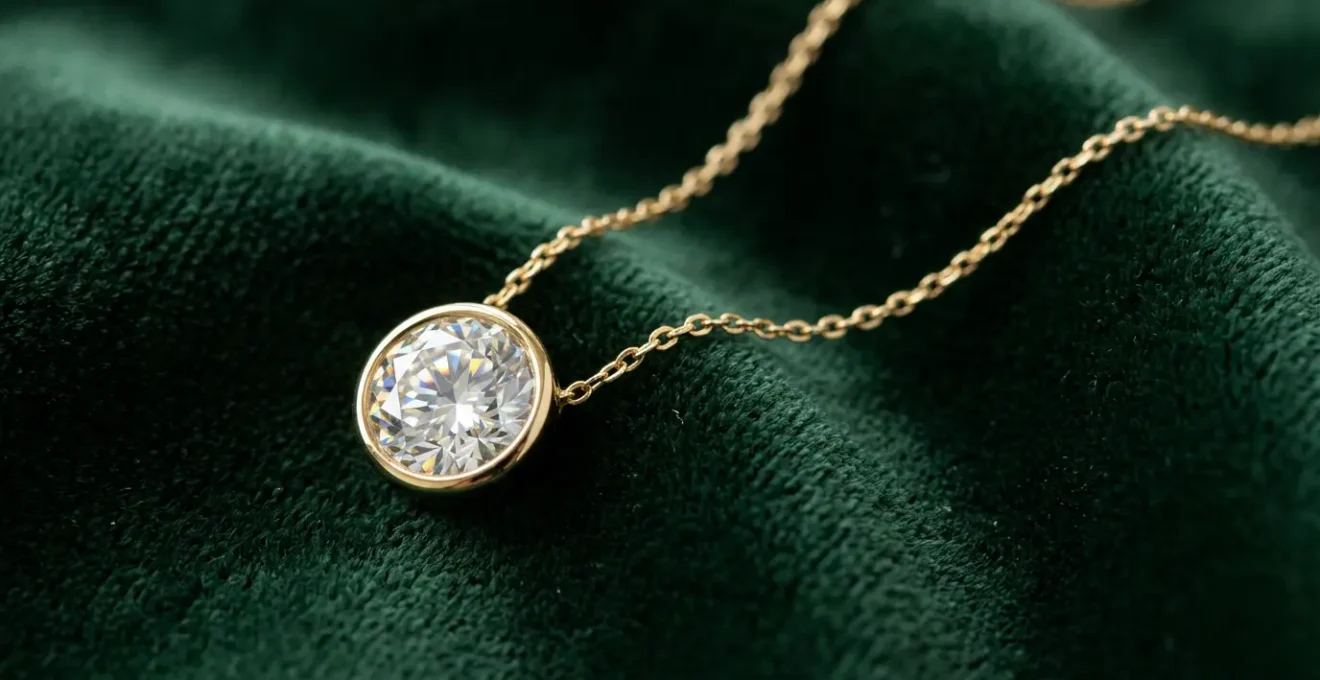
A flipping pendant is a symptom of a design imbalance, not a wearer’s mistake.
- The issue stems from a high center of gravity and an unstable pivot point at the bale.
- Chain weight and stiffness are critical components that can either cause or correct the problem.
Recommendation: Prioritize pendants with a sliding bezel and pair them with a solid, appropriately weighted chain to engineer an inherently stable system.
The frustration is universal: you invest in a beautiful diamond pendant, only to find it has spent half the day facing backwards. This constant flipping is not just an annoyance; it’s a sign of a fundamental imbalance in the jewelry’s design. Many believe the solution lies in simple tricks like shortening the chain or using a heavier one, but these are often just bandages on a deeper mechanical issue. From a jewellery designer’s perspective, a flipping pendant is a solvable physics problem related to its center of gravity, the mechanics of its bale, and the dynamics of the chain it hangs from.
Understanding this issue requires looking at the necklace not as separate components, but as a single, interconnected system. The pendant’s weight, the shape and position of its connection point (the bale), and the chain’s structure all contribute to creating either a stable equilibrium or a constant tendency to twist. The market for fine jewellery continues to grow, with the average price for pieces like gold fashion pendants set with natural diamonds averaging $534, making it crucial to select a piece that is not only beautiful but also well-engineered for daily wear.
This guide moves beyond generic advice to provide a technical breakdown of why pendants flip. We will deconstruct the problem from an engineering standpoint, analyzing how each design choice—from the bale to the prong count—impacts the stability and performance of your diamond pendant. By understanding these principles, you can diagnose an existing piece or make an informed choice for your next purchase, ensuring your diamond always shines forward.
To navigate this technical analysis, this guide is structured to address each critical component of the pendant-chain system. Explore the sections below to understand the mechanical forces at play and learn how to select a pendant engineered for perfect stability.
Summary: The Engineer’s Guide to Stable Diamond Pendants
- Why a Sliding Bezel Protects Your Diamond Chain Better Than a Fixed Bale?
- 0.50ct or 1.00ct: Which Size Sits Best in the Suprasternal Notch?
- 4-Prong or 6-Prong: Which Setting Lets More Light into a Solitaire Pendant?
- The Risk of Pairing a Heavy Diamond with a Hollow Rope Chain
- How to Adjust Your Pendant Length to Sit Perfectly Over High-Neck Jumpers?
- The Risk of Wearing a Prong-Set Bracelet with Delicate Knitwear
- How to Stop Your Choker Clasp from Spinning to the Front?
- 3-Prong or 4-Prong: Which Tennis Bracelet Style Sits Flat on the Wrist?
Why a Sliding Bezel Protects Your Diamond Chain Better Than a Fixed Bale?
The primary culprit behind a flipping pendant is almost always its bale—the loop that connects it to the chain. A fixed bale, which is soldered directly to the top of the pendant, creates a high and rigid pivot point. This design raises the pendant’s overall center of gravity. Any movement, from walking to turning your head, introduces torsional stress on the chain, causing this top-heavy system to easily flip over to find a more stable, albeit incorrect, position. A jewelry expert on the PriceScope forum perfectly summarizes the mechanics involved, stating:
By simple high-school physics, the lower set the better, the shorter the chain the better, the heavier the pendant (metal plus stone) the better.
– PriceScope Community Member, PriceScope Forum Discussion
In contrast, a sliding bezel or a “rabbit ear” bale, where the chain passes directly through the setting itself, is an inherently more stable design. This configuration lowers the center of gravity significantly. The pendant is free to slide along the chain, allowing it to self-center naturally at the lowest point of the chain’s catenary curve. Furthermore, this design distributes wear and tear along a larger section of the chain, preventing the focused friction damage that can occur with a fixed bale. A sliding design essentially “goes with the flow,” absorbing movement rather than fighting against it.
This table breaks down the key mechanical differences between the two primary pendant suspension systems.
| Feature | Sliding Bezel | Fixed Bale |
|---|---|---|
| Self-centering ability | Excellent – naturally finds lowest point | Poor – fixed position |
| Chain wear distribution | Distributed over longer section | Concentrated at single point |
| Flipping resistance | High – allows natural movement | Low – prone to torsional stress |
| Chain flexibility requirement | Works with most chain types | Requires specific chain weight/stiffness |
0.50ct or 1.00ct: Which Size Sits Best in the Suprasternal Notch?
The size and weight of the diamond play a crucial role in how a pendant behaves when worn. The suprasternal notch—the small hollow at the base of the neck—is the natural resting place for a solitaire pendant. The goal is for the diamond to sit securely within this space. While a larger diamond offers more visual impact, its increased weight and surface area can make it more prone to instability if not set correctly. Recent market data shows a clear trend towards larger stones, with the average diamond size purchased increasing to 1.39 carats in early 2024.
A 0.50ct diamond (approximately 5.0mm in diameter) is often an ideal size for nestling perfectly in the notch. Its lower mass and smaller profile make it less susceptible to the leverage that causes flipping. It can be supported by a wider variety of chain styles without issue. A 1.00ct diamond (approximately 6.5mm in diameter), however, has significantly more mass. While this added weight can contribute to stability (as per the physics principle), it also presents a greater engineering challenge. If the setting has a high center of gravity (like a tall basket with a fixed bale), the weight of the 1.00ct stone will amplify the flipping force.
The growing consumer preference for larger diamonds, with demand for 2-carat stones rising to 10% of demand by units sold in early 2024, underscores the need for better-engineered settings. For a larger stone to sit properly, the setting must be designed to keep the center of gravity as low as possible. This means prioritizing sliding bezels or basket settings with integrated bales that allow the chain to pass through the body of the pendant itself, ensuring the heavier diamond remains stable and forward-facing.
4-Prong or 6-Prong: Which Setting Lets More Light into a Solitaire Pendant?
The prong setting is a classic choice for solitaire pendants, designed to hold the diamond securely while maximizing its exposure to light. The choice between a 4-prong and a 6-prong setting presents a fundamental trade-off between sparkle and security, which also indirectly impacts stability. A 4-prong setting uses less metal, leaving more of the diamond’s surface area, particularly the pavilion (the lower part), open to light. This generally results in more brilliance and fire, as light can enter and exit the stone with minimal obstruction. However, the squarer shape it imparts on a round diamond and the reduced number of contact points can sometimes contribute to a less balanced weight distribution, making it slightly more prone to tipping if not perfectly paired with its chain and bale.
A 6-prong setting, on the other hand, offers superior security. The additional two prongs provide redundancy and a more secure grip on the diamond’s girdle. This setting also creates a more rounded, “flower-like” appearance. While it covers slightly more of the diamond’s surface, a well-executed 6-prong setting with delicate prongs will have a negligible impact on light performance for the casual observer. More importantly for stability, the six points of contact often create a more balanced and symmetrical weight distribution around the stone’s center, which can help resist the twisting forces that cause flipping.
Ultimately, the choice is not just about light but about the entire system’s balance. A 4-prong setting can be perfectly stable with a low-profile basket and a sliding bale. A 6-prong setting can provide extra peace of mind for active wearers while contributing to the overall equilibrium of the pendant. An open basket design is also crucial, as it allows light to enter from the sides regardless of the prong count.
Your Action Plan for Selecting a Stable Setting
- Assess the stability-sparkle trade-off: 4-prong settings maximize light, but a 6-prong design can offer a more balanced weight distribution to resist flipping.
- Evaluate your lifestyle: For active wearers, the added security of a 6-prong setting is a significant advantage.
- Consider the diamond shape: Round diamonds are versatile, but square or rectangular shapes benefit from the corner protection of a 4-prong setting.
- Check the basket design: Prioritize settings with open baskets and a low profile to allow maximum light entry and keep the center of gravity low.
- Test the weight distribution: A 6-prong setting typically provides a more even distribution of metal weight, which is a key factor in anti-flip performance.
The Risk of Pairing a Heavy Diamond with a Hollow Rope Chain
The chain is not just a carrier; it’s an active component in the stability equation of a pendant. The wrong chain can undermine even the most well-designed pendant. A common mistake is pairing a substantial diamond pendant with a hollow rope chain. While these chains offer a voluminous look for a lower price point, their construction makes them fundamentally unsuitable for heavy pendants. They are lightweight, structurally weak, and prone to denting and kinking. More importantly, their stiffness and lack of density fail to provide the necessary counterbalance and dampening effect to prevent a heavy pendant from twisting and flipping.
A solid chain is essential for supporting any pendant of significant weight (typically over 0.50ct). Solid chains, such as a solid rope, snake chain, or box chain, provide the necessary mass and structural integrity. As noted by industry expert David S. Atlas, the chain’s properties are a critical part of the solution:
A heavier chain will help, a stiffer chain will help, wide is good, shorter length is good… if the chain is more than 20-24 inches long, it won’t matter much what you do.
– David S. Atlas, GG(GIA), PriceScope Expert Discussion
A solid chain acts as a stabilizer. Its weight helps to keep the entire necklace system anchored, and its flexibility allows it to drape naturally and absorb movement without transmitting torsional stress to the pendant. Snake chains are particularly effective due to their high density, smooth surface, and fluid movement, making them an ideal choice for heavier pendants.
This comparison highlights the vast difference in structural integrity between hollow and solid chains, making it clear why one is a risk and the other a necessity for valuable pendants.
| Chain Type | Weight (18″ 1.5mm) | Structural Integrity | Flexibility | Suitable Diamond Weight |
|---|---|---|---|---|
| Hollow Rope | 2-3 grams | Weak – prone to denting | Stiff | Under 0.5ct |
| Solid Rope | 5-7 grams | Strong | Fluid | Up to 2ct+ |
| Snake Chain | 4-6 grams | Very Strong | Very Fluid | Ideal for all weights |
How to Adjust Your Pendant Length to Sit Perfectly Over High-Neck Jumpers?
Styling a pendant over clothing, especially thick fabrics like high-neck jumpers or turtlenecks, introduces a new set of physical challenges. The friction between the chain and the fabric, combined with the uneven surface of knitwear, can easily cause a pendant to snag, sit awkwardly, or flip over. The key to successful layering is selecting the right chain length and pendant style to overcome these forces. A standard 16- or 18-inch chain that sits perfectly on bare skin will often get lost or caught on a crew neck sweater.
To ensure a pendant drapes correctly over a high-neck jumper, a longer chain is required. A 22 to 24-inch chain will typically have enough length to form a graceful catenary curve over the fabric, allowing the pendant’s weight to anchor it in place. The type of chain also becomes more important. Heavier chains like snake or box chains have the mass needed to overcome fabric friction and maintain a clean drape. For maximum versatility, an adjustable lariat or a chain with a sliding ball clasp allows you to fine-tune the length for any neckline, from a V-neck to a turtleneck.
The pendant’s setting is another crucial consideration. Prong settings are notorious for snagging on delicate knitwear, which can both damage the garment and cause the pendant to flip. Bezel or channel-set pendants are far superior choices for wearing over sweaters. Their smooth, metal-enclosed edges glide over fabric without catching, ensuring the pendant stays in place and both your jewelry and clothing remain undamaged. When styling with knitwear, always prioritize a snag-free design and sufficient chain length to ensure an elegant and stable presentation.
The Risk of Wearing a Prong-Set Bracelet with Delicate Knitwear
The principles of stability and material interaction extend beyond pendants. A prong-set tennis bracelet, for example, presents a similar risk when worn with delicate fabrics like cashmere or silk. While beautiful, the exposed prongs that hold each diamond act like tiny claws. As you move your arm, these prongs can easily catch on the fine fibers of a sweater, causing pulls, snags, and potentially irreparable damage to the garment. This snagging can also put stress on the prongs themselves, increasing the risk of one becoming loose and compromising the security of a diamond.
The risk level is directly related to the profile of the prongs. Sharp, “claw” style prongs are the highest risk and should be avoided entirely with delicate knitwear. Standard rounded prongs are safer but still protrude enough to pose a threat. The safest prong options are short, stubby prongs that sit low against the diamond. However, the ultimate solution for worry-free wear with any fabric is to choose a bracelet with a completely smooth profile. Settings like bezel, channel, or pavé encase the diamonds in metal, leaving no exposed edges to catch on clothing. These designs offer a sleek, modern aesthetic while providing total peace of mind.
Understanding the risk associated with different prong profiles is essential for preserving both your jewelry and your wardrobe. This scale helps quantify the danger each setting type poses to delicate fabrics.
| Setting Type | Risk Level | Description | Recommended For |
|---|---|---|---|
| Sharp Claw Prongs | High | Pointed tips catch fibers easily | Avoid with knitwear |
| Standard Rounded Prongs | Medium | Smooth but still protrude | Careful wear only |
| Short Stubby Prongs | Low | Minimal protrusion | Occasional knitwear contact |
| Bezel/Channel/Pavé | Zero | No exposed prongs | Safe for all fabrics |
How to Stop Your Choker Clasp from Spinning to the Front?
A choker or short necklace presents a unique stability challenge: clasp rotation. Because the chain is short and sits snugly against the neck, there is very little gravitational pull to keep the heaviest part (the clasp) at the back. The natural movements of the neck and shoulders can easily cause the necklace to spin, bringing the unsightly clasp to the front. This is particularly common with graduated necklaces where the front is heavier, or with necklaces that are slightly too tight, creating uniform tension all around.
While a simple fix is to ensure the necklace is not too tight, a more robust, professional solution involves altering the physics of the necklace itself. This is achieved by adding a calibrated counterbalance weight at the back. Think of it as a reverse pendant designed to be hidden and functional.
Case Study: The Professional Counterweight Solution
As detailed in an analysis by fine jewelry specialists, a weighted counterbalance is a discreet custom addition that attaches near the clasp. It adds a calibrated amount of weight to prevent the necklace from spinning. This hidden mechanism is typically crafted from the same metal (e.g., 14K gold or platinum) to blend in seamlessly. It works by ensuring the center of mass remains firmly at the back of the neck, overpowering any rotational forces from movement. This solution is particularly effective for graduated diamond necklaces, where the significant weight of the front stones naturally wants to pull the lighter clasp forward.
This engineering-based approach is far more effective than temporary fixes like fashion tape. By strategically adding weight to the system, a jeweler can permanently solve the clasp-spinning problem, ensuring the front of your choker always remains the main attraction. It’s a perfect example of applying a simple physics principle to solve a common and frustrating jewelry issue.
Key Takeaways
- A flipping pendant is a physics problem caused by a high center of gravity, typically from a fixed bale.
- Sliding bezels and chains that pass through the setting create a more stable, lower center of gravity.
- Solid, heavy chains (like snake or box chains) are crucial stabilizers; hollow chains are a risk for valuable pendants.
3-Prong or 4-Prong: Which Tennis Bracelet Style Sits Flat on the Wrist?
The tendency of a tennis bracelet to twist or “flip” on the wrist is governed by the same principles of stability and weight distribution. The goal is for the bracelet to sit flat, keeping the diamonds facing upwards. The choice between a 3-prong and a 4-prong setting for each diamond link can influence this behavior, but it’s not the only factor. A 4-prong setting typically creates a square “footprint” for each link. This provides a wider, more stable base on the flat surface of the wrist, which can help prevent individual links from rolling over.
A 3-prong setting, often called a martini setting, creates a more triangular footprint. While this can sometimes allow for more light to enter the sides of the diamonds, the narrower base can make each link slightly more prone to tilting, especially on a very flat wrist. However, for a more rounded wrist profile, the flexibility of a 3-prong setting might allow for a more comfortable and conforming fit. More important than the prong count itself is the quality of the bracelet’s articulation. The fluidity and precision of the hinges between each link determine how well the bracelet drapes. A well-made bracelet, regardless of prong count, will have flexible but not loose links, allowing it to conform to the wrist without kinking or twisting.
When selecting a tennis bracelet for optimal fit, consider the following technical points:
- Link Articulation: This is the most critical factor. Test how the links move; they should be fluid but not floppy. Poor articulation will cause any bracelet to flip.
- Wrist Profile: Flatter wrists may benefit from the stable base of a 4-prong style, while rounded wrists might find a 3-prong more conforming.
- Security: A 4-prong setting offers a small but significant security advantage. If one prong fails, three remain to hold the stone, whereas a failed prong in a 3-prong setting means the stone is almost certain to be lost.
Ultimately, a bracelet’s stability is a function of its entire construction. A professional assessment of hinge tightness and link flexibility before purchase is the best way to ensure it will sit beautifully flat.
To ensure your jewelry performs as beautifully as it looks, approach your next selection not just as a purchase, but as an engineering assessment. Evaluate the piece as a complete mechanical system and prioritize designs that demonstrate an understanding of balance, weight distribution, and stability.