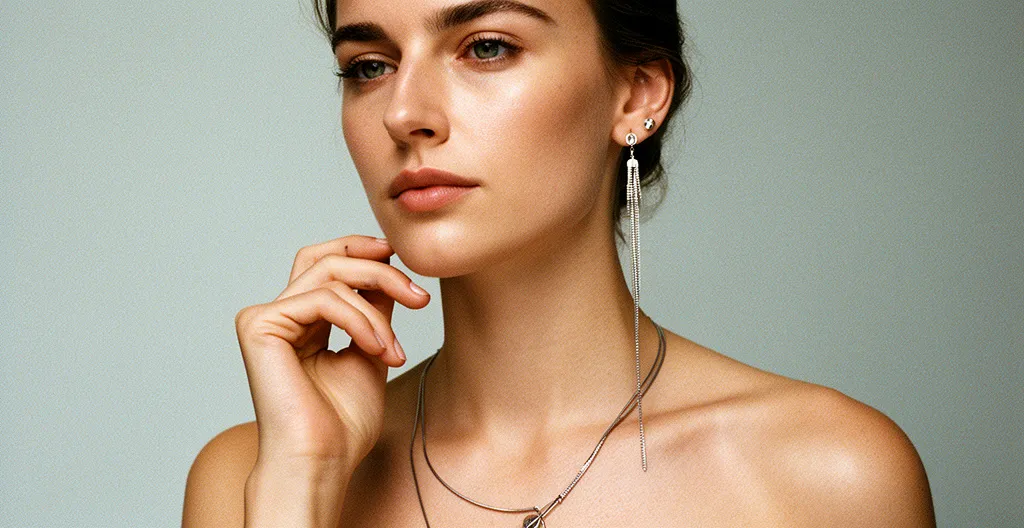
Asymmetrical jewellery is the single most effective tool to inject personality and modern edge into a classic, “safe” wardrobe.
- It introduces ‘controlled disruption’—a deliberate break in visual patterns that creates interest without causing chaos.
- Perfectly mismatched pieces tell a story of confidence and individuality, moving your style from predictable to personal.
Recommendation: Start by swapping one of your regular stud earrings for a longer, complementary piece to instantly test the power of asymmetry.
You have a wardrobe full of timeless, classic pieces. The tailored blazer, the perfect white shirt, the elegant black dress. Yet, when you look in the mirror, you can’t shake the feeling that something is missing. It’s beautiful, it’s appropriate, but it’s… safe. This is the challenge for many women who have curated a sophisticated look but now crave a touch of personal, modern edge without overhauling their entire collection. The common advice is often to buy a trendy new item, but this can feel wasteful and inauthentic.
The conversation around modernizing a look often circles around bold new silhouettes or fleeting trends. But what if the most powerful tool for transformation was already in your jewellery box, waiting to be re-imagined? The secret isn’t about adding more, but about rethinking balance. It’s about moving beyond perfect pairs and symmetrical sets. We’re talking about the art of asymmetry, a concept that is less a trend and more a fundamental shift in styling philosophy.
This isn’t just about wearing mismatched earrings. It’s about understanding the power of controlled disruption—the deliberate act of creating visual tension to draw the eye and tell a more interesting story. This guide will move beyond the superficial and dive into the strategy of asymmetry. We will explore how to use this principle not as a random act of rebellion, but as a precise instrument to express your unique personality and breathe new life into the classic outfits you already love.
In this guide, we’ll deconstruct the art of imbalance, providing you with a clear roadmap to master this sophisticated styling technique. Follow along as we explore everything from balancing different earring weights to building a future-proof jewellery capsule.
Summary: The Art of Deliberate Imbalance in Jewellery Styling
- How to Balance a Long Earring on One Side with a Stud on the Other?
- How to Position an Off-Centre Pendant so It Doesn’t Look like a Mistake?
- Toi et Moi Rings: Why Are Two Different Stones More Popular Than Solitaires?
- The Risk of Wearing Asymmetrical Jewellery with Busy Patterns
- How to Overcome the “Is It Missing?” Feeling When Wearing One Earring?
- Why Should You Stick to One Metal Colour When Mixing Earring Shapes?
- How to Style the Same Gemstone Necklace for the Office and a Gala?
- How to Build a Jewellery Capsule That Remains Stylish for 20 Years?
How to Balance a Long Earring on One Side with a Stud on the Other?
This is the gateway to asymmetrical styling and the easiest way to experiment. The fear of looking unbalanced is real, but the key is to think like a designer, not a jeweller. It’s not about matching weight in grams, but in visual weight. An incredible 210% increase in searches for asymmetrical earrings shows this is a look people are actively seeking to master. It signals a move away from rigid rules towards more personal expression.
The goal is to create a dynamic yet harmonious look. You want people to think, “What an interesting choice,” not, “Did she lose an earring?” This is achieved through deliberate choices that guide the viewer’s eye and create a cohesive, albeit uneven, picture. It’s about replacing symmetry with a more compelling form of balance. This isn’t just a trend; it’s a statement of confidence in your own editorial eye.
Think of your head and décolletage as a canvas. The long earring is your focal point, the “action” in the piece. The stud is the anchor, a quiet nod that completes the composition. By consciously playing with proportion, texture, and even your hairstyle, you control the narrative and turn a simple earring combination into a sophisticated style statement. The following checklist provides a framework for getting it right every time.
Your Action Plan: Mastering Mismatched Earrings
- Balance Visual Weight: Pair a small, dark-coloured stud (like black onyx) with a larger, airier long earring in a bright metal. The dark stud has high visual weight in a small package, balancing the larger but lighter-looking piece.
- Use Your Hairstyle: Create a deep side part that fully exposes the ear with the long, dramatic earring. Allow your hair to partially or fully veil the ear with the simpler stud, reinforcing which piece is the star.
- Apply the Visual Triangle: Your face is the canvas. Balance the single long earring with a touch of highlighter on the opposite cheekbone and, for a truly editorial look, a small brooch on the opposite lapel of your blazer. This creates a triangle of interest points, achieving perfect asymmetrical balance.
Embracing this technique is your first step in breaking free from a “safe” style. It’s a small change with a massive impact on your overall look, signaling an evolution in your personal style narrative.
How to Position an Off-Centre Pendant so It Doesn’t Look like a Mistake?
An off-centre pendant is the next level of controlled disruption. Unlike a perfectly centered stone, which is predictable, a pendant that sits slightly askew creates immediate intrigue. But how do you ensure it reads as intentional and not just sloppy? The secret lies in a classic artistic principle: the rule of thirds. Imagine two vertical and two horizontal lines dividing your décolletage into nine equal parts. Your pendant should be placed at one of the four intersections, ideally in the hollow of your collarbone.
This placement feels natural yet unexpected. It draws the eye and highlights the elegant lines of the neck and collarbone. It works because it forces the brain to engage. As the design experts at LaCkore Couture note, great design is about creating a unified whole. A thoughtfully placed off-centre pendant does just that, creating a relationship between the jewellery, the wearer’s body, and the neckline of their garment.
The success of this look also depends heavily on the neckline. An asymmetrical neckline, for instance, provides the perfect canvas. The goal isn’t to fill the empty space, but to honor the shape of the garment. Let the pendant follow the diagonal line of the neckline or nestle into the corner where the strap meets the shoulder. With a simple crewneck or boatneck, the pendant has more freedom, but the rule of thirds remains your most reliable guide.
This is a subtle but powerful statement. It says you understand the rules of composition so well that you know precisely how to break them for maximum effect. It’s the sartorial equivalent of a confident, knowing smile.
Ultimately, wearing an off-centre pendant is an act of quiet confidence, turning a simple necklace into a piece of wearable art.
Toi et Moi Rings: Why Are Two Different Stones More Popular Than Solitaires?
The “Toi et Moi” (French for “You and Me”) ring, featuring two distinct gems, has exploded in popularity, eclipsing even the classic solitaire for those seeking a more personal statement. But why is this inherently asymmetrical design so captivating? It’s a perfect storm of deep symbolism and modern psychological appeal. At its core, the design is a celebration of two entities coming together—historically, two lovers. Napoleon Bonaparte gave the first famous Toi et Moi ring to his future wife, Josephine, in 1796.
Today, that symbolism has evolved. The two stones can represent dual facets of one’s own personality—logic and creativity, strength and softness, a public self and a private self. In a world that champions individualism, the Toi et Moi ring becomes a powerful piece of style narrative. It’s a way to tell a complex story on your finger, far more expressive than a single, perfect stone.
The design’s allure is also rooted in cognitive science. Our brains are hardwired to recognize patterns. A solitaire is a perfect, expected pattern. A Toi et Moi ring, with its two different shapes, sizes, or colors, creates deliberate imperfection. This slight deviation from the norm instantly captures our attention, triggering curiosity and holding our interest far longer than a more predictable design. It’s visually more dynamic and feels more alive.
This desire for personalization and unique expression is why these rings resonate so deeply. They offer endless opportunities to mix birthstones, favourite gems, and different cuts to create something truly one-of-a-kind. It’s a move away from the traditional status symbol of a single large diamond towards a more nuanced and personal declaration of self.
Choosing a Toi et Moi ring over a solitaire isn’t just a style choice; it’s a declaration that you value story and personality over simple perfection.
The Risk of Wearing Asymmetrical Jewellery with Busy Patterns
Pairing asymmetrical jewellery with a patterned garment can feel like a high-wire act. Get it right, and you look like a styling genius. Get it wrong, and you risk creating visual chaos where the eye doesn’t know where to land. The key is not to avoid the combination, but to approach it with a clear strategy. The main goal is to ensure your jewellery and your clothing are in a dialogue, not a shouting match.
The first rule is to create an anchor point of calm. If your blouse is a riot of florals or geometrics, you need to give the jewellery a neutral space to breathe. A V-neck, scoop-neck, or off-the-shoulder neckline can create a block of exposed skin that isolates the jewellery from the pattern, allowing it to be seen and appreciated. Without this negative space, a delicate asymmetrical necklace can be completely swallowed by the print.
Next, think about integration. The easiest way to create harmony is through color. Pick a minor, accent color from your pattern and choose a gemstone or metal that echoes it. This creates an instant, subconscious link between the two elements, making the pairing feel intentional. Another advanced technique is to match the style of the pattern to the style of the jewellery. For instance:
- Geometric patterns pair beautifully with clean, architectural asymmetrical pieces.
- Floral or organic patterns are complemented by more fluid, natural shapes like single leaf earrings or mismatched pearls.
When in doubt, keep the jewellery smaller and more sculptural. Let the pattern on your clothing be the main event, and let the asymmetrical jewellery be the clever, thought-provoking accent.
By following these guidelines, you can confidently mix and match, proving that bold patterns and bold jewellery can coexist in perfect, stylish harmony.
How to Overcome the “Is It Missing?” Feeling When Wearing One Earring?
The single earring is the ultimate power move in asymmetrical styling. It’s bold, confident, and unapologetic. Yet, it’s also the look that can trigger the most self-consciousness. The nagging feeling that people think you’ve simply lost an earring can be hard to shake. The secret to overcoming this is twofold: understanding the look’s powerful history and committing to the choice with absolute confidence.
First, reframe your thinking. A single earring isn’t an absence; it’s a presence. It’s a deliberate choice to use negative space as part of your design. As the fashion team at Refinery29 points out, this look has been championed on the highest-fashion runways. They state that “A singular statement earring was embraced by the likes of Valentino, Prabal Gurung, and Gucci.” However, they also offer a practical tip: “But if wearing just one eye-catching piece will leave your face feeling half naked, try an asymmetrical pair.” This validates the feeling while offering a stepping stone.
This look has been a celebrity staple for years, with icons like Meghan Markle making it an everyday signature by mixing and matching ear climbers and geometric studs. To truly embrace it, you must own it. Your posture, your confidence, and the rest of your styling must communicate that this is a deliberate, thought-out choice. Wear it with a sleek hairstyle that fully exposes the adorned ear. This commitment signals to the world that you are in complete control of your style narrative.
Understanding the historical context also helps. A single earring has meant many things over time, but it has never meant “incomplete.” It has always been a mark of a specific identity or purpose. Seeing the modern single earring as the next chapter in this story transforms it from a fashion trend into a piece of personal storytelling.
This small table, with data drawn from a comparative analysis in Wallpaper* magazine, shows how the meaning has evolved from function to pure fashion.
| Historical Context | Modern Interpretation |
|---|---|
| Sailors wore single earrings for protection | Fashion statement of confidence |
| Punk rebellion symbol | Deliberate minimalist strength |
| Renaissance dandies’ mark of distinction | Negative space as design choice |
When you wear a single earring with this understanding, you’re not just wearing jewellery; you’re wearing a piece of history, reinterpreted through your own modern, confident lens.
Why Should You Stick to One Metal Colour When Mixing Earring Shapes?
The conventional wisdom for asymmetrical earrings has been to maintain a single metal color to act as a unifying element. When you’re already playing with different shapes, sizes, and placements, keeping the metal consistent—all gold or all silver—creates a common thread that ties the look together. This is the “safe” way to do asymmetry. It ensures the pairing looks intentional and curated, preventing the pieces from feeling like a random assortment.
Sticking to one metal is a fantastic strategy for beginners. It simplifies the decision-making process and guarantees a polished result. It allows the shapes of the earrings to be the primary focus of the “controlled disruption.” The unified color palette tells the brain, “These two different objects belong together,” creating harmony amidst the contrast. For a classic, elegant take on asymmetry, this is a rule that serves you well.
However, you’re here to modernize your look and embrace a bolder style. So, let’s talk about how to break this rule like an expert. Mixing metals is an advanced technique, but it’s not impossible. If you choose to mix gold and silver in an asymmetrical pairing, you are doubling down on the contrast, and you need a new strategy to create cohesion. The key is to ensure the mix looks deliberate and not accidental. This requires confidence and a few pro tips.
Here are the expert-approved rules for breaking the one-metal rule:
- Apply the 80/20 Rule: Don’t aim for a 50/50 split. Make one metal clearly dominant (80%) and use the other as a subtle accent (20%). For example, a large gold hoop with a tiny silver stud.
- Use a “Bridge” Piece: Wear another piece of jewellery that incorporates both metals, like a two-tone watch, a stack of mixed-metal rings, or a necklace with both gold and silver elements. This “bridge” piece officially sanctions the mix.
- Keep the Finish Consistent: If you’re mixing metals, don’t also mix finishes. Keep all the pieces in a matte finish or a high-polish finish. This consistency acts as the new unifying element.
Ultimately, whether you stick to one metal or bravely mix them, the goal is the same: to create a look that is unapologetically you. One approach whispers confidence; the other shouts it.
How to Style the Same Gemstone Necklace for the Office and a Gala?
The true measure of a great piece of jewellery is its versatility. A gemstone necklace that can transition from a professional office setting to a formal gala is a cornerstone of a modern jewellery capsule. The secret to this transformation isn’t in the necklace itself, but in the styling context you build around it. It’s about changing the narrative of the piece to match the energy of the occasion.
For the office, the necklace should be a point of interest, not a distraction. The key is coverage and subtlety. Style the necklace over a crisp collared shirt, letting just the gemstone peek out from the top button, or wear it against a high-necked cashmere sweater. Here, the necklace complements your professional attire, adding a touch of color and personality without commanding the entire spotlight. For a video call, 2-4 simple pieces are usually enough to look polished; the necklace can be one of them, paired with simple studs.
To transition for a gala, the focus shifts from subtlety to statement. This is achieved through two primary levers: exposure and layering. Swap the high-necked top for a garment with a lower neckline—a strapless gown, a V-neck, or a boat neck. Placing the gemstone against bare skin instantly elevates its impact and sensuality. The necklace is no longer an accent; it’s a focal point. You can amplify this by layering it with other, more delicate chains of varying lengths. This adds texture, depth, and a sense of opulence perfect for an evening event.
The most powerful tool, however, is your mindset. Before you even choose your clothes, ask yourself: “What is the primary energy of this event?” Is it about competence and focus (office) or celebration and glamour (gala)? Letting this question guide your styling choices—from your neckline to your layering—is what transforms a simple necklace into a versatile powerhouse.
By understanding the power of context, you unlock the full potential of every piece in your collection, ensuring your investments work for you, no matter the dress code.
Key Takeaways
- Embrace Controlled Disruption: Asymmetry isn’t chaos; it’s a deliberate choice to break visual patterns and create an engaging focal point.
- Balance Visual Weight, Not Physical Weight: A small, dark stud can balance a large, airy drop earring. It’s about perception, not grams.
- Context Is Everything: The same piece of jewellery can be professional or provocative depending on the neckline, layering, and hairstyle you choose to pair it with.
How to Build a Jewellery Capsule That Remains Stylish for 20 Years?
Building a jewellery capsule that defies trends and remains relevant for decades is the ultimate goal for anyone seeking a truly sustainable and personal style. It’s not about accumulating more, but about choosing better. A timeless capsule is built on a foundation of quality, versatility, and personal meaning, with just enough room for a touch of the unexpected—the very asymmetry we’ve been exploring.
The foundation should consist of classic archetypes in your preferred metal: a simple chain necklace, a pair of perfect hoops or studs, a signet ring or a simple band. These are your workhorse pieces, the “anchor points” of your style. Choose them for their craftsmanship and their feel against your skin, not for their fleeting trendiness. These pieces should be so classic they almost become invisible, a seamless extension of you.
The next layer is personality. This is where you add pieces that tell your story. It might be a Toi et Moi ring with your children’s birthstones, a vintage locket, or a pendant from your travels. These pieces carry emotional weight and are inherently timeless because their value is personal, not commercial. They are your style narrative made tangible.
Finally, the most crucial element for a modern, dynamic capsule is the “disruptor.” This is your dedicated asymmetrical piece. It could be a single statement earring you pair with your classic studs, a necklace with an off-centre pearl, or a mismatched pair of designer earrings. This piece is your secret weapon against feeling “safe” or “boring.” It’s the piece you pull out to instantly modernize your little black dress or add an edge to your tailored blazer. It ensures your timeless capsule never becomes a static museum, but remains a living, evolving expression of your style.
Now, go to your jewellery box. Don’t look for what matches. Look for what intrigues. Take one classic earring and one statement earring, and try them on. This is your first step toward building a style that is not just timeless, but uniquely yours.
Frequently Asked Questions on Asymmetrical Jewellery
What makes two-stone rings more dynamic than solitaires?
Our brains are instantly captivated by asymmetry as it deviates from expected patterns – this cognitive response triggers curiosity and interest. A two-stone ring is a mini-story, while a solitaire is a single statement, making the former feel more dynamic and engaging.
How do Toi et Moi rings represent modern individualism?
The two stones can represent dual facets of personality like logic and creativity, making it a statement of modern self-expression. It’s a move away from a single ideal of perfection towards a celebration of complexity and inner duality.
Why is personalization easier with two-stone designs?
The inherent two-stone design offers unparalleled personalization opportunities through mixing birthstones and favorite gems. It’s a built-in canvas for telling a personal story that is much more flexible than a single-stone setting.
How many jewelry pieces are appropriate for office wear?
For work or Zoom calls, stick to 2–4 pieces that sit in the camera frame. A short necklace, small hoops or studs, and one or two rings are usually enough to look polished without being distracting.
What transforms a necklace from day to evening wear?
The primary transformation comes from context. For evening, this means layering with additional chains to add opulence and switching from the coverage of a collared shirt to the exposure of bare décolletage, which instantly makes the piece more of a focal point.