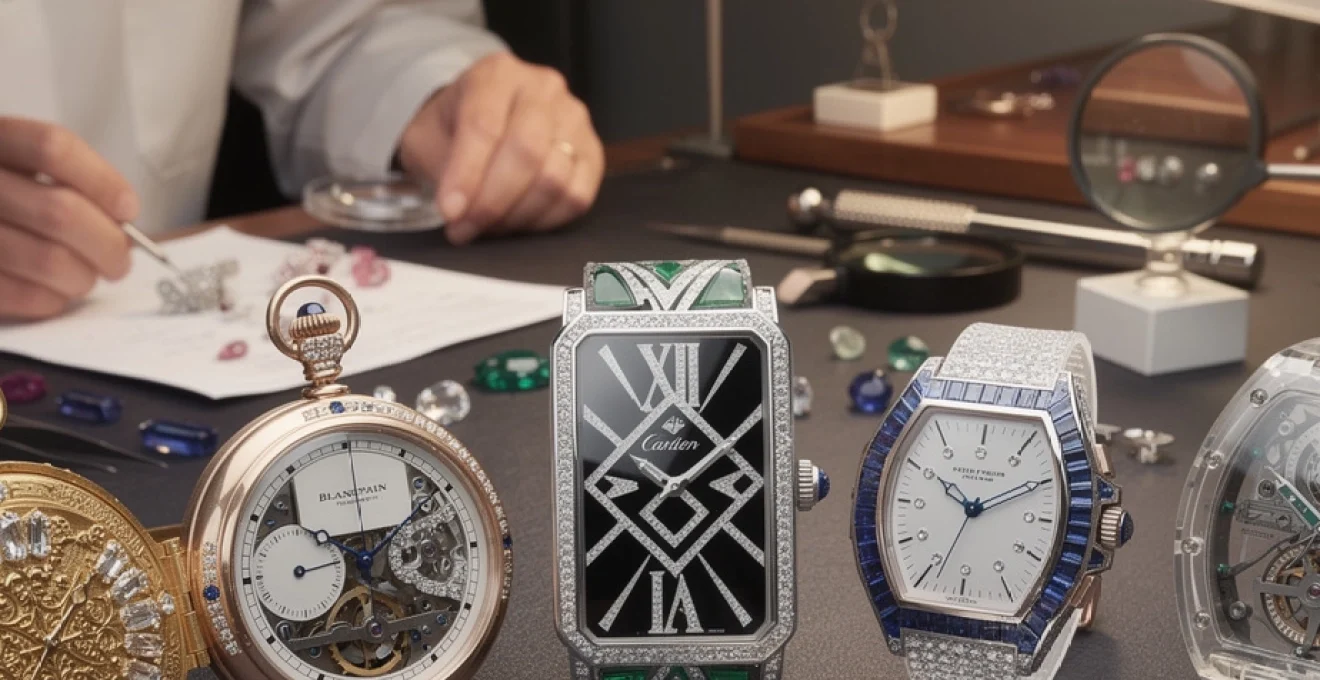
The marriage between precision watchmaking and precious gemstones represents one of the most enduring alliances in luxury craftsmanship. For centuries, master horologists and skilled lapidaries have collaborated to create timepieces that transcend mere functionality, transforming watches into wearable works of art. This convergence of mechanical ingenuity and natural beauty continues to captivate collectors worldwide, with gem-set watches commanding extraordinary prices at auctions and inspiring passionate devotion among connoisseurs. The fascination extends beyond aesthetic appeal—it encompasses technical innovation, historical significance, and the celebration of human artistry at its most refined. Understanding why this relationship between horology and gemstones remains so compelling requires exploring the evolution of gem-setting techniques, the technical challenges involved, and the unique value proposition these timepieces offer to discerning collectors.
Today’s collectors recognize that gem-set watches occupy a distinctive position in the horological landscape. Unlike purely mechanical complications or sports watches valued for their robustness, these timepieces blend multiple disciplines: metallurgy, gemology, mechanical engineering, and haute joaillerie. The result is an object that simultaneously serves as precision instrument, status symbol, investment asset, and artistic statement. Whether you’re drawn to the understated elegance of a diamond-bezel dress watch or the audacious craftsmanship of a fully pavé chronograph, the world of gem-set horology offers endless possibilities for discovery and appreciation.
Historical evolution of Gem-Set watchmaking from 16th century royal commissions
The tradition of adorning timepieces with precious stones traces its origins to the Renaissance courts of Europe, where portable watches first emerged as symbols of wealth and technological prowess. Early watchmakers quickly recognized that their clients—royalty and aristocracy—desired objects that proclaimed status as emphatically as they measured time. These initial gem-set pieces were primarily pendant watches, ornately decorated with table-cut diamonds, colored gemstones, and intricate enamelwork. The technical limitations of early cutting techniques meant that gemstones were valued more for their rarity and color than their brilliance, resulting in designs that emphasized quantity and coverage over the refined precision we associate with modern gem-setting.
Royal commissions drove innovation throughout the 16th and 17th centuries, with monarchs commissioning increasingly elaborate timepieces as diplomatic gifts and personal treasures. These early examples established several conventions that persist today: the use of precious metals as base materials, the integration of gemstones into both functional and decorative elements, and the concept of the watch as a complete artistic statement rather than merely a timekeeping device. The craftsmanship required was extraordinary—each stone had to be individually cut, fitted, and secured using rudimentary tools, making these pieces exceptionally labor-intensive and costly.
Baroque era techniques: Table-Cut diamonds in blancpain and breguet pocket watches
The Baroque period witnessed significant refinement in both watchmaking and gem-cutting techniques. Master watchmakers like Abraham-Louis Breguet began incorporating diamonds and other precious stones with greater technical sophistication, moving beyond purely decorative applications. Table-cut diamonds—featuring a large, flat top facet—were particularly popular during this era, as they could be effectively set into the relatively thick cases and bezels of pocket watches. These stones provided subtle brilliance while allowing for secure mounting, an essential consideration given the mechanical stresses watches experienced during daily wear.
Blancpain and other prestigious maisons developed specialized setting techniques during this period, including early versions of bezel setting and collet mounting. These methods allowed gemstones to be integrated more seamlessly into watch architecture, creating pieces where decoration and function existed in harmony. The Baroque aesthetic favored symmetry and repetition, resulting in watches adorned with precisely arranged diamond patterns that emphasized the mathematical beauty of both the movement within and the embellishment without. This period established gem-set watchmaking as a recognized specialty requiring collaboration between multiple master craftsmen.
Art deco movement’s influence on cartier’s mystery clock gem integration
The Art Deco movement of the 1920s and 1930s revolutionized gem-set watchmaking, introducing geometric designs, bold color contrasts, and innovative technical solutions. Cartier emerged as the preeminent innovator during this era, creating timepieces
that appeared almost magical in their execution. The famed Cartier mystery clocks, in which hands seem to float freely in transparent dials, exemplify how horology and gems were fused into a single artistic language. Sapphire, onyx, coral, rock crystal, and diamonds were combined in daring combinations, with gemstones not just framing the clock but structurally integrated into the case, base, and decorative elements. This era marked a decisive shift: gemstones were no longer merely applied ornamentation but architectural components that shaped how time itself was displayed.
For collectors today, Art Deco gem-set watches and mystery clocks represent a perfect synthesis of design and engineering. The linear arrangements of baguette-cut diamonds, stepped bezels, and stylized numerals speak to a new modernity that still feels contemporary. Importantly, Cartier and its peers pioneered industrialized yet ultra-precise gem-setting techniques, allowing for repeatable quality at the very highest level. When we study these pieces, we see the foundation of many modern high horology practices in gem integration, from symmetrical pavé layouts to technically complex settings that must withstand decades of wear without compromising chronometric performance.
Mid-century modernism: patek philippe’s transition to baguette-cut sapphire bezels
By the mid-20th century, aesthetic tastes had shifted toward cleaner lines and restrained luxury, yet the dialogue between horology and gemstones remained vibrant. Patek Philippe, long regarded as the custodian of classical watchmaking, began to explore a subtler, more architectural approach to gem-setting. Instead of the exuberant pavé surfaces seen in earlier decades, the maison favored precise rows of baguette-cut sapphires and diamonds set into slim bezels and hour markers. These minimalist designs perfectly reflected mid-century modernism, where less was more and every line served a purpose.
The transition to baguette-cut sapphire bezels was more than an aesthetic choice; it posed serious technical challenges for watchmakers and gem-setters alike. Baguette stones require near-perfect calibration in length, width, and depth to form a seamless ring around the dial. Any deviation can disrupt water resistance, compromise structural integrity, or create visual irregularities under magnification. For collectors, Patek Philippe’s gem-set references from this era embody a new ideal of refined luxury: watches that reveal their opulence only upon close inspection, yet demand exceptional precision in both movement manufacture and gemstone setting.
Contemporary haute joaillerie: richard mille’s sapphire crystal case construction
In the contemporary era, brands such as Richard Mille have pushed the encounter between horology and gems into truly experimental territory. Rather than simply decorating cases with diamonds or colored stones, Richard Mille has turned the case itself into a gemstone-like object through the use of sapphire crystal construction. Milling an entire case from a block of synthetic sapphire demands hundreds of hours of CNC machining and polishing, with tolerances measured in microns. The result is a transparent, almost ethereal case that allows you to observe the movement from every angle, much like examining a rare mineral specimen under glass.
These sapphire cases also highlight the intersection between mineralogical properties and functional watchmaking. Sapphire is second only to diamond on the Mohs hardness scale, which makes it exceptionally scratch-resistant but also notoriously difficult to machine without inducing micro-fractures. Richard Mille’s haute joaillerie creations often combine sapphire cases with gem-set bezels, skeletonized movements, and advanced materials such as carbon TPT or titanium. For the modern collector, such pieces represent the apex of technical ambition: high-horology complications encased in what is effectively a watch-sized gemstone, blurring the boundaries between scientific innovation and jewelry art.
Technical gemstone setting methods in high-horology complications
As gem-set watchmaking matured, the techniques used to secure and display gemstones evolved into a sophisticated discipline of its own. High-horology complications such as perpetual calendars, tourbillons, and minute repeaters impose stringent constraints on weight, tolerances, and durability. Gem-setters must work in perfect concert with movement designers, engineers, and case makers to ensure that aesthetic brilliance never undermines mechanical reliability. Understanding how invisible setting, snow setting, and other advanced techniques operate helps us appreciate why certain gem-set watches are considered benchmarks in the field.
For collectors evaluating high-end gem-set timepieces, these technical methods are more than background details—they are indicators of artisanal mastery and long-term stability. A perpetual calendar with an invisibly set dial, or a minute repeater with grain-set lugs, tells us that dozens of hours of extra work have been invested, often by specialized artisans who may handle only a handful of pieces per year. This is one reason why gem-set complications often command a premium over their non-set counterparts and why they tend to retain strong desirability in the secondary market.
Invisible setting techniques for perpetual calendar dial manufacture
Invisible setting, sometimes called serti invisible, is one of the most technically demanding methods in haute joaillerie watchmaking. In this technique, gemstones—typically baguette-cut rubies, sapphires, or diamonds—are mounted without visible metal prongs, creating the illusion of a continuous, seamless surface. In the context of perpetual calendar dials, invisible setting is particularly challenging because the dial must accommodate apertures for day, date, month, leap year, and moonphase, often with moving discs underneath. Any excess height or misalignment in the stone setting can interfere with the calendar mechanism’s precise motion.
To achieve this effect, each stone is specially grooved on its pavilion, allowing it to slide onto thin rails of gold hidden beneath the visible surface. Think of it as a gemstone mosaic where each tile locks into a microscopic framework. For you as a collector, an invisibly set perpetual calendar dial signals not only aesthetic extravagance but also an extraordinary level of coordination between gem-setter and watchmaker. It’s the horological equivalent of building a glass floor over a complex engine: the visual purity must never compromise the flawless functioning of the machinery below.
Snow setting applications in audemars piguet royal oak frosted gold editions
Snow setting is another highly specialized technique that creates a textured, organic surface reminiscent of freshly fallen snow. Instead of using uniformly sized stones arranged in strict rows, the gem-setter selects diamonds of varying diameters and places them in an apparently random pattern. In reality, this “randomness” is meticulously planned to avoid gaps while maintaining structural integrity. Audemars Piguet has applied this approach to certain Royal Oak Frosted Gold and high-jewellery references, combining it with hammered finishes to amplify the play of light on the case and bracelet.
From a technical standpoint, snow setting requires immense patience and an intuitive understanding of how different stone sizes interact. Each diamond is secured in place by tiny grains of metal that are raised and shaped around the girdle, often under high magnification. For owners of these gem-set Royal Oaks, the result is a watch that sparkles from every angle yet retains the iconic geometry and robustness of the original design. It’s a powerful example of how a sports watch architecture can be transformed by haute joaillerie techniques without losing its functional soul.
Serti descendu method for securing precious stones on tourbillon bridges
The serti descendu method—literally “lowered setting”—is frequently used when stones must be anchored directly into structural components such as bridges or plates. In tourbillon watches, where weight and balance are critical, this technique allows gem-setters to integrate diamonds, sapphires, or rubies into bridges without adding unnecessary height or bulk. The metal around each stone is carved into a steep, cup-like recess, and minute beads of metal are then pushed over the girdle to secure the stone at a lower profile than traditional claw settings would permit.
Why does this matter to chronometric performance? A tourbillon cage must rotate with minimal friction and perfectly balanced mass distribution. Excess metal or poorly distributed stones could upset this balance, affecting rate stability. By using serti descendu, watchmakers can embellish bridges and cages while preserving the ultra-fine tolerances that precision demands. For the collector, a gem-set tourbillon bridge exemplifies how far the dialogue between horology and gems has advanced: the decorative elements are literally interwoven with the regulating organ of the watch.
Grain setting precision requirements for minute repeater case decoration
Minute repeaters, with their delicate gongs and hammers, are acutely sensitive to any modification of the case. Grain setting—where tiny beads or “grains” of metal are raised and shaped around small diamonds—offers a way to decorate repeater cases without compromising acoustic performance. Each stone is nestled into a small seat, and four or more grains are pushed over its girdle, creating a secure yet relatively low-mass setting. The even distribution of small stones helps preserve the case’s vibrational characteristics, which is essential for a clear, resonant chime.
Achieving consistency in grain size, height, and spacing requires a steady hand and exacting control. Any unevenness can create visual disharmony or introduce weak points in the metal. For collectors evaluating gem-set minute repeaters, close inspection under loupe reveals the quality of the work: uniform, rounded grains with clean separation between stones are hallmarks of top-tier craftsmanship. In a sense, the grain-set surface acts like the soundboard of a string instrument—its material, thickness, and pattern influence how the repeater’s voice projects into the room.
Mineralogical properties affecting chronometric performance and durability
Beyond aesthetics, the physical and chemical properties of gemstones have a direct bearing on how a gem-set watch performs over decades. Hardness, toughness, refractive index, and thermal expansion all influence how crystals, bezels, and jeweled components behave under real-world conditions. When we talk about sapphire crystal anti-reflective coatings or ruby jewel bearings, we are not merely invoking marketing terms; we are discussing concrete engineering choices rooted in mineralogy. Understanding these properties helps you make informed decisions when investing in high-end gem-set watches.
In modern horology, synthetic corundum (sapphire and ruby) dominates functional applications because it combines high hardness with stability and relative affordability in laboratory-grown form. Meanwhile, more fragile gems such as emerald are typically reserved for bezels and dials, where they are less exposed to shocks. The challenge for contemporary brands is to harness the beauty of diverse gemstones while ensuring that the timepiece remains a reliable instrument—especially when subjected to daily wear or even sports usage.
Mohs hardness scale considerations for sapphire crystal anti-reflective coating
Sapphire ranks 9 on the Mohs hardness scale, just below diamond, which explains its widespread use for watch crystals. A sapphire crystal is extremely resistant to scratching from everyday materials such as steel, glass, or sand, helping a gem-set watch maintain its clarity and perceived value over time. However, the anti-reflective coatings applied to the crystal are usually made from much softer materials such as magnesium fluoride or multi-layer dielectric stacks. These coatings can scratch or wear even when the underlying sapphire remains pristine.
For collectors who plan to wear their gem-set watches frequently, this creates an interesting trade-off. A double anti-reflective coating (inside and outside) enhances legibility and showcases gem-set dials with remarkable depth, but it can be more vulnerable to visible marks. By contrast, interior-only coatings offer slightly less optical performance but greater long-term durability. When evaluating a sapphire crystal, it’s worth asking: how does the crystal’s hardness interact with the softer layers above it, and how will that affect the watch’s appearance five or ten years from now?
Ruby jewel bearings: friction reduction in escapement mechanisms
Rubies have been used as jewel bearings in watch movements for more than two centuries, and their role becomes even more crucial in high-complication, gem-set watches. Synthetic ruby, a form of corundum, combines extreme hardness with a smooth surface finish when polished, making it ideal for reducing friction at pivot points and in escapement components. Lower friction means less wear, improved amplitude, and more stable timekeeping between services—key factors for collectors who expect both precision and longevity from their investment-grade timepieces.
In a sense, ruby jewels are the hidden cousins of the decorative gemstones you see on the bezel or dial. While the latter catch the eye, jewel bearings quietly ensure that the movement continues to perform to chronometer standards. High-end manufacturers may choose to highlight this synergy by exposing the escapement or tourbillon through a sapphire caseback, allowing you to see the interplay between visible gems and functional ruby bearings. For anyone passionate about both horology and gems, this convergence of beauty and utility is one of the most satisfying aspects of collecting.
Thermal expansion coefficients of emerald versus diamond in case construction
When integrating gemstones into watch cases, engineers must consider not only hardness but also thermal expansion—how much a material expands or contracts with temperature changes. Diamond has a relatively low coefficient of thermal expansion, meaning it remains dimensionally stable across a wide temperature range. Emerald, by contrast, is not only softer and more brittle (often containing internal fissures) but also exhibits different expansion behavior. When emeralds are set tightly into metal bezels or links, seasonal temperature shifts or rapid changes—such as stepping from a cold street into a warm room—can induce stress at the stone-metal interface.
To mitigate these risks, watchmakers designing emerald-set cases often leave microscopic tolerances or use flexible setting structures that allow slight movement without visible gaps. This is one reason why emerald-set watches from top maisons command a premium: the underlying engineering must account for the stone’s fragility as well as its optical allure. For the informed collector, understanding thermal expansion is akin to knowing how a high-performance car’s engine responds to heat cycles—it’s a hidden but critical factor in long-term reliability.
Investment-grade gem-set timepieces: market analysis and auction records
The last two decades have seen a significant reappraisal of gem-set watches in the secondary market. Once dismissed by some purists as “jewelry pieces,” they are now recognized as serious investment-grade assets, particularly when associated with iconic models and impeccable provenance. Auction data from major houses such as Christie’s, Phillips, and Sotheby’s shows a sharp rise in hammer prices for rare gem-set references—from Rolex “Rainbow” Daytonas to Patek Philippe Nautilus and Aquanaut models with factory-set bezels and dials. When rarity, quality of setting, and brand prestige align, the market response is often emphatic.
For collectors, this raises an important question: what distinguishes an investment-grade gem-set timepiece from a purely decorative one? Key factors include the use of factory (not aftermarket) setting, documented production numbers, and alignment with broader trends in high-end collecting. For instance, a gem-set sports watch from a blue-chip brand that retains its original box, papers, and service history is far more likely to hold or appreciate in value than a heavily modified piece, no matter how visually striking. As always, buying from reputable dealers and requesting independent assessments is essential when significant capital is at stake.
Master gem-setters and lapidaries shaping modern watchmaking heritage
Behind every remarkable gem-set watch lies the often-unseen work of master gem-setters and lapidaries. These artisans shape, calibrate, and fix each stone into place, working under microscopes with tools that would look more at home in a dental lab than a jeweler’s workshop. In many haute horlogerie maisons, a single specialist may be responsible for an entire piece, spending weeks or even months on a single case, bracelet, or dial. Their signatures are not stamped on the movement, yet their touch defines the watch’s visual identity and perceived quality.
Some brands have begun to highlight these craftspeople more openly, featuring them in factory tours, documentaries, and marketing campaigns. This increased visibility reflects a broader shift in collector culture: we are no longer satisfied with knowing the reference number; we want to understand the human skill embedded in each component. Recognizing the role of gem-setters and lapidaries helps place modern gem-set horology within a lineage that stretches back to royal workshops of the 16th century. It also underscores why certain pieces feel “alive” on the wrist—they carry the imprint of an individual’s hand and eye, not just the precision of industrial machinery.
Material innovation: lab-grown diamonds and synthetic sapphires in contemporary horology
As technology advances, the materials used in gem-set watches are evolving as quickly as the movements that power them. Lab-grown diamonds and synthetic sapphires now play a major role in contemporary horology, both as functional components and decorative elements. Lab-grown diamonds offer chemically identical properties to natural stones, including exceptional hardness and brilliance, but with improved consistency and often at lower cost. This enables watch brands to experiment with more ambitious pavé patterns, colored diamond gradients, and even fully diamond-coated components without the same constraints on supply or price.
Synthetic sapphires, already ubiquitous in crystals and movement jewels, are now being used for entire cases, bezels, and bracelet elements in a spectrum of colors. For collectors, these innovations pose intriguing questions. Does a lab-grown diamond-set bezel hold the same emotional and investment appeal as one crafted from rare, natural stones? Or does the emphasis shift toward design freedom, transparency of sourcing, and environmental considerations? In practice, we are seeing a diversification of the market: natural gemstone pieces continue to dominate the top of the auction charts, while watches using lab-grown materials cater to a growing audience that values technological progress and responsible luxury.
Ultimately, the encounter between horology and gems remains as compelling today as it was in the Renaissance courts—perhaps even more so. Whether a watch is adorned with historically rare natural stones or cutting-edge lab-grown diamonds and synthetic sapphires, the underlying fascination is the same: the transformation of inert mineral beauty into a living object that measures, frames, and celebrates time. For collectors who appreciate both mechanical nuance and mineralogical wonder, this timeless encounter will continue to inspire, surprise, and reward for generations to come.