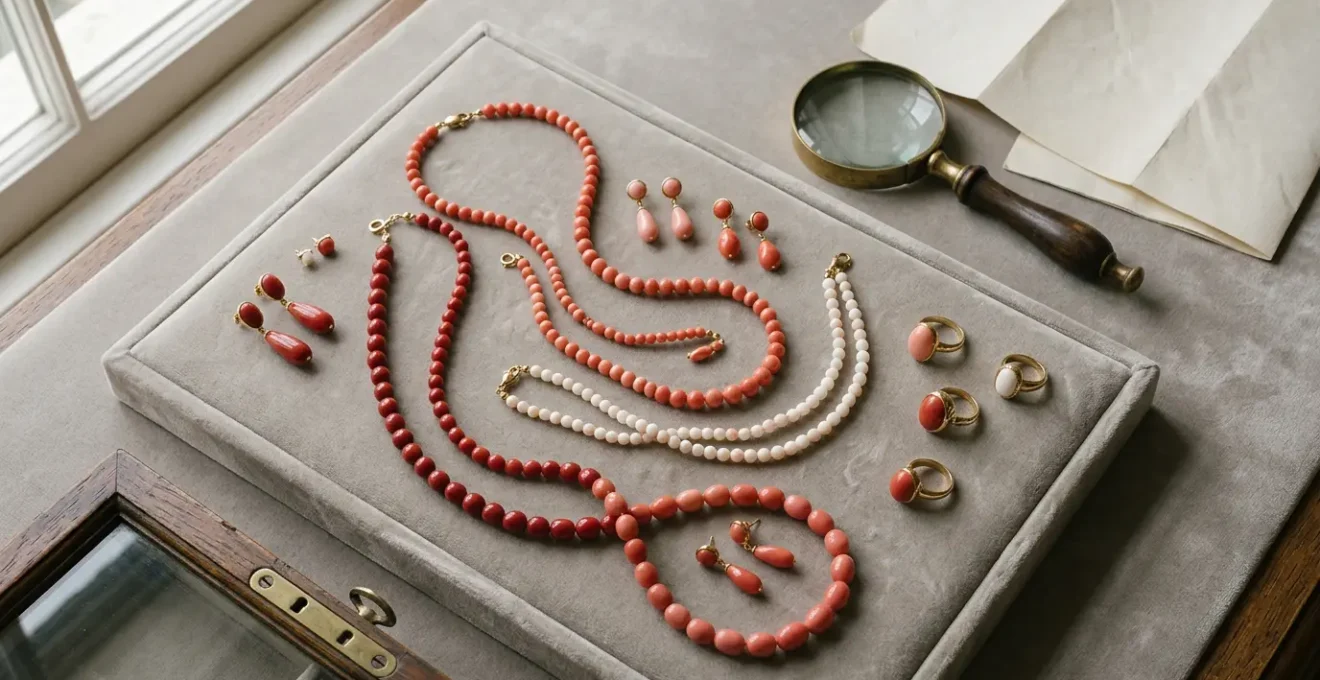
Navigating the UK’s coral trade laws hinges on one critical principle: the burden of proof rests entirely on you, the owner.
- The legality of your coral jewellery is determined by its species, age, and, most importantly, the documented evidence you can provide.
- Distinguishing natural precious coral from treated fakes like bamboo coral is the first step in assessing both value and legal standing.
Recommendation: Assemble a ‘Provenance Dossier’ for each piece, including gemologist reports, dated photographs, and any ownership history to unequivocally demonstrate its legal antique status.
For the discerning collector of vintage jewellery, the vibrant allure of coral carries a complex and often misunderstood legal weight. You may own a treasured family heirloom or be considering an acquisition, yet find yourself facing a critical question: is this piece a beautiful antique or a piece of contraband? The answer is far from simple and is governed by a web of international and national regulations designed to protect endangered species. The common advice to simply ‘buy from a reputable dealer’ or the vague assumption that ‘antique’ pieces are exempt is dangerously inadequate in the eyes of the law.
The core of the issue lies with the Convention on International Trade in Endangered Species of Wild Fauna and Flora (CITES), an international agreement to ensure that trade does not threaten the survival of wild animals and plants. Many coral species fall under its protection. In the UK, the Animal and Plant Health Agency (APHA) enforces these rules, and ignorance of the law offers no protection. The responsibility falls squarely on the owner to prove that their item is compliant, particularly if they intend to sell it or travel with it internationally.
However, this regulatory landscape should not be a source of fear, but a call for diligence. The true key to navigating this is to shift your mindset from that of a passive owner to a proactive provenance detective. This guide moves beyond the generic advice to provide a strategic framework for legal validation. We will explore the forensic techniques for identifying coral types, the species-specific rules under CITES, and, most crucially, the precise documentation required to build an unassailable case for your jewellery’s legality. By understanding these principles, you transform legal risk into a verifiable asset, securing the history, value, and future of your collection.
This article will provide a structured approach to understanding your responsibilities as a collector. The following sections will equip you with the knowledge to assess your jewellery, from its material properties to the essential legal paperwork.
Summary: A Collector’s Guide to Coral Jewellery Legality
- Why Does Your Red Coral Lose Its Shine When Exposed to Sweat?
- How to Spot Dyed Bamboo Coral by Looking at the Grain?
- How to Trace the Origin of a Stone to Avoid Unethical Mines?
- What Documents Do You Need to Sell Antique Coral Jewellery?
- The Error of Storing Coral in Cotton Wool That Dries It Out
- Can You Re-Polish Faded Coral to Restore Its Gloss?
- Why Should You Never Sell the Earrings Separately from the Necklace in a Set?
- How to Modernize an Inherited Brooch You Would Never Wear?
Why Does Your Red Coral Lose Its Shine When Exposed to Sweat?
Understanding the legality of coral begins with understanding its biology. Unlike mineral gemstones, coral is an organic gem, formed from the calcium carbonate skeletons of marine polyps. This organic origin is precisely why it is regulated, and also why it is so sensitive to its environment. If you’ve noticed your red coral jewellery losing its lustre after contact with skin, you are observing its natural porosity in action. Sweat, along with cosmetics, perfumes, and even natural skin oils, contains acids and chemicals that can be absorbed by the coral, causing it to dull, discolour, or become brittle over time.
Precious coral, in its raw, harvested state, is naturally matte. The vitreous, glossy lustre you see on a finished piece is the result of a meticulous polishing process. When this polished surface is compromised by chemical exposure, that original dullness can begin to reappear. This sensitivity is not a flaw, but an inherent characteristic of its calcium carbonate structure. It underscores the need for careful handling and storage, not just for aesthetic reasons, but to preserve the very features that may be required for future identification and valuation.
Maintaining the condition of your coral is the first step in preserving its value and legal standing. Gentle cleaning with a soft, damp cloth is advised, but harsh chemicals and ultrasonic cleaners must be avoided at all costs. For minor dulling, some specialists suggest a very light, occasional application of olive oil on a soft cloth can help restore some gloss, but this is a temporary measure. Significant loss of shine requires professional intervention to avoid damaging the delicate structure of the gem.
How to Spot Dyed Bamboo Coral by Looking at the Grain?
A critical step in your forensic assessment is determining whether your piece is genuine precious coral or a common imitation, such as bamboo coral. This is not merely a question of value; it is a question of accurate representation, which has legal implications. Bamboo coral (of the family Isididae) is a naturally greyish-white, porous coral that is often dyed a vibrant red or pink to mimic the highly sought-after precious coral (Corallium). While its trade is not as restricted, selling it as genuine Corallium is fraudulent.
The key to distinguishing the two lies in a close examination of the material’s surface, ideally with a 10x jeweller’s loupe. Precious coral exhibits a fine, uniform grain pattern that resembles the grain of wood, running parallel along the length of a branch or bead. This texture is consistent and smooth. Bamboo coral, by contrast, has a more striated and porous structure. Its most telling feature is the presence of small black or brown specks or segments. These are the remnants of the joints or “nodes” of the original bamboo-like sea plant, which absorb the dye differently and remain visible upon magnification.
When inspecting a piece, pay close attention to less visible areas like drill holes, the back of a cabochon, or the inside of a clasp. Dye often pools in these crevices, appearing darker and more concentrated, which is a clear giveaway. The following table provides a clear guide for visual identification.
This comparative analysis from Wirecutter provides a clear framework for identification, which is a key skill for any serious collector. Being able to spot these differences is your first line of defence against misrepresentation.
| Characteristic | Precious Coral | Bamboo Coral |
|---|---|---|
| Natural Color | Red, pink, white naturally | Gray (requires dyeing for red) |
| Grain Pattern | Fine, uniform wood-like grain | Porous, striated with visible segments |
| Magnification Features | Smooth, consistent texture | Black/brown specks from bamboo nodes |
| Price Range | High value, premium pricing | More affordable, widely available |
| Best Inspection Area | Surface uniformity | Drill holes, back of piece |
How to Trace the Origin of a Stone to Avoid Unethical Mines?
Once you have a preliminary identification, the next layer of legal inquiry involves the specific species and its status under CITES. The term “coral” is a broad category, and different species are afforded different levels of protection. This species-specific compliance is where a detailed understanding of the law becomes paramount. Simply knowing your piece is “red coral” is insufficient; you must endeavour to know if it is Corallium rubrum from the Mediterranean, or perhaps Aka coral from Japan, as their regulations differ.
CITES regulations are organized into Appendices. Appendix II lists species that are not necessarily threatened with extinction but may become so unless trade is strictly controlled. This includes all Black Coral (Antipatharia) and Blue Coral (Heliopora coerulea). Any international trade in these species requires CITES permits. Appendix III is for species protected in at least one country, which has asked other CITES Parties for assistance in controlling the trade. This includes the highly-prized Angel Skin and Japanese Aka corals. Precious Red Coral (Corallium rubrum), historically from the Mediterranean, is notably not listed under CITES but is heavily regulated by other bodies like the EU’s Common Fisheries Policy. For instance, current regulations stipulate that coral harvesting is now limited to scuba diving only at a minimum 50m depth, banning destructive dredging methods.
This information, provided by the National Jeweler, is essential for understanding the legal landscape. Tracing the precise origin is challenging for antique pieces, but a gemological laboratory can often identify the species, which is the first step in determining which regulations apply.
| Coral Type | CITES Status | Traceability Requirements |
|---|---|---|
| Precious Red Coral (Corallium rubrum) | Not listed | EU regulations, FAO oversight |
| Japanese Aka Coral | Appendix III | Export permits required |
| Black Coral (Antipatharia) | Appendix II | CITES permits mandatory |
| Blue Coral (Heliopora coerulea) | Appendix II | Documentation required |
| Angel Skin Coral | Appendix III | Country-specific permits |
What Documents Do You Need to Sell Antique Coral Jewellery?
This is the crux of the matter for any collector in the UK. If your coral is from a CITES-listed species, you cannot legally sell it without the correct permits unless you can prove it qualifies as an “antique.” Under UK law implementing CITES, an item is generally considered antique if it is a “worked” item that was acquired in its finished state before March 3, 1947. The critical point here is that the burden of proof is on you, the owner. Without documentation, your piece is legally unprotected, regardless of its true age.
This is where the concept of the “Provenance Dossier” becomes your most powerful tool. This is not a single document, but a comprehensive collection of evidence that substantiates the age and history of your jewellery. The global trade is vast; CITES data shows that over 15 million pieces of coral were exported internationally between 2016-2022, highlighting why authorities scrutinise the trade so carefully. Your dossier must be robust enough to remove all reasonable doubt about your item’s antique status.
Assembling this file is the most important action you can take to protect your collection. It should be a living file, updated with any new information you discover. This dossier not only ensures legal compliance but also significantly enhances the piece’s value, as it provides a verifiable history that is highly attractive to future buyers or auction houses.
Action Plan: Building Your Provenance Dossier
- Gemologist Certification: Obtain a formal report from a qualified gemologist (e.g., FGA, DGA) that identifies the coral species and provides an expert opinion on its probable age and origin.
- Historical Documentation: Collect any old photographs of family members wearing the piece, original receipts, or insurance valuations that are dated. These are powerful chronological anchors.
- Written Statements: If the piece was inherited, obtain a signed and dated statement from family members detailing its history, such as who owned it and when it was acquired.
- CITES Exemption Claims: If you believe your item is pre-1947, explicitly document this claim with your supporting evidence. For any international sale or transport, a formal CITES pre-convention certificate may be required from APHA.
- Expert Appraisals: Commission appraisals from respected antique jewellery experts who can provide a written assessment of the piece’s style, construction, and likely period of manufacture.
The Error of Storing Coral in Cotton Wool That Dries It Out
Preserving the physical integrity of your coral is inextricably linked to preserving its legal and financial value. An item that is damaged or degraded is harder to identify and appraise, weakening the evidence in your Provenance Dossier. One of the most common and damaging mistakes is storing coral in cotton wool or other absorbent materials. As we’ve established, coral is a porous organic material containing trace amounts of water within its calcium carbonate structure. This moisture is essential to its stability.
Materials like cotton wool act as a desiccant, wicking this essential moisture away from the coral over time. This process of dehydration can lead to a loss of lustre, increased brittleness, and a higher susceptibility to cracking. Professional conservators, as noted in publications like Bedouin Silver, emphasize the need for controlled environments. Storing coral in a manner that dries it out is a slow but certain way to destroy it. Instead of cotton, you should use materials that do not absorb moisture.
The best practice is to store each piece of coral jewellery separately to prevent scratching. Use a jewellery box with a soft, non-absorbent lining like silk or velvet. Ensure the storage location is not subject to extreme temperature fluctuations or low humidity. Keeping the pieces away from direct sunlight and heat sources is also crucial. This approach not only maintains the coral’s beauty but also protects the physical evidence of its age and quality, which is vital for any future legal or commercial transaction.
Can You Re-Polish Faded Coral to Restore Its Gloss?
Over time, even with careful storage, antique coral can lose its shine due to age and exposure. The question then arises whether this lustre can be restored. The answer is yes, but it is a task that must be approached with extreme caution and, in almost all cases, be entrusted to a professional. Given its softness (around 3.5 on the Mohs scale) and porosity, coral is exceptionally easy to damage with improper polishing techniques.
Attempting a DIY restoration with abrasive cloths or household polishes can permanently scratch the surface or inflict heat damage, causing irreversible discoloration. While some minor revitalization can be attempted at home, the risks are high. As experts in the field advise, professional judgment is paramount. Eredi Jovon, specialists in coral, offer this cautious advice:
At most I can only recommend you to use a drop (but not more) of extra virgin olive oil soaked in cotton wool, to bring some gloss to your necklace; I still remain of the idea that, in any case, it is best to trust an expert.
– Eredi Jovon Coral Specialists, How to Clean and Polish Red Coral Jewelry
A professional jeweller experienced with organic gems will follow a careful process. They will first assess the coral for any existing cracks or structural weaknesses. They use specialized, ultra-fine polishing compounds like cerium oxide and soft buffing wheels at very low speeds to avoid generating heat. They understand how to work with the coral’s natural grain to achieve a high-lustre finish without removing excess material or compromising the integrity of the piece. For any piece of significant value, especially one with a detailed Provenance Dossier, professional restoration is the only responsible choice.
Why Should You Never Sell the Earrings Separately from the Necklace in a Set?
In the world of antique jewellery, the concept of the “parure” or “demi-parure”—a matching set of jewellery pieces—holds a special significance. This is particularly true for coral. When you inherit or acquire a matched set, such as a necklace with corresponding earrings and a brooch, you possess something far more valuable than the sum of its parts. The primary reason is irreplaceability. The colour, grain, and quality of natural coral from a specific time and location are unique. Breaking up a set means losing a piece of historical and artistic integrity that can never be recreated.
As the editorial team at National Jeweler astutely points out, the value proposition is not linear but exponential. The rarity of finding a complete, original set in good condition elevates its status and desirability dramatically among collectors.
A matched coral set has exponentially higher value than individual components, especially for antique pieces where matching the exact colour and quality is now impossible.
– National Jeweler Editorial, 5 Things to Know About Coral
Think of the artistry involved in a piece like the carved coral bellflower necklace designed by Cartier around 1950, where the components were designed to work in harmony. Selling the earrings separately would be akin to tearing a chapter out of a rare book. The act diminishes not only the financial value but also the historical narrative of the ensemble. For a collector focused on provenance and legacy, keeping a set intact is a fundamental principle of value preservation. It maintains the original artistic intent and secures the piece’s status as a significant historical artefact, making its provenance clearer and its value far greater.
Key Takeaways
- The burden of proving your coral is a legal antique (pre-1947 in the UK) falls entirely on you.
- Building a “Provenance Dossier” with gemologist reports and historical documents is your primary legal defence.
- Different coral species have different CITES protections; identifying the species is a critical step in determining legality.
How to Modernize an Inherited Brooch You Would Never Wear?
Many collectors face the dilemma of owning a beautiful, historically significant piece of coral jewellery—often a brooch—that feels out of step with contemporary style. The temptation might be to have it completely remade, but this would destroy its antique status and historical value. The goal should be to find ways to wear and enjoy the piece without invasive alterations. Modernizing an inherited item is about creative styling and non-permanent adaptations, not irreversible changes.
A classic Victorian coral brooch can find a new life when moved from its traditional placement. Instead of the lapel of a blazer, consider pinning it to the knot of a silk scarf, using it as an accent on a hatband, or clustering it with other brooches on the pocket of a denim jacket for a high-low fashion statement. This re-contextualizes the piece, making it feel fresh and personal. For a more integrated solution, a professional jeweller can add a “bail”—a small loop—to the back of the brooch, converting it into a pendant that can be worn on a variety of chains or modern torque-style necklaces. This is a reversible alteration that respects the original craftsmanship.
Ultimately, if a piece truly feels unwearable, its value can still be appreciated. Displaying an ornate brooch in a velvet-lined shadow box turns it into a piece of decorative art for your home. These non-invasive transformation options allow you to honour the legacy and craftsmanship of an inherited piece. They bridge the gap between its historical context and your modern life, ensuring the piece is cherished and seen, rather than hidden away in a box, all while preserving the integrity that is crucial to its legal and financial standing.
Ultimately, being a responsible collector of coral jewellery is an active role. It requires curiosity, diligence, and a commitment to understanding the story behind each piece. By building a robust Provenance Dossier, you are not merely complying with regulations; you are acting as a custodian of a natural and cultural treasure, ensuring its legacy and value are secure for generations to come. To put these principles into practice, the next logical step is to begin the formal assessment of your collection.