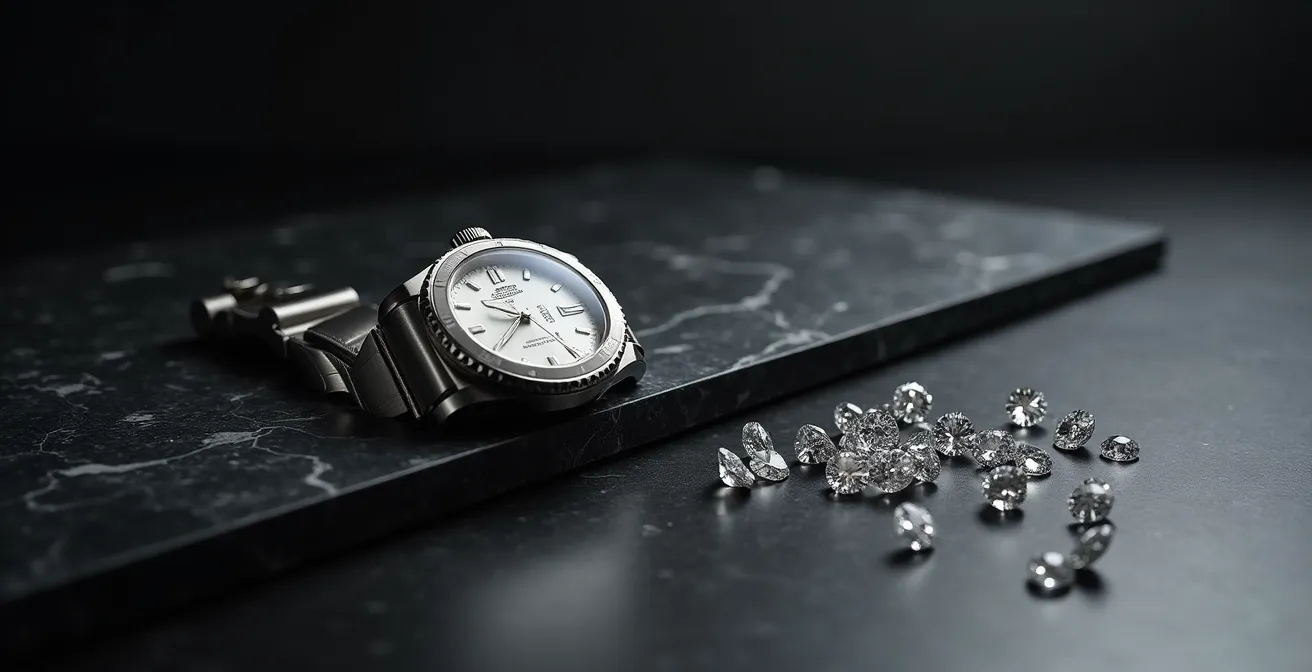
Adding aftermarket diamonds to a Rolex is arguably the fastest way to destroy its resale value and market liquidity.
- The market classifies “busted down” watches as damaged goods, often resulting in a 50%+ drop in value compared to original models.
- Rolex Service Centers frequently refuse to service modified watches, forcing owners to rely on independent, sometimes uncertified, watchmakers.
Recommendation: If you desire the “iced out” look, buy a factory-set model or use a reversible bezel replacement, but never drill into the original case or dial.
Every week, I see the same scenario play out at the counter. A client walks in with a “busted down” Datejust or Submariner, covered in aftermarket diamonds, expecting to trade it in for a premium price. They see the sparkle and the cost of the stones; the market sees a compromised asset. It is a harsh reality check that often ends in frustration and significant financial loss.
The allure of customization is understandable. In a world of standardized luxury, we crave uniqueness. We see celebrities and influencers flaunting timepieces that drip with gems, and the temptation to replicate that aesthetic is strong. You might think, “It’s still a Rolex, plus I added $5,000 worth of diamonds, so it must be worth more.” This logic applies to real estate, where a renovation adds value. While reversible upgrades like vulcanized FKM rubber straps respect the original engineering, permanent modifications represent a dangerous fallacy in horology. We are not dealing with home improvements; we are dealing with precision engineering and brand integrity.
But what if the real issue isn’t just about taste, but about the fundamental mechanics of asset classes? While many articles will tell you to “keep the original parts,” the financial damage often goes deeper than just swapping a bezel. We need to look at this through the lens of the “Purist’s Financial Reality.” This article will dissect why the market punishes aftermarket modification so severely and how you can navigate the desire for bling without burning your equity.
text
To navigate this complex market safely, it is essential to understand the structural and financial mechanisms at play, as detailed in the following analysis.
Contents: The Economics of Aftermarket Customization
- The Foundation: Understanding Intrinsic vs. Market Value
- Why Does a “Cartier” Signature Add 30% to the Hammer Price?
- The Physical Toll: Engineering Tolerances and Integrity
- The Error of Melting Down Signed Vintage Pieces for Scrap Gold
- The Liquidity Crisis: Why Dealers Reject Modified Watches
- Why Is High Jewellery Considered a Portable Asset Class for the Ultra-Rich?
- Factory vs. Aftermarket: The Critical Distinction
- Strategic Alternatives to Devaluation
The Foundation: Understanding Intrinsic vs. Market Value
To understand why diamonds devalue a watch, you must first understand what you are actually owning. A luxury watch is a sum of its parts, but its value is derived from the *coherence* of those parts. When you buy a standard Rolex Submariner, you are buying a liquid asset. It is cash on the wrist. You can fly to Tokyo, New York, or London, and walk into a dealer who will offer you a predictable price based on the model reference.
When you modify that watch, you break that coherence. You move the object from the “watch market” to the “jewelry market,” and these two operate on vastly different principles. In the watch market, originality and condition are king. In the jewelry market, items are often valued at the melt value of the gold and the wholesale price of the stones. By customizing, you are effectively asking a watch collector to pay for jewelry labor, or a jeweler to pay for a watch mechanism they don’t value. You fall into a gap where neither buyer is satisfied.
This fundamental disconnect explains why the base value evaporates the moment the drill bit touches the steel.
Why Does a “Cartier” Signature Add 30% to the Hammer Price?
It is a common counter-argument: “But rare, special edition Rolexes sell for millions!” This is true, but there is a massive difference between *provenance* and *modification*. To illustrate this, we must look at how the market treats authorized third-party signatures versus unauthorized work. A “double-signed” dial, such as one retailed by Cartier or Tiffany & Co. in the past, is the holy grail of collecting. It represents a documented, authorized partnership between two luxury giants.
The image below highlights the extreme detail and historical weight of such a signature, which adds value precisely because it is rare and legitimate.
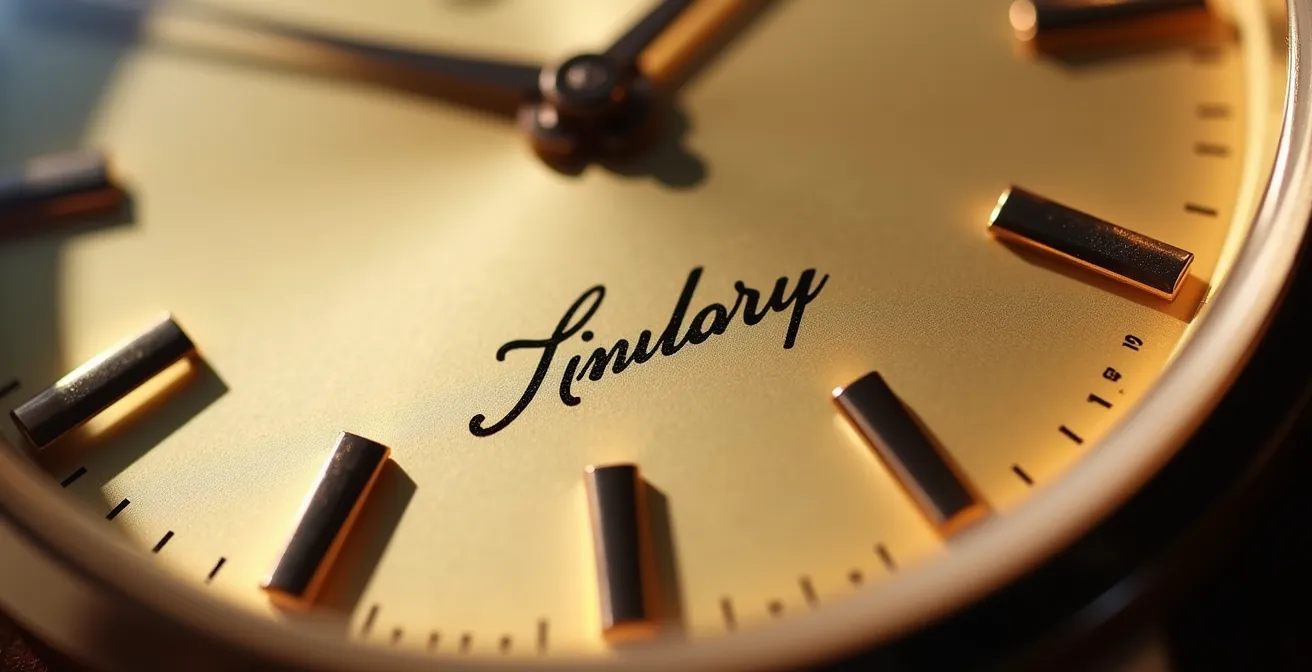
As you can see, the typography and aging of the dial are pristine. This is not graffiti; it is history. The market pays for this history. When a third party creates a dial *without* the manufacturer’s blessing, the equation flips.
The “Official” Premium: Cartier-Signed Rolex GMT-Master 1675
A two-tone Rolex GMT-Master ref. 1675 retailed by Cartier sold at Christie’s in 2020 for CHF 68,750. Watch dealer Eric Ku subsequently called it ‘perhaps the most expensive two-tone Rolex ever.’ The cursive Cartier signature above 6 o’clock and accompanying Cartier archival papers transformed an otherwise ordinary GMT-Master into a highly collectible piece, demonstrating how documented provenance from a second luxury brand creates exponential value. A similar Cartier-signed Sea-Dweller sold at auction for $91,000 even without documentation or original hands, confirming that the Cartier signature alone commands a significant premium over standard references.
The contrast is stark. An official stamp adds value; an unofficial diamond setting subtracts it. The market is ruthless in distinguishing between “rare” and “altered.”
As the editorial team at Barrington Watch Winders notes:
For purists, a Rolex altered outside Geneva is no longer a Rolex; it is a compromise.
– Barrington Watch Winders Editorial Team, Do Diamonds Lower the Value of a Rolex Watch?
Once we step outside this authorized ecosystem, we enter the territory of structural compromise.
The Physical Toll: Structural Integrity and Waterproofing
Beyond the financials, there is an engineering reality that many jewelers gloss over. A Rolex Oyster case is designed to withstand massive pressure. The tolerances are measured in microns. Adhering to the precision engineering standards for watch components is what preserves an asset during any technical update. To set diamonds into the lugs or the case of a watch that was not designed for them, metal must be removed. This process involves drilling holes into the stainless steel or gold architecture of the watch.
This structural modification often compromises the water resistance of the timepiece. A “busted down” Submariner—a watch famous for its diving capabilities—often becomes a watch you cannot even wear in the shower. The structural integrity is weakened, making the case more susceptible to warping or snapping under stress. Furthermore, aftermarket dials are often heavier due to the added stones, which can put strain on the movement’s geartrain, leading to premature wear and inaccurate timekeeping.
This physical damage is the precursor to the financial damage we are about to explore.
The Error of Melting Down Signed Vintage Pieces for Scrap Gold
The tragedy of the “bust down” is that it is irreversible. Unlike a strap change, you cannot undrill holes in a case. You are essentially taking a finished, high-value product and reducing it to its raw materials. The market reacts to this by pricing the watch not as a Rolex, but as a collection of used parts.
The illustration below captures the somber reality of a modified watch: a lonely object that has been stripped of its original identity.

This visual represents the “point of no return.” Once the metal is cut, the warranty is void, and the asset is fundamentally altered. The financial hit is immediate and brutal.
In fact, a standard stainless steel Submariner can sell for $10,000–$15,000 pre-owned, while the same watch with aftermarket diamond setting would struggle to bring even $5,000 according to pre-owned watch specialist Bob’s Watches. You are paying for the diamonds, paying for the labor, and then paying a penalty on the watch itself.
Irreversible Damage from Aftermarket Diamond Setting: The Myth of Reversibility
Rolex craftsmen position each factory stone by hand within tolerances of microns, ensuring flawless alignment and enduring stability without compromising water-resistance. Aftermarket modifications use stones of varying cut or clarity and setting techniques that cannot achieve the same microscopic precision. Even minor inconsistencies disturb the watch’s symmetry and durability. Furthermore, Rolex Service Centers are known to require owners to restore watches to the original factory-intended configuration at the owner’s expense as a condition of service, effectively confirming that aftermarket modifications are never truly ‘reversible’ without compounding financial loss.
The loss of value is compounded by the fact that you have severely shrunk your pool of potential buyers.
The Liquidity Crisis: Why Dealers Reject Modified Watches
Liquidity is the ability to sell an asset quickly without losing significant value. A standard Rolex is highly liquid. A modified Rolex is an illiquid asset. When you try to sell a customized watch, most reputable dealers will simply say “no.” We cannot verify the quality of the diamonds easily, we cannot guarantee the waterproofing, and we know that our core clientele—collectors—will not touch it.
You are left trying to sell to private parties on platforms like eBay or specialized “bling” marketplaces, where buyers are notorious for low-balling. You lose the safety net of the professional dealer network. The buyer demographics shift from investors and collectors to bargain hunters looking for a flashy look at a discount. They know you have nowhere else to go, and they will price their offers accordingly.
This stands in stark contrast to how the wealthy handle actual jewelry investments.
Why Is High Jewellery Considered a Portable Asset Class for the Ultra-Rich?
It is important to distinguish between “jewelry on a watch” and “High Jewellery.” The ultra-rich invest heavily in jewelry, but they buy signed pieces from houses like Graff, Van Cleef & Arpels, or Cartier. These items have intrinsic artistic value and brand provenance. A generic diamond setting on a Rolex has neither.
The following table breaks down exactly where the risks lie when modifying a watch.
As this hierarchy demonstrates, not all modifications are created equal. Drilling the case is the ultimate destroyer of equity, as supported by an analysis of customization risks.
| Risk Level | Modification Type | Value Impact | Reversibility | Market Effect |
|---|---|---|---|---|
| Level 1 — Low | Aftermarket strap or bracelet swap | Minimal to none (if original retained) | Fully reversible | No impact on liquidity; easily sold as original |
| Level 2 — Medium | Aftermarket dial replacement | Moderate depreciation; watch no longer certifiable as authentic | Reversible only if original dial preserved | Reduced buyer pool; reputable dealers will not certify |
| Level 3 — High | Aftermarket bezel or PVD/DLC coating | Significant depreciation; Rolex refuses service on PVD-coated watches | Bezel partially reversible; PVD coating extremely difficult to remove | Severely limited market; classified as custom project |
| Level 4 — Extreme / Irreversible | Adding diamonds to case, lugs, or bracelet | Catastrophic loss — value may drop 50% or more | Irreversible — drilling permanently compromises case structural integrity | Near-total illiquidity; market shrinks to niche iced-out sub-market |
Real investment data backs this up. 70% of UHNWIs increased their allocation to luxury investments over the past year, with luxury assets making up approximately 20% of UHNWI portfolios globally. They treat these items as banks. Furthermore, Jewellery showed a 2.3% increase in 2024 and an impressive 33.5% increase over the past decade. But crucially, this data applies to *investment-grade* jewelry, not modified watches.
The smart money knows the difference between a modification and a masterpiece.
Factory vs. Aftermarket: The Critical Distinction
Does this mean all diamond Rolexes are bad investments? Absolutely not. A “Rainbow Daytona” or a factory-set Day-Date is a tremendous asset. The difference is the *origin*. Factory-set gems are selected by Rolex gemologists (only IF quality or better) and set by Rolex master jewelers. The watch is documented as a “gem-set” reference in the catalog.
When a dealer checks the serial number of a factory-set watch, it matches the database. When they check a “bust down,” the database says “Stainless Steel Submariner,” but the eye sees diamonds. That discrepancy is a red flag. Factory gems are rare; aftermarket gems are commodities. The former is a collectible; the latter is a franken-watch.
Pre-Modification Audit: Your Safety Checklist
- Database Check: Confirm if the “look” you want exists as a factory reference.
- Reversibility Assessment: Will metal be removed? (Drilling = NO).
- Warranty Verification: Acknowledge that this voids the 5-year guarantee.
- Cost-Benefit Analysis: Calculate Watch Cost + Diamond Cost vs. Resale Value (expect -40%).
- Exit Plan: Identify 3 specific dealers who would actually buy the modified result.
So, if you must have the look, is there a way to do it without losing your shirt?
Strategic Alternatives to Devaluation
If you absolutely love the diamond look but care about your financial health, there is a middle ground. The golden rule is non-destructive modification. Instead of drilling the case, purchase a high-quality aftermarket bezel that can be swapped onto the watch. Keep the original factory bezel in a safe place. When it comes time to sell, swap the original back on. You can then sell the watch as a pristine original and sell the diamond bezel separately for the scrap gold and stone value.
Key Takeaways
- Aftermarket diamonds almost always reduce the value of a luxury watch, often by 50% or more.
- Drilling into the case or lugs creates irreversible structural damage and voids warranties.
- Liquidity is the hidden cost; modified watches are incredibly difficult to sell to reputable dealers.
You get to enjoy the aesthetic while you own the watch, but you protect the asset’s integrity for the future. It is the only strategy that satisfies both the desire for flair and the necessity of financial prudence.
Before you make any changes to your timepiece, consult with a certified watchmaker to understand the irreversible impacts on its value.
Frequently Asked Questions about Rolex Customization
Does adding a diamond bezel devalue my Rolex?
Yes, if you do not keep the original bezel. However, if you swap the bezel without altering the case and retain the original factory part to reinstall later, the devaluation of the watch itself is minimal. The aftermarket bezel itself will lose significant value, but the watch remains protected.
Can I send my custom diamond Rolex to the Service Center?
Likely not. Rolex is notorious for refusing to service watches with aftermarket parts. In many cases, they will require you to pay to replace all modified parts with factory originals before they will touch the movement, resulting in a massive service bill.
Are aftermarket diamonds real diamonds?
Usually, yes, they are real carbon diamonds. However, the cut, color, and clarity are often far inferior to the stones Rolex uses. “Bust down” settings often use “commercial grade” stones to keep costs down, which have little to no resale value on the secondary market.