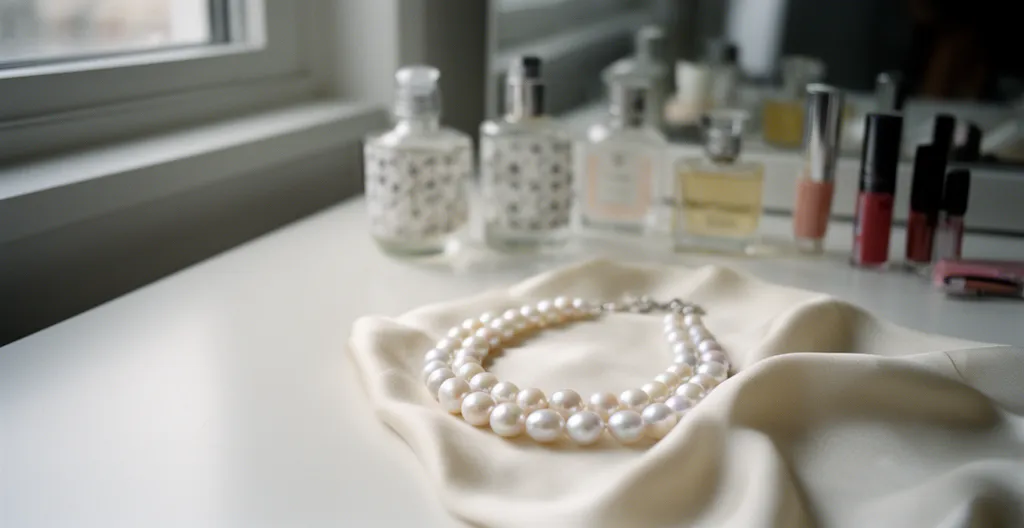
The secret to wearing pearls with perfume is not restriction, but understanding: your pearls are organic gems that require a thoughtful approach to your beauty routine.
- Chemicals in cosmetics, especially perfume, can permanently damage a pearl’s surface and the silk thread that holds them.
- Strategic styling, such as choosing longer necklaces and applying scents away from contact points, allows for a harmonious coexistence.
Recommendation: Adopt the “last on, first off” rule, wipe your pearls with a soft cloth after every wear, and store them in a breathable, fabric-lined box away from other jewellery.
It’s a familiar, elegant ritual: a spritz of your favourite perfume on the neck, followed by the cool, smooth feel of a pearl necklace being clasped. For the woman who appreciates both the allure of a fine fragrance and the timeless beauty of pearls, this moment feels complete. Yet, it unknowingly initiates a slow, silent process of damage. The common advice—to simply avoid this combination—often feels like a compromise, forcing a choice between two beloved elements of personal style.
Many guides will offer a simple list of “don’ts,” but this approach overlooks the heart of the matter. The key isn’t a rigid set of rules, but a deeper understanding of the pearl as a unique, organic creation. Unlike diamonds or gold, a pearl is a living gem, born from nature and composed of delicate layers that react to their environment. Its care is less about prohibition and more about creating a harmonious ecosystem where your modern lifestyle and your cherished jewellery can not only coexist but thrive together.
This guide moves beyond the basic warnings to explore the science and strategy behind true pearl preservation. We will delve into why pearls react to their surroundings, how to perform crucial maintenance checks, and how intelligent styling choices can protect your investment without sacrificing your daily rituals. By embracing this protective and educational approach, you can ensure your pearls remain as lustrous and beautiful as the day you received them, for a lifetime to come.
To help you navigate this essential knowledge, this article is structured to answer the most pressing questions about pearl care in a modern world. Explore the sections below to build your expertise and confidence.
Summary: A Specialist’s Guide to Lifelong Pearl Care
- Why Do Pearls Dehydrate and Crack If Left in a Safe for Years?
- How to Check if Your Pearl Necklace Needs Restringing Immediately?
- Akoya or Freshwater: Which Pearl Type Has the Sharpest Mirror-Like Lustre?
- The Error of Using Acidic Home Cleaners on Calcite-Based Pearls
- Choker or Matinee Length: Which Pearl Strand Suits a High Neckline?
- Why Does Mother-of-Pearl Scratch So Easily Against Keys?
- Lace or Satin: Which Dress Fabric Calls for Pearls Instead of Diamonds?
- How to Prevent Mother-of-Pearl Inlays from Peeling Out of Jewellery?
Why Do Pearls Dehydrate and Crack If Left in a Safe for Years?
The intuition to store precious items in a secure place like a bank safe is understandable, yet for pearls, it can be a devastating mistake. Unlike mineral gemstones forged in the earth’s crust, pearls are organic gems. They are formed within a living mollusc and contain a small percentage of water—typically around 2%—within their crystalline structure. This moisture is essential for maintaining their resilience and lustrous surface. When pearls are left in an overly dry environment, such as a climate-controlled safety deposit box, this vital moisture begins to evaporate.
This process of dehydration causes the organic layers of nacre to shrink and become brittle. Over time, this can lead to visible surface cracks, a dull or chalky appearance, and a complete loss of their signature orient and lustre. To prevent this, pearls require a specific environment that mimics their natural origins. According to gemological experts, the ideal environment for pearl preservation involves a stable humidity level. For instance, GIA recommendations suggest maintaining a relative humidity of between 50% and 70%.
Instead of a sealed vault, the best storage location is a fabric-lined jewellery box kept in a room with moderate, stable temperatures. This allows the pearls to breathe and retain their internal moisture. If you live in a very dry climate, placing a small glass of water in the room can help maintain an adequate humidity level. Treating your pearls with this understanding of their organic nature is the first step in ensuring their longevity.
How to Check if Your Pearl Necklace Needs Restringing Immediately?
The beauty of a pearl necklace lies not only in the gems themselves but also in the delicate silk thread that holds them together. This thread, however, is the most vulnerable part of the piece. Like the pearls, the silk is an organic material that degrades over time, weakened by exposure to body oils, cosmetics, and the chemicals in perfume. A broken strand can mean the devastating loss of one or more cherished pearls, especially if the necklace is not individually knotted.
To check for wear, lay your necklace on a flat, white surface. Look closely at the knots between each pearl. If you see that the knots are frayed, discoloured, or have stretched, allowing the pearls to move loosely along the thread, it is a clear sign that the silk has weakened. Another simple test is to hold the necklace up by the clasp; if you notice significant gaps between the pearls, the thread has stretched and is at risk of snapping. The integrity of these knots is paramount for security.
This visual inspection is crucial for preventing unexpected breakage and loss.
As a guideline for proactive care, experts provide clear timelines for maintenance. In the case study below, a GIA-certified professional outlines a schedule based on frequency of wear, transforming maintenance from a reaction to a planned part of your jewellery care ecosystem.
Professional Pearl Care Restringing Guidelines
Ashley McNamara of PurePearls.com, a GIA-certified expert with over 20 years of experience, recommends restringing pearls once every two to three years for occasional wear, or once a year if worn weekly. The silk thread absorbs oils and perspiration that can weaken the fibers over time. McNamara emphasizes checking for stretched knots and ensuring each pearl is knotted separately to prevent loss.
Akoya or Freshwater: Which Pearl Type Has the Sharpest Mirror-Like Lustre?
When selecting pearls, understanding the differences between types is crucial, especially when considering a lifestyle that includes daily cosmetics. The two most popular choices, Akoya and Freshwater pearls, offer distinct advantages in lustre, durability, and value. The choice between them can be a strategic part of creating your harmonious jewellery ecosystem. Akoya pearls, the classic Japanese saltwater variety, are renowned for their exceptional lustre. They possess a sharp, mirror-like reflection and a perfectly round shape, making them the traditional choice for fine jewellery.
As GIA-certified Pearl Specialist Kevin Canning of Pearls of Joy states:
Japanese Akoya pearls can’t be matched for quality and high-end appeal with a mirror like luster.
– Kevin Canning, Pearls of Joy – GIA-certified Pearl Specialist
However, this brilliant lustre comes from a relatively thin layer of nacre (0.4-0.6mm) over a bead nucleus, making them more susceptible to damage from acids and chemicals found in perfumes. Freshwater pearls, on the other hand, are cultivated in lakes and rivers and are composed of solid nacre. This makes them significantly more durable and resistant to chipping or erosion from cosmetics. While their lustre is often described as a softer, more satiny glow, modern cultivation techniques have produced Freshwater pearls with lustre that rivals that of Akoya. This durability, combined with their more accessible price point, makes them an excellent choice for daily wear.
This comparative table breaks down the key differences to help you make an informed decision based on your lifestyle and aesthetic preferences. This data, sourced from a detailed analysis by pearl specialists, provides a clear overview.
| Characteristic | Akoya Pearls | Freshwater Pearls |
|---|---|---|
| Lustre Quality | Mirror-like, sharp reflection | Softer, satin-like glow |
| Nacre Thickness | 0.4-0.6mm (thin) | Solid nacre throughout |
| Durability Against Perfume | Less resistant (thin nacre) | More resistant (thick nacre) |
| Price Range | Higher ($300-10,000+) | More affordable ($50-2,000) |
| Best For Daily Wear | Special occasions | Daily use with cosmetics |
The Error of Using Acidic Home Cleaners on Calcite-Based Pearls
The impulse to clean jewellery with common household products like vinegar, lemon juice, or even commercial jewellery cleaners can be catastrophic for pearls. These substances are highly acidic, and pearls are made of calcium carbonate—the same material as chalk or marble. When an acid comes into contact with calcium carbonate, it causes a chemical reaction that dissolves the material, permanently etching the surface and destroying its lustre. This vulnerability is underscored by the pearl’s softness; it ranks at just 2.5 on the Mohs scale of hardness, making it susceptible to both chemical and physical damage.
Even mild soaps can be problematic if they contain harsh detergents or fragrances. Ultrasonic cleaners, which use high-frequency vibrations to dislodge dirt, are also forbidden. These vibrations can cause the delicate layers of nacre to crack or shatter, and can damage the bond between the pearl and its setting. Steam cleaners are equally dangerous, as the high heat can cause the pearl to dehydrate, expand, and crack.
The only safe way to clean pearls is with a gentle, mindful approach that respects their organic composition. Wiping them with a soft, damp cloth after wear is usually sufficient to remove oils and residues. For a deeper clean, a simple, pH-neutral solution is all that is required. Following a clear, step-by-step process ensures you never have to guess, protecting your investment from irreversible mistakes.
Your Action Plan: The Safe Pearl Cleaning Method
- After every wear, gently wipe your pearls with a soft, dry cloth to remove body oils and perfume residue.
- For a deeper clean, mix a few drops of mild, fragrance-free dish soap into a bowl of lukewarm water.
- Dip a soft cloth into the solution, wring it out so it’s damp (not wet), and carefully wipe each pearl. Never submerge the strand.
- Rinse the cloth with clean water, wring it out, and wipe the pearls again to remove any soap residue.
- Lay the pearls flat on a soft towel and allow them to air dry completely before storing them to prevent the silk thread from stretching.
Choker or Matinee Length: Which Pearl Strand Suits a High Neckline?
Beyond chemical interactions, a powerful way to protect your pearls is through strategic styling—a concept we call “scent-safe styling.” This involves choosing necklace lengths and styles that minimize direct contact with areas where perfume is applied. The pulse points on the neck and décolletage are prime zones for fragrance, but they are also where shorter pearl strands, like chokers (14-16 inches) and princess lengths (17-19 inches), rest directly against the skin.
For those who love wearing high necklines, such as turtlenecks, mock necks, or collared blouses, a longer pearl strand is both a stylish and a practical choice. A matinee length (20-24 inches) is perfectly suited for this. It is designed to rest on the chest, well below the collarbone and away from the primary perfume zones of the neck. This positioning creates a physical barrier—the fabric of your top—between your skin and your pearls, drastically reducing their exposure to the alcohol and oils in your fragrance.
This simple choice of length is an elegant solution that allows you to enjoy both your signature scent and your beautiful pearls without compromise.
Jewellery experts actively recommend this approach to their clients, framing it as a way to build a sustainable and protective relationship with one’s collection. The following example demonstrates how this advice is applied in a real-world setting.
Strategic Pearl Length Selection for Perfume Protection
CJ Charles jewelers emphasize that matinee length pearls (20-24 inches) naturally rest below the clavicle, away from neck pulse points where perfume is typically applied. This positioning significantly reduces direct contact with fragrances and cosmetics. For clients who prefer choker styles, they recommend applying perfume to wrists and behind the knees instead, creating a scent cloud that doesn’t directly endanger the pearls.
Why Does Mother-of-Pearl Scratch So Easily Against Keys?
The iridescent beauty of mother-of-pearl, or nacre, makes it a popular choice for jewellery inlays, watch faces, and decorative objects. However, like pearls, it is an organic material that is exceptionally soft and prone to damage. The reason it scratches so easily when it comes into contact with common objects like keys lies in a simple comparison of material hardness, measured on the Mohs scale. Mother-of-pearl has a hardness of around 3.5 on the Mohs scale.
In contrast, the metals used to make keys, such as brass or nickel silver, are significantly harder. According to the Gemological Institute of America, these common metals rank much higher, with a hardness of 4.0 to 5.5 on the Mohs scale. According to the principle of the scale, any material can be scratched by a material with a higher number. Therefore, when a piece of mother-of-pearl jewellery is tossed into a purse or pocket with a set of keys, the harder metal will inevitably abrade and scratch the softer nacre, leaving permanent marks and dulling its beautiful sheen.
This principle of “material empathy”—understanding and respecting the physical limitations of your gems—is fundamental to proper care. It extends beyond just keys to include other items like pocketknives, metal pens, and even the prongs of other jewellery. To prevent these scratches, mother-of-pearl pieces must be stored separately in a soft pouch or a dedicated compartment in a jewellery box, isolated from any harder objects that could cause damage.
Lace or Satin: Which Dress Fabric Calls for Pearls Instead of Diamonds?
The art of accessorizing is a dance between light, texture, and form. While diamonds are often seen as the ultimate luxury, there are specific fabrics and occasions where the subtle elegance of pearls is not only more appropriate but also a safer choice. This is especially true when pairing jewellery with delicate textiles like lace and satin. The choice between pearls and diamonds in these contexts is a perfect example of building a harmonious fashion ecosystem.
With satin, the goal is to complement its soft, diffuse sheen, not compete with it. The fiery, brilliant sparkle of diamonds can create harsh points of light that clash with the gentle glow of the fabric. Pearls, with their soft, luminous lustre, create a far more harmonious and sophisticated look, echoing the light in a similar manner. With delicate lace, the consideration becomes purely practical. The metal prongs that hold diamonds in their settings are notorious for snagging and tearing intricate lacework, potentially causing irreparable damage to a cherished garment. Pearls, being smooth and round, glide harmlessly over even the most fragile fabrics.
This perspective is shared by professional stylists who work with these materials daily.
At CJ Charles, stylists consistently observe that pearls complement satin’s soft sheen without competing for attention, unlike diamonds which create jarring points of light. They note that pearls are the safer choice with delicate lace, as diamond prongs frequently catch and tear intricate fabrics. One stylist shares: ‘We’ve seen countless vintage lace pieces damaged by diamond settings, while smooth pearls glide harmlessly across even the most delicate textiles.’
Choosing pearls for these fabrics is a decision rooted in both aesthetic harmony and material empathy. It shows a deep appreciation for the interplay between textiles and gems, ensuring that both your clothing and your jewellery remain in perfect condition.
Key Takeaways
- Pearls are organic gems containing water; they must be stored in a breathable, fabric-lined box with 50-70% humidity to prevent dehydration and cracking.
- Protect your pearls through “scent-safe styling” by choosing longer necklace lengths and applying perfume to areas that won’t make direct contact.
- Always clean pearls with a soft, damp cloth and mild, pH-neutral soap. Never use acidic cleaners, ultrasonic machines, or steam.
How to Prevent Mother-of-Pearl Inlays from Peeling Out of Jewellery?
Mother-of-pearl inlays, prized for their captivating iridescence, are held in place by specialized adhesives. While strong, these adhesives are the weak link when exposed to the chemicals prevalent in a modern lifestyle. The primary culprits are the same substances that threaten pearls themselves: the alcohols, oils, and solvents found in perfumes, lotions, hairsprays, and even sunscreens. These chemicals can compromise the integrity of the setting over time.
As the Gemological Institute of America explains in its care guidelines, this is a slow but steady process of degradation.
The alcohols and oils in perfumes, lotions, and sunscreens can seep into micro-gaps and slowly dissolve adhesive.
– GIA Pearl Care Guidelines, Gemological Institute of America
When the adhesive bond weakens, the mother-of-pearl inlay can begin to lift at the edges, create gaps, or eventually peel and fall out completely. This risk is compounded by exposure to water. Soaking the jewellery during cleaning, swimming, or even showering allows moisture to penetrate beneath the inlay, further weakening the glue and accelerating its failure. Prevention, therefore, follows the same core principles as general pearl care: put your jewellery on last, after all cosmetics have been applied and have had a moment to dry.
Beyond daily habits, professional oversight is the best insurance against loss. A jeweller can inspect the setting under magnification, identify any early signs of lifting, and re-secure the inlay before it becomes a critical issue. Jewellery experts often suggest this as a routine part of maintenance, with a recommended frequency for professional pearl jewelry inspection of at least once per year. This proactive check-up is a small investment to protect a beautiful and delicate piece.
Embrace these gentle, protective practices to ensure your cherished pearls and mother-of-pearl pieces remain a source of beauty and elegance for generations to come. A little understanding and mindful care are all it takes to build a lasting, harmonious relationship with these timeless organic gems.
Frequently Asked Questions About How to Keep Cultured Pearls Lustrous
Can I store pearls with other jewelry?
No, pearls should be stored separately in soft, fabric-lined compartments to prevent scratches from harder gemstones and metals. Their soft surface is easily damaged by contact with diamonds, sapphires, or even the prongs of other settings.
Is it safe to keep pearls in plastic bags?
Never store pearls in plastic bags. Certain chemicals used in plastic manufacturing can emit a gas that erodes the pearl’s surface over time. Furthermore, the lack of airflow in a plastic bag can cause the pearls to dry out and crack.
How should I store pearl necklaces?
Always lay pearl necklaces flat with their clasps fastened when storing them. Hanging a pearl strand for extended periods can cause the silk thread to stretch under the weight of the pearls, leading to unsightly gaps and increasing the risk of breakage.