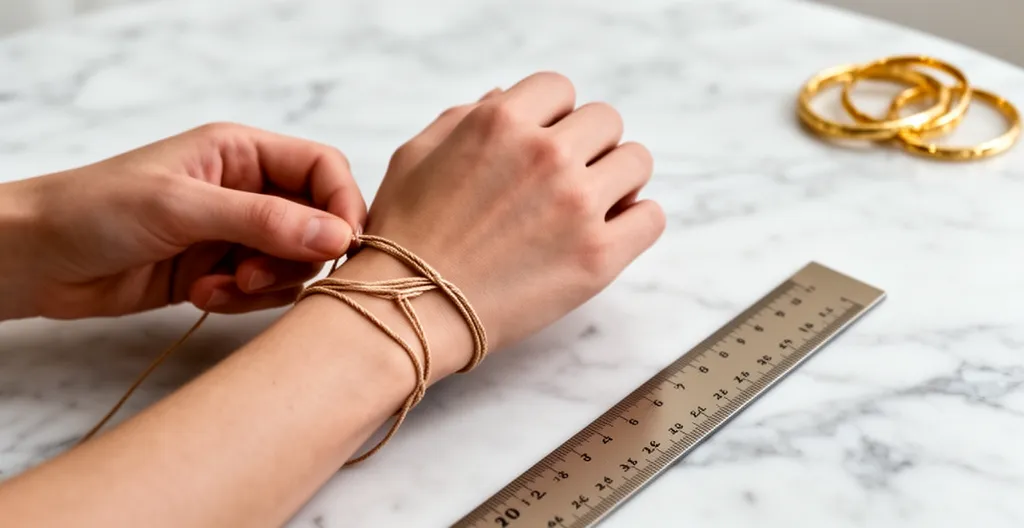
Buying a bangle online is stressful; a wrong measurement often leads to returns or, worse, a bracelet that gets stuck. The secret isn’t just measuring your wrist, but understanding its unique shape and matching it to the specific design of the bangle—whether it’s a slip-on, hinged, or cuff style. This guide provides the knowledge to choose the right size with confidence, ensuring your new jewelry fits perfectly from the moment it arrives.
There’s a moment every online jewelry shopper knows well: you find the perfect bangle, its polished curve or intricate design calling to you. But then, hesitation creeps in. A single, nagging question stops you from clicking “buy”: will it actually fit over my hand? This purchase anxiety is completely valid. Standard advice often involves a flexible measuring tape or a piece of string, but these methods only tell half the story. They measure your wrist, but for a solid bangle, the real challenge is getting it over the widest part of your hand.
The frustration of receiving a beautiful piece that you can’t wear, or the panic of forcing one on only to find it won’t come off, is an experience we want to help you avoid. The key to buying bangles online with total confidence isn’t just about finding a number. It’s about understanding the fundamental difference between wrist size and hand size, and recognizing how a bangle’s design dictates which measurement truly matters. This isn’t just a measurement guide; it’s a new way to think about fit, comfort, and style.
Instead of relying on generic charts, we’re going to delve into the biomechanics of your wrist and the specific dynamics of how different bracelets are worn. We will explore why oval bangles feel more stable, how to create a silent and professional stack, and the critical differences between hinged and slip-on styles. By the end of this guide, you won’t just have a measurement; you’ll have the expertise to select any bangle, cuff, or bracelet with the certainty that it will be a perfect, comfortable, and cherished addition to your collection.
This article provides a comprehensive overview to help you master the art of bangle sizing and styling. Below, you will find a summary of the key topics we will explore to build your sizing confidence.
Summary: Your Guide to Perfect Bangle and Cuff Sizing
- Why Do Oval Bangles Rotate Less on the Wrist Than Round Ones?
- How to Create a Bangle Stack That Doesn’t Jingle During Meetings?
- Hinged or Slip-On: Which Bangle Style is Safer for Small Wrists?
- The Mistake of Forcing a Small Bangle That You Can’t Remove Later
- How to Mix Gold and Silver Bangles for a Cohesive Modern Look?
- How to Measure Your Wrist Gap so the Cuff Doesn’t Spin?
- Can You Shorten a Tennis Bracelet Without Ruining the Pattern?
- How to Wear a Gold Cuff Over Knitwear Without Snagging the Wool?
Why Do Oval Bangles Rotate Less on the Wrist Than Round Ones?
The superior stability of an oval bangle isn’t a matter of opinion; it’s a matter of biomechanics. Your wrist is not a perfect circle. It’s an oval, with a typical width-to-depth ratio of about 1.3:1. A round bangle on an oval wrist has empty space on the sides, allowing it to spin freely with every movement. This constant rotation means any top-set stones or decorative elements are rarely facing upward, which can be frustrating.
An oval bangle, by contrast, is designed to match the natural anatomy of your wrist. It sits snugly across the flatter top and bottom surfaces, minimizing the gaps that allow for rotation. This concept is backed by science; a study in the Journal of Hand Surgery on the ‘oval ring concept’ explains that oval shapes align with the wrist’s natural ligament constraints and joint forces. By working with your body’s mechanics instead of against them, the bangle maintains its position.
To find the right size for an oval bangle, you simply need a small adjustment from your round bangle measurement. As a rule of thumb, add about 3mm to your standard round bangle diameter to get the correct oval size. This ensures the bangle is large enough to slip on but shaped correctly to sit securely without constant spinning, offering a more comfortable and visually consistent wearing experience.
How to Create a Bangle Stack That Doesn’t Jingle During Meetings?
A beautifully curated “wristscape” is a powerful style statement, but a noisy one can be distracting in a professional setting. The constant jingling and clanking of metal on metal can undermine an otherwise polished look. The secret to a silent stack lies in the thoughtful selection and arrangement of materials. It’s about creating a buffer between the noisiest offenders, typically your metal bangles.
The most effective strategy is to alternate materials with different sound-dampening properties. Instead of stacking three gold bangles together, place a leather, wood, or silicone bangle between them. These softer materials absorb the impact and sound, creating a “silent luxury” effect. This approach not only solves the noise problem but also adds textural interest and depth to your stack, making it more visually compelling.
This visual guide demonstrates how different materials interact. The contrast between hard, reflective metals and soft, matte surfaces is the key to both visual and acoustic harmony.
As you can see, the textures do the work. A brushed metal finish will also be slightly quieter than a highly polished one. The trend towards more personal and considerate jewelry choices is growing, with some experts noting that 2026 will see soundless luxury become a key trend in wristwear. By curating your stack with both sound and style in mind, you create a look that is both sophisticated and workplace-appropriate.
Hinged or Slip-On: Which Bangle Style is Safer for Small Wrists?
For individuals with particularly small or slender wrists (typically under 5.5 inches), the choice between a hinged and a slip-on bangle is not just about style—it’s about security and fit. While a slip-on bangle must be large enough to pass over the knuckles, this often results in a final fit that is too loose on a small wrist, creating a constant risk of it falling off.
Hinged bangles solve this problem entirely. Because they open and close with a clasp, their sizing is based on your actual wrist circumference, not your hand size. This allows for a much snugger, more secure fit. As The Jewellery Room’s experts note in their sizing guide, this is a significant advantage. They state:
For individuals with small wrists, hinged bangles eliminate the need to base sizing on hand circumference, allowing for a perfect fit when closed without the gap danger of slip-ons.
– The Jewellery Room, Bangle Size Chart and Safety Guide
While a clasp can introduce a minor snagging risk, the security it offers for smaller wrists far outweighs this. Furthermore, in an emergency, a hinged bangle can be opened immediately, whereas a too-tight slip-on bangle can be very difficult to remove if swelling occurs. The following table breaks down the key safety and fit considerations for each style.
| Safety Factor | Hinged Bangles | Slip-On Bangles |
|---|---|---|
| Risk of Falling Off | Very Low – Secured with clasp | Moderate to High – Can slip over compressed hand |
| Snagging Risk | Moderate – Clasp mechanism can catch | Low – Smooth continuous surface |
| Emergency Removal | Easy – Open clasp immediately | Difficult – May require lubricant if swollen |
| Recommended Minimum Size | Can match exact wrist size | Must be 1/4 to 1/2 inch larger than hand |
| Best For | Very small wrists (under 5.5 inches) | Average to larger wrists (6+ inches) |
The Mistake of Forcing a Small Bangle That You Can’t Remove Later
It’s the scenario every bangle-wearer dreads: the piece that went on with a bit of a struggle now refuses to come off. Panic sets in, you pull harder, and your hand begins to swell, making the situation worse. Forcing a bangle that is too small is a common mistake, often stemming from wishful thinking or measuring at the wrong time of day. In fact, jewelry sizing experts recommend measuring in the evening, as hands are naturally at their largest due to daily activity and temperature changes.
If you find yourself in this situation, the first and most important step is to stop pulling and stay calm. There is a safe and effective protocol for removal that works by reducing swelling and lubricating the skin. One of the most effective methods involves using a simple plastic bag to compress the hand and create a frictionless surface.
This image demonstrates the plastic bag technique, which uniformly compresses the soft tissue of the hand, making it much easier to slide the bangle off without causing injury or additional swelling.
If you need to remove a stuck bangle, follow these steps methodically. Do not force the bangle, and if you experience significant pain, numbness, or discoloration, stop immediately and seek professional help.
- Elevate your arm above heart level for at least 5 minutes to help reduce swelling.
- Apply an ice pack wrapped in a cloth to your wrist for 10 minutes. Never apply ice directly to the skin.
- Use a lubricant. Hair conditioner or cooking oil are often more effective than soap and water.
- Place your hand inside a thin plastic bag, pulling the bag’s opening taut around your wrist to compress your hand.
- Gently rotate the bangle while pulling it over the plastic-covered hand. Avoid a straight, forceful pull.
- Stop immediately if you experience numbness, tingling, or your fingers start to turn blue.
How to Mix Gold and Silver Bangles for a Cohesive Modern Look?
The old rule of never mixing metals is officially outdated. A well-executed stack of gold and silver bangles creates a look that is modern, personal, and effortlessly chic. However, achieving a cohesive look rather than a chaotic jumble requires a strategic approach. The key isn’t to just throw them together; it’s to create intentional harmony through dominance, texture, and bridging.
According to an analysis of jewelry trends by Wempe Jewelers, the focus for 2025 has shifted from single statement pieces to creating personalized stacks by mixing tones and gifting individual pieces over time. This “one is none” philosophy encourages building a collection that tells a story. To do this successfully, follow a simple three-step formula:
- Establish Dominance: Your stack should have a clear primary metal. Choose either gold or silver to make up about 70-80% of the stack. This creates a strong foundation and prevents the two metals from competing for attention.
- Create Consistency Through Finish: The easiest way to unify different metals is to match their texture. A stack of all polished, all brushed, or all hammered bangles will look instantly cohesive, regardless of color.
- Add a Bridge Piece: This is the secret weapon of mixed-metal styling. Introduce a single two-tone piece that contains both gold and silver. This “bridge” bangle justifies the mix and ties the entire look together seamlessly.
By following this formula, you move from simply wearing jewelry to actively styling it. Your wrist becomes a canvas for a curated collection that reflects your personal taste, blending the warmth of gold with the cool elegance of silver in a way that feels both intentional and sophisticated.
How to Measure Your Wrist Gap so the Cuff Doesn’t Spin?
Unlike a slip-on bangle, a cuff bracelet has a gap that allows it to be put on sideways over the narrowest part of your wrist. The size of this gap is the single most important factor in determining whether the cuff will be stable or spin annoyingly. A gap that is too wide will cause the cuff to rotate and potentially fall off. A gap that is too narrow will be difficult or painful to put on and take off.
The goal is to find the perfect balance. The measurement process is one of precision, focusing on the thickness of your wrist, not its circumference. You’ll need to locate the “anatomical sweet spot”—the slight indentation just behind your prominent wrist bone. This is where the cuff will naturally sit. The key is to measure the top-to-bottom thickness of your wrist at this point.
Once you have this measurement, you can calculate the optimal gap. For a secure yet comfortable fit, the gap in the cuff should be 1/4 to 1/2 inch (about 6mm to 13mm) smaller than your wrist’s thickness. You can test this by creating a simple mock-up with a strip of stiff paper. It’s also important to account for the cuff’s weight; a heavier cuff with stones needs a slightly smaller gap (closer to 1/4 inch) to prevent gravity from pulling it out of position.
Key Takeaways
- Sizing for slip-on bangles is determined by hand circumference, not wrist size, to ensure it can pass over your knuckles.
- Oval bangles are more stable and rotate less because their shape matches the natural biomechanics of your wrist.
- For small wrists, hinged bangles offer a more secure fit than slip-ons because they are sized to the wrist itself.
- To avoid a stuck bangle, measure your hand in the evening when it’s at its largest, and never force a tight fit.
- Create a silent bangle stack by alternating metal pieces with softer materials like leather or wood to absorb sound.
Can You Shorten a Tennis Bracelet Without Ruining the Pattern?
A tennis bracelet is a feat of engineering, with dozens of identical links designed to create a seamless, fluid line of brilliance. Shortening one is possible, but it’s a delicate operation that, if done incorrectly, can permanently ruin the bracelet’s symmetry and pattern. It is not a DIY job; it requires the skill of a professional jeweler who understands the bracelet’s underlying structure.
The critical concept is the “pattern unit.” Most tennis bracelets are constructed from repeating sequences of links (often 3 or 4). A skilled jeweler will identify these units and only remove complete sets to maintain the visual flow. Removing a partial unit or an arbitrary number of links will disrupt the pattern, creating a noticeable “hiccup” in the design. Furthermore, links should be removed symmetrically from both sides of the clasp to ensure the clasp remains centered on the underside of your wrist.
Before entrusting your valuable bracelet to anyone, you should have a detailed conversation with the jeweler. As a customer, you have the right to ask specific questions to gauge their expertise and ensure they will respect the integrity of your jewelry. This simple checklist will help you lead that conversation with confidence.
Your Action Plan: Questions to Ask Your Jeweler Before Shortening
- Can you identify and commit to removing only complete pattern units to maintain design symmetry?
- Will you remove links from both sides of the clasp to preserve the bracelet’s balance on my wrist?
- Can the removed links be returned to me in a small bag for potential future lengthening or repairs?
- How will you reinforce the new solder joints to ensure they are as strong as the original links for long-term durability?
- Does this bracelet have an integrated or “invisible” clasp, and what specific risks does that present for alteration?
How to Wear a Gold Cuff Over Knitwear Without Snagging the Wool?
Wearing a bold gold cuff over the sleeve of a sweater is a chic and powerful style move, but it comes with a risk: snagging. A beautiful knit can be ruined in an instant by a rough edge on a piece of jewelry. The key to pulling off this look successfully lies in both choosing the right cuff and pairing it with the right type of knitwear.
Before you even purchase a cuff for this purpose, perform a simple “snag test.” Run a piece of delicate fabric, like a silk scarf or even sheer pantyhose, along all the interior edges and especially around the corners of the gap. If it catches anywhere, that cuff is not suitable for wearing over fine fabrics. The inside of the cuff must be as smooth as the outside. When wearing, position the cuff over a durable part of the sleeve, like the sewn seam, for added protection.
Not all knits are created equal when it comes to snag risk. Tightly woven fabrics are far more resilient than open, lofty ones. This guide provides a quick reference for pairing your smooth-edged cuff with the safest knitwear options.
| Knit Type | Snag Risk | Recommended | Special Precautions |
|---|---|---|---|
| Merino Wool | Low | Yes | Position over seams |
| Cashmere | Low | Yes | Ensure cuff edges are smooth |
| Jersey Knit | Very Low | Yes | Most durable option |
| Mohair | Very High | No | Avoid completely |
| Bouclé | High | No | Texture catches easily |
| Crochet/Open Weave | Very High | No | Gaps create snag points |
Now that you are equipped with this comprehensive knowledge, you can approach browsing online jewelry collections not with anxiety, but with the confidence of an expert. You have the tools to select the right style, find the perfect size, and care for your pieces intelligently. Find the bangle or cuff that speaks to you, knowing it will be a perfect and comfortable fit from the very first wear.