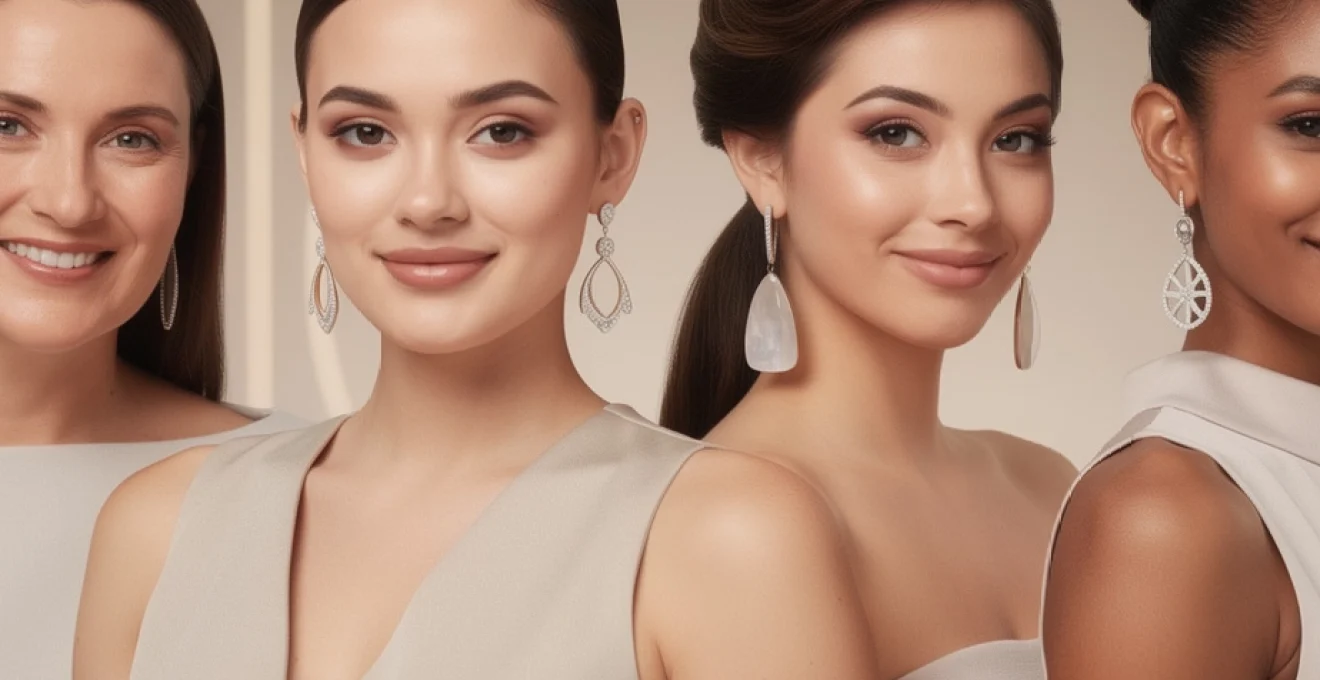
Drop earrings possess a remarkable ability to enhance facial features across diverse face shapes, making them one of the most universally flattering jewellery choices available. Unlike rigid geometric styles that work for specific facial structures, drop earrings create visual harmony through their natural downward movement and proportional balance. This versatility stems from fundamental principles of visual perception and facial geometry that jewellery designers have understood for centuries.
The transformative power of drop earrings lies in their capacity to create optical illusions that enhance natural beauty whilst addressing proportional imbalances. Whether you possess angular features that benefit from softening curves or rounded contours that require structural definition, drop earrings offer solutions through their varied lengths, shapes, and movement patterns. Understanding these principles enables more informed jewellery choices that complement rather than compete with your natural features.
Facial geometry principles: how drop earrings create universal flattering effects
The science behind drop earrings’ universal appeal centres on fundamental visual perception principles that govern how we process facial proportions. When positioned correctly, drop earrings create vertical lines that naturally elongate the face, whilst their weight distribution draws attention away from areas you might prefer to minimise. This dual action makes them particularly effective for addressing common facial proportion concerns.
Drop earrings work as visual anchors, creating balanced focal points that guide the eye naturally around the face whilst enhancing symmetry and proportion.
Vertical elongation theory and visual weight distribution
Vertical elongation represents the primary mechanism through which drop earrings achieve their flattering effects. The downward movement creates visual lines that extend beyond the natural jaw and neckline, effectively lengthening the perceived facial structure. This principle proves particularly beneficial for round or square face shapes, where the goal involves creating the illusion of increased vertical dimension.
Visual weight distribution operates simultaneously, with the earring’s mass positioned below the ear creating a counterbalance to facial width. Research in visual perception indicates that objects positioned in the lower visual field create grounding effects, making upper facial features appear more refined and balanced. This phenomenon explains why drop earrings consistently enhance facial harmony across different structural types.
Golden ratio applications in drop earring proportions
The golden ratio, approximately 1:1.618, appears consistently in aesthetically pleasing proportions throughout nature and design. When applied to drop earrings, this mathematical relationship determines optimal length-to-width ratios that create natural visual harmony. Earrings following these proportions tend to complement facial features more effectively than those with arbitrary dimensions.
Professional jewellers often incorporate golden ratio principles when designing drop earrings, ensuring that the relationship between the earring’s top section and its drop creates visually pleasing proportions. This mathematical foundation explains why certain drop earring styles appear universally attractive whilst others seem unbalanced or disproportionate to the wearer’s features.
Optical illusion mechanics: length versus width perception
Drop earrings manipulate visual perception through strategic length placement that alters how observers perceive facial width and proportion. Longer drops create stronger vertical emphasis, effectively narrowing the perceived facial width whilst adding elegant sophistication. Conversely, shorter drops provide gentle elongation without overwhelming delicate features.
The mechanics of optical illusion in drop earrings extend beyond simple length considerations. The interplay between the earring’s silhouette and facial contours creates visual bridges that enhance natural symmetry. Angular drops complement rounded features by introducing structural elements, whilst curved drops soften harsh angles through their organic movement patterns.
Anatomical balance points and jawline softening techniques
Anatomical balance points represent specific facial locations where jewellery placement creates optimal visual harmony. Drop earrings excel at targeting these points, particularly around the jawline where their positioning can dramatically alter perceived facial structure. The weight and movement of drops create gentle visual interruptions that soften pronounced jawlines whilst adding definition to softer contours.
Professional stylists recognise that drop earrings’ effectiveness in jawline enhancement stems from their ability to create visual transitions between the face and neck. This transitional quality proves particularly valuable for square or rectangular face shapes, where the goal involves reducing angular prominence whilst maintaining facial character and
softness. By interrupting a strong horizontal jawline with a vertical element that moves with you, drop earrings act almost like clever tailoring for the face, subtly reshaping how observers read your bone structure without changing a single feature.
Drop earring design elements that enhance facial proportions
While the underlying principles of facial geometry remain constant, not all drop earrings will flatter you in the same way. The impact of this jewellery category depends heavily on specific design elements such as length, weight distribution, movement, and material density. By understanding these factors, you can select drop earrings that actively work with your facial proportions rather than simply decorating them.
Think of drop earrings as architectural structures that frame your features. Just as an architect considers height, width, and load-bearing points, you can assess how each element of a drop earring will interact with your unique face shape. This approach transforms earring selection from guesswork into a considered styling strategy grounded in proportion and visual balance.
Graduated length variations: short, medium, and statement drops
Length is the most obvious yet most misunderstood variable in drop earring design. Short drops, which typically fall just below the earlobe (around 1–2 cm), offer subtle vertical elongation and are ideal if you have a shorter neck or delicate features. They provide the elegance of a drop silhouette without overwhelming petite frames, making them particularly suitable for oval and heart-shaped faces that already possess natural vertical balance.
Medium-length drops (approximately 3–5 cm) tend to be the most universally flattering option for everyday wear. They extend the vertical line enough to slim the face visually, yet remain practical and comfortable for long periods. For round and square face shapes, this length often strikes the perfect balance between elongation and wearability, especially when paired with refined silhouettes such as slim teardrops or vertical bar designs.
Statement drops and shoulder-duster styles (6 cm and beyond) create dramatic elongation and draw the eye decisively downward. These designs can be transformative for fuller or wider facial structures, but they require careful moderation for those with long or rectangular faces where additional vertical emphasis may exaggerate length. When selecting bold statement drops, paying attention to width and volume distribution becomes just as important as overall length.
Weight distribution patterns: top-heavy versus bottom-heavy designs
Beyond length, where the visual weight of a drop earring sits along its vertical axis profoundly influences how it interacts with your face. Top-heavy designs concentrate ornamentation near the earlobe, with finer or lighter elements extending downward. These styles keep attention closer to the eyes and cheekbones, making them effective for heart-shaped and diamond-shaped faces that benefit from upper-face emphasis.
Bottom-heavy drops, by contrast, place gemstones, pearls, or decorative clusters toward the lower third of the earring. This creates a more pronounced downward pull that visually anchors the look and adds fullness near the jawline. If you have a narrow chin or wish to soften a strong jaw, bottom-weighted styles can introduce welcome balance, acting almost like a visual counterweight to prominent foreheads or cheekbones.
Even distribution along the length of the earring offers a middle ground that works well for most face shapes, particularly oval and round. When the decorative elements are spaced in a graduated fashion, the eye travels smoothly from ear to shoulder, creating a continuous line that lengthens without overemphasising any single area. This equilibrium often feels effortless and is especially practical for earrings you plan to wear from day to night.
Movement dynamics: static versus kinetic drop mechanisms
Movement is another critical factor in how drop earrings flatter the face. Static drops—where the components are fixed and do not swing independently—create clean, architectural lines. They are excellent for adding structure to softer, rounder features because the eye reads them as stable vertical markers. Minimalist bar drops, linear gemstone arrangements, and rigid geometric designs all fall into this category.
Kinetic drops, on the other hand, incorporate hinges, chains, or multiple articulated segments that respond to your movements. This subtle motion catches the light and introduces softness around more angular features, making kinetic designs particularly flattering for square and rectangular faces. The gentle sway breaks up strong lines and prevents the overall look from appearing too severe.
If you are frequently on video calls or photographed in motion, kinetic drop earrings can be especially effective. Their movement draws the viewer’s attention toward the centre of the face and eyes rather than any specific contour you may wish to de-emphasise. It is similar to how a softly draped fabric can be more forgiving than a rigid, structured one—motion diffuses focus and adds a dimension of liveliness.
Material density impact on facial frame enhancement
The materials used in drop earrings influence more than just aesthetic preference; they affect how the earrings occupy visual and physical space. High-density materials such as solid gold, dense gemstones, or thick enamel create a more substantial visual presence, even in smaller pieces. On fuller or wider face shapes, this extra density can provide a confident, grounding effect, whereas on very fine bone structures, it may feel overpowering if not carefully scaled.
Lightweight materials—including hollow metals, resin, acrylic, and fine chains—deliver volume without corresponding heaviness. These are often ideal for longer drops because they minimise physical strain on the earlobe whilst still framing the face effectively. For rectangular and oval faces that already possess natural length, airy materials prevent excessive visual heaviness and keep the overall look refined.
Surface finish also plays a role. Highly reflective metals and faceted stones bounce light around the lower third of the face, subtly brightening the complexion and drawing focus to the jawline and lips. Matte or brushed finishes absorb more light, resulting in a softer, more understated frame. By matching material density and finish to your facial proportions and personal comfort tolerance, you can fine-tune how assertive or delicate your drop earrings appear.
Face shape compatibility matrix: round, square, heart, and oval analysis
Although drop earrings are inherently versatile, tailoring specific styles to your face shape will maximise their flattering potential. Each facial structure interacts differently with vertical lines, width, and movement, so understanding these dynamics allows you to choose designs that support your styling goals. Rather than rigid rules, consider the following as a practical compatibility matrix to guide your selection.
For round faces, the priority is introducing verticality and subtle structure. Long, slim drops, vertical bar designs, and elongated teardrops help visually lengthen the face and create definition along the jawline. Avoid overly wide or circular drops that echo facial roundness; instead, look for earrings where the width never exceeds the width of your earlobe by too great a margin.
Square faces, with their defined jawlines and broad foreheads, benefit from drop earrings that combine length with curvature. Soft teardrops, organic shapes, and kinetic chains that end in rounded elements all help to diffuse angularity. Medium-length drops that fall just above the jawline can be especially effective, as they intersect the strongest part of the jaw with a gentle, moving curve.
In heart-shaped faces, where the forehead is typically wider and the chin narrower, the goal is to add visual weight toward the lower half of the face. Bottom-heavy teardrop earrings, inverted triangle shapes (narrow at the top, fuller at the bottom), and chandelier-inspired drops all work beautifully. These designs create the illusion of a more balanced lower face, much like a flared hem balances a fitted bodice in fashion.
Oval faces enjoy the broadest compatibility with drop earring styles, thanks to their naturally balanced proportions. Most drop silhouettes—from refined linear designs to bold statement pieces—will work harmoniously. The main consideration is avoiding extreme lengths that extend far beyond the jawline, as these can over-elongate and draw attention away from the eyes and cheekbones, which are typically strong assets for this face shape.
Professional styling techniques for maximising drop earring impact
Even the most beautifully designed drop earrings can underperform if they are not styled thoughtfully. Professional stylists treat earrings as integral components of an overall look, coordinating them with hair, neckline, and occasion. By adopting a similar approach, you can ensure your drop earrings always feel intentional, polished, and proportionally appropriate.
Effective styling considers not only aesthetic harmony but also practical factors such as comfort, visibility, and wardrobe synergy. The same pair of medium-length teardrop earrings can appear understated with loose hair and a high neckline, or dramatically prominent with a sleek updo and open décolletage. Learning to manipulate these variables gives you greater control over how your drop earrings read in different contexts.
Hair positioning strategies for optimal earring visibility
Hair placement significantly affects how drop earrings frame your face. With hair worn up—in a bun, ponytail, or sleek chignon—drop earrings become focal points, creating a clear vertical line from ear to shoulder. This configuration is ideal when you want your earrings to do the heavy lifting in shaping the perceived face length, especially for round or square shapes seeking elongation.
When hair is worn down, especially if it is long or voluminous, the earrings interact with your hairstyle to create layered framing. In this scenario, slightly longer or more structured drop earrings help ensure they do not disappear within the hair. Choosing high-shine metals or light-catching stones can also make the earrings more visible, as reflections will peek through strands even when the design is partially obscured.
If you favour side-parted or asymmetrical hairstyles, consider how the parting line and hair drape affect facial balance. Wearing a more prominent drop earring on the side with less hair (for those with multiple piercings or mismatched pairs) can restore symmetry. Alternatively, ensuring that both earrings are visible at least intermittently—through tucking one side behind the ear or using hair clips—preserves their framing function.
Neckline coordination principles with drop earring lengths
The interaction between neckline and earring length is crucial for maintaining proportional harmony. As a rule of thumb, drop earrings should either echo or intentionally contrast the lines created by your clothing. With high necklines (such as turtlenecks, mock necks, or crew necks), medium to long drops create a continuous vertical line that elongates both face and neck. Slim, streamlined silhouettes tend to look most polished in this context.
For open necklines—including V-necks, scoop necks, and off-the-shoulder styles—there is greater flexibility. V-necklines pair particularly well with teardrop or triangular drops that mirror the downward angle, subtly reinforcing the shape and drawing the eye toward the centre of the chest. Scoop or sweetheart necklines, by contrast, often look best with curved or chandelier-inspired drops that echo their softness.
Strapless or minimalist necklines present an opportunity for more dramatic statement drops, as there is no competing fabric near the shoulders. However, if you introduce a bold necklace as well, you risk visual clutter. In professional styling, you will often see either strong drop earrings with a bare neck, or a statement necklace paired with simpler, shorter drops or studs to maintain balance.
Occasion-specific drop earring selection methodology
Matching drop earrings to the occasion ensures that your look feels context-appropriate while still flattering your face shape. For professional settings and daytime meetings, refined short to medium drops in classic metals (such as gold, silver, or platinum tones) project polish without distraction. Clean lines and moderate movement keep the focus on your face and expressions, supporting, rather than competing with, your professional presence.
In social and evening contexts, you can embrace bolder silhouettes, increased length, and more dynamic movement. Statement drops with gemstone clusters, intricate metalwork, or high-shine finishes enhance low lighting environments and photograph particularly well. If you anticipate being in many photos, consider how the earrings align with your facial goals: longer, slimmer designs for elongation, or wider, curved pieces for softening angles.
For casual and everyday wear, comfort and versatility become key. Lightweight medium-length drops that coordinate easily with multiple outfits offer the best return on investment. Many people find that one or two pairs in neutral metals, with subtle design details, can serve almost every informal occasion whilst still leveraging all the face-flattering advantages of drop earrings.
Celebrity case studies: successful drop earring applications across face shapes
One of the most effective ways to understand how drop earrings flatter different face shapes is to observe how stylists use them on public figures. Celebrities offer a wealth of visual case studies because their red carpet appearances are meticulously planned to enhance their natural features under intense scrutiny. By analysing these strategies, you can adapt similar principles to your own styling choices.
Consider celebrities with round faces, such as Selena Gomez. She is frequently styled in elongated drop earrings or slim linear designs for formal events. These choices pull the eye downward, refining the fullness of her cheeks and creating a more oval appearance in photographs. When her team wants a softer, more youthful effect, they opt for shorter drops that still maintain some verticality without intense length.
For square or angular faces like Angelina Jolie’s, stylists often reach for curved drops, teardeps, or kinetic designs that end in rounded stones. These earrings introduce softness around her strong jawline and prevent her striking bone structure from appearing too severe on camera. Notably, when she wears very geometric, angular earrings, the overall effect becomes sharper and more editorial—showing how earring shape can dial up or down the perception of facial angles.
Actresses with heart-shaped faces, such as Reese Witherspoon, are frequently seen in bottom-heavy drops or chandelier earrings. These styles balance her wider forehead by adding visual width near the jawline and shoulders. On occasions where she opts for simple studs or very small drops, stylists typically compensate by adjusting hair volume or neckline to maintain lower-face balance, demonstrating how earrings, hair, and clothing work together as a system.
For oval faces like that of Zendaya, the sheer variety of drop earring styles she successfully wears underscores how versatile this face shape can be. From ultra-long shoulder-duster drops on the red carpet to sculptural, medium-length pieces for fashion events, her looks show how different silhouettes can emphasise different features—eyes, cheekbones, or jawline—without disrupting overall harmony. Observing which styles you are drawn to on celebrities with similar face shapes can be a surprisingly effective way to refine your own preferences.
Common drop earring styling mistakes and professional correction methods
Despite their versatility, drop earrings can sometimes miss the mark when certain proportional or styling missteps occur. Recognising these common errors—and knowing how professionals correct them—allows you to make more confident choices. The goal is not perfection, but rather an awareness of how small adjustments can significantly enhance your overall look.
One frequent mistake is selecting drop earrings that are disproportionate to facial and body scale. Very petite faces can be overwhelmed by excessively long or dense drops, while larger or taller individuals may find that tiny, delicate drops disappear visually. Professionals address this by assessing shoulder width, neck length, and overall stature alongside face shape, then scaling earring length and volume to create cohesive balance from head to toe.
Another common issue involves reinforcing, rather than balancing, existing proportions. For instance, wide, circular drops on a round face, or ultra-rectangular drops on an already long face, tend to exaggerate the very features many wearers hope to soften. The correction is straightforward: introduce contrast. Opt for more elongated, slim designs on wider faces, and slightly shorter, fuller styles on longer faces to restore equilibrium.
Finally, many people underestimate the impact of competing focal points—wearing dramatic drop earrings alongside an ornate necklace, highly detailed neckline, or very elaborate hairstyle. This can fragment visual attention and diminish the flattering effect of the earrings themselves. Professional stylists resolve this by choosing a single hero element near the face: either the earrings or the necklace, supported by simpler companions. By consciously editing your jewellery and styling choices, you allow your drop earrings to perform the role they are best at—framing your face with clarity, intention, and subtle transformative power.