In summary:
- Mixing gold and silver is no longer a fashion faux pas; it’s a mark of sophisticated, personal style when done with intention.
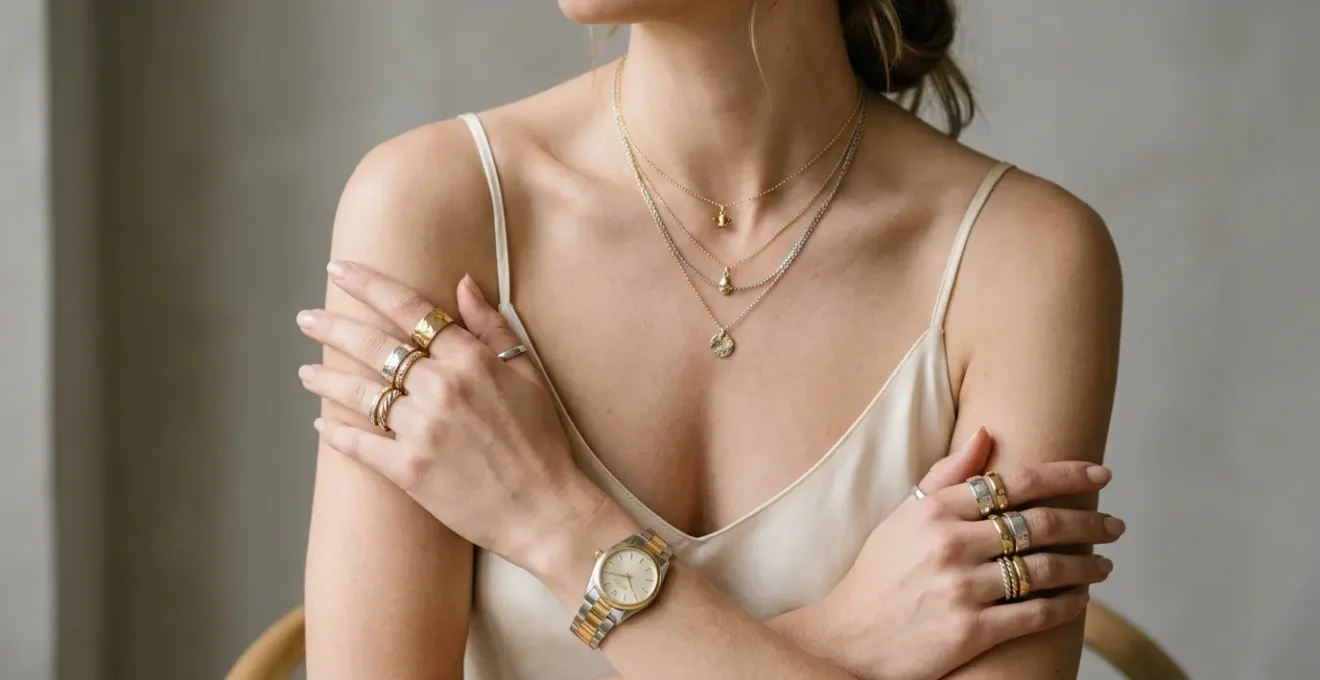
- Use a “bridging” piece, like a two-tone watch or enamel jewellery, to create a natural link between the two metals.
- Focus on unifying elements beyond colour, such as consistent textures (all polished or all matte) and similar design styles (all minimalist or all vintage).
- Balance the visual weight of your pieces, rather than strictly separating metals, to create a look that feels curated and collected over time.
- Start small by experimenting with delicate earring stacks to build your confidence in mixing metals.
Open your jewellery box. Chances are, it’s a beautiful, eclectic mix of memories and metals. There’s the silver bracelet from a milestone birthday, the gold heirloom ring passed down from your grandmother, and the trendy pieces you’ve collected along the way. For years, an unwritten rulebook dictated that these treasures must live separate lives, that mixing gold and silver was a cardinal sin of style, creating a look that felt messy or accidental. You were told to pick a side: gold or silver, but never both.
Let’s be clear: that rulebook is obsolete. The most stylish individuals today understand that jewellery is a form of personal narrative, and our stories are rarely monochromatic. The fear of “looking messy” doesn’t come from the metals themselves, but from a lack of intention. A truly cohesive look isn’t about rigid adherence to one colour; it’s about thoughtful curation where metal is just one part of the equation, alongside texture, shape, proportion, and personal meaning. The question is no longer *if* you can mix gold and silver, but *how* you can do it in a way that feels deliberate, sophisticated, and authentically you.
This guide is your new rulebook—one that celebrates freedom and personality. We will deconstruct the old myths, explore the technical aspects you need to know, and provide you with strategic frameworks for everything from stacking rings to curating the perfect “ear party.” Get ready to unlock the full potential of your entire jewellery collection and wear your story with confidence.
Contents: How to Master the Art of Mixed Metals
- Why You Don’t Need to Worry About Galvanic Corrosion Between Your Rings?
- How to Use a Two-Tone Watch to Anchor a Mixed Metal Look?
- Rose Gold or Yellow Gold: Which Mixes Better with Sterling Silver?
- The Risk of Resizing a Ring Made of Two Different Metal Alloys
- 70/30 or 50/50:Cold Enamel vs Hot Enamel: Which is More Durable for Daily Wear?
- Why Should You Stick to One Metal Colour When Mixing Earring Shapes?
- The Error of Wearing a Tie Bar, Cufflinks, and a Watch All in Gold
- How to Curate a “Mismatched” Earring Look That Still Feels Cohesive?
Why You Don’t Need to Worry About Galvanic Corrosion Between Your Rings?
One of the most persistent myths that fuels the fear of mixing metals is a pseudo-scientific one: the idea that gold and silver will react with each other, causing tarnish, corrosion, or damage. Let’s put this concern to rest. While galvanic corrosion is a real phenomenon in industrial or marine environments, the effect on your fine jewellery is so negligible it’s practically non-existent. Precious metals like gold, silver, and platinum are chosen for their durability and resistance to tarnish, making them perfectly safe to wear side-by-side.
The real, tangible risk isn’t chemical but physical: scratching. Different metals have different levels of hardness. For instance, platinum (4-4.5 on the Mohs scale) can scratch gold (2.5-3 Mohs), not the other way around. This means a harder metal ring can, over time, wear away at a softer one stacked next to it. However, even this is a slow process that can be mitigated with smart styling. The key is to be mindful of the pairings. For a collected-over-time feel, you can stack thin gold and silver rings across your fingers rather than concentrating them on one. Focusing on differences in shape, like pairing a structured bangle next to a fluid chain, can also create a balanced look where the contrast feels intentional.
To further minimize physical wear, consider the finishes of your pieces. Mixing highly polished metals will emphasize contrast and potential scratches, while mixing different finishes—like a brushed silver cuff with a polished gold ring—softens the overall effect and hides minor wear more effectively. Pairing larger silver pieces with smaller, more delicate gold items also helps manage the visual and physical weight, preventing any single piece from overwhelming the others.
How to Use a Two-Tone Watch to Anchor a Mixed Metal Look?
If you’re hesitant to dive into the world of mixed metals, the easiest and most elegant entry point is the “anchor piece.” This is a single item that already contains both gold and silver, acting as a deliberate bridge that sanctions the entire look. The undisputed king of the anchor piece is the two-tone watch. It’s a classic for a reason: it instantly signals that your choice to mix metals is intentional and sophisticated.
As the experts at Gabriel & Co. note, this strategy provides an immediate sense of harmony. The watch becomes the foundation upon which you can confidently build the rest of your look. As they state:
When one piece already combines both metals, it anchors everything else around it and makes the rest of the mix feel cohesive from the start.
– Gabriel & Co. Jewelry Experts, Gabriel & Co. Blog
Once your two-tone watch is in place, the “rules” become guidelines for enhancement, not restrictions. You can stack bracelets on the same wrist, confident that the watch ties them together. To elevate the look, stick to similar design styles; if your watch is minimalist, pair it with dainty, minimalist bracelets. If it’s a vintage-inspired piece, complement it with similar styles. You can also use matching gemstones, like diamonds or pearls, across different metal pieces to create another layer of unity. The goal is to create a conversation between the pieces, with your anchor watch leading the dialogue.
As you can see, the interplay of textures and finishes is just as important as the colour. By spreading your pieces evenly and maintaining a consistent texture—such as all hammered or all polished finishes—you ensure the final look feels balanced and effortlessly chic, rather than chaotic. The anchor piece gives you the permission to play.
Rose Gold or Yellow Gold: Which Mixes Better with Sterling Silver?
When curating a mixed-metal look with silver, the choice between yellow and rose gold can dramatically alter the final aesthetic. Neither is “better,” but they offer different effects. Your decision depends on the statement you want to make. Yellow gold mixed with silver creates a classic, high-contrast look that is bold and dramatic. It’s a power combination that demands attention and works beautifully for creating a statement.
On the other hand, rose gold mixed with silver offers a much softer, more harmonious blend. The warm pinkish hue of rose gold has a lower contrast against the cool tone of silver, resulting in a modern and romantic aesthetic that feels effortlessly blended. Because of this subtlety, rose gold is often considered easier to mix for those new to the trend. Furthermore, its unique undertones are known to be universally flattering on all skin tones.
The following table breaks down the key differences to help you choose the right combination for your personal style:
| Aspect | Yellow Gold + Silver | Rose Gold + Silver |
|---|---|---|
| Visual Contrast | High contrast, bold look | Lower contrast, softer blend |
| Style Effect | Classic, dramatic statement | Modern, harmonious aesthetic |
| Skin Tone Compatibility | Best on neutral undertones | Universal – flatters all undertones |
Ultimately, the choice is yours. For a bold, timeless look, reach for yellow gold. For a subtle, contemporary, and easily harmonized style, rose gold is an excellent choice. And don’t forget other elements that can bridge the gap. As Mejuri Virtual Stylist Cady Palley-Samson points out, pavé diamond pieces are a fantastic way to get the best of both worlds, combining the warmth of gold with the crisp, cool look of diamonds that echoes the brightness of silver.
The Risk of Resizing a Ring Made of Two Different Metal Alloys
While wearing mixed metals is a style statement, creating or altering a single piece made of two different metals is a task for a master jeweller. Resizing a two-tone ring, for example, is not as straightforward as resizing a ring of a single alloy. The primary risk lies in the different properties of the metals. Gold, silver, and platinum all have different melting points, and even within gold, the alloys vary. For instance, creating 14-karat gold involves specific formulations; an industry study notes that for 14k gold jewelry, 10 parts of another metal are added to 14 parts of gold. This affects not only hardness but also how the metal behaves under the heat of a jeweller’s torch.
When a jeweller heats a two-tone ring to resize it, one metal may melt or become malleable at a different temperature than the other. This can compromise the integrity of the join between the two alloys, leading to a weak spot, discoloration, or a visible seam. A skilled jeweller might use advanced tools like a laser welder, which allows for incredibly precise work with minimal heat transfer, protecting the integrity of the piece. Without the right equipment and experience, however, there’s a significant risk of damaging the ring permanently.
Because of this complexity, it is absolutely crucial to entrust such work to a reputable professional with specific experience in two-tone jewellery. Before handing over your treasured piece, you should have a detailed conversation about their process. To ensure your ring is in safe hands, it’s wise to perform a small audit of the jeweller’s capabilities.
Your Action Plan: Questions to Ask Before Resizing a Mixed-Metal Ring
- Assess their experience: “Do you have specific experience working with two-tone jewellery and can you show me examples of previous work?”
- Inquire about their tools: “What equipment do you use? Do you have a laser welder for precision work on mixed alloys?”
- Understand their process: “How will you protect the integrity of the join between the two metals during the heating process?”
- Check for alternatives: “Are there any alternatives to traditional resizing that you would recommend for this particular piece to minimize risk?”
- Confirm the guarantee: “What is your policy if the join is compromised or the ring is damaged during the resizing?”
70/30 or 50/50:Cold Enamel vs Hot Enamel: Which is More Durable for Daily Wear?
Obsessing over the perfect ratio of gold to silver—whether it’s 70/30 or 50/50—is a classic sign of overthinking it. A more modern and creative approach is to introduce a third element that makes the ratio irrelevant: enamel. Enamel jewellery acts as a powerful visual bridge, creating a cohesive theme that ties gold and silver together effortlessly. Using a neutral enamel colour like black, white, or grey can create a sophisticated, graphic link that makes the entire combination feel intentional and chic.
Alternatively, a bright pop of enamel colour can become the dominant focal point of your look, with the gold and silver metals acting as complementary frames. This is where the type of enamel matters. Hot enamel (or “hard enamel”) is a vitreous glaze fused to the metal at high temperatures. It’s known for its superior durability, depth of colour, and jewel-like lustre, making it ideal for daily wear. Cold enamel, by contrast, is an epoxy resin that is applied without heat. While it offers a wide range of colours, it is softer and more prone to scratching and fading over time. For a piece that lasts, hot enamel is the clear winner.
This move towards using unifying elements like enamel reflects a broader shift in fashion. It’s less about following rigid rules and more about expressing individuality. In fact, a recent survey shows most fashion enthusiasts believe that personalisation is more important than adhering to old-fashioned style mandates. Influencers and designers are championing this mindset, dismantling the stigma around combining metals and proving that creative curation always trumps outdated rules.
By looking for pieces where enamel creates a consistent design element across different metals, you can build a collection that is both playful and perfectly harmonized. The richness of hot enamel, in particular, adds a layer of quality and texture that elevates the entire look beyond a simple colour story.
Why Should You Stick to One Metal Colour When Mixing Earring Shapes?
Let’s address this question by turning it on its head: you absolutely shouldn’t. The idea of sticking to one metal colour when playing with different earring shapes is one of the most outdated rules in the book. In reality, the “ear party”—a curated collection of multiple earrings—is the perfect laboratory for experimenting with mixed metals. Because earrings are typically small and dainty, the perceived “risk” is minimal, but the stylistic benefit is enormous.
As the styling team at Astrid & Miyu, a brand famous for its stackable jewellery, advises, this is the best place to start your mixed-metal journey. They encourage a playful approach:
Mixing metals with your earrings is the easiest place to experiment, as the pieces are super dainty – it’s a small risk with maximum benefit. For an everyday look, try mixing huggies & studs of different platings, or add chunky hoops in a different colour as an eye-catching accent.
– Astrid & Miyu Styling Team, The Mixed Metals Guide
The key to a successful mixed-metal ear stack isn’t random chaos; it’s a sense of loose structure. One of the most effective methods is the “2+1 Rule”. In a stack of three piercings, use two pieces of one metal (like two gold huggie hoops) and one accent piece in the other metal (like a silver stud or charm). This creates an intentional, rhythmic pattern that feels balanced. To further refine the look, place the visually “heaviest” or largest earring in your primary lobe piercing and let the pieces get smaller and more delicate as they go up the ear. This creates a natural and flattering gradient.
Finally, you can tie the entire look together with a unifying theme beyond metal colour. This could be a consistent texture (e.g., all hammered finishes) or a recurring motif (e.g., celestial shapes like stars and moons). By doing this, you’re telling a cohesive story, and the different metals simply become different voices in the same beautiful narrative.
The Error of Wearing a Tie Bar, Cufflinks, and a Watch All in Gold
The art of mixing metals extends to men’s accessories, where the old rule of “match everything” now feels dated and uninspired. The error of wearing a tie bar, cufflinks, and a watch all in the same polished gold is that it can look like a pre-packaged set rather than a thoughtfully curated collection. A modern, confident approach involves understanding the hierarchy of your accessories and knowing where to match and where to intentionally contrast.
Think of it as a system with a clear order of command. Your watch is the “King” of your accessories. It’s the primary piece that sets the tone. Whether it’s gold, silver, or two-tone, it’s your foundation. All other metal accessories are subordinate and should relate back to the watch. Your cufflinks can either match the watch for a classic, cohesive look or—for a more contemporary statement—be a contrasting metal. A silver watch with gold cufflinks, for example, is a powerful and stylish choice.
The tie bar is an optional player; if worn, it should generally match the cufflinks to avoid introducing too many competing elements. Your belt buckle is a supporting actor that, when possible, should match the watch for a subtle thread of cohesion. Finally, your ring is an accent piece. It can absolutely contrast with your watch, serving as another point of intentional mixing. This hierarchy allows for a look that is both coordinated and full of personality, as highlighted by a modern men’s accessory guide.
A recent style analysis confirms this shift in mindset, noting that pairing gold and silver, once a faux pas, is now a mark of bold, modern style embraced by fashion insiders. The table below provides a simple framework for coordinating your metals.
| Accessory | Priority Level | Metal Mixing Rule |
|---|---|---|
| Watch | King (Primary) | Sets the tone – can be gold, silver, or two-tone |
| Cufflinks | Subordinate | Match watch OR go contrasting metal for modern look |
| Tie Bar | Optional | Match cufflinks OR skip for cleaner aesthetic |
| Belt Buckle | Supporting | Try to match watch for cohesion |
| Ring | Accent | Can contrast with watch for intentional mixing |
Key takeaways
- Embrace an “anchor piece,” like a two-tone watch, to create an instant and intentional bridge between gold and silver.
- Focus on unifying elements beyond colour, such as consistent textures, finishes (polished, matte), and design motifs, to create true cohesion.
- Think in terms of “visual weight” and balance rather than rigid ratios, distributing metals thoughtfully across your hands and wrists.
How to Curate a “Mismatched” Earring Look That Still Feels Cohesive?
Curating a “mismatched” earring look that feels cohesive is the final frontier of personal styling, and it’s where you can truly express your unique point of view. The secret isn’t in the mismatch itself, but in the underlying structure you create. This is about moving from accidental to intentional. As the Shani Jacobi design team states, “For years, combining these two metals was seen as a fashion faux pas, but today it’s celebrated as a bold style statement.” The goal is to make that statement with clarity and confidence.
To do this, you can adopt a tiered system of curation, allowing you to choose your level of boldness. At the first level is the “Mirrored” approach: you create the same mismatched look on both ears. For example, a gold hoop with a silver charm on the left ear is perfectly mirrored on the right. This provides balance and symmetry, making it a safe yet stylish entry point.
The next level is “Balanced Asymmetry.” Here, you wear different designs on each ear but maintain a similar visual weight or metal ratio. For instance, you might wear three small gold studs on one ear and a single, slightly larger silver hoop on the other. The “story” is different on each side, but the overall look doesn’t feel lopsided. This is where you can truly start to play with your collection. Finally, there is the “Anarchist” level: a completely different story on each ear. This is the boldest, most individualistic look, perfect for those who have mastered the art of balance and want to showcase their creativity.
Remember, this is an enduring trend because it shows you can ignore the old rules and create an authentic look that’s a true expression of you. It’s about telling your story, one earring at a time. The cohesion comes not from perfect matching, but from the confidence with which you wear your curated collection.
Now that you’re armed with the strategies and the confidence to break the old rules, the next step is to look at your own jewellery box not as a divided collection, but as a palette of possibilities. Start today by choosing one anchor piece and building a small, intentional stack around it.