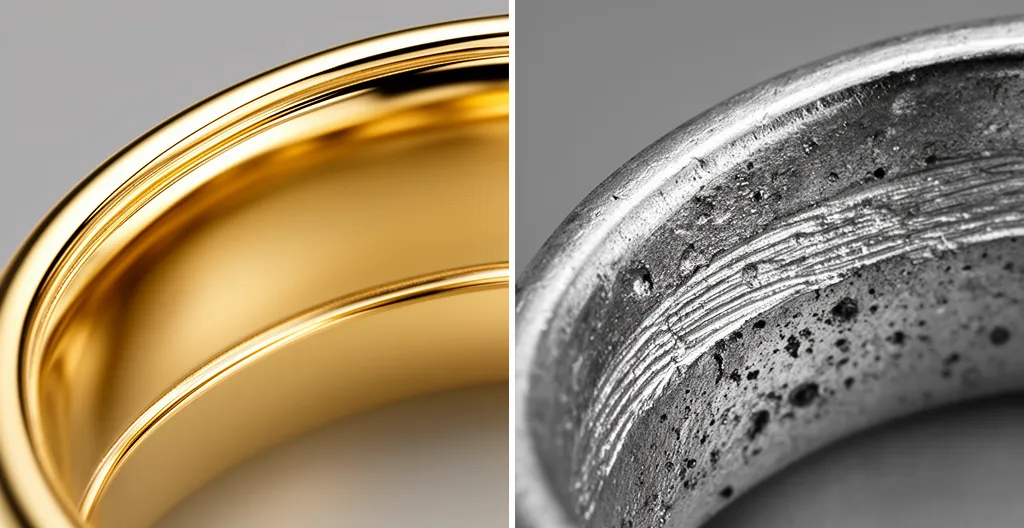
The true sign of a jewellery piece’s quality isn’t its surface shine, but its hidden structural integrity and finishing details.
- Mass-cast jewellery often conceals flaws like porosity and rough surfaces in hard-to-see areas, compromising long-term durability.
- Hand-finished pieces feature denser, work-hardened metal and meticulously polished interiors, reflecting a commitment to both aesthetics and wearer comfort.
Recommendation: Train your eye and your touch to look beyond the obvious. Inspect the inside of the band and the base of the settings—these “forgotten zones” are where true craftsmanship reveals itself.
In a world saturated with mass-produced goods, the allure of a truly handcrafted object holds a special power. This is particularly true for jewellery, an intimate form of expression we wear against our skin. As a discerning buyer, you understand that the value of a piece lies not just in its materials, but in the skill, time, and intention invested in its creation. Yet, telling the difference between a meticulously hand-finished piece and a cleverly polished mass-cast item becomes increasingly difficult.
Many will offer simple advice, such as “look for a seam” or “handmade items have charming imperfections.” While not entirely wrong, these platitudes barely scratch the surface. They fail to equip you with the deeper knowledge needed to assess an item’s fundamental quality. The true distinction lies in the metallurgical signature of the piece—the very structure of the metal—and the uncompromising attention paid to the ‘forgotten zones’ that factory finishing processes simply cannot reach. An item made with pride is perfect in every aspect, seen or unseen.
But what if the key wasn’t just looking, but knowing *what* you are looking for? What if you could learn to see a piece of jewellery through the eyes of the goldsmith who made it? This guide moves beyond the superficial. It is an education in connoisseurship, designed to reveal the tangible, structural differences between transient factory products and enduring artisanal treasures. We will delve into the secrets of metal density, stone setting security, and the tell-tale signs of poor finishing that are invisible to the untrained eye.
By the end of this article, you will be empowered to assess a piece not by its price tag, but by its intrinsic quality. You will learn to identify the subtle yet definitive marks of true craftsmanship, ensuring your next acquisition is an investment in artistry that will last a lifetime. This is the knowledge that separates a casual buyer from a true collector.
Summary: A Goldsmith’s Guide to Identifying True Jewellery Craftsmanship
- Where to Look for “Casting Lines” on a Ring to Spot Mass Production?
- Why Does a Rough Interior Finish Indicate Poor Quality Craftsmanship?
- Hand-Set or Cast-in-Place: Which Stones Are More Likely to Fall Out?
- The Difference Between “Handmade” and “Hand-Assembled” in UK Law
- How to Clean Hand-Finished Filigree Without bending the Fine Wires?
- Why Should the Inside of a Ring Be as Polished as the Outside?
- Hand-Forged or Cast: Which Technique Produces a Denser Metal Structure?
- How to Spot Poor Finishing on a Ring Before You Buy It?
Where to Look for “Casting Lines” on a Ring to Spot Mass Production?
The most common tell-tale sign of a mass-produced cast ring is the presence of a “casting line” or “seam.” This is a faint, often minuscule ridge or textural difference left where two halves of a mould met. While high-end casting can minimise these, mass production relies on rapid, less precise methods, making these lines a frequent giveaway. They are most often found on the outer edges of the shank (the band of the ring) or along its bottom. However, a truly skilled artisan removes every trace of this, so their absence isn’t a guarantee of hand-fabrication. The real secrets are found where machines can’t easily polish.
To inspect a piece like a professional, you must investigate the areas that are difficult and time-consuming to finish by hand. These are the corners that automated tumblers and polishing wheels miss. Look at the inside corners of a bezel setting, the small space at the base where prongs emerge from the ring, or deep within intricate engraved patterns. A hand-finished piece will be as smooth and perfect in these hidden recesses as it is on the most visible surfaces. This is a non-negotiable mark of quality, as it demonstrates a commitment to perfection beyond what is immediately visible.
Your Action Plan: The Professional Jeweler’s Inspection Method
- Joint & Seam Integrity: Run your fingernail along every joint, especially where the shank meets the setting. In a hand-fabricated piece, you should feel no ridges, gaps, or textural changes; it should feel like one continuous piece of metal.
- Loupe Examination of ‘Forgotten Zones’: Use a 10x jeweler’s loupe to examine the hard-to-polish areas: the inside corners of settings, the base of prongs, and within deep patterns. Mass-finishing machines can’t reach here, leaving behind a rougher, tell-tale texture.
- The ‘Loupe and Light’ Technique: Angle a bright, direct light source at 45 degrees while examining the piece through the loupe. As detailed by guides for spotting true craftsmanship, this technique makes textural differences ‘pop’, revealing matte-textured casting lines against mirror-polished surfaces.
- Symmetry & Precision: Check the alignment of prongs, the evenness of the bezel wall, and the symmetry of the design. Hand craftsmanship allows for minute adjustments to achieve perfect balance, whereas casting replicates the (often imperfect) master model exactly.
- Hallmark Clarity: Inspect the quality stamps (hallmarks). On a hand-finished piece, they are struck with precision and are crisp. On a poorly cast piece, they can appear mushy, blurred, or partially filled in.
Why Does a Rough Interior Finish Indicate Poor Quality Craftsmanship?
The interior of a ring—the part that touches your skin—is one of the most revealing areas for assessing quality. For a master craftsperson, this surface is as important as the diamond it holds. For a mass-producer, it’s a “forgotten zone” where corners can be cut to save time and money. A rough, unpolished, or porous interior is an immediate red flag. It signals that the piece was likely tumbled in a mass-finishing machine that polishes exposed surfaces but cannot properly finish the inside of the band. This shortcut has consequences that go far beyond aesthetics.
From a practical standpoint, a rough interior is a functional flaw. As experts in professional jewelry care point out, a rough or porous interior traps dirt, lotion, and moisture, which can lead to skin irritation like contact dermatitis and create a breeding ground for bacteria. Beyond hygiene, the metallurgical implications are significant. This roughness is often a sign of porosity, microscopic air bubbles within the metal that are a common byproduct of the casting process. According to metallurgical studies, this porosity is a critical weakness. A study on durability found that hand fabricated jewelry is nearly 50% harder than cast jewelry, precisely because the process of forging and working the metal compresses its molecular structure and eliminates this porosity. A rough interior isn’t just uncomfortable; it’s a sign of a structurally weaker piece.
As this comparison shows, the difference is stark. The mirror-like polish of a hand-finished interior (comfort fit) is not just for comfort; it is the visible evidence of dense, non-porous metal. It signifies a commitment to the wearer’s experience and the piece’s longevity. When you see a rough interior, you are seeing evidence of a compromised process and, ultimately, a compromised piece of jewellery.
Hand-Set or Cast-in-Place: Which Stones Are More Likely to Fall Out?
The security of a gemstone is not a matter of luck; it is a direct result of the setting method. In mass-produced jewellery, a common cost-cutting technique is “cast-in-place” setting. Here, the gemstone is placed directly into the wax model before the metal is cast around it. This is fast and requires minimal skill. In stark contrast, traditional hand-setting is an art form. After the ring is fully formed and polished, a master setter meticulously carves a precise seat for the stone and then skilfully pushes or hammers the prongs or bezel over it, using the metal’s own tension to create a secure grip.
The difference in security is profound and comes down to the metal’s properties. Cast metal has a brittle, crystalline structure. When a cast-in-place prong receives an impact, it’s more likely to crack or break off. Hand-fabricated or hand-forged metal is ductile and work-hardened. When a hand-set prong is pushed into place, it acts like a spring, holding the stone under constant tension. If it takes a hit, it’s more likely to bend than to snap, often keeping the stone safe. Furthermore, experts confirm that the casting process itself introduces risks; porosity from casting can make the final product weaker and more prone to breaking, especially in delicate areas like prongs.
This table summarises the critical differences that affect a stone’s long-term security. A hand-set stone is not just a mark of quality; it’s an insurance policy on your investment.
| Setting Method | Metal Structure | Stone Security | Long-term Durability |
|---|---|---|---|
| Hand-Set | Ductile, forged metal | Spring-loaded grip | Withstands impact better |
| Cast-in-Place | Brittle crystalline structure | Static hold | Prone to cracking under stress |
| Hybrid (Cast+Hand-finished) | Mixed properties | Moderate security | Better than pure cast |
The Difference Between “Handmade” and “Hand-Assembled” in UK Law
The term “handmade” is one of the most misused in the jewellery industry. Many consumers reasonably assume it means a piece was created from scratch by an artisan. However, the term is often stretched to describe items that are merely “hand-assembled” from mass-produced, cast components. An operator might solder a cast setting onto a cast shank and call the result “handmade.” While technically a hand was involved, this is a world away from the true meaning of the word.
In the United Kingdom, trading standards and hallmarking laws provide some clarity, though ambiguity can still be exploited. True “handmade” implies a significant level of skilled craftsmanship applied to raw materials. According to authoritative market analysis, the term “handmade” should denote that the jewellery is meticulously created by a qualified manufacturing jeweller. This emphasizes the artisan’s training and experience, as they employ a range of techniques like rolling, carving, and soldering to transform raw metal. An analysis of the market confirmed the gold sub-segment dominated the global handmade jewelry market share in 2022, with artisans using these traditional skills.
“Hand-assembled,” by contrast, typically refers to the process of joining pre-fabricated, often cast, parts. “Hand-finished” is another term that can be misleading; it may simply mean a cast piece was polished by a person rather than a machine. To protect yourself as a buyer, you must ask the right questions. Ask the jeweller directly: “Was this piece fabricated from metal sheet and wire, or was it cast from a wax model?” Ask them to show you where the finishing was done by hand. A proud artisan will be eager to point out the seamless solder joints and perfectly polished interiors that are a signature of their work. Ultimately, asking “Who made this piece?” can be the most revealing question of all. A truly handmade item has a traceable creator, not an anonymous factory line.
How to Clean Hand-Finished Filigree Without bending the Fine Wires?
Filigree, with its delicate, lace-like patterns of twisted metal wires, is a testament to a jeweller’s skill. This intricacy, however, makes it exceptionally vulnerable to damage during cleaning. The primary risk is not from chemicals, but from mechanical stress. Rubbing with a cloth or using a stiff brush can easily catch on a fine wire, bending or breaking it permanently. The key to safely cleaning hand-finished filigree is to use methods that dislodge dirt without applying force.
The safest approach is a ‘soak and spray’ protocol. Begin by preparing a solution of warm (never boiling) water and a few drops of a mild, fragrance-free dish soap. Allow the filigree piece to soak for 20 to 40 minutes. This will soften and loosen most grime, lotions, and oils. For any remaining particles, avoid the instinct to scrub. Instead, use a ‘sacrificial tool’—an instrument softer than the metal itself. A new, extra-soft-bristled baby toothbrush or a clean, soft makeup brush is ideal. The bristles will bend or break before they can damage the delicate metalwork. For surface tarnish on more robust areas, use a soft polishing cloth with gentle, pressing motions, never rubbing. A final, gentle rinse using a low-pressure water stream, such as from a water-pick on its lowest setting, can effectively flush out loosened debris from the tiny crevices without risking damage.
For particularly intricate pieces with many hard-to-reach areas, ultrasonic cleaners can be highly effective, as they use sound waves to create microscopic bubbles that gently lift dirt away. However, it’s crucial to ensure the piece has no loose stones before using one, as the vibrations can sometimes dislodge them. When in doubt, the gentle soak and soft brush method remains the gold standard for preserving the integrity of priceless filigree work.
Why Should the Inside of a Ring Be as Polished as the Outside?
A perfectly polished ring interior, often called a “comfort fit,” is one of the most significant, yet frequently overlooked, hallmarks of high-quality craftsmanship. To the mass-producer, it’s an unnecessary expense. To the artisan, it is an ethical and philosophical imperative. The reason is twofold: it is a commitment to the wearer’s physical experience and a testament to an uncompromising standard of quality. A ring is an object that becomes part of you; it should feel as good as it looks. A mirror-polished interior glides onto the finger and is a constant, tactile pleasure to wear.
A rough, unfinished interior is not just uncomfortable; it is a sign of a shortcut. It indicates the piece was cast and then likely thrown into a tumbler for mass-polishing—a process that cannot adequately finish the inside surface. This leaves a gritty or porous texture that, as we’ve discussed, can trap dirt and cause skin irritation. It is a loud declaration that the maker’s concern for quality ended where the public’s eye could no longer see. This philosophy is anathema to a true goldsmith.
A perfectly polished interior is a tactile pleasure that connects the wearer to the piece daily. It’s a ‘secret’ detail that elevates the piece from a mere object to a personal treasure, reflecting a commitment to the wearer’s intimate experience.
– Jewelry Design Philosophy, Professional Craftsmanship Standards
This “secret detail” is a conversation between the maker and the wearer. It is a promise of integrity. When you see and feel a perfectly polished interior, you are witnessing the maker’s refusal to compromise. It means the piece was handled with care at every stage, and that the artisan invested the significant extra time required to polish these hard-to-reach areas by hand. It is, in essence, a mark of respect for both the material and the person who will ultimately wear the jewellery.
Hand-Forged or Cast: Which Technique Produces a Denser Metal Structure?
The answer is unequivocally: hand-forged metal. The difference in density and durability between a hand-forged piece and a cast piece is not a matter of opinion; it is a metallurgical fact. This structural difference is the most fundamental distinction between the two methods and the primary reason why hand-fabricated jewellery possesses superior longevity. The process of casting involves pouring molten metal into a mould. As it cools, it forms a crystalline structure that inherently contains microscopic air pockets, a weakness known as porosity. No matter how well-finished on the surface, a cast piece contains this innate fragility.
Hand-forging, a type of hand-fabrication, is the exact opposite. The process begins with a solid ingot of metal that is subjected to immense and repeated force. It is hammered, rolled, and pulled, which significantly compresses the metal’s molecules. This process, known as “work hardening,” forces out the microscopic air pockets, resulting in a much denser and more resilient material. Metallurgical testing confirms this vast difference in structural integrity. As one comprehensive study demonstrated, “All of that pounding and bending significantly compresses the molecules…pushing the air out… Hand fabricated jewelry is nearly 50% harder than cast jewelry.“
This superior density has tangible benefits. A hand-forged ring is significantly more resistant to scratching, bending, and everyday deformation. Its dense surface can take a more brilliant, liquid-like polish that lasts longer. In contrast, the surface of a cast piece, due to its underlying porosity, can sometimes exhibit a faint “orange-peel” texture under magnification and is more susceptible to damage. When you choose a hand-forged piece, you are not just choosing an aesthetic; you are investing in a superior material structure that is built to endure.
Key takeaways
- Inspect the ‘Forgotten Zones’: The quality of finish inside the band and under the settings reveals more about craftsmanship than the polished top surfaces.
- Understand Metal’s History: Hand-forged metal is inherently denser and up to 50% harder than cast metal, leading to superior durability and scratch resistance.
- Question the Setting: Hand-set stones are held by the metal’s tension, offering a far more secure and durable hold than faster cast-in-place methods.
How to Spot Poor Finishing on a Ring Before You Buy It?
You are now equipped with the core knowledge to distinguish true craftsmanship from mass production. The final step is to synthesize this knowledge into a holistic inspection routine. Spotting poor finishing before you buy requires engaging more than just your eyes; it requires your sense of touch and even hearing. A poorly finished piece will betray itself through a lack of harmony across these senses. Your goal is to find the inconsistencies where the pursuit of efficiency has left its mark.
Begin with a tactile inspection. Close your eyes and run your fingertip along every single edge and surface, both inside and out. A well-finished piece should feel seamless and smooth, with no sharp edges, gritty patches, or abrupt transitions. It should also feel balanced in your hand. Next, perform ‘The Reflection Test’. A truly well-polished, dense metal surface will give a crisp, undistorted reflection like a small mirror. A poorly polished or porous cast surface will produce a slightly wavy or “blurry” reflection. Finally, listen. Gently tap the ring near your ear. A tell-tale buzz or rattle is an immediate sign of loose stones or poor assembly—something you should never find in a meticulously crafted piece.
This multi-sensory approach allows you to build a complete picture of the ring’s quality. It moves you beyond a passive observer to an active, informed inspector. As the world of jewellery increasingly moves online, these hands-on evaluation skills become more critical than ever. You must be your own quality control expert. By focusing on the feel of the edges, the clarity of the reflection, and the integrity of the ‘forgotten zones’, you can confidently identify the pieces that are built with integrity and designed to last. This is the final and most important skill in investing in jewellery that holds its value, both financially and sentimentally.
Now, apply this knowledge with confidence. When you next consider a piece of jewellery, you are no longer just a consumer. You are an informed connoisseur, capable of recognizing and investing in the enduring value of true craftsmanship. Choose pieces that tell a story of skill and dedication, not of factory efficiency.