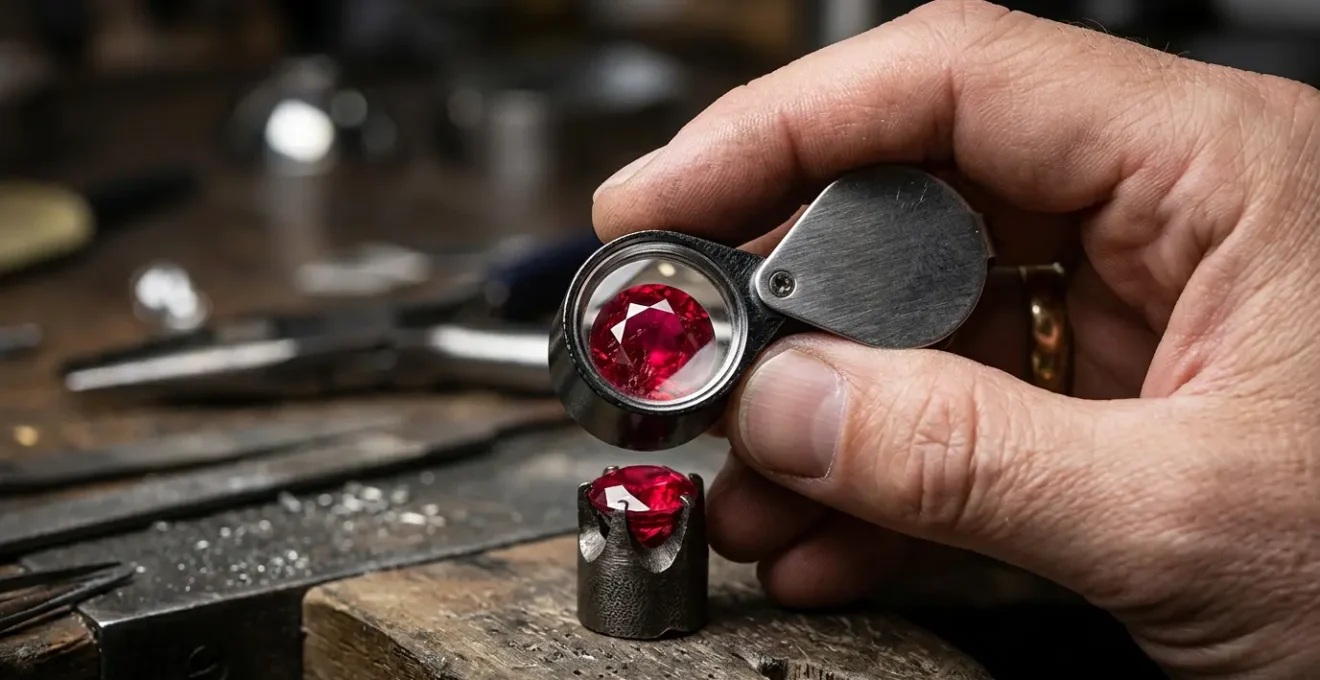
Identifying real gems isn’t about memorizing tricks; it’s about understanding the core physical principles that fakes can’t replicate.
- Thermal conductivity (the ‘cheek test’) reveals a material’s true nature, not just its appearance.
- Specific density explains why two stones of the same size can have vastly different values.
- Diagnostic inclusions seen under a 10x loupe are a stone’s unique fingerprint, telling the story of its origin.
Recommendation: Start by mastering the 10x loupe not just to look for flaws, but to observe and interpret these fundamental physical clues.
Stepping into a flea market or examining an inherited piece of jewelry, you’re faced with a tantalizing question: is this sparkling stone a treasure or a trinket? Many people rely on simple home tests, like breathing on a stone or trying to scratch glass with it. While these methods have a grain of truth, they often lack the context to be truly reliable and can even be misleading. You might hear that you just need a good eye for color or a loupe to spot imperfections, but this only scratches the surface of professional gem identification.
The real secret isn’t a single magic test. It’s about shifting your mindset from a casual observer to a gem detective. True identification for an enthusiast lies in understanding the fundamental physical principles behind a stone’s properties—its interaction with heat, its density, and the way light travels through it. This is where the 10x loupe transforms from a simple magnifying glass into a powerful diagnostic tool. It allows you to see the evidence of these principles, the tiny clues that separate a natural wonder from a man-made imitation.
This guide will empower you with that knowledge. We won’t just give you a checklist of tests; we will explain the ‘why’ behind each observation. You will learn to interpret what you see and feel, moving beyond simple color judgment to understanding the secrets held within the stone itself. We will cover the essential tools, what to look for, and why a professional certificate is the ultimate confirmation of your findings.
This article will guide you through the essential steps and knowledge needed to start identifying gemstones with more confidence. Below is a summary of the key areas we will explore.
Summary: Spot Fakes Like a Pro
- Why Can’t You Identify a Red Stone Just by Looking at the Colour?
- Glass or Quartz: How to Feel the Temperature Difference on Your Cheek?
- What Does a “Hardness of 7” Really Mean for Daily Wear?
- The Mistake of Judging Carat Weight Without Considering Stone Density
- Which 3 Tools Should Every Amateur Gem Hunter Carry in Their Pocket?
- How to Check the Laser Inscription on Your Diamond Girdle?
- How to Check if the Diamonds in an Old Ring Are Worth Reusing?
- Why Should You Demand a GIA or IGI Certificate for Diamonds Over 0.50ct?
Why Can’t You Identify a Red Stone Just by Looking at the Colour?
One of the first mistakes a beginner makes is relying solely on color. A vibrant red stone could be a priceless ruby, but it could also be a spinel, a garnet, a tourmaline, or even colored glass. Color in a gemstone is often caused by trace elements, and different stones can share the same coloring agent. Furthermore, some gems exhibit pleochroism, meaning they show different colors when viewed from different angles. This is a property that glass fakes cannot replicate.
Instead of judging by color alone, you must look for internal characteristics, or what gemologists call inclusions. These are the stone’s birthmarks. While a flawless stone is rare and valuable, the *type* of inclusion is what often reveals its identity and origin. A 10x loupe is your window into this world. For red stones, you’re looking for specific diagnostic clues that separate a natural ruby from its common imitators.
Your Action Plan: Identifying Red Stones with a Loupe
- Master the 10X loupe: The ten-power magnification is the industry standard. While more powerful loupes exist, their shallow depth of field makes them difficult to use for initial identification. Opt for a triplet loupe, which corrects for distortion and color, giving you a truer view.
- Look for “silk”: Search for fine, needle-like inclusions that intersect. This is known as silk and is a tell-tale sign of a natural corundum like a ruby. It’s the result of natural rutile crystals forming within the stone.
- Check for curved striae: If you see faint, curved growth lines instead of straight ones, you are likely looking at a flame-fusion synthetic. These lines are a byproduct of the manufacturing process.
- Examine for gas bubbles: Perfectly round, sharp-edged bubbles are a dead giveaway for glass. Inclusions in natural stones are typically more irregular.
- Inspect the girdle: Look for glue lines or visible layers around the stone’s edge (the girdle). This could indicate an “assembled” stone, like a doublet, where a thin slice of a real gem is glued to a less valuable material.
By focusing on these internal features, you move from a simple color guess to an evidence-based identification, which is the foundation of gemology.
Glass or Quartz: How to Feel the Temperature Difference on Your Cheek?
This might sound like an old wives’ tale, but there’s real science behind the “cheek test.” The method relies on a physical property called thermal conductivity. Gemstones, like quartz, are generally good conductors of heat. Glass, a common simulant, is an insulator. When you touch a gemstone to your skin, it quickly draws heat away from the surface, making it feel distinctly cool. Glass will feel much closer to room temperature because it doesn’t conduct heat as efficiently.
To perform this test effectively, make sure the stone has been sitting out and is at room temperature. Gently touch it to a sensitive area of your skin, like your cheek or lips. A genuine crystal will give a small, sharp sensation of cold, while glass will feel relatively neutral. This is a quick and effective way to separate many crystalline gems from glass imitations. Another related test involves breathing on the stone. Moisture from your breath will evaporate very quickly from a real gem but takes longer than 2-3 seconds to clear from glass due to the same heat-conducting properties.
Under a loupe, the difference is even more apparent. This is where you can confirm your initial thermal test.
As you can see in the comparison, glass often contains perfectly spherical gas bubbles trapped during its manufacturing process. Natural quartz, on the other hand, will have more irregular, feathery, or crystalline inclusions, which are hallmarks of its slow growth deep within the earth. These visual cues, combined with the thermal test, create a strong case for identification.
What Does a “Hardness of 7” Really Mean for Daily Wear?
As gemology tutor Pat Daly states, “Gemstones show their truth through color, shine, see-through quality, and special effects inside them.” One of the most discussed properties is hardness. Gemstone hardness is measured on the Mohs scale, which ranks minerals from 1 (Talc) to 10 (Diamond). However, it’s not a linear scale; a diamond (10) is many times harder than corundum (9). A common misconception is that any hard stone is durable.
A hardness of 7 on the Mohs scale, the hardness of quartz, is a critical benchmark. Why? Because common dust contains microscopic quartz particles. This means that any gemstone with a hardness of less than 7 can be scratched simply by being wiped with a dusty cloth over time. This is why stones like tanzanite (6.5-7) or opal (5.5-6.5) are better suited for earrings or pendants rather than rings that are exposed to daily bumps and dust.
A hardness of 7 is considered “good” for daily wear, but it’s not invincible. Over years of use, a quartz or amethyst ring will show minor scratches and abraded facet edges. A diamond, at 10, will remain pristine. This knowledge is practical: when you find a vintage piece, the condition of the stone can offer clues to its identity. A heavily scratched “diamond” is almost certainly a fake made of glass or a softer material.
The following table, based on an analysis of gemstone durability, illustrates how Mohs hardness translates into real-world wear and tear.
| Gemstone | Mohs Hardness | Daily Wear Suitability | Visible Signs After 1 Year |
|---|---|---|---|
| Diamond | 10 | Excellent | Pristine, no scratches |
| Quartz | 7 | Good | Minor scratches, abraded edges |
| Glass | 5.5 | Poor | Multiple scratches, dulled surface |
| Tanzanite | 6.5-7 | Fair | Microscopic scratches from dust |
The Mistake of Judging Carat Weight Without Considering Stone Density
When you hear “carat,” you probably think of size. But carat is a measure of weight, not dimensions. This distinction is crucial because different gemstones have different densities (also known as specific gravity). Two stones can have the exact same measurements, but the denser one will weigh more and therefore have a higher carat weight.
This is a common trap for beginners. For example, a moissanite, a popular diamond simulant, is about 15-20% less dense than a diamond. This means that a 6.5mm round moissanite weighs approximately 0.88 carats, while a diamond of the exact same 6.5mm diameter weighs 1.00 carat. If you’re judging a stone by its “1-carat size” without considering what material it is, you could be making a significant valuation error.
This principle of density also helps in identifying assembled stones. These are fraudulent gems created by layering materials. For example, a doublet might consist of a thin slice of natural garnet on top, fused to a much larger base of colored glass. From the top, it might look like a solid garnet, but its weight will be off. When you examine the stone from the side with your 10x loupe, you might even see the glue line or a difference in luster between the layers. These assembled stones are designed to deceive both the eye and the scale, but understanding density gives you an advantage.
Which 3 Tools Should Every Amateur Gem Hunter Carry in Their Pocket?
While your senses are your first line of defense, a few simple tools can dramatically increase your accuracy. You don’t need a full gemology lab, but three pocket-sized instruments will form the core of your gem-hunting toolkit.
These tools are designed to extend your senses and allow you to observe the key physical properties we’ve discussed. Having them on hand during a flea market trip or antique store visit can mean the difference between finding a hidden gem and buying a clever fake.
- 10x Loupe: This is your most important tool. As a rule, you should always hold the loupe close to your eye and bring the gemstone towards it, not the other way around. This provides stability for detailed inspection. It’s used for spotting diagnostic inclusions, examining facet edges for chips and wear, and checking for laser inscriptions.
- Pocket LED Torch: A small, bright flashlight is invaluable. It can be used for backlighting to reveal color zoning in stones like sapphires, or for side lighting to spot surface features and special effects like aventurescence (the glittery effect in aventurine quartz).
- Dichroscope: This might sound advanced, but it’s a simple and powerful tool for separating stones based on pleochroism. When you look through it, it splits the light passing through the gem into two windows. If the gem is doubly refractive (like ruby or sapphire), you’ll see two different colors or shades in the windows. If it’s singly refractive (like spinel, garnet, or glass), the color in both windows will be the same.
- Bonus – Pocket UV Light: A small long-wave and short-wave UV light can reveal fluorescence. Many diamonds fluoresce blue, but other stones like rubies can glow a vibrant red, helping to separate them from non-fluorescent garnets.
How to Check the Laser Inscription on Your Diamond Girdle?
For modern, certified diamonds, one of the most definitive ways to verify authenticity is by checking the laser inscription. Reputable grading labs like the GIA (Gemological Institute of America) and IGI (International Gemological Institute) use a micro-laser to inscribe a unique report number onto the girdle (the thin outer edge) of the diamond. This number is invisible to the naked eye but can be seen with a loupe.
Checking this inscription is your way of matching the physical stone in your hand to its paper certificate, ensuring they haven’t been swapped. To do this, you’ll need good lighting and a steady hand. Using your 10x loupe, carefully examine the girdle of the diamond. The inscription is incredibly small, so you may need to slowly rotate the stone to find it. The numbers will appear as tiny, transparent outlines against the surface of the diamond.
It’s important to use the right magnification. While it might be tempting to use a more powerful loupe, the industry standard for diamond grading is 10x magnification, which provides sufficient detail for identifying inclusions and reading inscriptions. A higher power can make it harder to focus and navigate the stone’s surface. Finding the inscription for the first time takes patience, but it’s a skill that provides absolute peace of mind, confirming you have the exact stone described in the report.
How to Check if the Diamonds in an Old Ring Are Worth Reusing?
When you acquire a piece of vintage or antique jewelry, you’re not just buying a stone; you’re inheriting a piece of history. The small diamonds, or “melee,” in an old ring may hold significant value, but assessing their quality is key to deciding if they are worth the cost of being removed and reset into a new piece.
Your 10x loupe is once again your primary tool for this assessment. You’re not just looking for fakes, but for clues about the diamond’s age, quality, and condition. An antique diamond might not look like a modern brilliant cut, and that’s often a good thing. Different historical periods had distinct cutting styles that are now valuable in their own right. When inspecting, look for specific characteristics that tell a story.
- Check the Cut Style: Look for antique cuts like the Old European Cut (with a small table, high crown, and open culet) or the Old Mine Cut (a more squared, cushion-like shape). These cuts were done by hand and have a unique charm and value.
- Examine for Damage: Carefully inspect the girdle and facet junctions for chips, feathers, or cracks. A diamond is hard, but not indestructible. Significant damage could make the stone unsuitable for resetting.
- Assess Clarity and Color: Use the loupe to get a rough idea of the inclusions. Do they affect the stone’s brilliance? Can you see them with the naked eye after locating them with the loupe? This will tell you if the stone is “eye-clean.” Also, assess the color against a white background. Older diamonds often have a warmer, yellowish or brownish tint, which is part of their character.
- Match to a Report (if available): If the piece comes with an old grading report, use your loupe to see if the inclusion plot on the paper matches the inclusions you see in the stone. This verifies that the diamond hasn’t been swapped.
Key Takeaways
- Colour is deceptive; look for diagnostic inclusions like silk or curved striae under a 10x loupe to determine a stone’s origin.
- Reliable identification relies on understanding physical properties like thermal conductivity (the ‘cheek test’) and specific density, which are harder to fake than appearance.
- A 10x loupe is your primary tool, but its power comes from knowing *what* to look for and how to interpret the clues you find.
Why Should You Demand a GIA or IGI Certificate for Diamonds Over 0.50ct?
After all the tests, observations, and loupe inspections, the final pillar of confidence, especially for significant diamonds, is a certificate from a reputable gemological laboratory. As the experts at GemsRoot point out, “A certificate from a recognized gemological lab (like GIA, IGI, or GRS) verifies authenticity, treatments, and origin, making it the most reliable method of identifying real gemstones.” This document is not just a piece of paper; it’s a blueprint of your gemstone’s identity.
For diamonds over 0.50 carats, a certificate from a top-tier lab like GIA or IGI is non-negotiable. These labs are independent, third-party entities with no stake in the sale of the stone. Their analysis is objective and based on strict, globally recognized standards. The certificate provides a detailed account of the 4Cs (Carat, Color, Clarity, and Cut), as well as information on fluorescence, a plot map of inclusions, and confirmation of the stone’s natural origin. It also discloses any treatments the stone may have undergone, such as fracture filling or laser drilling, which can significantly affect its value.
Demanding a certificate protects you as a buyer. It serves as a universal language that allows you to compare stones fairly and ensures you are paying a price that reflects the stone’s true quality. It is the ultimate verification that links all your observations together, confirming what your eyes and tools have helped you discover. It transforms your purchase from a matter of trust in the seller to a matter of verifiable fact.
Now, take your loupe, start observing, and transform your curiosity into genuine expertise. The world of gems is waiting to be discovered, one detail at a time.