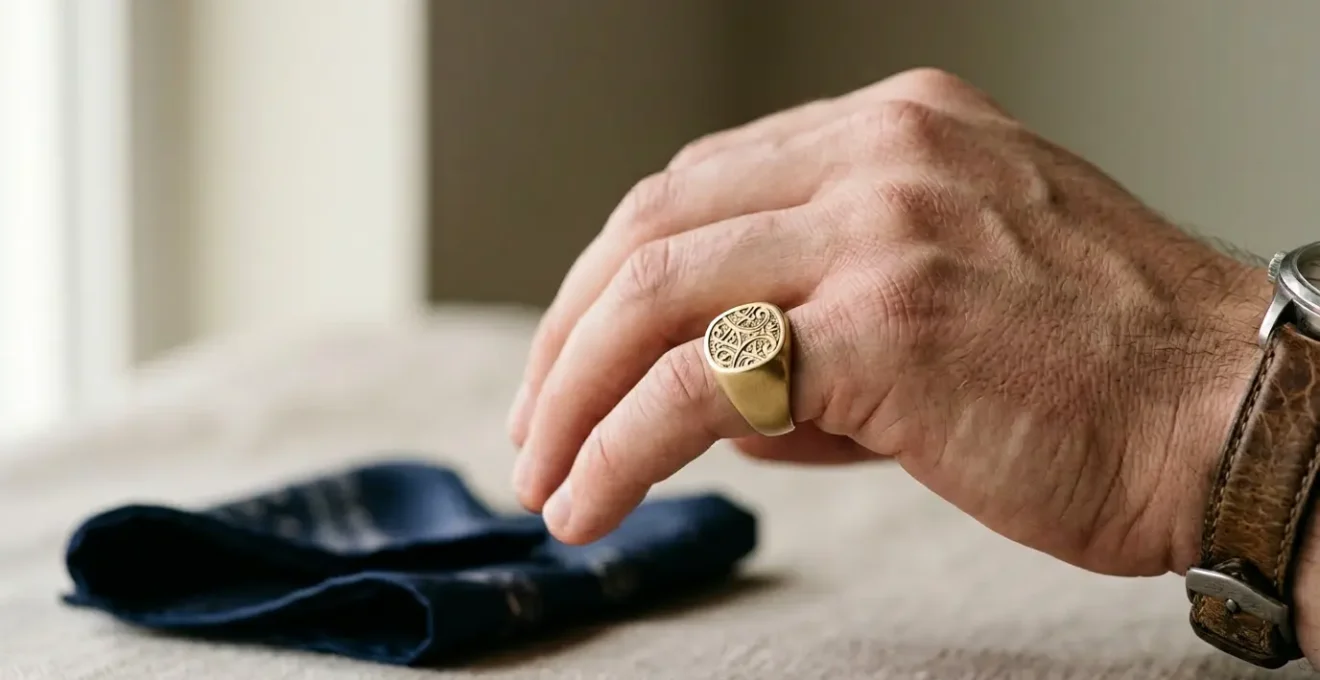
Wearing a signet ring today isn’t about following dusty rules, but about using it as a canvas to craft your personal statement.
- Your choice of symbol—whether a family crest, a meaningful stone, or a modern design—communicates your story.
- Where you wear it and the shape you choose are about creating visual harmony and a specific style signature, not rigid tradition.
Recommendation: Approach your signet ring as a piece of your personal brand. Focus on what story you want to tell, not just what history dictates.
The signet ring carries the weight of history. For centuries, it was a symbol of aristocracy, a tool of authority, and a marker of heritage. For the young professional today, interested in timeless style but wary of looking like a character from a period drama, this legacy can be intimidating. The fear is real: can you wear such a classic piece of men’s jewellery without appearing stuffy, pretentious, or simply out of touch? The common advice often revolves around rigid traditions—wearing it on the pinky finger, engraving a family crest you may not have, and adhering to strict protocols.
But this narrow view misses the point of modern style. While respecting its heritage is key, the true power of the signet ring in the 21st century lies in its transformation from a rigid heirloom into a dynamic personal canvas. The question is no longer “what are the rules?” but rather “what story do I want this ring to tell about me?” It’s about shifting the focus from inherited identity to curated, intentional symbolism. This is where the signet ring becomes a powerful tool for personal branding, not just a nod to the past.
This guide will deconstruct the old-fashioned notions surrounding the signet ring. We will explore the nuances of craftsmanship, placement, and form, providing you with the confidence to make choices that are both respectful of tradition and authentically modern. You will learn how to select a ring that complements your personal style, tells your unique story, and integrates seamlessly into any setting, from the corporate office to a casual weekend.
This article provides a complete framework for choosing and wearing a signet ring with contemporary confidence. The following sections will guide you through every critical decision, from understanding its intrinsic value to styling it for the modern world.
Summary: A Modernist’s Guide to the Signet Ring
- Why Does Traditional Seal Engraving Cost £300 More Than Laser Etching?
- Pinky or Ring Finger: Where Should You Wear Your Signet Ring Today?
- Oval or Cushion Shape: Which Signet Ring Suits Slender Fingers Best?
- The Risk of Buying Hollow Signet Rings for Daily Wear
- When to Order a Family Crest Ring to Have It Ready for an 18th Birthday?
- Family Crest or Plain Stone: Which Signet Style is More Versatile?
- Claddagh or Infinity Knot: Which Symbol Best Represents a Promise?
- How to Wear Men’s Jewellery in a Corporate Office Without Breaking Protocol?
Why Does Traditional Seal Engraving Cost £300 More Than Laser Etching?
The significant price difference between traditional hand engraving and modern laser etching comes down to one core factor: artistry versus automation. Laser etching is a fast, computer-driven process that can be completed in a couple of hours. It creates a precise and uniform mark on the surface of the metal. While efficient, it lacks the depth and character of traditional methods. In contrast, hand engraving is a meticulous art form, requiring deep expertise and a significant time investment.
A master engraver uses hardened steel tools called burins to physically carve away metal, sculpting a design with varying depths and line weights. This process is intensely manual; an intricate crest can take an enormous amount of time, as an industry analysis shows hand engraving requires 10-15 hours of skilled labor compared to just one or two for a laser. This “deep-cut” technique not only creates a more durable engraving that won’t wear away easily but also imparts a unique three-dimensional quality that a laser cannot replicate.
Furthermore, hand engraving guarantees a one-of-a-kind result. As noted in a detailed comparison by Lebrusan Studio, no two hand-engraved designs are ever identical, making each piece a truly unique work of art. The slight variations from the artist’s hand add a soul and warmth to the ring. You aren’t just paying for the time; you are investing in a miniature sculpture, a piece of craftsmanship that carries the signature of its maker. The £300 premium reflects this difference between a mass-produced image and a personal, handcrafted symbol.
Pinky or Ring Finger: Where Should You Wear Your Signet Ring Today?
The classic image of a signet ring places it squarely on the pinky finger, and for good reason. This placement has deep historical roots, particularly in British and European traditions, where it signalled heritage without interfering with the wedding band. Wearing it on the non-dominant hand’s pinky was practical, keeping it safe from daily wear and tear. Today, this remains a sophisticated and classic choice, perfect for formal occasions or for someone who wants to nod to tradition discreetly.
However, modern etiquette is far more flexible, transforming finger choice into a statement of personal style. As jeweller John Hardy explains, the traditional placement is just one of many options available today. His insight highlights the shift towards personal expression:
Traditionally, the pinky finger on the non-dominant hand was the go-to. In British and European traditions, the signet ring worn on the left hand’s little finger signified both taste and heritage. You might see a signet ring worn on the ring finger, middle finger, or even the index—each choice offering a different vibe. The ring finger tends to blend elegance with formality, while the middle finger commands attention.
– John Hardy, How to Wear a Signet Ring
Choosing another finger changes the ring’s message. The ring finger of the right hand is a popular modern choice for unmarried men, giving the ring prominence without competing with a wedding band. The index finger has a bolder, more authoritative feel, historically associated with pointing and commanding attention—a power move in a business setting. The middle finger is arguably the most fashion-forward placement, offering balance and a contemporary edge. Ultimately, the “correct” finger is the one that aligns with the style signature you want to create.
Oval or Cushion Shape: Which Signet Ring Suits Slender Fingers Best?
The shape of your signet ring’s face is not just an aesthetic choice; it’s a matter of proportional harmony. The goal is to select a shape that balances the mass of the ring with the structure of your hand and fingers. For those with slender or longer fingers, the wrong shape can look bulky or disproportionate. The classic oval is often the most flattering choice in this scenario. Its elongated form runs parallel to the finger, creating a continuous visual line that enhances length and elegance rather than interrupting it.
In contrast, more geometric shapes like a cushion or square have a stronger, more architectural presence. Their wider profiles and angular lines can add a sense of substance and weight, which is often ideal for wider hands or thicker fingers. On a slender finger, however, a large square face can sometimes appear to “overpower” the hand. This doesn’t mean you must avoid them, but proportion becomes even more critical. A smaller, more discreet cushion-shaped ring can still work beautifully.
The visual effect of each shape is distinct, and choosing the right one can significantly impact the overall look. The following table, based on a style guide from Robinsons Jewelers, breaks down the key considerations:
| Shape | Best For | Visual Effect | Style Vibe |
|---|---|---|---|
| Oval | Slender fingers | Elongates finger line | Classic, sophisticated |
| Cushion/Square | Wider hands | Adds geometric presence | Modern, architectural |
| Round | Balanced hands | Neutral proportion | Versatile, timeless |
| Octagon | Statement seekers | Eye-catching angles | Contemporary edge |
The Risk of Buying Hollow Signet Rings for Daily Wear
When browsing for signet rings, you will encounter two main types of construction: solid and hollow. Hollow rings are created by scooping out the metal from the underside of the face, making them lighter and significantly less expensive. While the lower price point can be tempting, it comes with a major compromise in durability and longevity, especially for a piece intended for daily wear. A signet ring is an intimate piece of jewellery that often gets knocked against desks, doors, and other surfaces.
A hollow ring is far more susceptible to denting and warping from these everyday impacts. The thinner walls of metal can easily be crushed, permanently damaging the ring’s shape and potentially loosening any stone settings. Over time, the risk of the ring breaking or deforming is substantially higher. This is why experts universally recommend a solid construction for a ring meant to last. The difference in lifespan is stark; jewelry experts report that solid signet rings last 50+ years, while hollow versions often show significant wear and damage within just two to five years.
Beyond durability, a solid ring has a satisfying heft and presence on the hand that a hollow one lacks. This weight is part of the traditional experience of wearing a signet ring—it feels substantial and permanent. A solid ring isn’t just a purchase; it’s an investment in a potential heirloom. It’s a piece designed to withstand the rigours of a lifetime and be passed down to the next generation. Opting for a hollow ring saves money in the short term but sacrifices the very essence of what a signet ring represents: permanence and endurance.
When to Order a Family Crest Ring to Have It Ready for an 18th Birthday?
Gifting a signet ring for a milestone birthday, particularly an 18th, is a cherished tradition that marks the transition into adulthood. As noted by Fink’s Jewelers, “Signet rings have traditionally been given as gifts for an 18th birthday, though as designs for this type of jewelry have broadened, so have the gifting opportunities.” However, commissioning a custom piece, especially one involving a family crest, is not an off-the-shelf purchase. It requires careful planning and a generous timeline to ensure the final product is perfect and ready for the special day.
The entire process, from initial research to final delivery, can easily take up to six months. The first and most crucial step is verifying the authenticity of the family crest. This involves genealogical research to ensure you have the correct heraldic design associated with your surname. Once the crest is confirmed, you must consult with a skilled jeweller or engraver to discuss the design, ring shape, and metal. This design finalization phase can take several weeks of back-and-forth communication.
Once the order is placed, the production itself is a lengthy process. Hand-crafting and engraving a quality signet ring typically requires 8 to 12 weeks. Rushing this stage is not an option, as it would compromise the quality of the craftsmanship. To avoid any last-minute stress, it is essential to follow a structured timeline.
Your Action Plan: Timeline for a Custom 18th Birthday Signet Ring
- Month 6-5 Before: Begin your research into the family heraldry to verify the crest’s authenticity and historical accuracy.
- Month 4 Before: Consult with your chosen engraver or jeweller to finalize the ring’s design, metal, and specific engraving details.
- Month 3 Before: Formally place your order to accommodate the standard 8-12 week production and engraving timeframe.
- Month 2 Before: Review the design proof or wax model provided by the jeweller and give your final approval for the engraving to proceed.
- Month 1 Before: Receive the finished ring. Perform a thorough quality check and allow time for any minor sizing adjustments.
Family Crest or Plain Stone: Which Signet Style is More Versatile?
The choice between a traditional family crest and a modern plain stone is at the heart of defining your signet ring’s purpose. A family crest is a direct link to heritage. It’s a powerful statement about lineage and tradition, making it an excellent conversation starter at formal or family events. However, its very specificity can limit its versatility. A crest is a fixed symbol, representing a collective past rather than an individual present. For someone without a crest or who prefers a more personal form of expression, it can feel like wearing someone else’s story.
This is where the plain stone or unadorned metal signet ring emerges as a highly versatile and modern alternative. A blank signet ring is not empty; it is a personal canvas for the future, not just a record of the past. It shifts the focus from “where I come from” to “who I am and where I am going.” A polished stone, such as black onyx, lapis lazuli, or bloodstone, offers a different kind of personalization. You can choose a stone based on its colour, its symbolic meaning (e.g., onyx for protection, lapis for wisdom), or simply its aesthetic appeal. This makes the ring deeply personal yet open to interpretation.
A stone signet ring is undeniably more versatile. It pairs effortlessly with both classic and contemporary wardrobes and is appropriate for virtually any occasion, from the boardroom to a casual weekend. While a family crest carries the weight of history, a plain or stone-set ring offers the freedom of modern style. The following comparison highlights the different strengths of each style:
| Aspect | Family Crest | Plain Stone |
|---|---|---|
| Versatility | Formal/traditional settings | All occasions |
| Conversation starter | High – invites heritage questions | Moderate – focuses on style |
| Style compatibility | Classic menswear | Modern to classic |
| Personalization | Fixed family symbol | Choice of stone meaning |
| Investment value | Higher as heirloom | Based on stone quality |
Claddagh or Infinity Knot: Which Symbol Best Represents a Promise?
When a signet ring is intended to represent a promise—be it romantic, familial, or a commitment to oneself—the choice of symbol is paramount. Two powerful and popular options are the traditional Claddagh and the modern infinity knot. Each carries a distinct message and cultural resonance. The Claddagh, with its iconic design of two hands holding a crowned heart, is rich with specific meaning. Originating from Ireland, it explicitly symbolizes love (the heart), loyalty (the crown), and friendship (the hands). This makes it an ideal choice for a promise with romantic or deep friendship connotations, especially for those with a connection to Irish heritage.
The infinity knot, on the other hand, offers a more universal and abstract representation of an eternal bond. Its continuous, flowing loop has no beginning and no end, making it a perfect metaphor for any concept of endlessness: unending love, an unbreakable family tie, or a perpetual spiritual journey. Its strength lies in its transcendent quality; it is not tied to a specific culture or a single type of relationship. This makes it an incredibly versatile symbol for anyone wishing to represent a promise that is deeply personal and unique to them.
Modern engraving techniques have even opened the door to combining symbols, allowing for a layered and highly personalized narrative. For instance, one could engrave an infinity pattern around a central initial or another small motif, creating a unique symbol that blends universal meaning with personal identity. The choice between the Claddagh and the infinity knot is a choice between specific, historic symbolism and universal, abstract meaning. The “better” symbol is simply the one whose story aligns most closely with the promise you wish to represent.
Key Takeaways
- The true value of a signet ring lies in craftsmanship (hand-engraving) and durability (solid construction).
- Modern style allows you to wear a signet ring on any finger; the choice communicates your personal vibe, from traditional (pinky) to fashion-forward (middle).
- Your ring is a personal canvas. Choose a symbol—crest, stone, or modern knot—that tells your story, not just your family’s history.
How to Wear Men’s Jewellery in a Corporate Office Without Breaking Protocol?
Integrating personal jewellery like a signet ring into a professional, corporate environment requires a delicate balance. The goal is to express personal style without causing a distraction or appearing unprofessional. The key principle is subtlety. In a conservative setting like law or finance, less is always more. A single, high-quality piece—such as a classic watch and a discreet signet ring—makes a much stronger and more refined statement than an armful of accessories.
As stylist Barron Cheng advises, balance is essential to a polished look. His guidance is a masterclass in understated elegance:
The key to timeless style is balance. If you’re wearing a watch, bracelet and a signet ring all on the same side, you’ll need to balance out the other hand. Switch your bracelet over for a much more even look.
– Barron Cheng, Effortless Gent Style Guide
This principle of balance extends to materials and finishes. For a cohesive and professional appearance, match the metals of your accessories. If your watch is steel, your signet ring should be silver, platinum, or white gold. If your belt buckle is gold, the ring should follow suit. Furthermore, consider the finish. In a corporate office, brushed or matte metals often read as more professional and less ostentatious than high-polish, reflective surfaces. To wear your jewellery with confidence, follow these simple protocol guidelines:
- Start with one quality piece: A single signet ring on the non-dominant hand is a perfect starting point.
- Match your metals: Keep silver tones with silver and gold tones with gold for a cohesive look.
- Choose understated finishes: Brushed or matte surfaces are generally more office-appropriate than high-shine polish.
- Position strategically: Wearing the ring on your non-dominant hand prevents it from becoming a distraction during handshakes.
- Consider industry norms: Creative and tech sectors allow for more expression than traditional fields like law or finance.
Now that you understand the principles of selecting and styling a signet ring, the next step is to begin envisioning your own. Consider what materials, shapes, and symbols resonate with your personal narrative and professional context. This is your opportunity to create a signature piece that is both timeless and uniquely you.
Frequently Asked Questions About How to Wear a Signet Ring in the 21st Century Without Looking Old-Fashioned?
What does the Claddagh symbol represent in modern jewelry?
The Claddagh represents love (heart), loyalty (crown), and friendship (hands), making it ideal for romantic promises with Irish heritage connections.
Is the infinity knot more universal than traditional symbols?
Yes, the infinity knot transcends cultural boundaries and can represent any eternal bond – romantic, familial, or spiritual.
Can I combine multiple symbols on one signet ring?
Modern engraving allows for layered symbolism, such as an infinity pattern surrounding a central motif, creating personalized meaning.