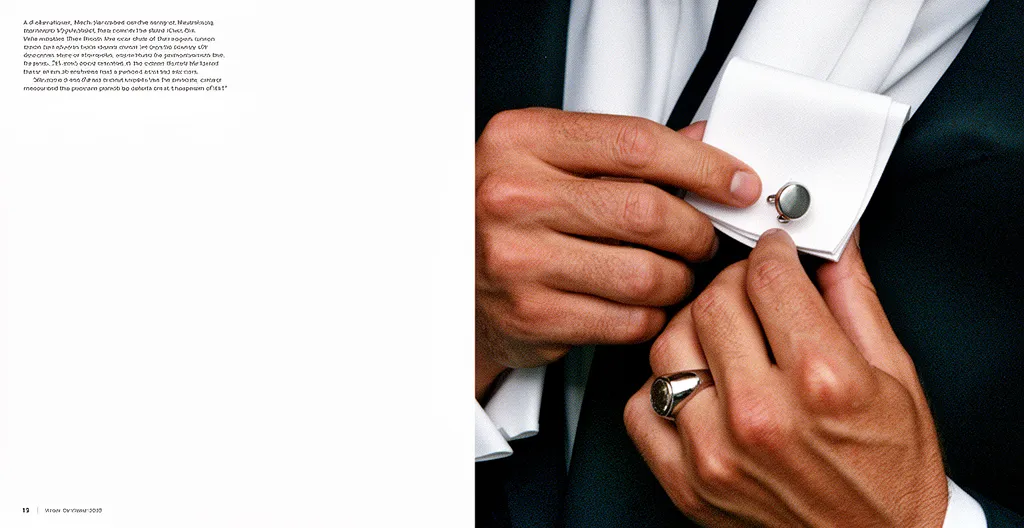
Wearing jewellery in a corporate setting isn’t about ‘less is more’; it’s about strategic signalling.
- Each piece—from cufflinks to a signet ring—must have a clear purpose and align with a single visual focal point.
- Material and finish (e.g., brushed vs. polished) are as critical as the design, communicating modernity, durability, and attention to detail.
Recommendation: Before you leave the house, assess your accessories not for their cost, but for the message they send. Remove one piece if the message is cluttered.
The modern professional operates within a paradox. You are encouraged to bring your “whole self” to work, yet the unwritten codes of the corporate world remain steadfastly in place. This is never more apparent than when a man considers wearing jewellery. The advice is often a uselessly vague “less is more,” a mantra that offers no real guidance for a man of substance who wishes to project personality and authority without appearing unprofessional or, worse, ostentatious.
Let us be clear: this is not about self-expression. In a corporate context, your accessories are not decoration; they are a tool for strategic non-verbal communication. Every choice, from the gleam of a watch to the weight of a ring, sends a signal. The common error is to think in terms of individual pieces. The strategist thinks in terms of the total message. A necklace, for instance, is an immediate risk—its visibility is inconsistent, making it a personal, rather than professional, statement. A cheap, loud accessory signals a lack of discernment. Conversely, a well-chosen piece projects quiet confidence and an unerring attention to detail.
The true key is not to avoid jewellery, but to master its language. It is about understanding the visual hierarchy of your entire presentation and ensuring each element has a purpose. Forget the platitudes. This guide will dissect the specific protocols for the essential pieces of men’s corporate jewellery. We will move from the boardroom-safe cufflink to the nuanced statement of a modern signet ring, providing you with the tactical knowledge to project controlled authority in any professional environment.
To navigate this complex terrain with precision, this guide breaks down the essential protocols and strategic considerations. Explore each section to master the art of corporate accessorising, from the foundational rules to the finer points of modern styling.
Summary: Mastering Men’s Jewellery in the Professional Sphere
- Why Are Cufflinks the Only Acceptable Jewellery in Conservative Law Firms?
- How Tight Should a Men’s Bracelet Be to Fit Under a Shirt Cuff?
- Family Crest or Plain Stone: Which Signet Style is More Versatile?
- The Error of Wearing a Tie Bar, Cufflinks, and a Watch All in Gold
- Which Metal Finish Hides Desk Scratches Best on Men’s Rings?
- Pinky or Ring Finger: Where Should You Wear Your Signet Ring Today?
- Matte or High Polish: Which Finish Appeals More to Masculine Tastes?
- How to Wear a Signet Ring in the 21st Century Without Looking Old-Fashioned?
Why Are Cufflinks the Only Acceptable Jewellery in Conservative Law Firms?
In the most traditional corridors of power, such as old-guard law firms or established financial institutions, the dress code is a uniform of intent. Here, cufflinks are not merely “acceptable”; they are a fundamental part of the lexicon. Their power lies in their discretion and purpose. A cufflink exists to perform a function—securing a double cuff—and its decorative aspect is secondary. This aligns perfectly with a professional ethos that values substance over show. It signals an appreciation for tradition, a meticulous attention to detail, and the financial means to invest in a quality wardrobe.
Unlike a ring or bracelet, a cufflink is an integrated part of the suit, a subtle flash of metal revealed only by movement. It does not demand attention but rewards it when noticed. This is the essence of controlled authority. While rings might speak of personal history and necklaces of private sentiment, cufflinks speak the public language of professionalism. They are the sartorial equivalent of a well-placed legal precedent: rooted in history, precise in their application, and undeniably effective.
Action Plan: Cufflink Selection for Conservative Offices
- Assess your role: For client-facing meetings, opt for precious metals like silver or gold in simple geometric designs (square, circular). Novelty designs are a liability.
- Select for subtlety: Younger professionals can use silk knots as a sophisticated, understated alternative to metal, signalling awareness of protocol without overstating status.
- Audit for coherence: Ensure your cufflinks match the other metals you are wearing, specifically your watch and belt buckle. This creates a polished, intentional visual statement.
- Contextualise your choice: Reserve personalised or themed cufflinks for internal meetings or less formal office days, never for high-stakes presentations or court appearances.
- Prioritise form: Choose designs that are simple, elegant, and functional. The primary signal should always be professionalism, not personality.
Therefore, in a conservative environment, the cufflink is not just jewellery; it is a strategic closing argument for your professional competence, presented before you’ve even spoken a word.
How Tight Should a Men’s Bracelet Be to Fit Under a Shirt Cuff?
A bracelet is the most challenging piece of jewellery for a man to wear in a corporate setting. If executed poorly, it appears sloppy, loud, or juvenile. The key to its success lies entirely in the fit and its interaction with your shirt cuff. The rule is absolute: a bracelet must be slim enough and fit correctly to glide effortlessly under the cuff. It should never be so tight as to constrict the wrist, nor so loose that it bunches up the fabric of your shirt or clatters against the desk.
The ideal fit allows for a single finger to slide comfortably between the bracelet and your wrist. This provides enough space for movement without creating excessive slack. When your arm is resting on a table, the bracelet should rest gently on your wrist, not hang down over your hand. The goal is a subtle glimpse of metal when you gesture or reach, not a constant, distracting presence. Thin chains or minimalist metal bands are the only viable options; leather, beads, or thick cuffs are entirely inappropriate for a formal corporate environment.
The “keyboard test” is the final arbiter. Sit at your desk and place your hands in a typing position. The bracelet should not make contact with the desk or the keyboard. As a corporate consultant noted in a recent style analysis, the switch to thin, hypoallergenic steel or silver link bracelets reflects the practical needs of an eight-hour workday. They must withstand handshakes and keyboard work without distraction. A piece of jewellery that interferes with your work is, by definition, unprofessional.
As this image demonstrates, the bracelet’s profile must be minimal. The choice of a thin, metallic band ensures it complements, rather than competes with, the clean line of the shirt cuff. It is a detail that speaks to a modern, yet controlled, approach to professional style.
Ultimately, a bracelet should be a whisper of personal style, not a shout. If it requires constant adjustment or you are conscious of its presence, you have failed the test.
Family Crest or Plain Stone: Which Signet Style is More Versatile?
The signet ring is a potent symbol, carrying the weight of history and status. However, in the modern corporate world, its message can be easily misconstrued. The choice between a traditional family crest and a more modern, unadorned style is a strategic one, with significant implications for how you are perceived. Versatility in a professional context demands an accessory that is understated, universally appealing, and opens no doors to unwelcome personal scrutiny.
A family crest signet ring is a high-risk proposition. While it may signal heritage and pedigree, it can just as easily be interpreted as elitist, exclusionary, or a boastful reliance on unearned status. It immediately invites personal questions about family and background—topics that have no place in a business meeting. It is a conversation piece, and in a corporate setting, the only conversation should be about the work at hand. Its versatility is therefore extremely limited, appropriate perhaps only within a family-run business or the most traditional of institutions where such lineage is a known and accepted currency.
By contrast, a signet ring with a plain stone—such as a deep black onyx or a lapis lazuli—or one with a clean, abstract geometric design is infinitely more versatile. It retains the classic, masculine form of the signet ring but shifts the focus from heritage to aesthetic. It is a choice based on design and taste, not bloodline. This style is universally acceptable, projecting a sense of modernity and quiet confidence without the baggage of aristocracy. It is a statement of personal style, not personal history, making it the unequivocally superior choice for the contemporary professional navigating diverse corporate environments.
This comparative analysis makes the strategic choice clear for any professional aiming for maximum versatility.
| Style | Professional Versatility | Conversation Risk | Best For |
|---|---|---|---|
| Family Crest | Limited – Can appear elitist | High – Invites personal questions | Traditional law firms, family businesses |
| Plain Stone (Onyx/Lapis) | High – Universally acceptable | Low – Aesthetic choice only | All corporate environments |
| Abstract/Geometric Design | Very High – Modern professional | Minimal – Design-focused | Creative industries, tech, consulting |
| Personal Symbol | Moderate – Requires explanation | Medium – Professional topics | Entrepreneurial, specialized fields |
In short, unless you are a feudal lord, leave the heraldry at home. Opt for the clean lines and impersonal elegance of a modern design to ensure your ring enhances, rather than defines, your professional identity.
The Error of Wearing a Tie Bar, Cufflinks, and a Watch All in Gold
There is a fundamental misunderstanding of the “match your metals” rule. It is a guideline for coherence, not a license for gilded excess. The error of wearing a tie bar, cufflinks, and a watch all in a matching, high-polish gold is a classic failure of strategic signalling. It is the visual equivalent of shouting in a library. Instead of projecting wealth and status, it signals a lack of subtlety and a fundamental misunderstanding of visual hierarchy. The effect is not one of power, but of ostentation—a fatal flaw in any conservative corporate setting.
The core principle is to establish a single focal point. Your accessories should not compete with each other for attention. When you combine three large, reflective pieces of the same metal, you create visual clutter. The eye does not know where to rest, and the overall impression is one of trying too hard. This is particularly true with gold, a metal that carries significant visual weight. A recent survey from a jewellery analyst confirms a shift in taste, revealing that 74% of men plan to embrace minimalist jewelry in 2024, a clear move away from such overt displays.
The sophisticated approach involves nuance and control. You might match your watch to your cufflinks in a subtle brushed silver, and forgo a tie bar altogether. Or, if a tie bar is necessary, it should be the dominant metallic statement, with the watch and other accessories taking a more subdued role (e.g., a watch on a leather strap). The goal is a balanced composition, not a metallic uniform. This requires a discerning eye and the confidence to edit. Before leaving the house, apply the stylist’s ultimate rule: look in the mirror and remove one accessory. In the case of the gold trio, this is not just advice; it is a command.
True power is quiet. Your accessories should communicate confidence through restraint, creating a harmonious whole rather than a clashing collection of parts.
Which Metal Finish Hides Desk Scratches Best on Men’s Rings?
For a professional who spends their day at a desk, the durability of a ring is not a trivial concern; it is a matter of practicality and long-term value. A ring, particularly on the dominant hand, is in constant contact with desks, keyboards, and other hard surfaces. Scratches are inevitable, but their visibility can be dramatically mitigated by a strategic choice of metal finish. This is an exercise in material intelligence, prioritising an aesthetic that endures the realities of the workplace.
A high-polish finish is the worst offender. Its smooth, mirror-like surface acts as a blank canvas, making every single nick and scratch glaringly obvious. It requires constant maintenance and quickly loses its pristine appearance, projecting an image of carelessness. It is a finish designed for occasions, not for the daily rigours of a corporate environment.
Conversely, textured finishes are your greatest ally. A brushed finish, with its fine, linear texture, is exceptionally effective at camouflaging minor scratches, as they blend into the existing pattern. A hammered finish is even more resilient; its varied, irregular facets are designed to catch the light in multiple directions, making new marks almost impossible to discern. These finishes not only hide wear but also offer a more modern, masculine aesthetic than a simple high polish. A 2025 workplace safety analysis confirms this, finding that brushed and hammered finishes effectively camouflage daily wear from desk contact. The study also highlights the rise of tungsten carbide and ceramic rings for their superior scratch resistance, a modern alternative for professionals in demanding fields.
This visual comparison underscores the point: the pristine surface of a high-polish ring is a liability, while textured finishes like brushed or hammered are assets. The choice is between an accessory that looks worn-out within weeks and one that maintains its character for years.
Choosing the right finish is not just about aesthetics; it is a practical decision that demonstrates foresight and an understanding of quality—two traits highly valued in any professional.
Pinky or Ring Finger: Where Should You Wear Your Signet Ring Today?
The placement of a signet ring is as significant as the ring itself. Historically, the signet ring was a tool, worn on the pinky finger of the non-dominant hand to be readily available for pressing into wax seals without interference. Today, its function is purely symbolic, and the question of placement—pinky or ring finger—is a matter of the message you wish to convey. The context has shifted from practicality to perception.
Wearing a signet ring on the traditional ring finger (the fourth finger) co-opts the space typically reserved for a wedding or partnership band. If you are unmarried, it can create ambiguity. If you are married, it can create visual clutter, forcing a competition between two significant rings. While some traditions place family rings on this finger, in a modern, globalised corporate environment, it is often a less strategic choice. It grounds the ring in the language of commitment and family, which may not be the primary message you wish to send professionally.
The pinky finger, however, offers a distinct and powerful alternative. It is a location of choice, not of convention. By wearing the ring on this finger, you are making a conscious style statement. The pinky is on the periphery, making the ring a deliberate accent rather than a central feature. This placement has been reclaimed in contemporary culture as a symbol of self-reliance and personal achievement. As the Viraasi Jewelry etiquette guide notes, a pinky ring has been culturally reclaimed as a symbol of self-love, independence, or personal achievement, distinct from its aristocratic roots. This modern interpretation aligns perfectly with the professional who wants to signal confidence and individuality without relying on traditional marital or familial signifiers.
For the 21st-century professional, the pinky finger is the superior strategic choice. It is a nod to history, but its message is firmly planted in the present: a statement of personal accomplishment and confident style.
Matte or High Polish: Which Finish Appeals More to Masculine Tastes?
The choice between a matte and a high-polish finish is not a simple matter of taste; it is a declaration of intent. The way a piece of metal interacts with light speaks volumes about the wearer’s personality and professional posture. This is a critical component of your strategic signalling. To ask which appeals more to “masculine tastes” is to miss the point. The correct question is: which finish best communicates the specific professional identity you aim to project?
A high-polish finish is extroverted. It reflects light directly and aggressively, demanding attention. It signals confidence, luxury, and a certain boldness. This can be a powerful tool in professions where visibility and projecting success are paramount, such as sales, client-facing roles in finance, or any field where a touch of flash is part of the performance. However, its loudness is a risk. In a more subdued or technical environment, it can read as arrogant or lacking in refinement.
A matte finish, by contrast, is introverted. It diffuses light, absorbing it rather than reflecting it. The effect is one of subtlety, modernity, and quiet strength. It does not shout for attention; it rewards closer inspection. This makes it an ideal choice for professionals in fields that value substance over style, such as engineering, research, technology, or law. It communicates a focus on the work itself, a seriousness of purpose, and an aesthetic that is contemporary and understated. Brushed and satin finishes offer a middle ground, providing texture and a soft glow that signals sophistication and balance.
The following table, sourced from a professional style guide, provides a clear framework for aligning your choice of finish with your industry and desired professional signal.
| Finish Type | Light Behavior | Professional Signal | Best Industry Fit |
|---|---|---|---|
| High Polish | Direct reflection | Confidence, luxury, extroversion | Sales, client-facing roles |
| Matte | Light diffusion | Subtlety, modernity, introversion | Tech, engineering, research |
| Brushed | Linear texture | Structure, attention to detail | Architecture, design, consulting |
| Satin | Soft glow | Sophistication, balance | Finance, law, management |
Therefore, the most “masculine” choice is the one that is most authentic to your professional identity and most effective in your specific environment. It is a choice based on strategy, not trend.
Key Takeaways
- Corporate jewellery is a communication tool; every piece must be assessed for the message it sends about your professionalism and attention to detail.
- Master the visual hierarchy by establishing one clear focal point. Avoid cluttering your message with too many competing metallic elements.
- Choose materials and finishes for their durability and the subtle signals they send. A textured finish often communicates more modern sophistication than a simple high polish.
How to Wear a Signet Ring in the 21st Century Without Looking Old-Fashioned?
The signet ring is arguably the most traditional piece of men’s jewellery. Worn incorrectly, it can make a man look like a relic, clinging to the affectations of a bygone era. The challenge for the modern professional is to harness its symbolic power without being burdened by its historical baggage. To wear a signet ring in the 21st century is to perform a delicate balancing act between heritage and modernity. Success hinges on a conscious departure from convention.
The first step is to reconsider the material. While gold is traditional, it is also what most strongly tethers the ring to the past. Opting for non-traditional materials is the fastest way to modernise the piece. A signet ring in brushed titanium, black ceramic, or tungsten carbide immediately signals a contemporary perspective. These materials speak of technology and engineering, not inherited wealth, which is a far more relevant message for most modern professions.
Secondly, you must reject antiquated symbolism. The family crest is, for most, an anachronism. The modern approach is to embrace minimalist abstraction. This could mean a completely blank, polished face—a statement of pure form—or a single, discrete engraved line or geometric shape. The focus shifts from “who I am” (by birth) to “what I value” (in design). Furthermore, embrace textured finishes like hammered or brushed surfaces. These details direct attention to the ring as a design object, rather than a piece of heraldry. Finally, this modernisation is not just about the ring itself but how you wear it. Pair it with a quality blazer and t-shirt as easily as with a formal suit. This “high-low” styling detaches the ring from a purely formal context and integrates it into a modern, versatile wardrobe. The global men’s jewellery market is undergoing a significant transformation, and as global market research indicates, it is projected to reach $71.8 billion by 2032, driven by this very fusion of modern tastes and classic forms.
The modern signet ring, therefore, is not about broadcasting lineage. It is a quiet, confident statement of personal taste, an appreciation for clean lines, and an understanding that true style lies in the intelligent reinterpretation of the classics.