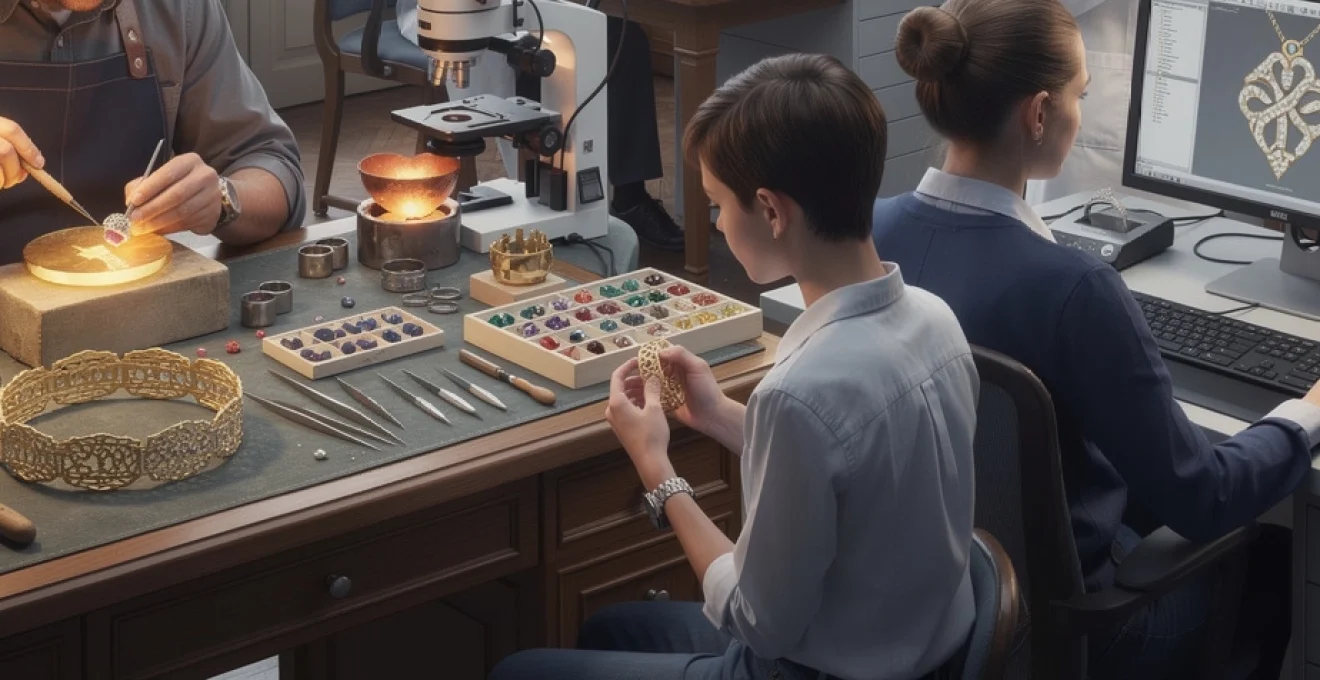
Behind every extraordinary piece of jewellery lies a world of meticulous craftsmanship, where ancient techniques meet cutting-edge technology in workshops that bridge centuries of tradition with contemporary innovation. From the prestigious ateliers of Place Vendôme to the bustling studios of London’s Hatton Garden, master craftsmen continue to shape precious metals and set brilliant gemstones using methods passed down through generations. Yet these same artisans now harness sophisticated CAD software and precision machinery to achieve levels of detail that would have astounded their predecessors. This marriage of traditional expertise with modern innovation creates the foundation upon which today’s most coveted jewellery collections are built.
The contemporary jewellery workshop represents more than just a manufacturing space; it serves as a sanctuary where creativity flourishes under the guidance of master craftsmen who understand that each piece carries within it the soul of its maker. Whether creating bespoke engagement rings or crafting elaborate high jewellery collections, these workshops maintain exacting standards that ensure every creation meets the expectations of discerning clients worldwide.
Traditional goldsmithing techniques in contemporary atelier settings
The foundation of exceptional jewellery creation rests upon time-honoured goldsmithing techniques that have remained virtually unchanged for millennia. Contemporary workshops maintain these traditional methods not out of nostalgia, but because they produce results that modern machinery simply cannot replicate. The tactile connection between craftsman and metal creates subtle variations and organic qualities that distinguish handmade pieces from mass-produced alternatives.
Master goldsmiths spend years developing the sensitivity required to work precious metals with their hands, understanding how gold, silver, and platinum respond to heat, pressure, and manipulation. This intuitive knowledge allows them to achieve textures, forms, and finishes that reflect the unique character of each piece. The warmth of human touch literally transforms cold metal into objects of beauty that resonate with emotional significance.
Hand forging methods using raising hammers and forming blocks
Hand forging represents one of the most fundamental metalworking techniques, where skilled craftsmen use raising hammers and forming blocks to shape metal through controlled percussion. This ancient method requires years to master, as goldsmiths must develop precise control over hammer weight, angle, and force to achieve desired forms without damaging the metal’s integrity.
The raising technique involves gradually stretching and shaping flat metal sheets into three-dimensional forms through systematic hammering. Each strike must be calculated and deliberate, as excessive force can create stress fractures while insufficient pressure fails to achieve proper forming. Modern workshops employ traditional anvils alongside specialised forming blocks designed for specific jewellery applications, allowing craftsmen to create complex curves and hollow forms that serve as foundations for rings, pendants, and decorative elements.
Granulation and filigree metalwork executed by master craftsmen
Granulation and filigree represent two of the most technically demanding decorative techniques in goldsmithing, requiring extraordinary precision and patience. Granulation involves applying tiny spheres of gold or silver to create intricate patterns, while filigree uses fine wires twisted and shaped into delicate lace-like designs. Both techniques originated in ancient civilisations yet continue to challenge even the most experienced craftsmen.
The granulation process demands perfect temperature control, as the minute gold spheres must fuse with the base metal without melting completely. Master craftsmen spend decades perfecting this technique, learning to read subtle colour changes in heated metal that indicate optimal temperatures. Contemporary workshops often combine these traditional methods with modern tools like precision torches and temperature monitoring equipment to achieve consistent results while maintaining the artisanal character that makes each piece unique.
Ancient repoussé chasing techniques applied to modern ring settings
Repoussé and chasing techniques, dating back over 4,000 years, involve manipulating metal from both front and back to create raised relief patterns and intricate surface textures. Modern jewellery workshops apply these ancient methods to create contemporary ring settings and decorative elements that showcase both technical skill and artistic vision. The process requires craftsmen to work alternately from opposite sides of the metal, gradually building up complex forms through patient, methodical work.
Contemporary applications of repoussé often focus on creating organic textures that complement modern design aesthetics while honouring traditional craftsman
Contemporary applications of repoussé often focus on creating organic textures that complement modern design aesthetics while honouring traditional craftsmanship. Goldsmiths might, for example, raise subtle botanical motifs along the shoulders of a ring or sculpt sculptural scrolls that appear to grow out of the band itself. The metal is usually supported with pitch or specialised polymers while chasing tools refine details from the front, ensuring crisp lines and controlled depth. In many high-end jewellery workshops, these hand-worked surfaces are combined with smooth, polished elements, creating a sophisticated contrast that highlights both the artistry of the maker and the brilliance of the gemstones they frame.
Because repoussé and chasing are executed entirely by hand, no two ring settings are ever completely identical, even when based on the same design. This slight variation becomes part of the appeal for clients seeking truly unique pieces of jewellery that reflect the touch of a particular artisan. In some European ateliers, master chasers still sign their work discreetly on the inside of a ring shank or beneath a setting, continuing a tradition of authorship that dates back centuries. For collectors, understanding that such labour-intensive techniques were used adds an additional layer of emotional and historical value to each piece.
Stone setting precision using bezel and prong construction methods
Stone setting represents the final, nerve‑wracking stage where months of work crystallise into a finished jewel. In high-end jewellery workshops, setters often train for a decade or more to achieve the precision needed for flawless bezel and prong constructions. A single slip of a graver can chip a gemstone or mar a carefully prepared surface, so every movement is calculated, steady, and informed by experience. The goal is always the same: to secure each stone safely while allowing the maximum possible light to interact with its facets.
Bezel settings, where a continuous rim of metal encircles the gemstone, are prized for their security and clean, modern lines. Setters must prepare the seat with micrometre accuracy, carving a perfect ledge that hugs the stone’s girdle without exerting undue pressure. By contrast, prong settings rely on carefully shaped claws that grip the stone at key points, allowing light to pass through the pavilion and enhance brilliance. In contemporary ateliers, these claws are often refined under microscopes, then polished to an almost invisible taper so that the gemstone appears to float above the metal.
To achieve this level of stone setting precision, many workshops combine traditional hand tools with advanced measuring equipment and digital magnification. Bench microscopes, digital callipers, and laser welding systems now sit alongside classic gravers and burnishers, enabling setters to work on pavé fields of diamonds as small as 0.5 mm in diameter. Yet despite the technological support, the critical decisions — how much pressure to apply, exactly where to place a prong, how tightly to close a bezel — remain rooted in human judgement. This blend of instinct and engineering is what gives fine jewellery its distinctive character and lasting durability.
Advanced CAD design integration in high-end jewellery workshops
While the romance of handcraft remains central to luxury jewellery, computer‑aided design has become indispensable in contemporary workshops. CAD tools allow designers and goldsmiths to visualise complex structures, test proportions, and simulate mechanical movement long before any metal is cut. For clients commissioning bespoke pieces, seeing a three‑dimensional model helps bridge the gap between imagination and reality, making the design process more collaborative and transparent. When used thoughtfully, CAD does not replace the hand of the artisan; instead, it becomes another instrument in the orchestra of jewellery creation.
The integration of CAD into high-end jewellery workshops has also transformed production accuracy and repeatability. Once a digital model is approved, it can be translated into wax or resin models via 3D printing or CNC milling, ensuring that key measurements are exact to a fraction of a millimetre. This consistency is especially valuable for complex settings, transformable pieces, or intricate pavé work where tiny discrepancies can affect both aesthetics and structural integrity. At the same time, many maisons encourage designers to sketch by hand first, then use CAD software to refine proportions, experiment with variants, and document every technical detail.
Rhinoceros 3D modelling software for complex pendant structures
Among the most widely used tools in professional jewellery design is Rhinoceros 3D, often simply called Rhino. Its strength lies in its ability to handle freeform surfaces and intricate geometries, making it ideal for complex pendant structures that might be impossible to visualise in two dimensions alone. Designers can build the framework of a hanging jewel, define thicknesses down to tenths of a millimetre, and ensure that bails, hinges, and hidden mechanisms function correctly. In essence, Rhino becomes a virtual workshop where every angle and junction can be tested before a single gram of precious metal is committed.
Consider a high jewellery pendant composed of interlocking elements that must move gracefully yet never tangle: in the past, achieving such balance might have required multiple physical prototypes. With Rhinoceros, designers can simulate how each component interacts, adjust the weight distribution, and check that chains sit correctly around the neck. Once the design is final, the digital file serves as the blueprint for rapid prototyping or direct metal printing. For workshops specialising in complex pendant designs, this 3D modelling software streamlines the path from concept to finished piece while maintaining the high level of craftsmanship clients expect.
Matrix CAD applications in bespoke engagement ring development
For bespoke engagement rings, where clients often arrive with a mixture of inspiration images and personal stories, Matrix (and its successor MatrixGold) provides a powerful, jewellery‑specific CAD environment. Built on the Rhino engine but tailored to the needs of goldsmiths, Matrix includes tools for building settings, shanks, galleries, and pavé layouts with remarkable precision. This allows designers to respond quickly to client feedback, adjusting stone sizes, profiles, or band widths in real time while maintaining correct proportions and technical feasibility. The result is a more interactive design experience where you can see your future ring evolve in front of you.
In practical terms, Matrix CAD applications help reduce costly errors and rework. Prong thicknesses, seat depths, and under‑galleries can be defined to exact tolerances, which is particularly important when working with large centre stones or delicate vintage‑inspired halos. Many workshops produce photorealistic renders or simple virtual turntables from these models, enabling clients to review how their bespoke engagement ring will look from every angle. Once approved, the CAD file guides either wax printing for casting or direct metal fabrication, ensuring that what arrives in the box matches the agreed design as closely as possible.
Zbrush organic surface texturing for contemporary bracelet design
When it comes to contemporary bracelet design, especially sculptural cuffs and bangles, ZBrush offers unparalleled freedom in creating organic surface textures. Unlike traditional CAD programs that focus on precise measurements and clean edges, ZBrush operates more like digital clay, allowing artists to push, pull, carve, and polish virtual material in three dimensions. This makes it a favourite for designers who want to emulate the irregular beauty of natural forms — think coral branches, tree bark, or flowing fabric — while still producing pieces that can be manufactured accurately.
In many high-end studios, designers will first sketch a bracelet concept by hand before “sculpting” it in ZBrush, refining textures that might echo textiles, geological layers, or even microscopic patterns. These organic surfaces can then be exported back into traditional CAD platforms for engineering checks, such as wall thickness and hinge mechanics. The combination of ZBrush’s artistic freedom with the technical rigour of software like Rhino or Matrix creates bracelets that feel alive on the wrist yet remain structurally sound. For clients seeking jewellery that blurs the line between art object and wearable design, this digital sculpting approach offers exciting new possibilities.
Keyshot rendering protocols for client presentation workflows
Once a digital model is complete, high-quality rendering becomes essential for communicating the design to clients, especially in remote consultations. KeyShot is widely used in jewellery workshops for its ability to simulate metals, gemstones, and lighting with convincing realism. Designers can assign specific alloys — from 18k rose gold to platinum — and accurately reproduce gemstone colours, refraction, and dispersion. The resulting images allow clients to compare variations side by side: should a pendant be executed in yellow gold with emeralds, or white gold with sapphires?
Professional workshops often develop internal KeyShot rendering protocols to maintain a consistent visual identity across all client presentations. Standardised lighting rigs, camera angles, and background colours ensure that pieces are shown clearly and elegantly, without misleading reflections or distortions. For complex commissions, short animated turntables can reveal how a ring or bracelet catches the light as it moves, providing an almost tactile sense of the finished jewel. By integrating these renderings into their workflows, ateliers not only streamline approvals but also elevate the overall client experience, making the design journey as memorable as the final piece itself.
Precious metal alloy formulation and thermal processing
Behind every luminous surface of gold or platinum lies a carefully controlled science of alloy formulation and thermal processing. Pure gold, for instance, is too soft for most jewellery applications, so workshops blend it with copper, silver, palladium, or other metals to create durable 18k or 14k alloys. The exact recipe determines not only hardness and wear resistance but also colour, from the warm blush of rose gold to the cool, steely tone of white gold. In high-end jewellery workshops, these formulas are often proprietary, fine‑tuned over decades to achieve a signature hue and working behaviour at the bench.
Thermal processing — including annealing, quenching, and age‑hardening — further refines the properties of these precious metal alloys. As goldsmiths hammer, roll, or bend metal, it work‑hardens, becoming more rigid and brittle. Controlled heating relieves internal stresses and restores malleability, allowing the artisan to continue shaping the piece without cracking. In some cases, such as certain platinum and white gold alloys, specialised heat treatments can significantly increase hardness after forming, enhancing scratch resistance while preserving intricate details.
Advanced workshops now combine traditional furnace techniques with modern temperature‑controlled kilns and even infrared monitoring to achieve consistent results. This is particularly important for high jewellery pieces that integrate multiple solders with different melting points; each joint must flow cleanly without disturbing previous connections. When you see a multi‑component necklace or an articulated bracelet that moves like fabric, it is the quiet mastery of alloy formulation and thermal processing that ensures strength, flexibility, and long-term stability beneath the surface glamour.
Gemstone procurement networks and quality assessment protocols
Exceptional jewellery begins with exceptional gemstones, and sourcing them requires a global network of trusted partners. From the ruby markets of Bangkok to auction houses in Geneva and specialist dealers in New York, high-end workshops rely on gem merchants who understand both the technical and aesthetic requirements of luxury jewellery. The rise of responsible sourcing has added another layer: today, many maisons demand verifiable provenance, supporting initiatives that promote ethical mining practices and transparent supply chains. As a client, you may never meet these suppliers, but their expertise shapes the palette of colours and qualities available to you.
Within the workshop, rigorous quality assessment protocols govern which stones make it into a final piece. Gemmologists evaluate each gemstone according to the “Four Cs” — colour, clarity, cut, and carat weight — while also considering additional factors such as fluorescence, symmetry, and treatment history. Advanced tools like spectrometers, polariscopes, and high‑magnification microscopes help verify authenticity and detect enhancements. For high‑value diamonds and coloured stones, laboratories such as GIA, SSEF, or Gubelin provide independent grading reports that accompany the finished jewel, giving you confidence in both quality and origin.
Yet beyond certificates and measurements, there is an artistic dimension to gemstone selection that only experience can provide. Craftsmen and designers spend countless hours matching pairs of stones for earrings, graduating colours for rivière necklaces, or finding the perfect side stones to flank a centre diamond. This process can take months or even years for exceptional high jewellery. Like curators assembling a museum exhibition, they consider how each stone interacts with the others, ensuring a harmonious visual narrative that elevates the piece from fine craftsmanship to wearable art.
Apprenticeship programmes at renowned european jewellery houses
The skills required to produce exceptional jewellery cannot be learned overnight; they are cultivated over years of structured training and workshop immersion. Across Europe, renowned jewellery houses and institutions maintain rigorous apprenticeship programmes that ensure traditional techniques are passed from one generation to the next. These apprenticeships combine formal instruction with hands‑on bench work, allowing students to absorb not only technical skills but also the culture and values of the ateliers they join. For many young goldsmiths, gaining entry to such programmes is a coveted first step into the world of high jewellery.
What sets these European models apart is their emphasis on long-term development and mentorship. Rather than focusing purely on speed or volume, master craftsmen guide apprentices through increasingly complex tasks, from simple solder joins to intricate settings and mechanisms. Mistakes are part of the process, analysed and corrected under expert supervision. Over time, apprentices learn to see and feel the difference between acceptable work and truly exceptional craftsmanship — a distinction that defines the reputation of top jewellery houses.
Cartier workshop training methodologies in place vendôme
At Cartier’s historic workshops near Place Vendôme, training methodologies are designed to immerse apprentices in the maison’s distinctive aesthetic and technical heritage. Newcomers typically begin by observing senior artisans at the bench, gradually taking on support tasks such as preparing components, cleaning castings, or executing basic polishing. As their skills develop, they progress to more demanding work under close supervision, often repeating the same operation dozens of times until it meets Cartier’s stringent standards. The goal is not just competence, but a deep internalisation of the precision and restraint that characterise the house’s style.
Cartier also invests heavily in structured education through its internal institutes, combining theoretical lessons with project‑based learning. Apprentices might, for instance, complete a ring from start to finish — designing, fabricating, setting, and polishing — before presenting it for critique by a panel of senior craftsmen and designers. This holistic approach ensures that future goldsmiths understand how their own discipline fits into the broader creation process, from initial sketches to client presentation. It is this spirit of dialogue and shared expertise that allows Cartier workshops to explore new territories while remaining faithful to their heritage.
Van cleef & arpels école des arts joailliers curriculum structure
Van Cleef & Arpels approaches training through both its internal workshops and the École des Arts Joailliers, an educational institution dedicated to the culture of jewellery. While not an apprenticeship in the traditional sense, the École’s curriculum offers aspiring professionals and passionate amateurs a structured pathway into the world of gemmology, design, and craftsmanship. Courses cover topics ranging from the history of jewellery to practical sessions on stone‑setting or wax carving, often led by experienced artisans from the maison. This blend of theory and practice helps demystify the métiers behind high jewellery and inspires new generations to consider careers at the bench.
Within the Van Cleef & Arpels workshops themselves, apprenticeships tend to be long‑term and specialised. Trainees may focus on one discipline — such as enamelling, stone setting, or glyptics — working alongside masters who have spent decades perfecting their art. The maison’s educational initiatives, such as the immersive workshops in Lyon, also extend beyond its own walls, engaging students in hands‑on experiences that mirror professional practice. By opening up these processes, Van Cleef & Arpels not only secures its future talent pipeline but also contributes to preserving centuries‑old savoir‑faire at a broader cultural level.
Birmingham jewellery quarter guild certification requirements
The Birmingham Jewellery Quarter in the UK remains one of Europe’s most important hubs for training independent goldsmiths and trade specialists. Apprentices here often work within small family‑run workshops while attending technical courses supported by local guilds and colleges. Certification requirements typically include demonstrated proficiency in core skills such as soldering, filing, setting, and finishing, assessed through both practical exams and portfolio reviews. These standards ensure that even entry‑level jewellers can meet the expectations of demanding trade clients and discerning consumers.
Guilds and professional bodies in the Quarter also emphasise business and legal knowledge, recognising that many graduates will go on to establish their own studios. Topics such as hallmarking regulations, metal pricing, and client communication form part of the training landscape, alongside traditional bench techniques. For you as a future client or collaborator, seeing that a maker holds recognised qualifications from the Birmingham Jewellery Quarter can serve as a reassuring indicator of technical competence and professional integrity.
Pforzheim university goldsmithing diploma standards
In Germany, Pforzheim University of Applied Sciences is renowned for its jewellery and object design programmes, which blend artistic exploration with rigorous technical training. Students pursuing goldsmithing‑related diplomas must meet demanding standards in both design thinking and hands‑on fabrication. Workshops equipped with state‑of‑the‑art tools sit alongside traditional benches, enabling students to move fluidly between casting, forging, CAD modelling, and experimental techniques. Assessment often revolves around self‑directed projects, where each piece must demonstrate conceptual clarity as well as flawless execution.
Pforzheim’s close ties to the regional jewellery industry mean that many graduates transition directly into leading ateliers or establish their own studios with a strong network of suppliers and collaborators. Internship requirements and industry projects expose students to real‑world constraints, from budget considerations to series production and brand positioning. For high-end jewellery workshops seeking new talent, a Pforzheim diploma signals not only technical ability but also an understanding of contemporary design discourse — an increasingly valuable asset in a globalised luxury market.
Quality control protocols and hallmarking compliance standards
However beautiful a design may be, it must ultimately pass through stringent quality control protocols before leaving a serious jewellery workshop. These checks begin at the bench, where craftsmen inspect solder seams, setting security, and surface finishes under magnification. Supervisors then conduct additional reviews, verifying that dimensions match technical drawings and that moving parts, such as clasps or hinges, operate smoothly. In high-end maisons, it is not unusual for a single piece to undergo several rounds of polishing and inspection, with any minor imperfection sent back to the relevant artisan for correction.
Beyond internal standards, jewellery must also comply with national hallmarking regulations that guarantee metal fineness to the consumer. In the UK, for example, independent assay offices in London, Birmingham, Sheffield, and Edinburgh test random samples from each batch, applying official hallmarks only once purity has been confirmed. Similar systems exist across Europe, from the French poinçon de garantie to the Swiss responsibility mark. These tiny symbols, usually hidden discreetly on the inside of a ring or the back of a pendant, function like passports for your jewellery, certifying that the declared metal content meets legal requirements.
Modern workshops increasingly document their quality control processes for transparency and traceability. Digital records may include photographs taken at each stage of production, copies of assay certificates, and logged results from stone inspections. Some maisons go further, offering clients digital passports or blockchain‑based records that track a piece from raw materials to finished jewel. While such measures may seem technical, they ultimately serve a simple purpose: to ensure that when you invest in a piece of fine jewellery, you receive not only beauty and craftsmanship but also verified quality and long‑term peace of mind.