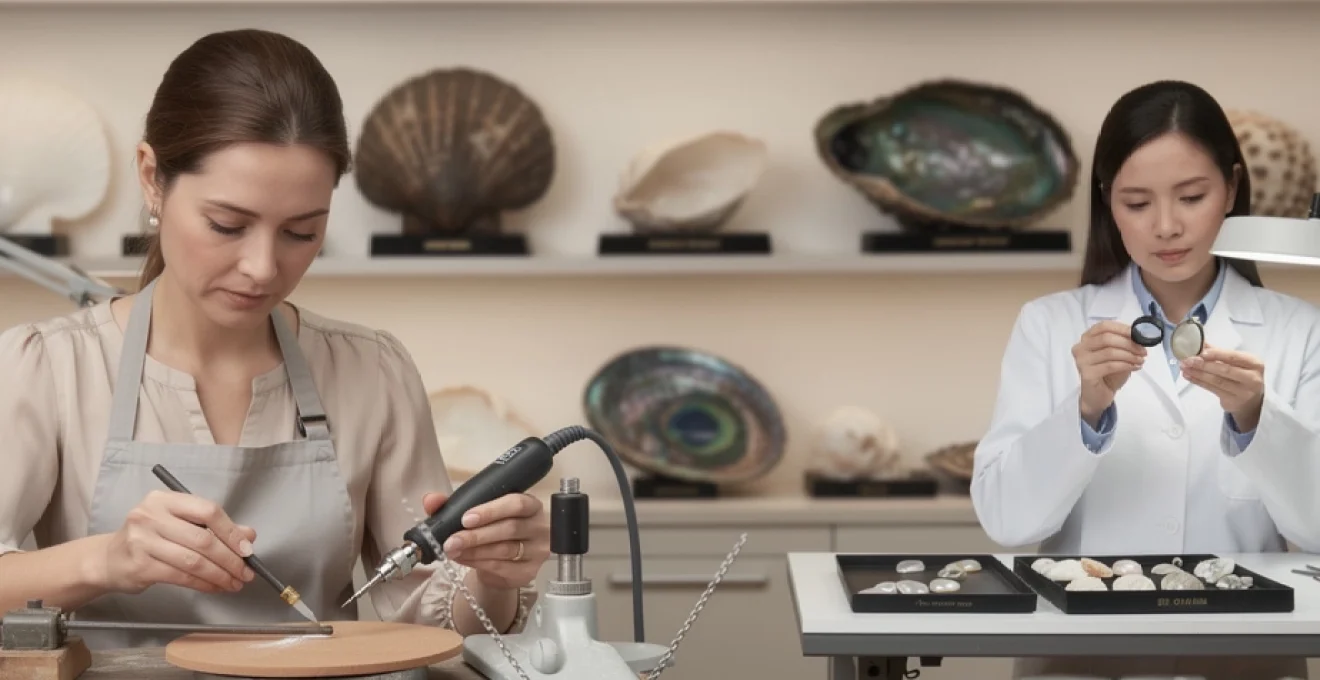
Mother-of-pearl stands as one of nature’s most exquisite materials, captivating jewellery enthusiasts with its ethereal luminescence and iridescent charm. This organic gemstone, scientifically known as nacre, represents centuries of evolutionary perfection within mollusk shells, creating a material that transforms light into mesmerising displays of colour and brilliance. The sophisticated interplay between natural formation processes and human craftsmanship has elevated mother-of-pearl from its oceanic origins to become a cornerstone of contemporary luxury jewellery design.
The allure of mother-of-pearl extends far beyond its visual appeal, encompassing a complex biomineralogical structure that produces optical phenomena unmatched by synthetic alternatives. When examining the finest specimens in high-end jewellery collections, you witness the culmination of millions of years of natural refinement, where calcium carbonate crystals and organic proteins work in harmony to create surfaces that seem to glow from within. This remarkable material continues to inspire master craftsmen and designers, who recognise that working with mother-of-pearl requires not merely technical skill, but an understanding of its unique properties and natural variations.
Nacre formation and mineralogical composition in mollusc shell structures
The formation of nacre represents one of nature’s most sophisticated biomineralisation processes, where living organisms create materials that rival engineered composites in their strength and optical properties. Within the protective confines of mollusk shells, specialised cells called epithelial cells orchestrate the precise deposition of calcium carbonate crystals, creating the lustrous inner lining that jewellers prize so highly. This biological manufacturing process occurs continuously throughout the mollusk’s lifetime, building layer upon microscopic layer of crystalline material that eventually achieves the thickness and quality suitable for jewellery applications.
Aragonite crystal arrangement in bivalve and gastropod species
The distinctive optical properties of mother-of-pearl arise from the precise hexagonal arrangement of aragonite crystals, a polymorph of calcium carbonate that forms under specific temperature and pressure conditions within mollusk shells. These crystals, measuring approximately 400-500 nanometres in thickness, are organised in a brick-and-mortar configuration that maximises both structural integrity and light-manipulating capabilities. The remarkable uniformity of crystal orientation across different bivalve and gastropod species demonstrates the evolutionary advantage of this particular arrangement, which provides both protective functionality and the optical brilliance that makes mother-of-pearl so desirable in luxury applications.
Biomineralisation process in pinctada margaritifera pearl oysters
Pinctada margaritifera, the renowned black-lip pearl oyster, exemplifies the pinnacle of nacre production through its highly evolved biomineralisation system. The mantle tissue of these oysters contains specialised cells that regulate the precise chemical conditions necessary for aragonite crystal formation, controlling factors such as pH levels, ion concentration, and organic matrix proteins. This species produces particularly thick nacre layers, often exceeding 0.5 millimetres in depth, which provides jewellers with substantial material for creating substantial pieces while maintaining the structural integrity essential for long-term durability.
Conchiolin protein matrix role in iridescent layer development
The organic component of mother-of-pearl, primarily composed of conchiolin proteins, plays a crucial role in determining the final optical characteristics of the finished material. These proteins form an intricate framework between aragonite crystals, acting as both binding agents and optical modulators that influence how light interacts with the crystalline structure. The composition and arrangement of conchiolin vary significantly between different mollusk species, contributing to the diverse range of colours and iridescent effects observed in various types of mother-of-pearl used in contemporary jewellery design.
Optical interference phenomena creating Mother-of-Pearl luminescence
The mesmerising luminescence characteristic of high-quality mother-of-pearl results from complex optical interference phenomena occurring within its layered crystalline structure. When light penetrates the nacre surface, it encounters multiple semi-transparent layers that act as natural diffraction gratings, splitting white light into its constituent wavelengths and creating the rainbow-like displays that captivate observers. This interference effect is particularly pronounced when the layer thickness approaches the wavelength of visible light,
which is why the most prized nacre often shows an almost holographic depth of colour rather than a flat, uniform sheen. In practical terms, this means that even a tiny change in layer thickness or orientation can shift the perceived colour, much like the shifting hues on a soap bubble or oil film. For jewellery designers, understanding this interference behaviour is essential: the way mother-of-pearl is cut, oriented and polished directly affects how dramatically it will play with light once set into a piece.
Premium Mother-of-Pearl sources for contemporary jewellery applications
Not all mother-of-pearl is created equal, and the origin of nacre has a profound impact on its suitability for refined jewellery. Different mollusc species, water conditions and cultivation methods produce nacre with distinct colours, textures and structural thicknesses. When you examine premium mother-of-pearl jewellery, you are often looking at carefully selected material from a handful of renowned sources, each associated with specific aesthetic and performance characteristics. For high-end collections, traceability and responsible harvesting are increasingly important, adding ethical value to the visual allure.
Tahitian black-lip pearl oyster harvesting techniques
The Tahitian black-lip pearl oyster, Pinctada margaritifera, is one of the most celebrated sources of dark mother-of-pearl used in contemporary jewellery. Found primarily in the lagoons of French Polynesia, these oysters develop a naturally dark nacreous layer that ranges from graphite grey to peacock green and aubergine tones. Rather than being indiscriminately collected, they are typically raised in managed farms where each shell is suspended on longlines, allowing farmers to monitor growth, health and nacre development over several years.
Harvesting mother-of-pearl from black-lip oysters involves a careful balance between maximising nacre quality and preserving marine ecosystems. Mature shells are usually collected after pearl extraction, ensuring that the full life cycle of the oyster is respected and waste is minimised. The shells are cleaned, sorted and graded according to thickness, colour saturation and surface integrity before being released to lapidaries. This sustainable use of by-product shell material allows jewellers to access rare, naturally dark mother-of-pearl without contributing to overfishing or unnecessary environmental pressure.
Australian south sea pearl shell quality classifications
Australian South Sea pearl oysters, predominantly Pinctada maxima, are famed for producing some of the world’s finest white and golden nacre. These large oysters, cultivated along the coasts of Western Australia and the Northern Territory, develop exceptionally thick nacre layers with a soft, satiny lustre ideal for luxury jewellery. In professional supply chains, shells are classified using a combination of criteria including nacre thickness, surface smoothness, curvature and colour uniformity.
High-grade South Sea mother-of-pearl typically displays a luminous white or cream base with subtle overtones of silver, pink or champagne. Such material is particularly prized for inlay work in high jewellery, watch dials and couture accessories where a refined, understated glow is preferred over bold colour contrasts. Lower-grade shells, while still attractive, may exhibit growth lines, chalky patches or thinner nacre and are more commonly reserved for decorative objects and fashion jewellery where cost-effectiveness is a priority. For designers seeking consistent quality at scale, the Australian grading systems provide a reliable framework for sourcing.
Abalone shell varieties from haliotis species cultivation
Abalone shells, belonging to the genus Haliotis, offer a dramatically different aesthetic from oyster-derived mother-of-pearl. Species such as Haliotis iris (pāua from New Zealand), Haliotis rufescens (red abalone from the Pacific coast) and Haliotis laevigata (greenlip abalone from Australia) produce nacre with vivid blues, greens, purples and sometimes fiery copper tones. These intense colours result from variations in layer thickness, pigmentation and microstructure, making abalone a favourite for bold, contemporary jewellery that aims to stand out.
Modern abalone mother-of-pearl is increasingly sourced from regulated aquaculture rather than wild harvesting, helping to protect vulnerable coastal ecosystems. In controlled farms, abalones are given optimised diets and carefully managed environmental conditions to promote strong shell growth and consistent nacre quality. Once harvested, the shells are processed to remove the rough exterior, revealing the iridescent inner layer that can be sliced into thin veneers or shaped into cabochons. Because abalone patterns are naturally irregular and highly individual, each finished jewellery component tends to be visually unique—an appealing feature for collectors seeking one-of-a-kind pieces.
Freshwater mussel nacre from hyriopsis cumingii farming
Freshwater mussels, particularly Hyriopsis cumingii cultivated in China and other parts of East Asia, represent one of the most important commercial sources of mother-of-pearl. These mussels thrive in lakes and controlled ponds, where farmers manage population density and water quality to ensure optimal nacre deposition. The resulting mother-of-pearl tends to exhibit soft white, cream or pastel tones with a gentle, uniform iridescence well suited to fashion and bridal jewellery.
Compared with marine sources, freshwater nacre typically forms on thinner shells, but what it lacks in individual shell thickness it compensates for in volume and accessibility. The scalability of mussel farming makes freshwater mother-of-pearl a cost-effective choice for brands producing larger collections while still wishing to use genuine nacre rather than synthetic substitutes. When responsibly managed, these farms can provide a renewable supply of shell material with controlled traceability, offering jewellers an attractive blend of affordability, consistency and ethical sourcing.
Advanced lapidary techniques for Mother-of-Pearl jewellery fabrication
Transforming raw shell into refined mother-of-pearl jewellery involves a series of specialised lapidary processes designed to preserve the delicate layered structure of nacre. Unlike hard gemstones, nacre is comparatively soft and brittle, which means conventional cutting and polishing methods must be adapted to avoid cracking, chipping or dulling the surface. The most accomplished workshops combine traditional hand craftsmanship with modern precision tools, ensuring that each piece of mother-of-pearl retains its luminous character while achieving the exact dimensions required by contemporary jewellery design.
Precision cutting methods preserving iridescent properties
Precision cutting is the first critical step in working with mother-of-pearl, and it demands an appreciation of nacre’s anisotropic structure. Because the iridescent effect depends on the orientation of microscopic layers, cutting must be planned so that the final surface lies parallel to these layers wherever possible. This orientation maximises the intensity of colour play and reduces the risk of exposing weaker interfaces that can flake under stress. Artisans therefore study each shell, mapping out regions of maximum lustre and structural integrity before marking cutting lines.
To minimise thermal shock and mechanical stress, thin diamond-coated saws and water-cooled cutting systems are commonly used. Feed rates are kept slow and controlled, allowing the blade to glide through the shell rather than force it apart. For intricate designs or inlay components, CNC (computer numerical control) machines can achieve sub-millimetre precision while maintaining consistent orientation across multiple pieces. When executed correctly, these cutting techniques ensure that the mother-of-pearl retains its natural glow and remains stable enough for long-term wear in jewellery.
Surface finishing protocols for maximum light reflection
The finishing stage is where mother-of-pearl truly comes to life, as successive polishing steps refine the surface to a mirror-like sheen that enhances light reflection. Unlike harder minerals that can withstand aggressive polishing compounds, nacre requires a more nuanced approach using progressively finer abrasives and gentle pressure. Initial smoothing is often carried out with silicon carbide or fine diamond abrasives to remove saw marks and minor irregularities without penetrating too deeply into the nacre layers.
The final lustre is typically achieved with ultra-fine polishing media such as alumina or cerium oxide, sometimes applied with soft felt or leather laps. Throughout this process, careful lubrication with water helps to disperse heat and prevent microscopic burning or clouding of the surface. The goal is to reveal a flawless, glassy finish that allows light to enter and reflect from multiple internal layers, amplifying the characteristic iridescence. In high-end workshops, artisans may hand-polish the final stage, adjusting angle and pressure by eye to coax the most vibrant optical performance from each individual piece.
Inlay setting techniques in precious metal bezels
Because mother-of-pearl is relatively thin and brittle compared with traditional gemstones, setting techniques must provide robust protection without inhibiting its visual impact. Inlay setting is particularly well suited to nacre, as it allows thin slices or plaques to sit flush within precious metal surfaces such as gold, platinum or sterling silver. Jewellers create shallow recesses—often by CNC milling or hand-carving—into which the mother-of-pearl is fitted with minimal tolerance, ensuring both stability and a seamless visual transition between metal and nacre.
Adhesives specifically formulated for fine jewellery, combined with mechanical retention from carefully designed bezels or channels, help secure the inlay without placing point pressure on the material. Edges are often slightly bevelled to reduce chipping, while the metal rim can be lightly burnished over the nacre to create a continuous, protective border. This technique is widely used in watch dials, signet rings, cufflinks and high jewellery pieces where designers wish to create bold motifs or geometric patterns using contrasting panels of metal and mother-of-pearl.
Calibrated cabochon shaping for designer applications
In addition to flat inlays, mother-of-pearl is frequently shaped into low domed cabochons that showcase its depth and luminescence in a more sculptural form. Cabochon cutting for nacre differs from that of harder stones, as the curvature must be gentle enough to avoid exposing weak points while still generating attractive highlights. Lapidaries begin with pre-cut blanks of consistent thickness, then grind and dome the surface using fine abrasives, constantly checking the symmetry and interplay of light across the curve.
Calibrated cabochons—those cut to standardised dimensions such as 6×4 mm or 10 mm round—are particularly valuable to designers creating repeatable collections. These standard sizes allow mother-of-pearl to be swapped into existing settings designed for other cabochon materials, offering a versatile palette of soft colour and sheen. For more avant-garde designs, freeform cabochons shaped to follow natural shell contours can be used to highlight organic patterns, giving each piece a distinct identity. In both cases, the success of the cabochon lies in achieving a harmonious balance between form, thickness and the intensity of iridescence.
Iconic Mother-of-Pearl jewellery collections and artisan craftwork
Across the global jewellery landscape, mother-of-pearl has become a signature element in numerous iconic collections that bridge traditional craftsmanship and modern aesthetics. Several heritage maisons have built recognisable design codes around luminous nacre motifs, often pairing it with yellow or rose gold to accentuate its warmth. These collections demonstrate how a material once associated mainly with functional objects and folk art can, in the hands of skilled artisans, ascend to the realm of haute joaillerie.
Beyond major luxury houses, independent artisans and small ateliers have also embraced mother-of-pearl as a canvas for creative expression. Hand-carved floral medallions, engraved talismans and sculptural earrings highlight the versatility of nacre when approached with patience and technical finesse. In regions with long-standing shell-inlay traditions—such as parts of the Middle East, India and East Asia—contemporary jewellers often reinterpret historic motifs, combining fine goldsmithing with intricate mother-of-pearl marquetry. For discerning collectors, these pieces offer not only visual appeal but also a tangible connection to craftsmanship lineages that span generations.
Gemological assessment and authentication of natural Mother-of-Pearl
As demand for mother-of-pearl jewellery grows, so does the importance of accurate gemological assessment and authentication. While nacre is less commonly counterfeited than high-value gemstones, synthetic and composite materials are increasingly used in cost-driven segments of the market. For both professionals and informed buyers, understanding the key diagnostic features of genuine mother-of-pearl is essential to ensuring quality and long-term satisfaction. Reputable laboratories and trained gemologists employ a combination of microscopic examination, spectroscopy and structural analysis to distinguish natural nacre from imitations.
Under magnification, authentic mother-of-pearl reveals its characteristic layered, plate-like structure, often described as a “stack of bricks” when viewed in cross-section. Subtle growth lines, natural colour zoning and minor surface irregularities further support a natural origin, whereas plastics and coated glass tend to appear homogenous and overly uniform. Additionally, genuine nacre typically exhibits a soft, multi-directional iridescence rather than the single-direction flash common in synthetic pearlescent coatings. In high-value pieces, documentation from an independent gemological institute can provide an extra layer of assurance, especially when rare sources such as Tahitian black-lip or golden South Sea shells are claimed.
Conservation methods and durability enhancement for Nacre-Based jewellery
Although mother-of-pearl has served as a durable protective layer in mollusc shells for millennia, it remains a comparatively soft and sensitive material in the context of jewellery wear. On the Mohs hardness scale, nacre typically ranges between 2.5 and 4.5, making it more susceptible to scratching than quartz-based gemstones or corundum. This does not mean that mother-of-pearl jewellery is inherently fragile, but it does call for conscientious design choices and thoughtful care. By combining intelligent mounting techniques with appropriate maintenance, you can enjoy nacre’s luminous beauty for decades.
From a design perspective, jewellers often enhance durability by recessing mother-of-pearl in protective settings, avoiding sharp edges and minimising exposure to high-impact areas such as ring shoulders. On the wearer’s side, simple habits make a significant difference: removing pieces before sports or housework, avoiding exposure to harsh chemicals and storing items separately in soft-lined compartments. Gentle cleaning with a slightly damp, soft cloth is generally sufficient to remove skin oils and surface residues; abrasive pastes, ultrasonic cleaners and steamers should be strictly avoided, as they can erode or fracture the nacre layers.
In some advanced workshops, thin transparent coatings or sealants may be applied to mother-of-pearl surfaces in high-wear applications, such as watch dials or cufflinks, to provide an extra barrier against micro-scratches and moisture. These treatments must be carefully chosen to preserve the material’s natural optical properties and should remain essentially invisible in normal use. Ultimately, conservation of mother-of-pearl jewellery is a collaborative process between maker and wearer: when expert craftsmanship is paired with informed, respectful handling, nacre’s delicate yet enduring luminescence can remain a defining feature of refined jewellery collections for generations to come.