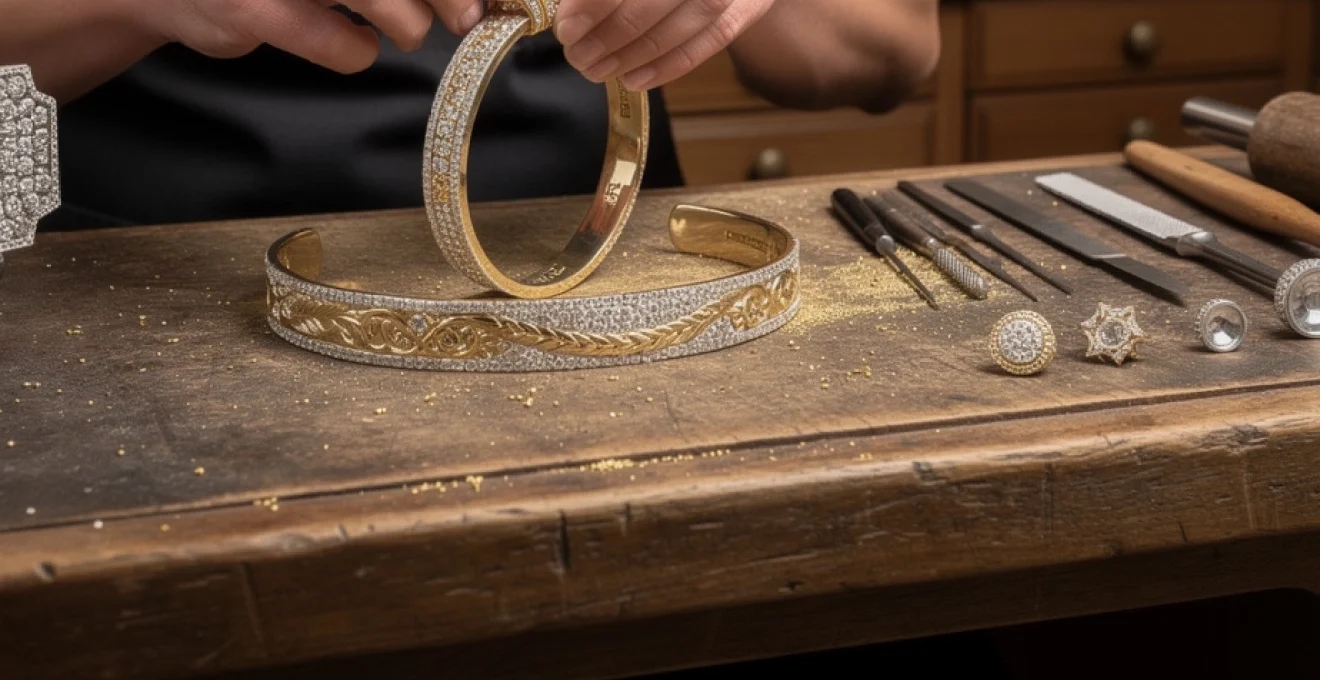
In an age where precision machinery can replicate forms with mechanical accuracy, the human touch remains irreplaceable in fine jewellery creation. Hand-finished pieces carry the unmistakable signature of artisanal expertise—subtle imperfections that paradoxically create perfection, surface textures that respond uniquely to light, and details so refined they can only be achieved through years of training. The world of haute joaillerie continues to celebrate these labour-intensive processes, not merely for tradition’s sake, but because hand-finishing delivers aesthetic and structural qualities that machines simply cannot duplicate. When you examine a truly exceptional piece, you’re witnessing the culmination of centuries-old techniques applied with contemporary precision, where the goldsmith’s hand becomes the ultimate tool for transforming precious materials into wearable art.
Artisanal craftsmanship techniques in Hand-Finished jewellery manufacturing
The distinction between machine-made and hand-finished jewellery becomes immediately apparent when examining the specialised techniques employed by master craftspeople. These methods, refined across generations, create visual and tactile characteristics that define exceptional quality in precious objects. Understanding these processes illuminates why collectors and connoisseurs continue to seek pieces bearing the marks of human craftsmanship.
Millegrain beading and Wire-Twist detailing methods
Millegrain, derived from the French mille-grain meaning “thousand grains,” represents one of the most delicate hand-finishing techniques in jewellery manufacture. This process involves creating a continuous row of tiny beads along metal edges using a specialised tool called a millegrain wheel or knurling tool. The craftsperson must maintain consistent pressure and angle whilst rolling the tool along the precious metal surface—a task requiring extraordinary steadiness and precision. Each microscopic bead catches light differently, creating a distinctive soft glow along setting edges and decorative borders. Wire-twist detailing, often accompanying millegrain work, involves manually twisting precious metal wire into rope-like patterns that add dimensional texture. These techniques appeared prominently during the Edwardian era and experienced renewed popularity in contemporary vintage-inspired designs, where their romantic aesthetic enhances engagement rings and heritage-style pieces.
Pavé setting and Micro-Claw fabrication precision
Pavé setting, from the French word for “paved,” creates the illusion of a continuous diamond surface through meticulous stone placement. Unlike machine-assisted setting processes, hand-executed pavé requires the setter to individually raise tiny beads of metal from the surrounding surface using a graver tool, securing each stone whilst maintaining perfect alignment. The micro-claws formed through this process—often measuring less than 0.3mm—must be burnished smooth to prevent snagging whilst providing adequate stone security. Master setters can position stones with gaps as narrow as 0.15mm, creating a seamless appearance that maximises brilliance. This technique demands exceptional visual acuity and hand-eye coordination; a single miscalculation can compromise the entire composition. Contemporary pavé work often incorporates stones as small as 0.8mm in diameter, pushing the boundaries of what human hands can achieve and creating surfaces that appear to shimmer with continuous light.
Hand-engraving traditions: florentine and scrollwork patterns
Hand engraving transforms smooth metal surfaces into textured artworks through the controlled removal of material using sharp gravers. Florentine finish, also called Florentine engraving or milrigatura, creates a distinctive cross-hatched texture through a series of precisely angled parallel lines. The engraver works methodically across the surface, first in one direction, then perpendicular, creating a fabric-like appearance that diffuses light beautifully. Scrollwork patterns, by contrast, feature flowing, organic designs inspired by botanical forms and baroque ornamentation. These decorative motifs require the engraver to work freehand, following sketched guidelines whilst maintaining consistent depth and width throughout curved pathways. The technique produces unique variations even when following traditional patterns—no two hand-engraved pieces are identical. This individuality adds considerable value, as collectors recognise that each engraved surface represents hours of concentrated artistic labour that cannot be replicated through mechanical means.
<hh3>Granulation and Filigree Wirework Heritage techniques
Granulation is one of the oldest decorative techniques in fine jewellery, dating back to Etruscan and Greek goldsmiths who mastered the art of fusing tiny gold spheres onto a surface without visible solder. The process begins with creating microscopic granules by cutting and heating fine gold wire until surface tension forms perfect beads. These grains are then painstakingly arranged with a brush or needle on a prepared base, following geometric or organic patterns before being fused in a carefully controlled firing process. Because the success of granulation depends on temperature, timing and the precise alloy composition, it is notoriously difficult to automate; the goldsmith’s intuition plays a central role in achieving clean, crisp results. When you examine a granulated surface under magnification, the subtle variation in bead size and spacing betrays the presence of the maker’s hand, giving the piece a living, almost textile-like texture.
Filigree wirework, often paired with granulation in high-end hand-finished jewellery, uses ultra-fine wires twisted, curled and soldered into lace-like motifs. The craftsperson draws down precious metal wire to hair-thin gauges, then forms spirals, tendrils and delicate scrolls using miniature pliers and custom-made jigs. These elements are assembled into frames or openwork panels, with each solder joint requiring precise heat control to avoid collapsing previous connections. Even with modern lasers, achieving uniform, symmetrical filigree demands an experienced eye and steady hand, especially when working at the microscopic scales seen in haute joaillerie. The result is an airy, architectural lightness that machine-stamped patterns cannot match, as the subtle irregularities in each twist and curve create a sense of movement and depth that feels unmistakably human.
The master goldsmith’s role in haute joaillerie creation
Behind every exceptional hand-finished piece stands a master goldsmith who orchestrates the entire creation process, from initial concept to final polish. In haute joaillerie ateliers, this role extends far beyond basic bench work; the master is responsible for interpreting design drawings, advising on structural feasibility and determining the most appropriate artisanal techniques for each element. They act as both engineer and artist, balancing aesthetics with wearability, durability and long-term serviceability. While computer-aided design and casting technologies are now standard in many workshops, the master goldsmith remains the authority who decides where hand intervention is essential to elevate a piece from luxury accessory to collectible art. In that sense, their role is similar to a conductor guiding an orchestra—each specialist contributes, but the goldsmith ensures harmony and coherence in the final work.
Bench work expertise: filing, burnishing and surface refinement
At the bench, the master goldsmith refines cast or fabricated components using an arsenal of hand tools: files, rifflers, scrapers and burnishers. While machine polishing can quickly create a high shine, it often rounds off crisp edges and obscures fine details; hand filing allows the maker to define contours with micrometric control, preserving design intent. Burnishing, which compresses the metal surface using a polished steel or agate tool, produces a dense, mirror-like finish that reflects light more sharply than a basic industrial polish. This compression also slightly hardens the surface, enhancing scratch resistance in high-wear areas such as ring shanks and bracelet links. When you run a fingertip along a truly hand-finished edge, the transition between planes feels precise yet soft, a tactile quality that mass-produced jewellery rarely achieves.
Surface refinement in fine jewellery also involves managing how light interacts with micro-topography. The goldsmith may deliberately alternate between high polish, satin, brushed or sandblasted finishes on adjacent surfaces to create visual contrast and depth. Achieving a consistent satin finish, for example, requires controlled, unidirectional strokes with specialist abrasives, whereas a radial brushed effect demands circular motions that follow the curvature of the piece. In high jewellery houses, it is common for a single bracelet to pass through many rounds of hand finishing, with inspection under magnification at each stage to detect even the smallest scratch or uneven reflection. This level of scrutiny explains why hand-finished pieces often appear to glow from within, as the refined surfaces manage reflections more subtly than those produced by simple tumble polishing.
Stone setting mastery: Bright-Cut and bead setting execution
Stone setting sits at the heart of fine jewellery craftsmanship, and in haute joaillerie it is typically entrusted to the most experienced artisans. Bright-cut setting involves carving clean, reflective facets into the metal around a gemstone using sharp gravers, effectively framing the stone with tiny mirrors that intensify its brilliance. The setter must maintain perfect control over angle and depth; a slip of less than a fraction of a millimetre can mar the symmetry of the setting or, in the worst case, chip a valuable gem. Bead setting, often used in pavé work and accent details, requires the creation of minuscule metal beads that are pushed and shaped over the stone’s girdle to hold it securely. Unlike mechanised setting, the hand setter can adjust pressure and bead shape in response to the individual stone’s subtle variations in size and girdle thickness, enhancing security without sacrificing elegance.
In practice, high-level setters treat each stone almost as a bespoke commission, adjusting their technique for diamonds versus coloured gemstones, or for modern precision cuts versus antique, irregular stones. They assess issues such as cleavage planes, inclusions and hardness, deciding how deeply to seat each stone and how much metal to leave for protection while maximising visible surface area. In bright-cut pavé, for example, the interplay between glittering stone surfaces and razor-sharp metal facets creates a distinctive “liquid light” effect that distinguishes master-set pieces from commercial pavé. As demand grows for ultra-fine micro-setting on delicate engagement rings and stackable bands, the value of skilled hand setters has increased, with some maisons boasting teams whose work is recognisable by connoisseurs through loupe examination alone.
Metal manipulation skills: forging, raising and anticlastic forming
Beyond surface detail, the way a goldsmith manipulates metal in three dimensions profoundly influences the character and comfort of a hand-finished jewel. Forging involves hammering metal to change its shape and internal grain structure, increasing strength while refining form. By systematically working the metal over stakes and anvils, the goldsmith can draw out tapers, open curves or flowing transitions that feel almost organic on the body. Raising, a related technique, allows the maker to shape hollow forms such as bangles, cups or sculptural ring heads from a flat sheet through sequential hammering, without cutting and soldering. This creates seamless volumes with remarkable durability, as there are no joints that can weaken over time.
Anticlastic forming, a more advanced technique, produces surfaces that curve in opposite directions along perpendicular axes—imagine a saddle or a Mobius-like twist. Achieving this in precious metal requires a nuanced understanding of material elasticity and spring-back, as well as patience in gradually coaxing the form rather than forcing it. Such shapes are almost impossible to replicate with simple stamping and are rarely seen in mass-market pieces. For the wearer, these complex, hand-shaped forms often translate into unexpected comfort and fluidity, as the metal conforms more naturally to the contours of the wrist, neck or finger. When combined with expert hand-finishing and stone setting, these sculptural techniques contribute to the sense that a piece of haute joaillerie is not just worn, but almost becomes part of the body.
Quality distinctions between Hand-Finished and Machine-Made jewellery
For many collectors, the most compelling reason to choose hand-finished fine jewellery is the noticeable difference in quality and character compared with machine-made alternatives. These distinctions are not always obvious at first glance, especially to an untrained eye viewing pieces under bright retail lighting. However, when we look at specific aspects—surface texture, structural tolerances and hallmarking—the contrast becomes clear. Understanding these indicators can help you make more informed decisions when investing in bespoke jewellery or evaluating pieces from different brands. So how can you recognise a truly hand-finished jewel without relying solely on brand reputation or price?
Surface texture analysis: Hand-Polished versus Tumble-Finished lustre
One of the clearest indicators lies in the quality of the polish and the way light moves across the metal. Hand-polished jewellery is finished using a series of progressively finer abrasives and felt or cotton buffs, with the polisher adjusting pressure and angle in response to every curve and edge. This labour-intensive process, which can take several hours for a complex piece, produces a deep, almost liquid lustre—when you tilt the jewel, reflections glide smoothly without distortions or cloudy patches. By contrast, mass-produced pieces are often tumble-finished: placed in a rotating drum with abrasive media that abrades all surfaces uniformly. Tumble finishing is efficient and cost-effective, but it tends to round off sharp details and can leave a slightly orange-peel texture visible under magnification.
In hand-finished fine jewellery, different surfaces may receive tailored treatments to enhance design details: mirror polish on bezels, soft matte on background planes, and high-satin on structural elements for a sophisticated play of light. Achieving crisp demarcations between these finishes is a hallmark of superior craftsmanship, requiring masking, careful tool control and repeated inspections. Machine finishing, on the other hand, often results in uniform shine across the piece, which may look impressive initially but lacks nuanced character. Over time, the denser, more carefully compacted surfaces of a hand polish also tend to age more gracefully, with scratches blending into a patina rather than standing out harshly. For long-term wear, this subtle difference in surface engineering can significantly affect how your jewellery looks after years of daily use.
Tolerance variations in prong placement and gallery construction
Structural precision offers another reliable clue to hand-finished quality, particularly in settings and galleries that support gemstones. In machine-made jewellery, prongs and galleries are often produced from standardised components or cast in bulk, leading to uniform but sometimes imprecise tolerances. Prongs may be slightly misaligned, different in thickness or too bulky for the stones they are meant to secure, a compromise that prioritises speed over aesthetics. In a hand-finished piece, each prong is carefully shaped, cut and adjusted to the specific stone, creating a harmonious balance between metal and gem. The prongs sit snugly at consistent angles, hugging the girdle without excess metal that could obscure brilliance or snag on clothing.
Gallery construction—the understructure visible when you turn a ring or pendant upside down—reveals even more about craftsmanship. In haute joaillerie, galleries are often elaborately pierced, engraved or shaped to allow maximum light entry while maintaining strength. The thickness of each strut, the smoothness of internal edges and the symmetry of patterns indicate the level of hand refinement involved. Machine-made galleries may appear solid and functional but lack this thoughtful detailing, sometimes exhibiting rough casting marks or uneven surfaces in hidden areas. When you examine a piece under magnification, subtle consistency in distances, angles and junctions typically points to careful hand fitting rather than purely automated production. This attention to invisible structures contributes to superior durability and comfort, particularly for large stones or elaborate multi-level settings.
Hallmarking depth and strike quality indicators
Even the hallmark—the official stamp indicating metal purity—can reveal whether a piece has undergone thorough hand finishing. In fine jewellery, the hallmark is usually applied after most fabrication steps but before final polishing. On a hand-finished piece, the goldsmith ensures the mark is struck or laser-engraved at an appropriate depth and in a location that does not compromise aesthetics or structural integrity. The surrounding surface is then carefully refinished so that the hallmark remains crisp and legible without raised burrs or distortions. Under close inspection, the edges of the stamp look sharp, and the impression is evenly struck, signalling controlled pressure and a stable work surface.
By contrast, on lower-end, mass-produced jewellery, hallmarks may appear shallow, incomplete or distorted due to fast, high-throughput stamping. In some cases, aggressive machine polishing after hallmarking can soften the mark so much that it becomes difficult to read, a sign that finishing was not coordinated with marking procedures. In luxury ateliers, the depth and clarity of hallmarks, maker’s marks and serial numbers are treated almost as a signature of pride, reinforcing traceability and authenticity. For collectors concerned with provenance and resale value, these subtle details can be just as important as carat weight or design, serving as a permanent record that the piece met specific standards of craftsmanship and assay.
Precious metal finishing processes in bespoke jewellery
In bespoke jewellery creation, precious metal finishing is not a single step but a carefully choreographed sequence that shapes the final character of the piece. After casting or fabrication, the jeweller undertakes numerous intermediary stages: de-spruing, filing, emerying, pre-polishing and, finally, the application of special finishes such as rhodium plating or patination. Each stage removes a controlled amount of material, so the goldsmith must anticipate cumulative loss and protect critical dimensions and fine details. This is one area where bespoke hand-finished jewellery diverges sharply from mass production; rather than standardising every process, the artisan adapts the finishing route to the specific design, metal alloy and intended wear conditions. A heavy platinum cocktail ring, for instance, will demand different finishing strategies than an ultra-fine yellow gold chain or a pair of high-polish hoop earrings.
Rhodium plating on white gold offers a useful example of how finishing choices influence appearance and performance. While many commercial pieces receive a quick, uniform rhodium coat to ensure a bright, white look, bespoke jewellers often pre-polish the underlying metal to a high standard before plating. This ensures that, as the rhodium slowly wears over time, the metal beneath still reflects light evenly and does not reveal casting imperfections. Similarly, in hand-finished rose or yellow gold pieces, the craftsperson may selectively apply brushed, sandblasted or Florentine textures to emphasise form or protect high-contact areas from visible scratching. Advanced techniques such as laser texturing or controlled oxidation on silver and certain gold alloys introduce further creative possibilities, giving bespoke jewellery a distinctive fingerprint of surface treatments. For clients seeking heirloom-quality pieces, understanding and specifying these finishing processes can be as important as choosing the gemstone itself.
Time investment and labour economics in atelier production
The special character of hand-finished jewellery is inseparable from the time and labour invested in each piece. In an artisanal atelier, production schedules are measured in days or weeks rather than minutes, with a significant proportion of that time devoted to hand processes that cannot be effectively automated. Industry surveys suggest that for high-end, diamond-set rings, hand-finishing and setting can account for 40–60% of total labour hours, even when CAD and casting are used for initial structures. This extended timeline directly impacts cost, but it also yields benefits in terms of quality control: with more touchpoints between maker and object, there are more opportunities to correct minor issues before they become structural problems. From an economic perspective, you are not only paying for raw materials and brand name, but for concentrated human expertise applied over many hours.
However, atelier production also faces modern challenges. As experienced goldsmiths retire and fewer young craftspeople enter long apprenticeships, the supply of top-level bench talent is tightening in many jewellery hubs. This scarcity of skills contributes to rising labour costs and longer waiting lists for bespoke commissions at respected maisons and independent studios. For collectors, this scarcity underscores why hand-finished pieces often hold or increase their value over time: they represent a finite resource of skilled human labour, not just luxury materials. From the maker’s perspective, balancing artistry with commercial viability requires thoughtful project planning, with simpler, semi-hand-finished lines sometimes subsidising the intense labour requirements of haute joaillerie masterpieces. When we appreciate the economics behind atelier production, the price of a hand-finished jewel begins to look less like a markup and more like a rational reflection of what it truly takes to create enduring quality.
Heritage maisons renowned for Hand-Finishing: cartier, van cleef & arpels and buccellati
Certain heritage maisons have become synonymous with exceptional hand-finishing, using their ateliers to preserve and advance traditional techniques. Cartier, for example, is renowned for its meticulous stone setting and metalwork, particularly in iconic collections such as Panthère and Trinity. Behind the scenes, teams of specialised setters, polishers and engravers work under strict quality protocols, with every piece undergoing multiple rounds of inspection under high magnification. Cartier’s pavé and invisible settings are often cited in trade publications as benchmarks for consistency and brilliance, reflecting thousands of hours of collective know-how. Collectors seeking hand-finished jewellery with a strong design heritage frequently turn to such maisons, confident that each piece embodies decades—if not centuries—of refined workshop practice.
Van Cleef & Arpels offers another compelling case study in artisanal excellence, especially with its patented Mystery Set technique developed in the 1930s. This method, in which gemstones appear to float without visible metal, requires extremely precise cutting of stones and intricate understructures that only a handful of master setters in the world can execute. The brand’s Alhambra and Frivole collections also showcase exceptional finishing, from perfectly mirrored surfaces on clover motifs to delicate edge bevels that ensure comfort against the skin. Each element is polished separately before being assembled, then re-polished as a whole—a time-consuming approach that prevents rounded details and preserves sharp silhouettes.
Buccellati, meanwhile, is celebrated for its distinctive textural handwork: rigato, telato and ornato engravings that give gold a fabric-like appearance. Craftspersons spend years learning to wield specialised burins to create these signature finishes, working under microscopes to achieve uniform line depth and spacing. Granulation and intricate piercing further enhance the house’s sculptural aesthetic, making each piece instantly recognisable even from a distance. In Buccellati’s ateliers, a single cuff bracelet can require over 200 hours of manual engraving and finishing, a level of input that simply cannot be replicated by machines. When you hold such a jewel in your hand, you are encountering not just a luxury object, but a concentrated expression of human skill, time and cultural heritage—precisely what makes a hand-finished piece so special in fine jewellery.