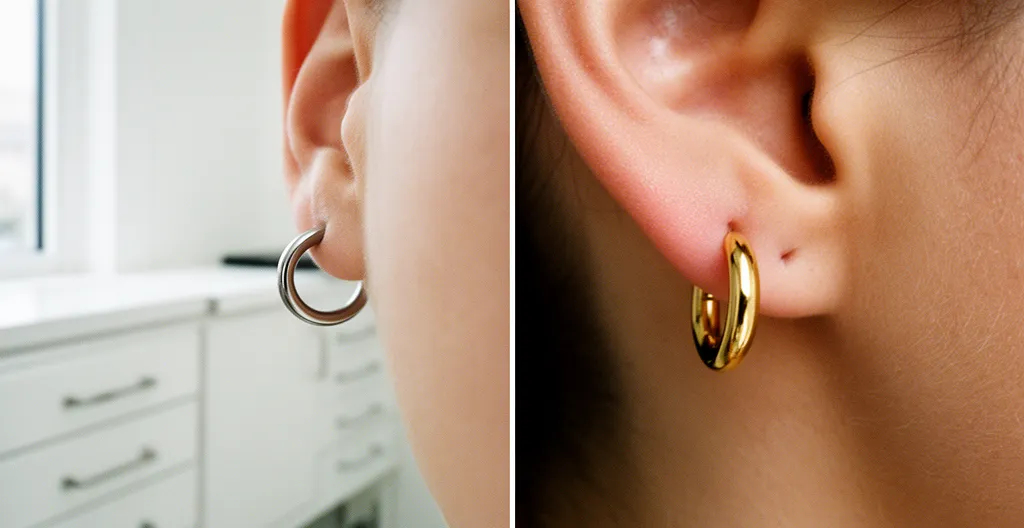
The key to preventing piercing infections isn’t just choosing a “hypoallergenic” metal; it’s selecting a material and design that are biomechanically compatible with an active body.
- Material inertness (like Grade 23 titanium) prevents reactions with sweat and reduces infection risk during exercise.
- Low-profile, correctly-sized designs minimize mechanical stress, catching, and pressure on the piercing channel.
Recommendation: Prioritize implant-grade (Grade 23) titanium for its superior biocompatibility, light weight, and durability for any 24/7 wear, especially if you lead an active lifestyle.
For anyone with an active lifestyle, the struggle is real. You need earrings you can wear from a morning run to the swimming pool and through the night without a second thought. Yet, the fear of irritation, snagging, or a full-blown infection is a constant concern, especially with new or sensitive piercings. Many articles will simply advise you to choose “hypoallergenic” materials like surgical steel or gold, but this advice often falls short. It doesn’t account for the unique stresses an active body places on a piercing: constant movement, pressure from headphones or helmets, and exposure to sweat.
The standard solutions don’t address the core of the problem. What if the key to preventing infection wasn’t just about avoiding nickel, but about understanding the biomechanics of your jewelry? This involves looking at a material’s weight, its thermal conductivity, and its ability to remain inert when in contact with bodily fluids. It’s about how the design itself—the size, the closure, and its profile against your skin—mitigates the risk of mechanical stress and trauma. This is where a clinical, health-focused perspective becomes crucial.
This guide moves beyond generic advice. We will analyze sleeper earrings from a functional, biomechanical standpoint, treating them as equipment for your body. We’ll compare the clinical properties of leading materials, dissect the risks associated with different designs during sports, and provide a framework for choosing earrings that are truly compatible with a life in motion. By focusing on material science and proper fit, you can finally achieve comfortable, worry-free, 24/7 wear.
Contents: Your Guide to Infection-Free Sleeper Earrings
- Why Can’t You Find the Seam on Your Seamless Sleeper Ring?
- How to Disinfect Your Piercing Holes While Wearing Sleepers?
- Grade 23 Titanium or 18k Gold: Which is Better for Reacting Ears?
- The Risk of Wearing Large Sleepers During Contact Sports or Yoga
- How to Fix a Clicker Hinge That Has Become Loose?
- The Mistake of Buying 6mm Loops When You Have High Piercings
- The Risk of Sleeping in Studs That Aren’t Designed for 24/7 Wear
- How to Choose Single Loop Earrings You Can Sleep In Comfortably?
Why Can’t You Find the Seam on Your Seamless Sleeper Ring?
The very feature that makes a seamless ring perfect for 24/7 wear—its smooth, continuous surface—is also what makes it challenging to open. There are no hinges or clasps. The ‘seam’ is a precision cut, designed to be nearly invisible to prevent it from rotating into the piercing channel and causing irritation or bacterial entry. This design is superior for healing and long-term wear, but it requires a specific technique to open safely without damaging the jewelry or your ear. The goal is not to pull the ends apart, which would permanently deform the ring, but to use a gentle twisting motion.
This technique, often called a torsional twist, maintains the ring’s circular shape. You grip the ring on either side of the seam and gently push one end away from you while pulling the other end towards you. This opens the ring just enough to slide it into your piercing. Reversing the motion closes it securely. Mastering this is key to using seamless rings effectively, ensuring you get all the comfort benefits without the frustration.
As you can see in the demonstration, the movement is a subtle rotation, not a forceful pull. This preserves the integrity of the metal and ensures a perfect closure every time. For those with an active lifestyle, a properly closed seamless ring is the most secure option, with virtually no risk of catching on clothing or hair during activity.
Action Plan: 4 Essential Steps to Open a Seamless Ring Safely
- Clean your hands thoroughly and sanitize the jewelry with a sterile saline solution before handling it.
- Grip the ring firmly on opposite sides of the invisible seam using your thumb and index finger.
- Apply a gentle twisting motion in opposite directions (the torsional twist); you must never pull the ends directly apart as this will ruin the ring’s shape.
- Once opened slightly, thread it through your piercing and then carefully reverse the twisting motion to bring the ends back together perfectly.
How to Disinfect Your Piercing Holes While Wearing Sleepers?
Keeping a piercing clean, especially when you’re not removing the jewelry, is critical for preventing infection. The primary goal is to clean the area without introducing irritants. Many people mistakenly reach for harsh chemicals like alcohol or hydrogen peroxide, believing they are effective disinfectants. However, these substances are cytotoxic, meaning they kill new, healthy cells that are essential for healing. This can prolong inflammation and actually increase infection risk. The professional standard is to use a simple, sterile saline solution.
Effective cleaning involves a “rinse and rotate” method. Twice a day, saturate a piece of non-woven gauze or a cotton swab with sterile saline solution. Gently clean the area around the piercing entry and exit points, removing any ‘crusties’ (dried lymph fluid). Then, carefully rotate or slide the sleeper earring through the piercing. This action helps to work the saline solution inside the piercing channel, flushing out bacteria and debris. It is crucial to be gentle; aggressive movement can cause micro-tears and introduce new trauma to the healing tissue.
This routine is especially important for active individuals. Sweat can introduce bacteria and salt that can irritate a piercing. A quick saline rinse after a workout or swim (followed by a fresh water rinse to remove chlorine) is an excellent preventative measure. Remember that, according to piercing industry statistics, up to 80% of piercing infections are caused by improper aftercare, not the piercing itself. The Mayo Clinic also strongly advises against harsh antiseptics, as they can delay healing and increase the risk of complications. Consistency and the right solution are your best defense.
Grade 23 Titanium or 18k Gold: Which is Better for Reacting Ears?
When it comes to sensitive ears, the debate often centers on titanium versus gold. However, not all titanium or gold is created equal. For a true, clinical comparison, we must specify Grade 23 (Ti-6Al-4V ELI) titanium and 18k solid gold. Grade 23 titanium is an implant-grade material, meaning it’s certified for biocompatibility and is used in surgical implants like bone screws. It is 100% nickel-free, making it the safest choice for individuals with extreme sensitivities or compromised immune systems.
18k gold is a popular choice for its aesthetic, but it’s an alloy. While it’s 75% pure gold, the remaining 25% consists of other metals, which can include traces of nickel, copper, or silver to add durability. For most people, this is not an issue. However, for someone with a true nickel allergy or highly reactive skin, even these trace amounts can trigger a reaction, especially when combined with sweat during exercise. From a physiotherapist’s perspective, titanium also has superior mechanical properties for an active lifestyle: it’s about 45% lighter than steel (and noticeably lighter than gold), and it’s extremely scratch-resistant. Gold is much softer and can accumulate microscopic scratches that harbor bacteria.
This table breaks down the key differences from a health and performance perspective, based on standards from professional piercing organizations.
| Property | Grade 23 Titanium | 18k Gold |
|---|---|---|
| Nickel Content | 100% Nickel-Free | May contain trace amounts |
| Weight | 45% lighter than steel | Heavier, more noticeable |
| Thermal Conductivity | Low (stays body temperature) | High (can feel cold/hot) |
| Durability | Extremely scratch-resistant | Softer, prone to scratches |
| Price Range | $20-50 per piece | $100-300+ per piece |
The Association of Professional Piercers (APP) reinforces this clinical view. In their guidelines, they state that titanium is an ideal material for initial and healing piercings precisely because of its inertness.
Titanium is a lightweight metal that is ideal for people with concerns about nickel sensitivity.
– Association of Professional Piercers, APP Jewelry Standards Guidelines
The Risk of Wearing Large Sleepers During Contact Sports or Yoga
While sleeper earrings are designed for comfort, size and style matter immensely when you’re physically active. The primary risks are mechanical stress and acute trauma. Large hoops, even if lightweight, create a lever. During contact sports like basketball or martial arts, a large ring can easily be caught by a hand or piece of equipment, leading to a torn earlobe. Research from the American Academy of Family Physicians shows that up to 42% of piercing-related traumas require medical attention due to tearing or severe inflammation. For an active person, the risk of such an injury is simply not worth the aesthetic.
Even in non-contact activities like yoga or gymnastics, large or dangling earrings pose a threat. During inversions like a headstand, a larger hoop can get pressed between your head and the mat, creating a painful pressure point. It can also snag on your own clothing or hair during dynamic movements. The ideal earring for sports is one with a low-profile design. This means small, close-fitting hoops (like 6-8mm huggies) or flat-back labret studs that sit flush against the skin, presenting no edge to catch on anything. They move with your body, not against it.
This image perfectly illustrates the concept of a low-profile design. The small, flush-fitting hoops do not interfere with the pose, create no pressure points, and have a minimal risk of snagging. When choosing jewelry for an active lifestyle, thinking like a physiotherapist is key: minimize all external variables that could lead to injury. In this context, smaller is unequivocally safer.
How to Fix a Clicker Hinge That Has Become Loose?
Clicker-style hoops are incredibly popular for their ease of use—no twisting required. However, the convenience of the hinge mechanism is also its primary point of failure. Over time, the tension in the hinge can weaken, causing the earring to open unexpectedly. This is a significant risk during sports or sleep, as you could easily lose an expensive piece of jewelry or have it snag as it swings open. Fortunately, a slightly loose clicker can often be adjusted at home with the right technique and a gentle hand. The issue is usually a tiny misalignment of the closing post.
Before attempting any adjustment, it is vital to clean the hinge mechanism thoroughly with isopropyl alcohol to remove any oils or debris that might be affecting the closure. Once clean, you’ll need a pair of smooth-jawed pliers (to avoid scratching the metal) and excellent lighting. The goal is to apply a minuscule amount of pressure to the hinged arm to nudge it back into perfect alignment with the clasp. This is a delicate process; too much force will snap the hinge or deform the post, permanently ruining the earring. It’s about tiny, incremental adjustments.
If you have a loose clicker, follow these precise steps for a professional-style adjustment:
- Remove the clicker and clean the entire hinge mechanism with isopropyl alcohol on a cotton swab.
- Examine the hinge under a bright light to identify if the post is slightly bent or if the clasp appears worn.
- Using smooth-jawed pliers, apply minimal, gentle pressure (a squeeze of less than a millimeter) to the arm of the hinge that swings.
- Test the closure. It should make a crisp “click” sound. If it’s still loose, repeat the process with another tiny increment of pressure.
- If the hinge shows any visible cracks, or if it will not stay closed after a few careful adjustments, the metal is fatigued and the jewelry should be replaced to avoid loss or injury.
The Mistake of Buying 6mm Loops When You Have High Piercings
One of the most common and painful mistakes in buying sleeper earrings is choosing a diameter that is too small for the piercing’s placement. A 6mm hoop might be perfect for a low, first-lobe piercing, but it can be disastrous for a high lobe or a helix piercing. When a hoop is too tight, it puts constant pressure on the tissue. This compression restricts blood flow, which is essential for a healthy piercing. This can lead to irritation, swelling, and a condition known as pressure necrosis, where the tissue begins to die. It can also cause the piercing to migrate or reject entirely.
The anatomy of the ear is not uniform. The cartilage of the helix is thick and curved, requiring a larger diameter hoop (typically 8mm-10mm) to arc around it without putting pressure on the entry and exit points. Even a second or third lobe piercing, if placed higher up on the thicker part of the lobe, will need more room than a standard 6mm hoop can provide. While not a direct comparison, piercing industry data shows that pressure from improper sizing is a major factor in piercing failure, as statistics suggest around 20% of certain piercings are rejected by the body’s tissue. The principle of avoiding compression is universal.
The only way to know your correct size is to measure. You can use a ruler to measure the distance from your piercing hole to the edge of your ear in millimeters. Then, add 1-2mm to that measurement for a comfortable fit that allows for slight swelling during sleep or exercise. If in doubt, a professional piercer can measure you precisely and recommend the ideal diameter for each specific piercing location, ensuring both comfort and long-term health.
Key Takeaways
- Biocompatibility over aesthetics: Grade 23 titanium is clinically safer for active individuals than gold due to its inertness and nickel-free composition.
- Design dictates safety: Low-profile, correctly sized earrings drastically reduce the risk of mechanical stress, tearing, and pressure-related complications during sports and sleep.
- Proper aftercare is non-negotiable: Using sterile saline solution and avoiding harsh chemicals is the most effective way to prevent the vast majority of piercing infections.
The Risk of Sleeping in Studs That Aren’t Designed for 24/7 Wear
While this guide focuses on sleepers, many people opt for studs for their low-profile look. However, the wrong kind of stud can be far more dangerous to sleep in than a well-fitted hoop. The primary culprit is the traditional butterfly back. These backings are notorious for collecting bacteria, hair, and product residue in their folds. More critically, they can easily be pushed too tightly against the earlobe. This pressure restricts airflow and circulation, creating a warm, moist environment perfect for bacterial growth and increasing infection risk.
Furthermore, the post of a traditional stud is often unnecessarily long, and it can poke into the sensitive skin behind your ear, especially for side sleepers. This constant, sharp pressure can cause soreness, inflammation, and even break the skin, creating an open wound susceptible to infection. For anyone committed to 24/7 wear, especially active individuals who need reliable and safe jewelry, the butterfly back stud is a significant liability.
The only type of stud that is safe for continuous wear is a flat-back labret. This design features a smooth, flat disc as the backing, which sits flush against the skin. There are no sharp posts to poke you, and the flat surface does not trap debris in the same way a butterfly back does. They are internally threaded or push-pin style, creating a secure closure that won’t loosen over time. This design provides the low-profile benefit of a stud with the safety and comfort required for a healthy, active lifestyle.
How to Choose Single Loop Earrings You Can Sleep In Comfortably?
Choosing the perfect single loop earring for comfortable, 24/7 wear comes down to a synthesis of three key factors: material, size, and closure mechanism. As we’ve established, Grade 23 titanium is the superior material choice for its absolute biocompatibility, light weight, and durability, making it ideal for the demands of an active lifestyle and sensitive skin. Sizing is equally critical; the hoop must be large enough to encircle the tissue without any compression, with 1-2mm of ‘breathing room’ to account for minor swelling.
The final piece of the puzzle is the closure. For true ‘set it and forget it’ wear, a seamless ring or a fixed bead ring offers the highest level of security and comfort, as there are no hinges to fail or clasps to catch. However, they require tools or a specific technique to change. For those who like to switch jewelry more often, a high-quality clicker is a convenient compromise, provided you regularly check the hinge for tightness. A hinged hoop is easy to use but generally offers the lowest security for intense activity.
This comparative table can help you decide which closure type best fits your lifestyle and priorities.
| Closure Type | Comfort Level | Security | Ease of Change | Best For |
|---|---|---|---|---|
| Seamless Ring | Most Comfortable | Very Secure | Requires Tools | Long-term wear |
| Clicker | Comfortable | Secure (can fail) | Very Easy | Frequent changes |
| Fixed Bead | Moderate | Most Secure | Requires Tools | Active lifestyle |
| Hinged Hoop | Good | Moderate | Easy | Daily wear |
Ultimately, making the right choice is a process of elimination based on your body’s needs. If you have any metal sensitivities, start with titanium. If you engage in high-impact sports, prioritize security with a seamless or fixed bead ring. By systematically considering these elements, you can build a collection of sleeper earrings that are not only beautiful but function as a safe, comfortable, and integral part of your active life.
By applying this biomechanical framework to your selection process, you are investing in the long-term health of your piercings. The next logical step is to have your piercings professionally measured to ensure a perfect fit for any future jewelry purchases, eliminating the guesswork and risk of improper sizing.
Frequently Asked Questions About Sleeper Earrings
What size sleeper hoop do I need for a helix piercing?
Each ear anatomy is unique, with different cartilage thicknesses and piercing placements. A professional piercer can measure you for the perfect size, but generally, a helix requires a larger diameter of 8mm to 12mm to curve comfortably around the cartilage without causing pressure.
Can I use the same size for lobe and cartilage piercings?
No, it is highly inadvisable. Cartilage piercings like the helix or daith are thicker and require larger diameters (8-12mm) to prevent pressure and ensure proper healing. Lobe piercings, which are in softer tissue, can typically accommodate smaller sizes (6-8mm).
How much swelling buffer should I add?
For a comfortable and safe fit, always add 1-2mm to your precise measurement. This is especially important for active lifestyles, as heat and physical exertion can cause temporary swelling in the tissue, and a tight earring can quickly become painful and dangerous.