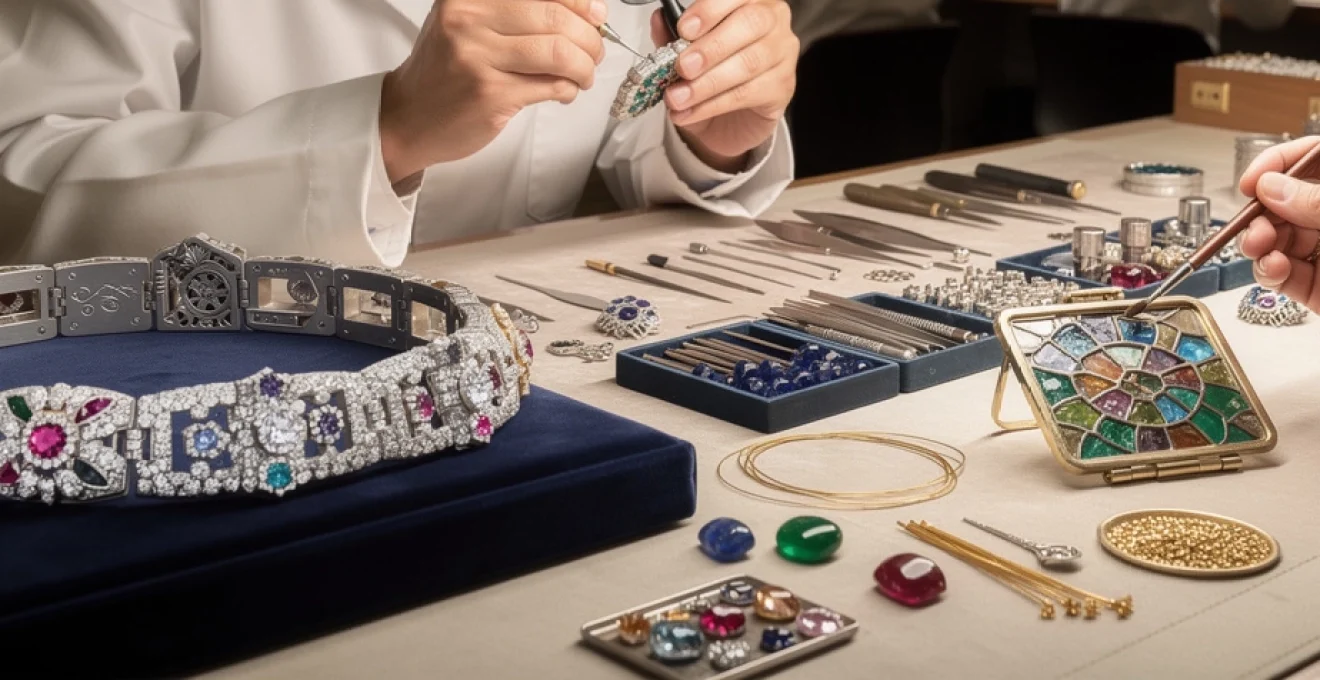
High jewellery stands as the ultimate expression of human artistry and technical mastery in the luxury goods sector, representing centuries of accumulated knowledge and innovation. This rarefied world of haute joaillerie transcends mere decoration, embodying cultural heritage, scientific precision, and artistic vision in pieces that often require hundreds of hours to complete. The distinction between fine jewellery and high jewellery lies not merely in price points, but in the exceptional rarity of materials, the complexity of craftsmanship techniques, and the innovative design approaches that push the boundaries of what’s technically possible. From the ancient workshops of master goldsmiths to today’s cutting-edge ateliers, high jewellery continues to evolve while maintaining its commitment to perfection and exclusivity.
Artisanal techniques and traditional methods in high jewellery creation
The foundation of high jewellery rests upon traditional artisanal techniques that have been refined over millennia, each requiring years of apprenticeship to master. These methods demand not only technical precision but also an intuitive understanding of materials and their behaviour under various conditions. Master craftspeople dedicate their entire careers to perfecting singular techniques, creating a depth of expertise that cannot be replicated through industrial processes.
Hand-engraving and guilloché mastery in cartier and buccellati workshops
Hand-engraving represents one of the most demanding skills in high jewellery, requiring steady hands, artistic vision, and profound patience. The technique involves using specialised burins to carve intricate patterns directly into precious metals, creating textures and designs that catch and reflect light in unique ways. Cartier’s workshops have maintained these traditions for over a century, with master engravers capable of creating patterns so fine they appear almost ethereal. The guilloché technique, popularised in the 18th century, involves creating precise geometric patterns through repetitive engraving motions, often enhanced by engine-turning lathes for perfect regularity.
Buccellati has elevated hand-engraving to an art form, developing proprietary techniques that create silk-like textures on gold surfaces. Their rigato engraving mimics the appearance of fine fabric, whilst the telato technique creates honeycomb patterns of extraordinary delicacy. These processes can take weeks to complete on a single piece, with artisans working under magnification to achieve the microscopic precision required. The investment in time and skill explains why hand-engraved pieces command premium valuations in the luxury market.
Micro-setting techniques for pavé and invisible settings
Pavé setting represents a pinnacle of technical achievement in high jewellery, requiring the precise placement of numerous small diamonds or gemstones with minimal visible metal between them. This technique creates the illusion of a continuous carpet of stones, maximising brilliance and fire. Master setters must drill microscopic holes with absolute precision, ensuring each stone sits at the exact height and angle to optimise light performance. The process demands extraordinary dexterity, as a single miscalculation can compromise the entire piece.
Invisible setting, pioneered by Van Cleef & Arpels, pushes these challenges even further by eliminating visible prongs or bezels entirely. This revolutionary technique requires stones to be cut with precise grooves that interlock with a hidden metal framework, creating seamless surfaces of pure gemstone. The engineering complexity is staggering, as each stone must be individually calibrated to fit its exact position. This method can increase production time by 300% compared to traditional setting techniques, but the visual impact justifies the extraordinary investment in craftsmanship.
Enamelling processes: champlevé, cloisonné, and Plique-à-Jour applications
Enamelling techniques in high jewellery showcase the marriage of artistry and chemistry, requiring mastery of both aesthetic principles and material science. Champlevé enamelling involves carving recesses into metal surfaces before filling them with powdered glass that’s then fired at precise temperatures to create smooth, lustrous surfaces. This technique allows for intricate colour gradations and pictorial representations that remain vibrant for centuries.
Cloisonné enamelling uses thin metal wires
Cloisonné enamelling uses thin metal wires to create tiny enclosed cells on the surface of the metal, which are then filled with enamel and fired multiple times to build up depth of colour. Each firing must be calibrated within a very narrow temperature range; a few degrees too hot or too long in the kiln can fracture hours of work. In high jewellery, maisons such as Patek Philippe and Vacheron Constantin have adopted cloisonné for miniature dials and medallions, turning each piece into a wearable painting. The precision required is comparable to miniature manuscript illumination, where every line and hue must be perfectly controlled.
Plique-à-jour, often described as “stained glass in miniature”, is among the most technically demanding enamelling techniques in haute joaillerie. Here, the enamel is suspended without a metal backing, allowing light to pass through the translucent glass. The result is an ethereal, luminous effect reminiscent of dragonfly wings or cathedral windows. Because there is no supporting metal beneath the enamel, the risk of cracking during firing is extremely high, and multiple firings are often necessary to achieve the desired saturation. This is why plique-à-jour appears almost exclusively in true high jewellery collections, where the time and failure rates are acceptable in pursuit of exceptional beauty.
Granulation and filigree work in contemporary high jewellery
Granulation and filigree are ancient techniques that have found new relevance in contemporary high jewellery, allowing maisons to reference historical aesthetics while achieving ultra-fine detail. Granulation involves fusing microscopic beads of gold onto a metal surface without visible solder, creating velvety, matte textures and intricate ornamental patterns. This technique, used by Etruscan goldsmiths more than 2,000 years ago, demands precise control of temperature and metal composition; a few seconds too long at heat can cause the granules to lose definition or melt into the base.
Filigree, on the other hand, uses slender threads and curled wires of gold or platinum to build lace-like structures that can be astonishingly light yet structurally sound. Contemporary high jewellery designers increasingly combine filigree with pavé diamonds or coloured stones, creating pieces that seem to float against the skin. When you look closely at a filigreed high jewellery bracelet, you are essentially seeing precious metal “drawn” as linework, much like an ink illustration translated into three dimensions. The resurgence of these slow, labour-intensive methods stands in sharp contrast to mass-produced jewellery, underlining why high jewellery represents the pinnacle of craftsmanship.
Gemstone sourcing and selection protocols for haute joaillerie
While artisanal techniques define how high jewellery is made, gemstone sourcing determines what it is made from. In haute joaillerie, the selection of stones follows strict protocols that go far beyond the standard “four Cs” of cut, colour, clarity, and carat weight. Leading maisons partner with specialised laboratories, field gemmologists, and long-established dealers to secure stones with exceptional characteristics and fully documented provenance. As supply of top-quality material continues to tighten, these protocols have become a strategic differentiator, shaping both the aesthetic and investment value of high jewellery pieces.
For the modern collector, understanding how stones are certified, traced, and graded provides critical insight into why certain pieces command seven- or eight-figure prices at auction. High jewellery is, in many ways, a collaboration between the earth’s rarest geological phenomena and the most exacting human standards. When a maison acquires a unique crystal—whether a 10-carat vivid blue diamond or a velvety Kashmir sapphire—it will often design an entire collection around that singular gem, underscoring just how central sourcing is to creative vision.
Gübelin and SSEF certification standards for exceptional stones
Among the most respected authorities in high-end gemstone certification are the Gübelin Gem Lab and the Swiss Gemmological Institute SSEF. Their reports have become a gold standard in the high jewellery world, particularly for rare coloured gemstones. These laboratories conduct exhaustive testing, using advanced spectroscopy, microscopic examination, and chemical analysis to determine whether a stone is natural, whether it has undergone treatments, and where it likely originated. For high jewellery clients, a Gübelin or SSEF report is not merely documentation—it is an assurance that the stone meets the most stringent scientific criteria.
In the context of high jewellery, these certifications can significantly influence value. A Colombian emerald or Burmese ruby accompanied by a Gübelin or SSEF report confirming absence of treatment will often command a multiple of the price of an apparently similar stone without such documentation. This is because the labs’ reputations rest on extreme conservatism and independence. If you are considering high jewellery as a long-term asset, paying attention to which laboratory has issued the report is as critical as evaluating the gem itself. For truly exceptional stones, collectors will often insist on dual certification from both institutions.
Kashmir sapphires and padparadscha: rarity assessment criteria
Few gems are as revered in haute joaillerie as Kashmir sapphires, famed for their unmistakable “cornflower blue” and velvety texture. Mined primarily in the late 19th and early 20th centuries from a remote region in the Himalayas, true Kashmir material is now essentially exhausted. When a maison acquires such a stone, laboratories assess not just colour but also microscopic inclusions, trace elements, and growth structures to confirm origin. The presence of characteristic “silk” inclusions, for example, can help distinguish Kashmir sapphires from those of Sri Lanka or Madagascar.
Padparadscha sapphires—whose name comes from the Sinhalese word for lotus blossom—are another rarity sought by high jewellery houses. Their delicate balance of pink and orange is notoriously hard to find; stones that are too brown, too orange, or too pink fall outside the strict definition used by top-tier labs. For high jewellery, only stones that achieve this precise balance, retain strong saturation, and show minimal inclusions are considered. Because both Kashmir and fine Padparadscha sapphires are so scarce, maisons often design settings that maximise visibility while protecting the stone, recognising that they are working with irreplaceable material.
Jadeite imperial green and burmese ruby provenance authentication
In the Asian high jewellery market, few materials command more reverence than top-quality jadeite jade, especially in the coveted “Imperial Green” colour. This material is evaluated according to saturation, translucency, and uniformity of colour, with the finest examples appearing almost like glowing green glass. However, the market is also rife with imitations and treated stones, which is why leading maisons rely on advanced testing methods such as Raman spectroscopy and infrared analysis to confirm that a piece is natural, untreated jadeite. For collectors in Hong Kong, mainland China, and beyond, a certificate indicating “Type A” (untreated) jadeite is non-negotiable.
Burmese rubies, particularly those from the legendary Mogok region, play a similarly iconic role in Western and global haute joaillerie. Their saturated “pigeon’s blood” red—combined with a subtle fluorescence—gives them an inner glow that is difficult to replicate. Provenance authentication involves both gemmological analysis and historical traceability through trusted supply chains. In many cases, auction catalogues will highlight not only a ruby’s Burmese origin but also the mine area, treatment status, and documented history of ownership. When you see a necklace featuring a matched suite of Mogok rubies, you are looking at decades, if not generations, of careful acquisition and curation.
Fancy coloured diamond grading: type IIa and type IIb classifications
Fancy coloured diamonds occupy a special niche in high jewellery, combining technical rarity with dramatic visual impact. Grading these stones goes far beyond the standard colourless diamond scale; laboratories assess hue, tone, saturation, and distribution of colour, resulting in descriptors such as “Fancy Vivid Blue” or “Fancy Intense Pink”. Within this category, Type IIa and Type IIb diamonds are especially prized. Type IIa diamonds, almost entirely free of nitrogen impurities, are known for their exceptional transparency and brilliance. Many of the world’s most famous colourless and pink diamonds, including the Cullinan and the Koh-i-Noor, fall into this category.
Type IIb diamonds, by contrast, contain trace amounts of boron, which can impart exquisite blue or greyish-blue hues. These stones are extraordinarily rare—some estimates suggest they account for far less than 0.1% of all diamonds mined. For high jewellery houses, acquiring a single sizeable Type IIb blue diamond can be a once-in-a-decade opportunity. The combination of advanced spectroscopic testing and stringent colour grading ensures that when a maison presents a high jewellery ring featuring a Fancy Vivid Blue Type IIb diamond, collectors can be confident they are encountering one of nature’s true anomalies.
Precision engineering in complicated jewellery mechanisms
Beyond surface beauty and gemstone quality, high jewellery often distinguishes itself through sophisticated mechanical engineering. Hidden hinges, articulated links, and secret compartments transform static adornments into dynamic objects, blurring the line between jewellery, watchmaking, and mechanical art. The tolerances involved can rival those of haute horlogerie, with components measured in hundredths of a millimetre. Why does this matter for the wearer? Because it allows a single piece to be worn in multiple configurations, moving fluidly with the body while remaining structurally secure.
In many leading maisons, jewellery engineers work alongside watchmakers and CAD specialists to solve complex mechanical challenges: how to make a diamond rivière that drapes like fabric, or a transformable tiara that converts into a necklace without visible seams. These projects can require hundreds of prototypes and months of testing. The result is high jewellery that not only looks extraordinary in a showcase but also performs flawlessly in real life, whether on a red carpet or at a private gala.
Transformable jewellery: van cleef & arpels mystery setting innovation
Van Cleef & Arpels is renowned not only for inventing the invisible “Mystery Set” but also for pioneering transformable high jewellery that adapts to different occasions. Their iconic Zip necklace, originally conceived in the 1930s, can be worn both fully closed as a necklace and partially unzipped as a bracelet. Achieving this required custom-engineered teeth and sliders in precious metal, all while maintaining a supple drape and precise alignment of gemstones. It is jewellery that behaves like haute couture: tailored, adaptable, and meticulously finished from every angle.
When Mystery Set techniques are integrated into transformable pieces, the engineering challenge increases exponentially. Each stone must remain secure through repeated transformations, yet the mechanisms must remain unseen to preserve the illusion of a continuous gemstone surface. To manage this, Van Cleef & Arpels often uses internal frameworks reminiscent of watch movements, with micro-springs, tension systems, and locking elements. For the client, the magic lies in being able to convert a lavish necklace into a pair of earrings or a brooch with a few discreet adjustments—ownership of a small, modular universe of high jewellery.
Kinetic elements in boucheron quatre and chopard L’Heure du diamant
Kinetic high jewellery incorporates elements that move, rotate, or oscillate with the wearer, adding a playful, almost hypnotic dimension to traditional luxury. Boucheron’s Quatre collections, for example, explore rotating bands and stacked rings where different textures and colours shift subtly as the jewellery turns. While the Quatre line spans fine and high jewellery, its most elaborate iterations feature fully set diamond segments and complex gearing beneath the decorative surfaces, ensuring smooth movement without loosening prongs or compromising structural integrity.
Chopard’s L’Heure du Diamant pieces extend this kinetic concept into the realm of high jewellery timepieces and necklaces, often featuring rotating diamond bezels or “floating” stones that appear to dance with each movement. Achieving such fluidity requires precise balancing of weight and friction. Engineers calculate how each articulated element will respond to gravity and motion, similar to the way an automotive designer models aerodynamics. For you as a wearer, the result is jewellery that seems almost alive—stones catching light differently with every glance, turning each gesture into a subtle performance.
Mechanical precision in Jaeger-LeCoultre reverso jewellery complications
Jaeger-LeCoultre’s Reverso is a compelling example of how horological complications intersect with high jewellery. Originally created as a sports watch with a reversible case to protect the dial, the Reverso has evolved into a canvas for gem-setting, enamelling, and engraving at the very highest level. In high jewellery versions, both sides of the reversible case may be fully paved with diamonds or decorated with miniature enamel paintings, while still maintaining the precise tolerances required for the flipping mechanism to function flawlessly.
The complexity lies in balancing the added weight and height of gemstones with the need for smooth rotation and durability. Each stone must be set without interfering with the case tracks or locking mechanism, and tolerances must remain stable over years of wear. This is where we see true convergence between high jewellery and grand complications: the Reverso’s mechanism can include additional horological functions such as dual time zones or moonphases, all integrated beneath a façade of fine gem-setting. For collectors, such pieces exemplify the union of technical ingenuity and decorative opulence.
Design innovation and artistic vision in contemporary maisons
While technique and engineering are vital, high jewellery ultimately distinguishes itself through bold design and coherent artistic vision. Contemporary maisons face the challenge of honouring archival codes while appealing to a new generation of clients who value individuality, storytelling, and cultural relevance. As a result, we see high jewellery collections inspired by everything from astronomy and marine biology to architecture and abstract art. This creative breadth is one reason high jewellery is often compared to museum-grade sculpture—except that these works are designed to be worn rather than displayed behind glass.
Innovative studios increasingly collaborate with artists, architects, and even data visualisation experts to push boundaries. We might see a necklace that maps constellations visible from a specific city at a certain historical moment, or earrings whose fluid curves are derived from algorithmic modelling. At the same time, maisons must ensure that these avant-garde concepts remain comfortable, wearable, and technically feasible in precious materials. It is a balancing act: too conservative, and the piece feels derivative; too experimental, and it risks becoming unwearable or quickly dated.
One practical way to evaluate design innovation in high jewellery is to look at how successfully a maison translates a complex idea into a clear, legible piece. Does a “garden of the sea” theme merely mean sprinkling shells and starfish motifs, or does it involve studying the micro-structure of coral and plankton to create genuinely novel forms? Clients today are more informed and discerning; they often ask about the narrative behind a piece, the sketches, and even the failed prototypes. When you wear a contemporary high jewellery creation, you are not just displaying gemstones—you are participating in an ongoing dialogue between tradition and modernity.
Quality control and finishing standards in luxury ateliers
Behind every finished high jewellery piece lies a rigorous quality control process that can involve dozens of individual checks. At the most prestigious ateliers, every stage—from casting and hand fabrication to stone setting and polishing—is audited by senior craftsmen who are empowered to send work back if it does not meet exacting standards. This culture of constructive scrutiny ensures that pieces leaving the workshop are free from structural weaknesses, visible tool marks, or uneven finishes. In many maisons, even the underside of a necklace or the interior of a ring shank will exhibit the same level of care as the visible surfaces.
Finishing is where high jewellery truly differentiates itself from mass-produced luxury. Edges are softened for comfort without losing crisp design lines, micro-scratches are removed through successive grades of polishing compounds, and each piece is inspected under magnification to check for minute irregularities. Some ateliers still perform the final polish by hand with traditional tools such as boxwood sticks and leather wheels, allowing for subtle control that machines cannot yet replicate. For the wearer, this translates into jewellery that not only looks flawless under bright lights but feels smooth and balanced against the skin during hours of wear.
Another often-overlooked aspect of quality control in haute joaillerie is long-term serviceability. Leading houses design with future maintenance in mind: prongs are shaped to allow for retipping, clasps can be adjusted or replaced, and modular components can be disassembled for cleaning or repair. This is crucial if a piece is intended as an heirloom. When you invest in high jewellery, you are also investing in the atelier’s ongoing commitment to support that piece across decades, if not generations, keeping it as technically sound as the day it was made.
Investment value and market positioning of high jewellery pieces
Beyond its aesthetic and emotional resonance, high jewellery occupies a distinctive position in the global luxury market as an asset class. While not every piece will appreciate, history shows that jewellery featuring top-tier gemstones, exceptional provenance, and recognised signatures from heritage maisons often performs strongly at auction. According to recent reports from major auction houses, demand for signed high jewellery from brands such as Cartier, Van Cleef & Arpels, and Bulgari has outpaced supply, contributing to record prices for rare pieces. This trend has been particularly marked for jewels combining iconic design with rare stones, such as Burmese rubies or Fancy Vivid coloured diamonds.
For collectors, the key is to view high jewellery not as a speculative commodity but as “wearable art” with potential for capital preservation or gradual appreciation. Factors that most influence long-term value include the quality and rarity of gemstones, the complexity and recognisability of design, the condition of the piece, and the strength of accompanying documentation. Pieces with clear, traceable provenance—especially those once owned by notable collectors or featured in museum exhibitions—often command a premium. When you acquire high jewellery from a leading maison, you are effectively buying into its brand equity, historical narrative, and curatorial standards.
Market positioning also affects how high jewellery is presented and sold. Unlike mainstream luxury goods, these pieces are rarely displayed openly in boutiques or listed in standard catalogues. Instead, they are offered through private viewings, invitation-only events, or curated auctions, reinforcing their aura of exclusivity. This controlled distribution helps maintain price integrity and protects existing collectors’ investments. If you are considering high jewellery as part of a diversified portfolio of tangible assets, it is wise to work with trusted advisors—whether from established maisons, specialist dealers, or auction house departments—who can help you navigate questions of quality, authenticity, and market timing while ensuring that each acquisition aligns with your personal aesthetic and long-term objectives.