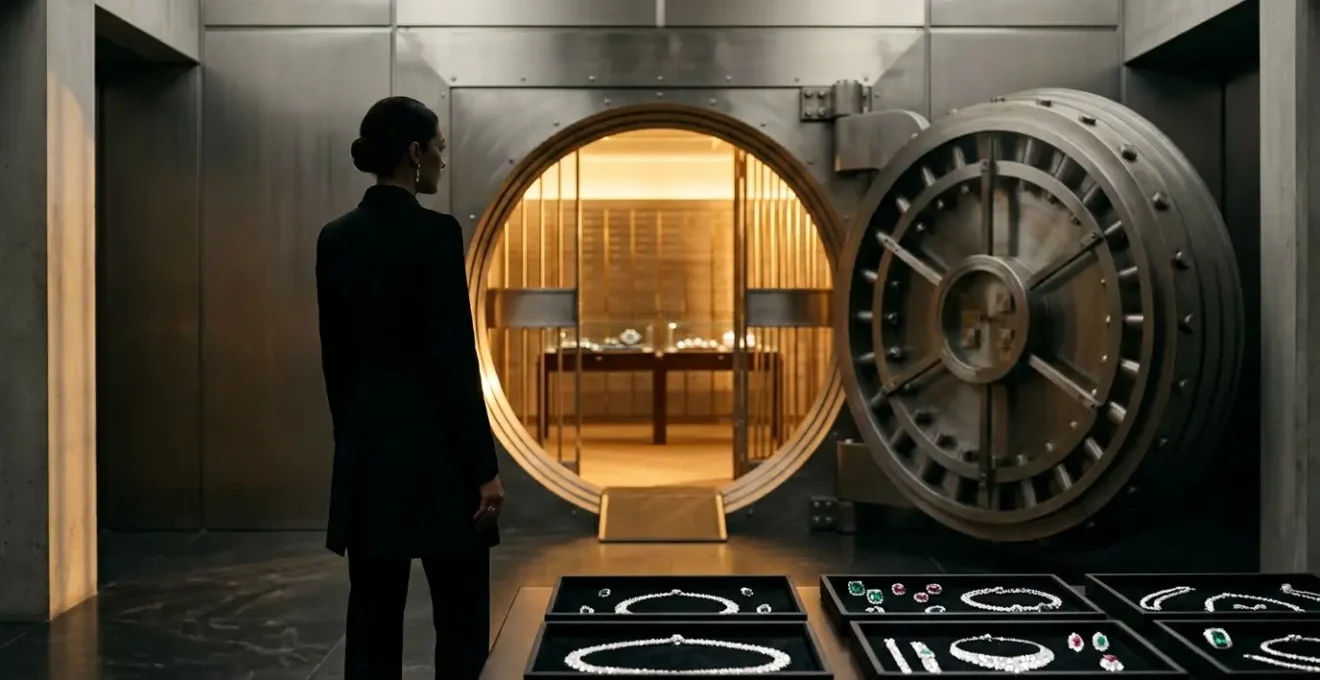
The long-term value of high jewellery as an asset is determined less by its initial purchase price and more by the sophisticated management of its insurance, security, and eventual liquidation.
- Standard insurance is inadequate; “agreed value” policies with worldwide “all-risk” coverage are non-negotiable for capital preservation.
- A maker’s signature (e.g., Cartier) and documented provenance are quantifiable value coefficients, not just markers of prestige, that directly impact liquidity.
Recommendation: Treat your collection not as a static treasure, but as an operational portfolio requiring active risk management and a clear exit strategy.
For the discerning High Net Worth Individual, tangible assets offer a compelling ballast against market volatility. While fine art and rare wines are common allocations, high jewellery represents a uniquely portable, discreet, and personal store of value. However, viewing these masterpieces solely through the lens of their gemological value or brand prestige is a common but costly oversight. The conventional wisdom—to buy rare stones and secure a basic appraisal—barely scratches the surface of what is required to manage this asset class effectively.
The true discipline of investing in high jewellery lies not in the acquisition but in the operational framework built around it. The conversation must evolve beyond the 4Cs to encompass the complex calculus of risk mitigation, insurance structuring, secure logistics, and strategic liquidation. The difference between an asset that appreciates and one that becomes a liability is found in these nuanced details. Is your insurance policy structured on “agreed value” or the far less favourable “market value”? Does your security plan account for the specific risks of travel versus static storage? Have you planned a liquidation strategy that balances discretion with market-timed value maximization?
This guide moves beyond the platitudes to provide a strategic framework for managing high jewellery as a serious, portable asset class. We will dissect the critical components that define its true worth, from the quantifiable premium of a maker’s signature to the costly errors hidden in standard insurance policies. By treating your collection with the same operational rigour as any other part of your portfolio, you can safeguard its capital value and unlock its full potential for appreciation.
To navigate this complex landscape, this guide is structured to address the most critical strategic decisions an investor will face. The following sections provide a clear roadmap for managing a high jewellery portfolio with the diligence it deserves.
Contents: A Strategic Framework for Managing Jewellery as an Asset
- Why Does a “Cartier” Signature Add 30% to the Hammer Price?
- How to Secure “All-Risks” Insurance for Jewellery That Travels With You?
- Home Vault or Bank Safety Deposit: Which Is Safer for High Jewellery?
- The Error of Wearing High Jewellery Without Notifying Your Broker of Travel
- Auction House or Private Treaty: Where to Sell a £100k Necklace?
- Why Your Home Insurance Might Undervalue Your Gem Collection by 40%?
- Why Do Factory Diamond Dials Command a Premium Over Aftermarket Settings?
- Which Precious Stones Retain Their Value Best After 10 Years?
Why Does a “Cartier” Signature Add 30% to the Hammer Price?
In the world of high jewellery, a signature from a revered house like Cartier is far more than a brand; it is a powerful value coefficient. This premium is not based on sentiment but on quantifiable market dynamics. While the intrinsic value of the gemstones and precious metals forms a baseline, the signature acts as a multiplier, reflecting a guarantee of design excellence, craftsmanship, and historical significance. Auction market analysis confirms this, showing a significant surge in the value of signed pieces. For example, some market analyses report a 37% increase in Cartier jewelry auction values over just three years, with pieces frequently selling at multiples of their median estimates.
This premium is rooted in risk perception and liquidity. As research from ArtTactic highlights in its Jewellery Market Outlook, a name like Cartier provides an immediate assurance of quality that de-risks the acquisition for the buyer. This perception is crucial for maintaining asset liquidity, as a signed piece is instantly recognizable and marketable on a global scale.
The Cartier name thus functions as a coefficient of artistic credibility on the market. This signature reduces the perception of risk and promotes high asset liquidity.
– ArtTactic Research, Jewellery Market Outlook 2024-2025
Furthermore, it’s essential to distinguish the maker’s signature from the separate, and often even more potent, premium of famous provenance. A piece owned by a celebrated figure carries its own narrative value. The 2011 Christie’s auction of Elizabeth Taylor’s collection, which garnered nearly $116 million, is a prime example. The La Peregrina pearl, once part of the Spanish Crown Jewels and later mounted by Cartier for Taylor, sold for almost $12 million, vastly exceeding estimates based on its intrinsic and maker value alone. This demonstrates how a documented history can elevate a piece from a valuable object to a unique, irreplaceable cultural artifact.
How to Secure “All-Risks” Insurance for Jewellery That Travels With You?
For a portable asset class, standard insurance is fundamentally inadequate. A High Net Worth Individual’s collection is often in motion—accompanying them on business trips, vacations, or to global events. Standard homeowners’ policies are riddled with sub-limits, geographical restrictions, and named-peril clauses that leave significant coverage gaps. The only viable solution is a standalone, specialized jewellery policy built around an “all-risk” framework with worldwide coverage.
An “all-risk” (or “open perils”) policy covers any eventuality that is not explicitly excluded. This is a critical distinction, as it provides coverage for scenarios like “mysterious disappearance”—for instance, a stone falling out of a setting during travel—which are almost never covered by standard policies. Securing this level of protection requires a deliberate and meticulous approach. It is not a standard product but a negotiated agreement between you and a specialist insurer who understands the lifestyle and risks associated with a high-value, mobile collection.
The process involves more than simply paying a premium; it is about establishing a clear, pre-agreed framework for how any potential loss will be handled, thereby protecting the asset’s capital value without dispute. The following checklist outlines the non-negotiable steps for securing robust, worldwide coverage for your collection.
Your Action Plan: Securing Worldwide Jewellery Coverage
- Choose “all-risk” coverage that explicitly includes mysterious disappearance, not just named perils like theft or fire.
- Verify that the policy provides seamless worldwide coverage with no restrictive geographic exclusions and covers individual trips for extended periods (typically up to 60-90 days).
- Negotiate an “agreed value” basis for the policy, which locks in the replacement value based on an appraisal before any loss occurs, as opposed to the much lower “actual cash value”.
- Ensure that the policy has no deductibles and that filing a claim will not impact the premiums or status of your primary homeowners’ insurance policy.
- Maintain a detailed inventory with high-resolution photos and ensure professional appraisals are updated every 2-3 years to account for market appreciation in gems and metals.
Home Vault or Bank Safety Deposit: Which Is Safer for High Jewellery?
The question of where to store high jewellery involves a complex trade-off between accessibility, security, and jurisdictional risk. The two most common options, a professionally installed home vault and a traditional bank safety deposit box, serve very different purposes and present distinct risk profiles. A third, more specialized option—the private, non-bank vault—adds another layer to the decision matrix. The optimal choice depends entirely on the owner’s lifestyle, the nature of the collection, and their risk tolerance.
A bank safety deposit box offers institutional, bank-grade security during business hours. However, it presents significant drawbacks for a dynamic asset. Access is limited, making spontaneous wear impossible. More critically, items in a bank box are not typically covered by your personal insurance policy and, in times of financial or political instability, can be subject to government freezes or seizures. A professionally installed home vault, particularly one certified to EURO/VdS security standards, offers the unparalleled benefit of 24/7 access. It is located within your private property, minimizing seizure risk, and items stored within are covered by a properly structured specialized jewellery policy.
For ultimate security and discretion, especially for pieces held purely for investment and not regular wear, a private non-bank vault is the superior choice. Often located in strategic, stable jurisdictions (like Switzerland or Singapore), these facilities offer military-grade security, extended access hours, and operate outside the traditional banking system, offering insulation from bank failures or freezes. The following table breaks down the key factors to consider in this critical decision.
This comparative analysis highlights the strategic trade-offs between access, cost, and layers of security. For further details, a comprehensive guide to high-net-worth asset protection can offer additional context.
| Security Factor | Home Vault | Bank Safety Deposit | Private Non-Bank Vault |
|---|---|---|---|
| 24/7 Access | Yes – Immediate | No – Banking hours only | Yes – Extended hours |
| Seizure Risk | Low – Private property | High – Government freezes possible | Minimal – Offshore jurisdiction |
| Insurance Coverage | Covered by homeowners/specialty | Often excluded from personal policies | Specialized coverage available |
| Security Rating | EURO/VdS certified available | Bank-grade security | Military-grade facilities |
| Annual Cost | One-time $5K-50K purchase | $200-2000/year | $3000-10000/year |
The Error of Wearing High Jewellery Without Notifying Your Broker of Travel
One of the most common and costly mistakes an owner can make is assuming their specialized jewellery policy provides blanket coverage at all times. While these policies are robust, they are contracts built on the principle of disclosed risk. A key area of vulnerability lies in the clauses related to travel and items being worn in public. Failing to notify your insurance broker of your travel plans, especially with high-value pieces, can inadvertently void or severely limit your coverage precisely when the risk of loss or theft is highest.
Many high-value policies contain specific sub-limits that must be understood. As a specialist agency points out, a policy’s overall coverage limit can be misleading if you don’t read the fine print regarding items outside of a vault.
A policy might cover a $5M collection but caps coverage for items ‘worn in public’ at a much lower figure (e.g., $500k) unless a specific travel notification is made.
– Mitchell-Joseph Insurance Agency, High-Value Jewelry Travel Insurance Guidelines
This “travel floater” or notification requirement is not a bureaucratic hurdle; it is a mechanism for the insurer to underwrite the temporarily elevated risk. By notifying your broker, you effectively “activate” the full coverage limit for the specific pieces you are traveling with. This simple communication is the difference between full capital replacement and a catastrophic, uncovered loss. A real-world incident illustrates this point perfectly.
Case Study: The Value of a Pre-Travel Phone Call
A client traveling to Paris on business experienced every owner’s nightmare: the center stone of her engagement ring was lost sometime between meetings. The exact moment of loss could not be identified, a classic case of “mysterious disappearance.” Because she had notified her broker before the trip, her specialized jewellery policy covered the full replacement cost of the stone without issue. A standard homeowners’ policy, or even a specialized policy without the travel notification, would almost certainly have denied the claim, leaving her with a total loss.
Auction House or Private Treaty: Where to Sell a £100k Necklace?
The liquidation of a high jewellery asset is as strategic a decision as its acquisition. The two primary channels for selling a significant piece, such as a £100,000 necklace, are a public auction through a major house (like Sotheby’s or Christie’s) or a discreet private treaty sale. The choice is not merely about achieving the highest price but involves a careful balance of speed, discretion, cost, and market exposure. Each path offers distinct advantages and is suited to different objectives.
An auction house provides a global stage, unparalleled marketing, and the potential for a bidding war that can drive the price far beyond expectations. Placing a piece in a curated sale creates a competitive environment and lends it the auction house’s institutional credibility. This is the ideal route for unique, highly desirable pieces with strong provenance, where public excitement can generate a record-setting “hammer price.” The downside is the process is public, can take months, and involves significant seller’s commissions and fees. The scale of this market is vast, with major houses achieving enormous sales figures annually, providing significant liquidity.
Conversely, a private treaty sale, arranged either directly by an auction house’s private sales division or through a trusted high-end dealer, offers complete discretion and speed. The sale is a quiet, one-on-one negotiation with a pre-qualified buyer from the dealer’s or auction house’s private client book. This is the preferred method for sellers who prioritize privacy, need to liquidate an asset quickly, or are selling a piece that is valuable but perhaps not unique enough to be a “star” lot at auction. While it may not achieve the headline-grabbing prices of a public auction, it provides certainty and control over the sale process.
Why Your Home Insurance Might Undervalue Your Gem Collection by 40%?
Relying on a standard homeowners’ insurance policy to protect a valuable gem collection is one of the most significant financial risks an owner can take. These policies are designed for general personal property, not for specialized, high-value assets. They contain several structural flaws that almost guarantee a substantial undervaluation in the event of a claim, potentially leaving you with a shortfall of 40% or more of the collection’s true worth.
The first major flaw is the low coverage sub-limit for jewellery, which is often capped at a mere $1,000 to $2,500 for theft. This cap applies regardless of your overall personal property limit; a $100,000 ring would only be covered up to this minimal amount. The second, more insidious flaw is the basis of valuation. Homeowners’ policies typically reimburse based on “Actual Cash Value” (ACV), which is the item’s replacement cost minus depreciation. This is fundamentally unsuited for jewellery, whose value often appreciates.
A specialized jewellery policy rectifies this by operating on an “Agreed Value” basis. As explained by experts in high-value asset protection, this is a crucial distinction that shifts the burden of proof.
Standard policies place the onus on you to prove the value after a loss, whereas a specialist jewellery policy with an agreed-upon appraisal documents the value beforehand, simplifying the claims process immensely.
– Griffithe Harris Insurance, High Value Jewelry Insurance Guide 2025
This “agreed value” is determined by a current appraisal and is locked in when the policy is written. If a loss occurs, the insurer pays out this pre-agreed amount without dispute or depreciation. This single feature is the most critical element in protecting the full capital value of your collection and avoiding the typical 40% undervaluation that occurs when trying to claim for fine jewellery under a standard home insurance plan.
Why Do Factory Diamond Dials Command a Premium Over Aftermarket Settings?
In the world of collectible assets, from vintage cars to fine watches, originality and verifiable provenance are paramount. The same principle applies with even greater force to high jewellery and gem-set timepieces. A factory-set diamond dial or bezel from a prestigious maison like Patek Philippe, Rolex, or Audemars Piguet commands a significant and durable premium over a piece customized with diamonds by a third-party jeweller, known as an “aftermarket” setting.
This premium is not about the quantity or even the quality of the diamonds alone. It is about authenticity, integrity, and guaranteed craftsmanship. A factory setting is an integral part of the piece’s original design and creation, documented by the maker. The diamonds are selected and set by the maison’s own master craftsmen to meet their exacting standards. This originality is verifiable through archival records, providing an unbroken chain of provenance. Market data consistently shows that this authenticity translates to real financial returns, with authenticated factory-signed pieces commanding 25-30% higher returns than unsigned or altered pieces.
An aftermarket setting, no matter how skillfully executed, fundamentally alters the piece from its original state. It breaks the chain of provenance and introduces uncertainty. Is the work guaranteed? Were the stones of a quality consistent with the brand’s standards? For serious collectors and investors, this alteration effectively diminishes the piece’s status as a purebred asset. As the market matures, sophisticated buyers are increasingly focused on these markers of authenticity, a trend noted by top industry experts.
Asian consumers have all the D-flawless diamonds they can have, so they are now educating themselves and investing in antique jewellery that will set them apart from consumers of modern brands.
– Andrés White Correal, Sotheby’s Senior Director of International Jewellery Business Development
This quote highlights a global shift towards valuing history and originality over simple material value. An aftermarket piece, while perhaps beautiful, is viewed as a customization, not an investment-grade original. The factory setting is the artist’s signature, and in the world of high-value assets, the signature is a non-negotiable component of long-term value.
What to Remember
- High jewellery’s asset performance hinges on strategic management of insurance, security, and liquidation—not just acquisition.
- Standard insurance is insufficient. An “agreed value,” all-risk policy with specific travel riders is the minimum standard for protecting capital.
- A signature from a prestigious house (e.g., Cartier) and documented provenance are quantifiable premiums that significantly impact liquidity and final sale price.
Which Precious Stones Retain Their Value Best After 10 Years?
While the entire framework of managing a jewellery asset is critical, the intrinsic, long-term value is ultimately anchored in the quality and rarity of its principal gemstones. Over a 10-year horizon and beyond, certain precious stones have consistently demonstrated superior value retention and appreciation. This performance is driven by a combination of enduring global demand, finite supply, and specific, highly-sought-after characteristics. An investor’s portfolio should be weighted towards these proven performers.
The undisputed leaders in value retention are the “Big Three” colored gemstones, but only at their highest echelons of quality and with specific origins. These include:
- Unheated Burmese Rubies: The “pigeon’s blood” red from the Mogok Valley in Myanmar is the global benchmark. A complete lack of heat treatment is crucial, as a certified unheated stone is exponentially rarer and more valuable than its treated counterpart.
- Unheated Kashmir or Burmese Sapphires: Kashmir sapphires, with their velvety, cornflower-blue hue, are the rarest and most coveted, their mines having been depleted for over a century. High-quality unheated royal blue sapphires from Burma (Myanmar) are the next most desirable tier.
- Untreated Colombian Emeralds: The vibrant, deep green of emeralds from the Muzo or Chivor mines in Colombia sets the standard. The most valuable stones have no or only insignificant amounts of clarity enhancement (oil), a rarity that commands a massive premium.
Beyond the colored-gem trinity, high-quality colorless diamonds (D-F color, IF-VVS clarity) remain a foundational store of value due to their universal demand and standardized pricing structure. However, the greatest potential for appreciation often lies in fancy colored diamonds. Natural pink, blue, and red diamonds are exceptionally rare and have consistently broken auction records over the past decade. Their finite supply, coupled with growing demand from sophisticated collectors, positions them as top-tier investment assets for long-term growth.
To ensure your collection is properly structured as an asset class, the next logical step is a professional review of your current insurance, security arrangements, and long-term liquidation strategy.
Frequently Asked Questions on High Jewellery Insurance
What is a sublimit and how does it affect my jewelry coverage?
Most homeowners policies cap jewelry coverage at $1,000-$2,500 total for theft, regardless of your collection’s actual value. A $50,000 ring would only be covered up to this sublimit.
Why does ‘market value’ coverage shortchange jewelry owners?
Market value means what the item would sell for second-hand, while ‘agreed replacement value’ covers the cost to replace it with a similar new piece from a top jeweler – often 40% higher.
How often should jewelry appraisals be updated?
Every 2-3 years minimum, as gemstone and precious metal values fluctuate significantly. An outdated appraisal from 5 years ago could result in a 40% coverage shortfall.