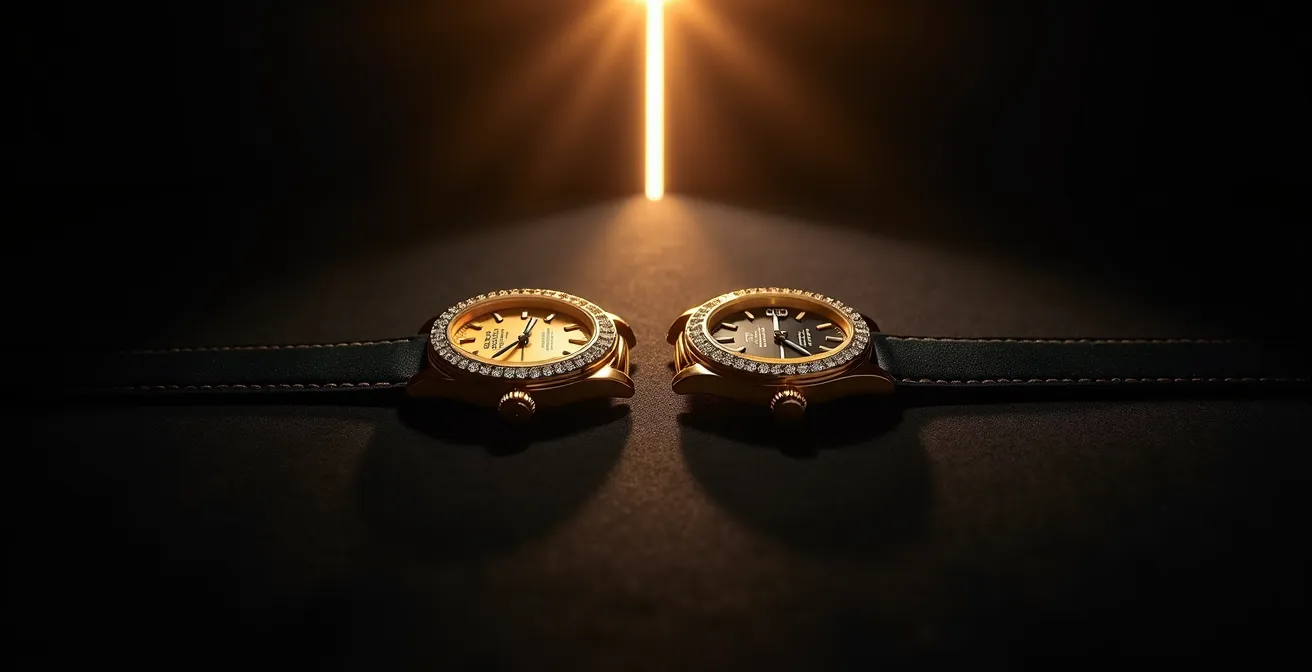
Adding aftermarket diamonds to a Rolex isn’t an upgrade; it’s a financial downgrade that fundamentally alters its identity.
- It voids the Rolex warranty and access to official servicing, breaking the chain of provenance.
- It typically reduces resale value by 40-60% as collectors and dealers prioritize factory originality.
Recommendation: Preserve the watch’s original components and consult a professional appraiser before making any irreversible modifications.
The temptation is understandable. You own a piece of horological excellence—a Rolex—and the thought of personalizing it, of making it uniquely yours with a “bust down” diamond setting, seems like the ultimate luxury statement. The common assumption is that adding precious stones can only increase an object’s worth. However, in the highly specific world of luxury watch collecting, this intuition is not only wrong but financially dangerous. As seasoned dealers, we see the unfortunate results daily: watches that have been permanently compromised.
The core of the issue isn’t about taste or style. It’s about a fundamental misunderstanding of what a Rolex truly is. It’s not just a timepiece; it’s a self-contained, meticulously engineered asset whose value is inextricably linked to its factory-original state. Any unauthorized modification, especially one as invasive as setting aftermarket diamonds, is viewed by the market as a breach of this asset integrity. It breaks the “brand DNA” and severs the all-important chain of provenance that Rolex itself guarantees.
This article will not debate the aesthetics of a diamond-encrusted watch. Instead, it will provide a market-focused, cautionary look at the real-world consequences of aftermarket customization. We will explore the critical differences between factory and aftermarket settings, the immediate impact on resale value, the reasons why collectors shun modified pieces, and the hidden structural risks you may not have considered. Before you make an irreversible decision, understanding these factors is paramount to protecting your investment.
This guide breaks down the critical factors you must consider before altering your timepiece, explaining why originality is the cornerstone of a Rolex’s value. Explore the sections below to gain a comprehensive understanding of the market dynamics at play.
Summary: The Market Realities of Customizing a Rolex
- Factory-Set vs. Aftermarket Diamonds: What’s the Difference?
- How Aftermarket Diamonds Affect Your Rolex Resale Value
- The Warranty Void: More Than Just a Service Issue
- Structural Risks: The Hidden Damage of “Busting Down”
- Why Rolex Collectors Value Originality Above All
- When Diamond Modifications Might Not Hurt Value
- How to Protect Your Rolex Investment
- The Final Verdict: An Investment Asset vs. a Fashion Item
Factory-Set vs. Aftermarket Diamonds: What’s the Difference?
The distinction between a Rolex that leaves the factory with diamonds and one that has them added later is not a minor detail; it is the entire basis for its future value. A factory-set Rolex is a holistic creation. The case and bracelet are engineered from the outset to accommodate the stones, ensuring structural integrity. More importantly, Rolex is famously exacting with its gemology. As Kloira Watch Experts note, the brand’s standards are incredibly high.
Rolex only uses the top 0.02 percent of natural diamonds.
– Kloira Watch Experts, Rolex Diamond Watches: Factory vs Aftermarket Explained
This commitment to quality extends to the setting itself. Rolex employs master gem-setters who align each stone with microscopic precision, creating a flawless and unified surface that becomes part of the watch’s brand DNA. This level of craftsmanship is an integral part of the watch’s identity and is documented by its serial number and papers.
Aftermarket settings, by contrast, are an intervention. A third-party jeweler, regardless of their skill, must drill into a case that was never designed to be altered. The quality of the diamonds and the setting can vary wildly, from excellent to poor, but this is almost irrelevant. The act itself separates the watch from its original, verifiable state. The difference is not just visible to a trained eye; it is a fundamental change in the object’s very nature. The following table breaks down these critical distinctions.
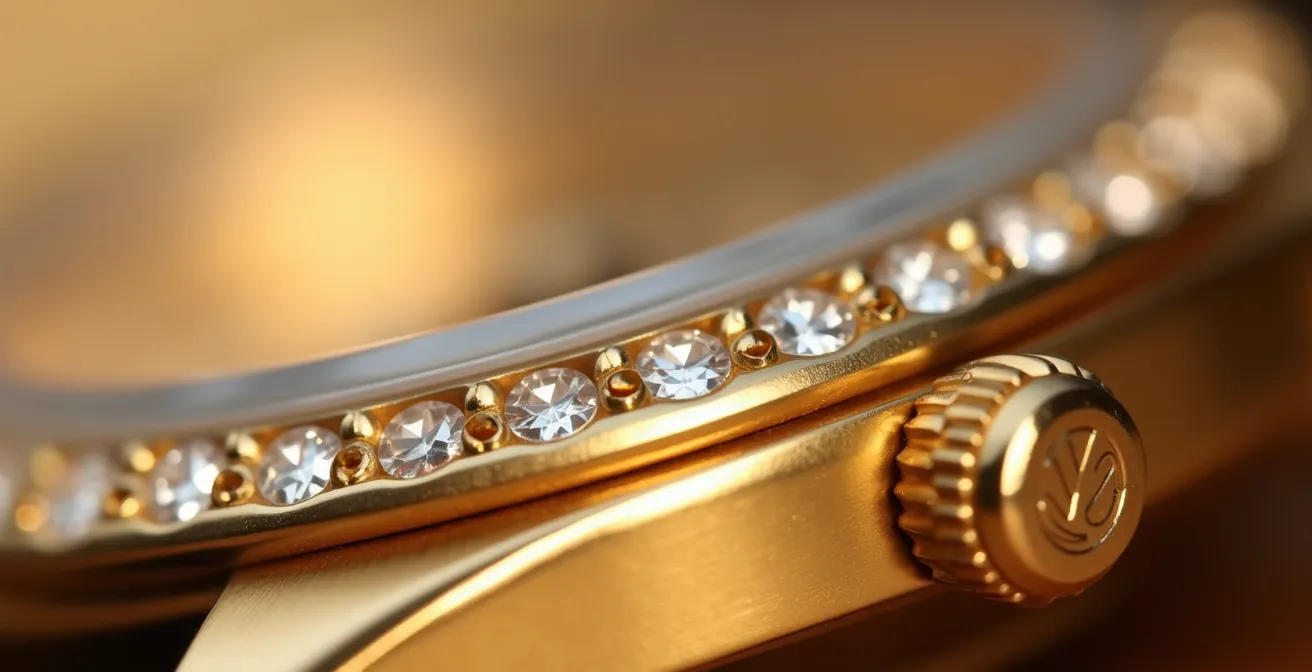
As the macro photograph shows, true luxury craftsmanship is visible in the microscopic details—the perfect alignment of facets and the clean metalwork of the prongs. This is the standard an aftermarket setting is judged against, and rarely does it measure up.
The following table, based on an analysis of market standards, highlights the stark differences between these two approaches.
| Criteria | Factory-Set Diamonds | Aftermarket Diamonds |
|---|---|---|
| Diamond Quality | Exceptional clarity (IF–VVS), near-colorless grades (D–G) | Varies from premium to commercial-grade depending on budget |
| Setting Precision | Micro-tolerance hand-setting by in-house gemologists, perfect alignment | Variable quality, often inconsistent table alignment |
| Warranty Status | Fully covered under Rolex warranty and eligible for service | Warranty voided; Rolex refuses service |
| Resale Value | Retains or enhances value over time | Typically loses value at resale |
| Structural Integrity | Engineered as part of original watch architecture | Risk of damage to case, reduced water resistance |
| Collectibility | Highly sought by collectors, hyper-limited production | Limited collector interest, niche buyer pool |
How Aftermarket Diamonds Affect Your Rolex Resale Value
From a dealer’s perspective, this is the most critical point to understand: adding aftermarket diamonds does not add value. In nearly all cases, it significantly destroys it. The moment a drill touches a factory Rolex case, the watch ceases to be a predictable, liquid asset and becomes a custom piece of jewelry with a very limited and fickle audience. The money spent on the customization—whether a few thousand or tens of thousands of dollars—is an expense, not an investment. You will not recoup it.
The secondary market for luxury watches thrives on authenticity and originality. Buyers, dealers, and auction houses are paying for the Rolex name, its history, and its unimpeachable provenance. A modified watch has none of that. It is immediately flagged as “altered,” and its liquidity plummets. While you might find a private buyer who shares your aesthetic taste, you will be cut off from the primary collector and dealer market that establishes baseline values.
The numbers are stark. According to luxury watch resale data, the financial penalty for such modifications is severe, confirming a resale value reduction of 40-60% compared to an equivalent, unmodified model. This means a $15,000 watch could be worth as little as $6,000 after a “bust down” modification, completely erasing the cost of the customization and a huge portion of the watch’s original value. The following case study is a common tale in our industry.
Customized Rolex Submariner: A Cautionary Tale of Lost Investment
A collector purchased a 1970s Rolex Submariner and commissioned a $3,000 custom diamond setting on the bezel, assuming the watch would have more appeal. When attempting to sell, established dealers declined to authenticate or purchase the watch. The modified Submariner eventually sold to a non-collector for 40% below the cost of the unmodified original. The customization investment was entirely lost, and the base watch depreciated further due to its modified status.
The Warranty Void: More Than Just a Service Issue
A common talking point is that aftermarket modifications “void the warranty.” While true, this statement drastically understates the severity of the situation. This isn’t like using a third-party charger for your phone; it’s a fundamental severing of the relationship between the creator and the creation. When Rolex voids a warranty due to unauthorized modification, they are effectively disowning the watch. It is no longer recognized as a genuine, integral product of their manufacture.
This has two catastrophic consequences for the watch’s value. First, it means Rolex Service Centers (RSCs) will refuse to service the watch. You lose access to factory-trained technicians, genuine parts, and official servicing that maintains the watch’s performance and value. Any future repairs must be done by independent watchmakers, creating a fragmented and untrustworthy service history—a major red flag for any serious buyer. The chain of provenance is officially broken.
Second, and more importantly, Rolex’s refusal to service is a refusal to authenticate. A watch’s papers and service history from Rolex are its passport in the secondary market. Without the ability to get that official stamp of approval, the watch becomes an orphan. No reputable dealer or auction house will touch it without significant caveats, as they cannot guarantee its inner workings or even the authenticity of its core components. You are left with an asset that the original maker no longer stands behind, making it a high-risk proposition for any future owner.
Structural Risks: The Hidden Damage of “Busting Down”
Beyond the financial and warranty implications lies a more tangible threat: the physical damage to the watch itself. A Rolex case is a masterpiece of precision engineering, designed to protect the delicate movement inside from shock, dust, and, most famously, water. The tolerances are measured in microns. The process of “busting down” a watch involves drilling dozens or even hundreds of holes into this perfectly sealed vessel.
This invasive procedure inherently compromises the watch’s structural integrity. The most immediate and common casualty is water resistance. The O-rings and gaskets that create a hermetic seal can be damaged, and the metal of the case itself is weakened. A Submariner rated for 300 meters might struggle to survive a splash in the sink after being drilled by a third party. This isn’t just a loss of a feature; it’s a degradation of the watch’s core purpose and engineering prowess.
Furthermore, the drilling process can introduce microscopic metal shards into the case, which can eventually find their way into the movement, causing untold damage. The heat and vibration from the setting process can also affect the delicate balance of the movement. While a skilled jeweler can mitigate some of these risks, they can never be eliminated entirely. You are trading the certainty of Rolex’s billion-dollar R&D for the hope that a third party can modify its work without causing catastrophic failure. For a collector or investor, this is an unacceptable gamble.
Why Rolex Collectors Value Originality Above All
To understand the massive value drop, you must understand the mindset of the people who drive the market: collectors and dealers. For this group, a Rolex is not just a watch; it’s a historical artifact. Each model represents a specific point in the brand’s evolution, with its own design language, materials, and documented history. The value lies in the purity and preservation of that original state. An all-original 1960s Submariner with a faded “ghost” bezel and matching patina on the hands and dial is a masterpiece precisely because it is an untouched, authentic record of its time.
Adding new, brilliant-white diamonds to that watch would be seen as an act of vandalism by the collector community. It erases the watch’s history and imposes a modern aesthetic that is alien to its original character. As the experts at Barrington Watch Winders state, the market has a clear and consistent preference.
In the secondary market, authenticity consistently commands a premium, while modification almost always leads to depreciation.
– Barrington Watch Winders, Do Diamonds Lower the Value of a Rolex Watch?
This isn’t a niche opinion; it’s the foundational principle of the entire collectible watch ecosystem. This is a massive and growing field; indeed, the global luxury watch market was valued at USD 44.99 billion in 2023 and continues to expand. In this market, originality is the ultimate currency. A “frankenwatch”—a watch assembled from non-original parts—is the lowest form of collectible, and a watch with aftermarket diamonds falls squarely into this undesirable category. It has lost its story and, with it, its soul.
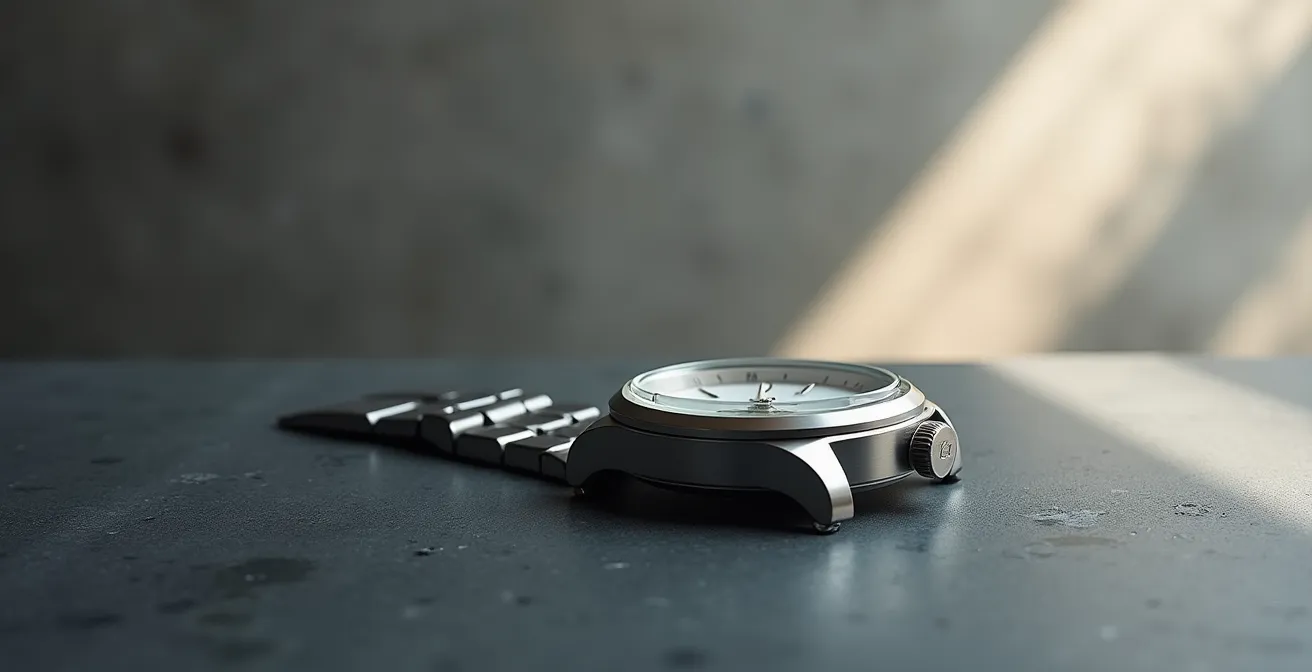
The image of an untouched, original timepiece represents the ideal for any serious collector. Its value is found in its purity and authenticity, not in any subsequent additions. It is a known quantity, a trusted asset.
When Diamond Modifications Might Not Hurt Value
While the rule is that aftermarket modifications destroy value, there are a few specific exceptions and nuances to consider. The most obvious is that of factory-set diamond models. Rolex produces its own gem-set watches, such as the Day-Date, the Pearlmaster, and the famous “Rainbow” Daytona. These pieces are highly collectible and command enormous prices because the diamonds are part of the original design, engineering, and brand guarantee. They are not modifications; they are masterpieces of integrated craftsmanship. A prime example is the fact that a factory sapphire and diamond Daytona Rainbow sold for over $500,000 at auction, proving the immense value of official gem-setting.
The second, more subtle exception involves reversible modifications. Some forward-thinking owners and jewelers have adopted a strategy that allows for personalization without permanently damaging the watch’s asset integrity. This approach is a clever way to have the best of both worlds, as detailed in the following example.
The Reversible Bezel Strategy: Preserving Original Parts While Customizing
As outlined by high-end jewelers like Raymond Lee Jewelers, this strategy involves creating a completely new, separate diamond bezel to fit the watch, rather than drilling the original. The owner carefully stores the untouched factory bezel. This allows them to enjoy the customized look while retaining the ability to revert the watch to its 100% original state at any time for servicing, appraisal, or resale. They can offer the watch to a buyer with its original bezel re-installed, or include both, preserving future flexibility and protecting the core investment.
This strategy is the only market-savvy way to approach customization. It treats the original components as sacred and ensures the watch’s core value and authenticity remain intact. It’s a testament to the fact that even when personalizing, the market’s preference for originality must be respected.
How to Protect Your Rolex Investment
Preserving the value of your Rolex is not a passive activity; it requires conscious effort and a clear understanding of what the market values. The single most important principle is to maintain the watch in its original, factory-spec condition. Any deviation from this, whether it’s an aftermarket part or an unauthorized polish that softens the sharp lines of the case, will diminish its value to a collector.
Beyond avoiding modifications, proper care and documentation are crucial. Regular servicing through authorized Rolex channels ensures the watch runs perfectly and creates an official paper trail that builds trust with future buyers. Think of it like maintaining a classic car; a full service history from the original manufacturer is worth a significant premium. Similarly, keeping the full “set”—the original box, papers, warranty card, and even the hang tags—is essential. This complete package proves the watch’s provenance and tells a story of a well-cared-for timepiece.
Ultimately, protecting your investment comes down to treating the watch not as a simple accessory but as the valuable, historical object it is. This means respecting its design, maintaining its mechanical health, and preserving its identity. The following checklist provides a clear roadmap for any owner looking to maximize their watch’s long-term value.
Your Action Plan: Maintaining Maximum Rolex Resale Value
- Keep all original components: Never replace factory parts like the bezel, bracelet, dial, or hands. Originality is the absolute foundation of collector value.
- Preserve your box and papers: A “complete set” with original documentation is non-negotiable for proving provenance and achieving a premium price.
- Avoid all aftermarket modifications: Resist the urge to add third-party diamonds or parts. These are seen as damage by the serious secondary market.
- Maintain the watch regularly via Rolex: Schedule professional servicing at an authorized center to keep the watch in excellent condition and build a trusted service history.
- Protect against unnecessary damage: Avoid wearing your Rolex during activities that could cause deep scratches, dents, or other cosmetic damage that lowers its value.
Key Takeaways
- Customizing a Rolex with aftermarket diamonds voids its warranty and severs its connection to Rolex’s official authentication and service network.
- Aftermarket modifications can decrease a Rolex’s resale value by 40-60%, as the collector market overwhelmingly prizes factory originality.
- The only safe way to personalize a Rolex is through reversible changes, such as a custom bezel, while preserving all original parts.
The Final Verdict: An Investment Asset vs. a Fashion Item
The decision to customize your Rolex ultimately comes down to a simple choice: are you treating it as a liquid investment asset or as a personal fashion item? There is no right or wrong answer from a personal standpoint, but from a market and investment perspective, the answer is unequivocal. If you value your watch’s financial worth, its history, and its standing in the world of horology, then any permanent, aftermarket modification is a mistake.
By “busting down” a Rolex, you are converting it from one category to another. It ceases to be a globally recognized and easily traded asset with a predictable value. It becomes a one-of-a-kind piece of jewelry whose worth is entirely subjective and dependent on finding a specific buyer who shares your exact taste. You are shrinking your potential market from thousands of dealers and collectors worldwide to a handful of individuals.
A factory-original Rolex carries the weight of a century of engineering, branding, and market trust. Its value is a testament to that unbroken chain of provenance. An altered watch carries only the story of its owner’s personal taste. While that has personal value, it has little to no currency in the sophisticated secondary market. The choice is yours, but it should be an informed one.
Before making an irreversible alteration to your timepiece, seek a professional appraisal from a reputable dealer to understand its true market value in its original, unaltered state. An informed decision is the best protection for your investment.
Frequently Asked Questions About Modifying a Rolex
Should I restore a modified Rolex to original condition before selling?
It depends on the modification. If restoration costs less than 20–30% of the anticipated unmodified resale value, it may improve net proceeds. However, restoration by unauthorized parties does not restore market trust or warranty access — only factory-original pieces carry that weight.
How much do aftermarket diamond modifications typically reduce resale value?
Aftermarket diamond modifications typically reduce resale value by 40–60%. Dial and bezel changes are the most costly to value, while surface-level changes like hands or crowns cause less damage but still suppress premiums.
Are there any modified Rolex watches that hold value well?
Very few. Intentional custom builds created with high-end parts and superior craftsmanship hold value better than amateur modifications. However, factory-set diamond models, such as the Day-Date or Datejust with original gems, are always the safest investment.