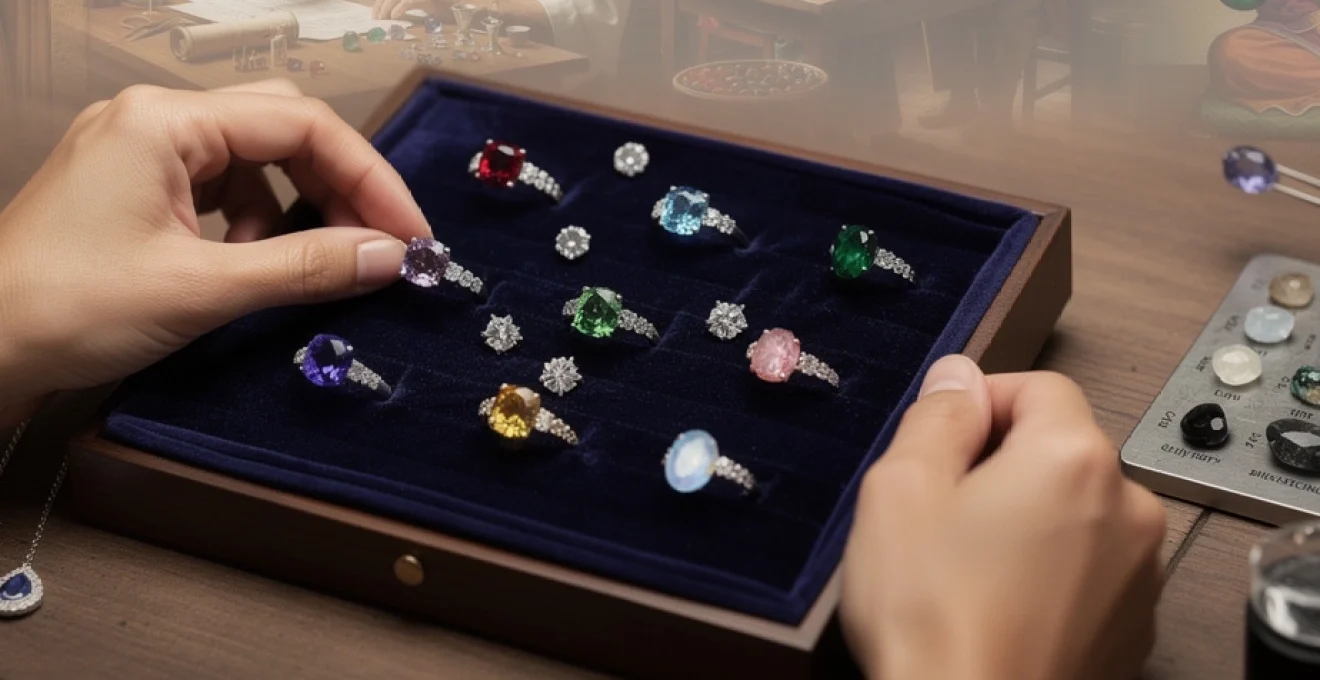
Birthstones represent one of humanity’s most enduring connections between gemstones and personal identity, weaving together ancient beliefs, cultural traditions, and modern jewellery artistry. These precious and semi-precious stones carry profound symbolic weight, transcending mere decorative purposes to become deeply personal talismans that connect wearers to their birth month, astrological influences, and cultural heritage. From the fiery garnet of January to the mystical tanzanite of December, each birthstone embodies unique metaphysical properties, historical significance, and aesthetic appeal that has captivated civilisations for millennia. The practice of wearing birthstones extends far beyond contemporary fashion trends, rooting itself in ancient wisdom traditions that attributed healing powers, protective qualities, and spiritual significance to specific gemstones based on celestial alignments and seasonal energies.
Historical origins and ancient civilisations’ birthstone traditions
The concept of birthstones traces its origins to the dawn of recorded civilisation, where gemstones held sacred significance across multiple cultures and spiritual traditions. Ancient civilisations recognised the profound connection between celestial movements, seasonal changes, and the earth’s mineral treasures, establishing sophisticated systems that linked specific stones to temporal cycles. These early traditions formed the foundation for modern birthstone practices, demonstrating remarkable consistency across diverse geographical regions and cultural contexts.
Mesopotamian foundation stones and the breastplate of aaron
The earliest documented evidence of systematic gemstone-month associations appears in ancient Mesopotamian texts, where Babylonian astronomers catalogued twelve sacred stones corresponding to zodiacal houses and lunar cycles. Archaeological discoveries from the ancient city of Babylon reveal intricate gemstone arrangements used in religious ceremonies, suggesting sophisticated understanding of mineralogical properties and their perceived cosmic connections. The biblical Breastplate of Aaron, described in Exodus, featured twelve distinct gemstones representing the tribes of Israel, establishing a theological foundation for gemstone symbolism that continues to influence modern birthstone traditions.
Hebrew scholars interpreted these twelve stones as divine conduits, each possessing unique spiritual attributes that enhanced the wearer’s connection to celestial energies. The arrangement included jasper, sapphire, emerald, and carbuncle among others, creating a template for subsequent gemstone classifications. This ancient system demonstrated remarkable sophistication in linking mineralogical characteristics with metaphysical properties, establishing precedents that would influence gemstone symbolism for centuries.
Roman calendrical gemstone assignments and pliny the elder’s naturalis historia
Roman civilisation significantly advanced birthstone traditions through systematic documentation and expansion of existing knowledge. Pliny the Elder’s comprehensive work, Naturalis Historia, provided detailed descriptions of gemstone properties, origins, and applications, establishing scientific approaches to mineralogy while preserving traditional beliefs about their mystical qualities. Roman citizens commonly wore specific stones during corresponding months, believing this practice enhanced the gems’ protective and beneficial properties.
The Roman system integrated practical observations with inherited traditions, creating sophisticated classifications that distinguished between precious and semi-precious stones based on rarity, hardness, and aesthetic appeal. Roman merchants established extensive trade networks, facilitating the global distribution of birthstones and spreading associated beliefs throughout the empire. This commercial expansion significantly influenced how different cultures adopted and adapted birthstone traditions, creating regional variations that persist today.
Medieval european guild systems and gemstone month associations
Medieval European guilds played crucial roles in standardising birthstone traditions, establishing formal systems that linked specific gems to calendar months while incorporating Christian symbolism and local folklore. Guild craftsmen developed sophisticated techniques for cutting and setting birthstones, creating jewellery pieces that served both decorative and protective functions. These artisans recognised that proper preparation and setting could enhance a stone’s perceived power, leading to increasingly elaborate birthstone jewellery designs.
The medieval period witnessed significant evolution in birthstone symbolism, as Christian theologians reinterpreted pagan traditions within biblical frameworks. Monastery scriptoriums produced illuminated manuscripts detailing gemstone properties, often attributing healing powers and spiritual protection to specific stones. This scholarly approach helped preserve ancient knowledge while adapting it to contemporary religious contexts, ensuring birthstone traditions remained relevant throughout societal changes.
Tibetan and ayurvedic Chakra-Based stone classifications
Eastern traditions developed parallel birthstone systems based on different philosophical foundations, particularly
associated with the chakra system and the flow of subtle energy through the body. In Tibetan and Ayurvedic traditions, gemstones were not primarily aligned with birth months but with energy centres, planetary rulers, and constitutional types. Ruby, for example, was linked to the heart and root chakras for vitality and courage, while sapphire was associated with the throat chakra to promote truthful communication and spiritual insight.
Ayurvedic texts from the first millennium CE describe navaratna (nine-gem) arrangements, where each stone corresponds to a planet and is chosen based on an individual’s astrological chart rather than their birth month alone. Tibetan systems similarly assigned stones such as turquoise, coral, and lapis lazuli to balance specific elements and life forces. These traditions laid the groundwork for modern holistic approaches to birthstones, where you might select a gemstone that supports your emotional or energetic needs in addition to, or instead of, the stone linked to your calendar month.
Modern standardisation through jewellers’ associations and industry bodies
While ancient and medieval systems offered rich but often conflicting gemstone associations, the rise of global trade and mass-produced jewellery created a need for standardisation. From the early 20th century onward, jewellers’ associations and gemological institutions began formalising birthstone lists to make purchasing decisions simpler for consumers and retailers. The result is the modern birthstone chart that many of us recognise today, underpinned by industry consensus, marketing considerations, and advances in gem science.
American national retail jewellers association 1912 codification
The pivotal moment in modern birthstone history arrived in 1912, when the American National Retail Jewellers Association (now part of Jewelers of America) published the first widely accepted standard list. Their goal was pragmatic: to reduce confusion among consumers and unify the messaging used in catalogues and shop displays. The 1912 list prioritised gemstones that were relatively available, visually distinctive, and suitable for everyday jewellery settings.
Over time, this codified chart was refined to reflect new discoveries and market realities. For instance, citrine was promoted alongside topaz for November due to its affordability, and tanzanite was added for December in the late 20th century following its discovery in Tanzania. This evolution illustrates how birthstone meanings have always been a dynamic interplay between tradition, symbolism, and what the jewellery trade can reliably source and certify.
British jewellers association contemporary modifications
In the United Kingdom, the British Jewellers’ Association and related trade bodies adopted the American framework while retaining certain regional preferences. The UK birthstone list broadly mirrors the US system but acknowledges traditional alternatives such as turquoise for December and opal as the primary October birthstone. These subtle differences reflect both historical usage in European courts and the preferences of British consumers, who often favour classic gems with long-established royal associations.
In recent decades, British jewellers have increasingly embraced “modern” companion stones, such as moonstone for June or tourmaline for October, offering greater choice in personal jewellery. This flexibility means you can select the stone that resonates most—whether you prefer the soft iridescence of moonstone or the vivid hues of tourmaline—without stepping outside accepted birthstone traditions.
Gemological institute of america certification standards
The Gemological Institute of America (GIA) plays a central role in underpinning birthstone jewellery with scientific credibility. Founded in 1931, GIA developed the now-universal 4Cs grading system for diamonds—cut, colour, clarity, and carat weight—and comparable grading criteria for coloured stones. For anyone investing in birthstone jewellery, GIA reports offer assurance that a gemstone’s identity, treatments, and quality have been independently verified.
GIA’s research also helps demystify long-held myths, distinguishing between natural colour and heat-treated enhancements, or between genuine gemstones and synthetics. When you purchase a significant birthstone ring or pendant with a GIA certificate, you’re not only honouring centuries of symbolism but also benefiting from state-of-the-art mineralogical analysis. This blend of romance and rigour defines much of today’s fine birthstone jewellery market.
International coloured gemstone association regional variations
The International Coloured Gemstone Association (ICA) represents miners, cutters, and dealers around the world, and its influence is particularly visible in regional birthstone variations. In some Asian markets, for instance, jade and citrine may be emphasised for luck and prosperity, while Middle Eastern traditions may highlight carnelian and turquoise for protection and spiritual strength. ICA members work to promote ethical sourcing and transparency, ensuring that coloured birthstones reach consumers through responsible supply chains.
These regional variants underscore that there is no single “correct” birthstone list, but rather a tapestry of overlapping systems shaped by culture, religion, and trade. As a wearer, this gives you the freedom to draw from global traditions—perhaps choosing turquoise as a December birthstone to honour Native American or Persian symbolism, or opting for ruby outside July because of its significance in Vedic astrology.
Mineralogical properties and gemstone metaphysical attributes
The enduring appeal of birthstones rests on a fascinating intersection between hard science and metaphysical belief. On one hand, each gemstone is defined by its crystal structure, chemical composition, and physical durability; on the other, it is associated with emotional qualities such as courage, love, or wisdom. Understanding how mineralogy and meaning interact can help you choose birthstone jewellery that is both symbolically rich and suitable for everyday wear.
Crystalline structure analysis and hardness scale classifications
Every birthstone belongs to a specific mineral family with a characteristic crystalline structure, which governs its hardness, cleavage, and overall durability. Gemmologists typically refer to the Mohs scale of hardness, where talc ranks 1 and diamond 10. Diamonds and sapphires, for example, sit at 10 and 9 respectively, making them ideal for engagement rings and daily-wear birthstone jewellery. Softer gems like opal and pearl, by contrast, require more care and are better suited to occasional or protected settings.
Why does this matter for you? If you plan to wear a birthstone ring every day—perhaps a garnet for January or aquamarine for March—it’s essential to consider how that stone will stand up to knocks, abrasion, and household chemicals. Consulting hardness and toughness ratings is a bit like checking the fabric composition of a favourite garment: it tells you how to enjoy it for years without unintended damage.
Chromophore elements and natural colour formation processes
The vivid colours that make birthstones so captivating arise from trace elements known as chromophores and from specific structural quirks within the crystal lattice. In emerald, traces of chromium or vanadium create that unmistakable green; in ruby, chromium again produces a saturated red; in amethyst, iron impurities and natural irradiation result in regal purple tones. These microscopic differences are what give each birthstone its signature hue and, in many traditions, its symbolic resonance.
Ancient observers had no way to identify chromium or iron, yet they intuitively linked colour with character: red stones with passion and life-force, blue with tranquillity and wisdom, green with growth and renewal. Today, when you choose a birthstone pendant or pair of earrings, you are also choosing a palette of elemental energies. Understanding that your sapphire draws its depth from trace iron and titanium, for instance, can add another layer of appreciation to its association with calm authority and clear thinking.
Pleochroism and optical phenomena in traditional birthstones
Many birthstones exhibit remarkable optical effects that contribute to their mystique and perceived metaphysical power. Pleochroism—where a gemstone shows different colours when viewed from different angles—is famously strong in tanzanite, December’s modern birthstone, which can shift from blue to violet to burgundy under changing light. Alexandrite, an alternative June stone, demonstrates dramatic colour-change, appearing green in daylight and red under incandescent light, a quality that has long been interpreted as a symbol of adaptability and transformation.
Other phenomena include adularescence in moonstone, the soft, floating glow that seems to move beneath its surface, and play-of-colour in opal, where flashes of spectral hues dance across the stone like captured lightning. It is easy to see why such effects inspired ancient wearers to attribute magical and protective properties to these gems. When you wear an opal birthstone ring or moonstone pendant, the ever-shifting light can feel like a visible reminder that your own emotional and spiritual landscape is constantly evolving.
Inclusion patterns and authenticity markers in precious specimens
Contrary to popular belief, internal inclusions are not always flaws; they can act as fingerprints that confirm a gemstone’s natural origin. Emeralds often contain moss-like inclusions known as jardin, while sapphires may reveal fine rutile needles creating a velvety appearance. Under magnification, these micro-features help gemmologists distinguish natural stones from lab-grown or imitation materials, an essential step when authenticating high-value birthstone jewellery.
For collectors and sentimental buyers alike, understanding inclusions can enhance both trust and storytelling. A tiny crystal trapped inside your garnet or peridot might be millions of years old, a geological time capsule carried on your finger or at your throat. When investing in a significant birthstone piece, asking for a gemstone report or viewing inclusions with a jeweller’s loupe can be a practical way to confirm authenticity and connect more deeply with the stone’s journey from the earth to your jewellery box.
Cultural symbolism across global jewellery traditions
Across continents and centuries, cultures have woven their own narratives around birthstones, shaping how these gems are worn, gifted, and cherished. In South Asian traditions, for example, navaratna jewellery combines nine planetary stones—ruby, pearl, coral, emerald, yellow sapphire, diamond, blue sapphire, hessonite, and cat’s eye—arranged in a specific pattern to harmonise cosmic influences. Here, a person’s “birthstone” is chosen not only by month, but by their unique horoscope and life path.
In the Middle East, turquoise has long been prized as a protective stone against the evil eye and misfortune, often set into silver amulets and signet rings. Indigenous cultures in the Americas similarly regard turquoise and opal as sacred, using them in ceremonial adornment and storytelling. European royal houses, meanwhile, popularised sapphires, rubies, and emeralds as symbols of dynastic power and divine favour, a legacy that still influences engagement ring and birthstone choices in the West. When you select a birthstone piece today, you are participating in this global conversation, blending your own story with traditions that span the world.
Contemporary jewellery design integration and setting techniques
Modern designers are reimagining birthstone jewellery for a new generation, combining traditional symbolism with minimalist aesthetics and ethical sourcing. Instead of ornate Victorian-style clusters, you might find sleek bezel-set birthstone necklaces, scattered-gem stacking rings, or asymmetrical earrings that pair your stone with those of your loved ones. This shift allows you to wear your birthstone as part of your daily wardrobe, rather than reserving it for special occasions.
Technical advances in setting and metalwork also expand what is possible. Micro-pavé techniques can encircle a softer centre stone like opal or tanzanite with a halo of harder accent diamonds, both protecting the focal gem and enhancing its brilliance. Bezel and half-bezel settings offer secure, low-profile options ideal for active lifestyles, while tension-style mounts showcase the birthstone almost as if it were floating. By matching the setting style to the gemstone’s hardness and your personal habits, you can create a piece that feels both meaningful and practical.
Market valuation factors and investment considerations for birthstone collections
For many people, birthstone jewellery is primarily sentimental, yet it can also represent a significant financial investment. Market value depends on a complex interplay of factors: intrinsic rarity, gem quality, fashion trends, and even geopolitical issues in mining regions. Fine rubies and emeralds, for instance, have seen sustained demand over the last decade, with top-tier stones achieving record auction prices. Newly popular gems such as tanzanite can show sharper price fluctuations, reflecting their more recent introduction to the market and limited geographic sources.
If you are building a birthstone collection with an eye to long-term value, it is wise to focus on quality over quantity. Look for stones with strong, even colour, good transparency, and reputable certification, especially for higher-value gems like sapphire, ruby, and emerald. Consider also the craftsmanship of the setting, as well-made pieces from respected ateliers tend to hold their value better than mass-produced items. Above all, remember that the true “return” on birthstone jewellery often lies in the emotional resonance it carries—marking births, anniversaries, and personal milestones—while any financial appreciation over time becomes a meaningful bonus rather than the sole objective.