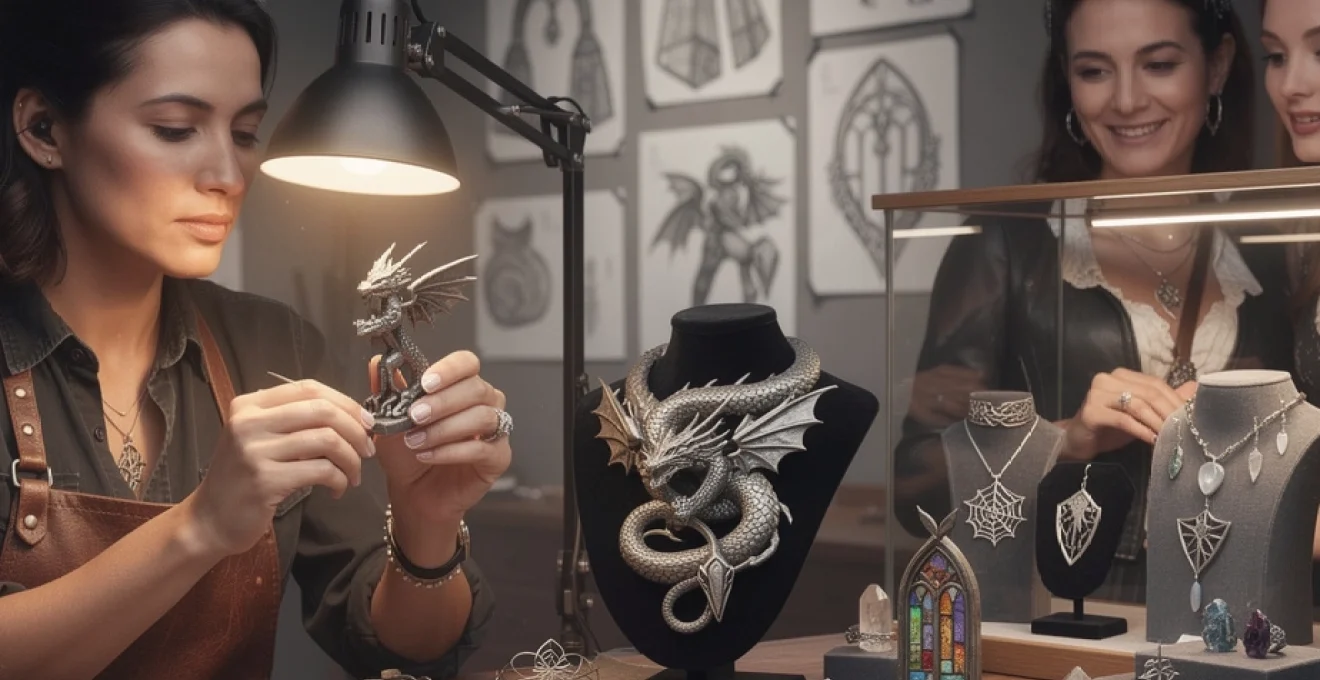
Fantasy jewellery has emerged as one of the most captivating segments within contemporary artistic collections, transforming traditional metalsmithing into a realm where imagination meets craftsmanship. This distinctive category transcends conventional boundaries, drawing inspiration from mythological narratives, medieval iconography, and fantastical literature to create wearable artworks that resonate with collectors and enthusiasts alike. The allure of fantasy pieces lies not merely in their aesthetic appeal, but in their ability to transport wearers into enchanted worlds through intricate design elements and symbolic meaning.
Modern fantasy jewellery represents a sophisticated fusion of ancient craftsmanship techniques with contemporary artistic vision, resulting in pieces that serve as both personal adornment and storytelling vessels. As designers increasingly embrace whimsical motifs and mystical themes, the market has witnessed remarkable growth in demand for these unique creations, particularly among collectors who value artistry over traditional gemstone value.
Medieval and mythological iconography in contemporary fantasy jewellery design
The integration of medieval and mythological elements into contemporary fantasy jewellery represents a fascinating intersection between historical artistry and modern creativity. Designers frequently draw inspiration from ancient civilisations, incorporating symbols that have captivated human imagination for millennia. These motifs serve not merely as decorative elements but as powerful conduits for storytelling, allowing wearers to connect with archetypal narratives that resonate across cultures and generations.
Contemporary artisans have mastered the art of translating complex mythological themes into wearable forms, creating pieces that maintain historical authenticity while appealing to modern sensibilities. The challenge lies in balancing respect for traditional iconography with innovative design approaches that speak to contemporary audiences. This delicate equilibrium has resulted in collections that honour ancient craftsmanship traditions while pushing creative boundaries.
Dragon motifs and serpentine elements in statement necklaces
Dragon imagery dominates fantasy jewellery collections, with designers employing sophisticated techniques to capture the mythical creature’s power and majesty. Statement necklaces featuring dragon motifs often incorporate articulated segments that create fluid movement, mimicking the serpentine grace traditionally associated with these legendary beings. The craftsmanship required to achieve realistic scale texturing and expressive facial features demands exceptional skill in metalworking and stone setting.
Modern dragon pendants frequently feature innovative mechanisms such as hinged jaws or moveable wings, transforming static jewellery into interactive art pieces. These kinetic elements add layers of engagement, allowing wearers to discover new details through handling and movement. The use of contrasting metals and strategic gemstone placement enhances the dramatic effect, creating pieces that command attention whilst maintaining wearable proportions.
Celtic knotwork integration in ring and bracelet craftsmanship
Celtic knotwork represents one of the most technically demanding aspects of fantasy jewellery creation, requiring precise mathematical calculations to achieve the continuous interlacing patterns that define this ancient art form. Contemporary jewellers have developed sophisticated CAD techniques to perfect these intricate designs whilst maintaining the hand-crafted aesthetic that gives Celtic-inspired pieces their distinctive character.
The symbolic significance of Celtic knots adds deeper meaning to fantasy collections, with different patterns representing concepts such as eternal love, spiritual protection, or the interconnectedness of life. Ring designers particularly favour these motifs for their ability to create visually stunning pieces that carry profound personal significance. The challenge lies in adapting traditional two-dimensional patterns into three-dimensional wearable forms without losing the essential character of the original designs.
Elven-inspired leaf and branch texturing techniques
Elven aesthetics in fantasy jewellery emphasise organic forms and natural texturing techniques that celebrate the beauty of the natural world. Artisans employ specialised tools and processes to create realistic bark textures, delicate leaf veining, and flowing branch structures that appear to have grown naturally rather than being manufactured. These pieces often incorporate asymmetrical designs that mirror nature’s inherent irregularity.
The technical execution of elven-inspired pieces requires mastery of multiple texturing techniques, including repoussé work for raised relief elements and careful patination to achieve the subtle colour variations found in natural materials. Contemporary designers often combine these traditional
techniques with digital modelling, enabling them to refine leaf silhouettes, branch curvature and stone placement before committing to metal. This hybrid approach allows for ultra-fine details, such as micro-pavé dew drops or enamel-tipped leaves, that would be difficult to prototype purely by hand. When executed successfully, elven-inspired fantasy pieces feel simultaneously ancient and futuristic, echoing the timeless quality that defines high fantasy jewellery design.
Gothic cathedral architecture translation to pendant design
Gothic architecture offers a rich visual language for fantasy jewellery designers, particularly in the creation of dramatic pendants and brooches. Pointed arches, rose windows, buttresses and tracery patterns are distilled into miniature compositions that evoke the soaring verticality of cathedrals. Artisans often employ openwork metal frameworks to mimic stained-glass windows, setting coloured gemstones or enamel panels within filigreed structures to recreate the luminous effect of light passing through glass.
Translating monumental architecture into wearable fantasy jewellery requires careful attention to proportion and negative space. Designers must simplify complex façades into legible silhouettes, using layering and depth to hint at structural complexity without overwhelming the wearer. Oxidised silver and black rhodium plating are frequently used to accentuate recessed details, while high-polish highlights on buttress-like edges create a dynamic interplay of light and shadow reminiscent of moonlight on stone.
Many contemporary collections fuse Gothic motifs with other fantasy jewellery themes such as dragons, seraphic figures or arcane symbols. A pendant might frame a central crystal with a halo of lancet arches, or conceal a tiny hidden compartment behind a rose-window motif. These narrative touches invite the wearer to engage with the piece as a personal reliquary or talisman, reinforcing the storytelling potential at the heart of fantasy jewellery design.
Gemstone selection and mystical stone properties for fantasy collections
Gemstone choice plays a decisive role in defining the character and perceived “magic” of fantasy jewellery collections. Beyond colour and clarity, designers consider metaphysical associations, historical lore and the way different stones interact with light. In recent years, there has been a marked shift away from purely status-oriented gems toward stones that enhance narrative depth and visual atmosphere, particularly in high-concept fantasy jewellery lines.
For collectors, gemstone selection often serves as a bridge between personal belief systems and aesthetic preference. Whether or not one subscribes to crystal healing, the symbolic meaning of a stone can enhance the emotional resonance of a piece. As a result, many brands now provide storytelling-driven stone descriptions alongside traditional technical data, transforming gemstone choice into an integral part of the fantasy experience rather than a purely decorative decision.
Labradorite and moonstone applications for ethereal light effects
Labradorite and moonstone have become indispensable in fantasy jewellery thanks to their distinctive optical phenomena. Labradorite’s labradorescence produces flashes of blue, green and gold that seem to originate from within the stone, creating an otherworldly “portal” effect ideal for amulets and sorcerer-inspired pendants. Moonstone, with its soft adularescent glow, lends itself to elven circlets, celestial rings and goddess-themed necklaces that rely on subtle, dreamlike luminosity.
To maximise these ethereal light effects, designers often favour cabochon or smooth domed cuts rather than faceting. This allows labradorite and moonstone to display broad, uninterrupted planes of colour shift, especially when set in closed-back or partially enclosed settings that control light entry. Darkened bezels in oxidised silver, blackened gold or gunmetal finishes can heighten contrast, making the inner glow appear more dramatic—much like a candle seen through a fogged window.
From a practical standpoint, labradorite and moonstone also support more accessible fantasy jewellery price points than traditional high-value gems. This enables artisans to experiment with larger stones in statement pieces without compromising affordability. When combined with motifs such as crescent moons, sigils or runic engraving, these gems help designers craft fantasy jewellery that feels mystical yet wearable, appealing to both casual enthusiasts and serious collectors.
Raw crystal integration in bohemian fantasy statement pieces
Raw crystals occupy a special niche within fantasy jewellery, particularly in bohemian and nature-centric collections. Unlike faceted stones, raw points and clusters retain their natural geometry, suggesting untamed magical energy or artefacts freshly unearthed from a sorcerer’s hoard. Designers harness this aesthetic by creating claw-like prongs, branch-inspired settings or minimal wire-wrapped structures that appear to “grow” around the crystal rather than constrain it.
These bohemian fantasy statement pieces often employ quartz, amethyst, citrine and aura-treated crystals for their dramatic shapes and light-catching surfaces. By juxtaposing rough textures with polished metal or silk cord, artisans create a tactile contrast that reinforces the sense of organic power. In some collections, multiple raw points are arranged in fan or crown formations, evoking protective wards or ceremonial regalia from imagined cultures.
From a design perspective, working with irregular raw crystals presents both opportunities and challenges. Each stone requires a bespoke setting strategy, demanding flexibility and strong technical skills from the jeweller. However, this uniqueness is precisely what appeals to consumers seeking one-of-a-kind fantasy jewellery pieces. When marketed effectively, raw crystal adornments resonate strongly with audiences interested in spiritual practices, festival fashion and alternative lifestyles, forming a bridge between bohemian style and high fantasy aesthetics.
Synthetic gemstone alternatives for affordable fantasy jewellery lines
As demand for fantasy jewellery has expanded, so too has the need for accessible price points that do not compromise visual impact. Synthetic gemstones—ranging from lab-created sapphires and spinels to advanced glass composites—offer designers a powerful toolkit for achieving vibrant colour palettes and dramatic fantasy motifs without the cost of natural stones. Importantly, modern synthetics can deliver excellent durability and optical performance, making them suitable for everyday wear.
For brands developing entry-level fantasy jewellery collections, synthetic gems enable consistent colour matching across large production runs, which is particularly valuable for themed ranges based on specific houses, guilds or elemental alignments. A fire-themed line, for example, might rely on richly saturated lab-created rubies and orange sapphires, while a water-aligned collection could use teal spinels and synthetic aquamarines. This control over hue supports cohesive visual storytelling across multiple SKUs.
Sustainability is another compelling argument for synthetic gemstone use in fantasy jewellery. Lab-grown stones often have a smaller environmental footprint and offer transparent supply chains compared with some mined alternatives. For ethically minded consumers—especially younger demographics—this can be a decisive factor. By clearly communicating these benefits, designers can position their fantasy pieces as both magical and mindful, aligning narrative escapism with contemporary values.
Colour psychology in amethyst and garnet fantasy settings
Colour psychology plays a pivotal role in how we perceive fantasy jewellery, particularly when working with evocative stones like amethyst and garnet. Amethyst’s purple tones have long been associated with spirituality, wisdom and mysticism, making it a natural choice for pieces that reference sorcery, prophecy or royal lineage. Garnet, with its deep red hues, conveys themes of passion, protection and sacrifice, often appearing in designs inspired by warrior cultures or dark fantasy narratives.
Designers leverage these associations by pairing gemstone colour with supporting metal finishes and motifs. Amethyst set in cool-toned white gold or silver, for instance, evokes ethereal, priestess-like energy, while the same stone in aged yellow gold might hint at arcane relics from a forgotten empire. Garnet framed by blackened metal and spike detailing can suggest vampiric or gothic themes, whereas polished rose gold settings soften its intensity, aligning it with love and devotion in romantic fantasy jewellery.
Understanding how viewers subconsciously respond to colour allows artisans to fine-tune the emotional impact of their collections. When we see a cluster of amethysts arranged like a constellation on a pendant, we may think of divination or celestial guidance; a band of garnets set like droplets along a dagger-shaped necklace might suggest blood, battle or unbreakable oaths. By intentionally composing these visual cues, designers ensure that their fantasy creations tell coherent stories even before a single word of marketing copy is read.
Advanced metalworking techniques for fantasy jewellery artisans
Behind every compelling piece of fantasy jewellery lies a foundation of advanced metalworking skill. While digital tools and casting services have become more accessible, the most memorable collections still rely on techniques that require years of practice to master. These methods allow artisans to create three-dimensional fantasy motifs—dragons, shields, sigils and otherworldly flora—with the nuance and durability demanded by discerning collectors.
For designers entering or scaling within the fantasy jewellery niche, investing time in specialised fabrication skills can be as transformative as investing in marketing. Sophisticated processes such as lost-wax casting, repoussé, filigree and patination not only expand what is technically possible but also differentiate a brand in a crowded marketplace. In essence, metalworking techniques function like a fantasy jeweller’s spellbook: the more techniques you master, the more complex and compelling your creations can become.
Lost-wax casting methods for intricate fantasy figurines
Lost-wax casting remains the cornerstone of intricate fantasy jewellery production, particularly for figurative elements such as dragons, gargoyles, knights and mythical beasts. The process begins with a detailed model—traditionally hand-carved in wax or, increasingly, 3D-printed from a digital sculpt. This model is encased in investment plaster, the wax is burned out, and molten metal is poured into the resulting cavity, capturing even the tiniest textures.
For fantasy jewellery artisans, lost-wax casting enables the creation of multi-layered scenes and miniature sculptures that would be nearly impossible to fabricate from sheet metal alone. Cloaks can ripple, wings can fold, and armour can feature engraved runes and hammered dents, all rendered at a wearable scale. Post-casting, jewellers refine the piece through filing, engraving and stone setting, adding highlights and shadows that bring the figurine to life.
As 3D modelling tools evolve, more designers are combining traditional hand-sculpting sensibilities with digital precision. This hybrid approach allows for repeatable production of complex fantasy motifs without sacrificing individuality; slight variations in finishing and patina ensure each casting retains a unique character. For small studios, outsourcing casting while retaining in-house finishing offers a scalable way to produce detailed fantasy jewellery without heavy investment in industrial equipment.
Repoussé and chasing applications in shield and armour motifs
Repoussé and chasing—sister techniques involving the shaping of metal from opposite sides—are particularly suited to shield and armour motifs in fantasy jewellery. In repoussé, the artisan works from the back of a metal sheet to raise forms; in chasing, they refine and detail those forms from the front. Together, these methods produce low-relief sculptures with a tactile, sculpted feel, perfect for heraldic crests, breastplate-inspired pendants and bracer-like cuffs.
Because repoussé preserves the metal’s thickness, pieces created with this technique are often surprisingly lightweight relative to their visual volume. This makes it feasible to produce bold fantasy jewellery elements—such as dragon-scale shields or embossed sigils—without compromising comfort. Chasing tools are then used to articulate scales, battle scars, inscriptions and border designs, enhancing the illusion of miniature armour forged for mythical campaigns.
For artisans seeking to distinguish their work from mass-produced cast pieces, incorporating repoussé and chasing can be a powerful differentiator. Each hammer blow leaves a subtle, unrepeatable mark, much like brushstrokes in a painting. As a result, collectors often perceive these items as more “alive” and authentic, particularly when the fantasy narrative emphasises craftsmanship, ancestral relics or hand-forged artefacts.
Filigree work for delicate fairy wing and web patterns
Filigree—a technique involving the soldering of fine wires into lace-like patterns—is synonymous with delicacy and lightness, making it ideal for fairy wings, spiderwebs and ethereal latticework in fantasy jewellery. By curving, twisting and granulating wires into organic forms, jewellers can create structures that appear almost weightless, echoing the fragility of gossamer wings or enchanted cobwebs glistening with morning dew.
In practice, filigree demands meticulous control of heat and alignment. Each junction must be carefully soldered without flooding the design with excess metal, a challenge that increases with the complexity of the pattern. To emphasise the fantasy aspect, artisans often combine filigree with coloured enamel, tiny gemstones or translucent backings, turning the negative spaces between wires into luminous “cells” of colour, like stained glass in miniature.
For contemporary brands, filigree offers not only visual appeal but also significant storytelling potential. Wing-shaped earrings might be marketed as tokens of a particular fae court, while a filigree collar could represent a magical barrier or spell lattice. When photographed against light, these pieces take on an almost holographic quality, aligning perfectly with the ethereal atmosphere that many fantasy jewellery enthusiasts seek.
Patination processes for aged medieval weapon replicas
Patination—the controlled oxidation or chemical treatment of metal surfaces—is essential for fantasy jewellery that aims to evoke age, battle-wear and historical gravitas. Sword-shaped pendants, axes, arrowheads and miniature shields gain authenticity when their finishes hint at centuries of use, rather than appearing freshly minted. Designers achieve this by applying sulphur-based solutions, liver of sulphur, or specialised patina chemicals to darken recesses and introduce subtle colour shifts.
For medieval weapon-inspired fantasy jewellery, patina functions much like make-up on a film prop: it tells a backstory at a glance. Darkened edges, selectively polished highlights and deliberately uneven hues can suggest soot, blood, or the gentle polish of repeated handling. Some artisans experiment with multi-colour patinas—greens, blues and browns—to mimic verdigris or meteor-forged alloys, further reinforcing the idea that the item hails from a world with its own material history.
From a technical perspective, successful patination requires an understanding of how different alloys respond to treatment and wear. Fantasy jewellery intended for daily use must balance visual drama with stability, often sealing patinas with waxes or lacquers to prevent unwanted transfer or fading. When executed thoughtfully, patina transforms simple metal shapes into convincing relics, deepening immersion for wearers drawn to gritty, dark fantasy aesthetics.
Notable fantasy jewellery designers and signature collection analysis
The fantasy jewellery landscape encompasses both independent artisans and established luxury houses, each contributing distinct perspectives on how imagination can be translated into metal and stone. Recognising the work of leading designers helps us understand current trends, pricing structures and the expectations of different customer segments. It also offers valuable inspiration for emerging brands seeking to carve out their own niche.
Among fine jewellery creators, designers such as Lydia Courteille, Fabergé’s contemporary studio teams and various avant-garde European ateliers are known for narrative-driven collections that verge on wearable sculpture. Their fantasy pieces often incorporate high-carat gold, rare gemstones and complex mechanisms, positioning them at the intersection of art object and high jewellery. At the same time, specialist labels focused exclusively on fantasy themes—ranging from Elven-inspired silver brands to studios producing licensed replicas from cult films and games—serve a passionate, global fanbase.
A recurring hallmark of notable fantasy jewellery designers is the ability to balance recognisable motifs with a clear, personal design language. A dragon rendered by one studio may differ profoundly from that of another in terms of line quality, texture, posture and expression. Over time, collectors learn to identify these signatures at a glance, much as art enthusiasts recognise a painter’s brushwork. For brands, cultivating such a signature style becomes a key driver of long-term loyalty and secondary-market interest.
Market positioning and consumer demographics for fantasy artistic jewellery
Understanding who buys fantasy jewellery—and why—is essential for effective market positioning. Recent industry surveys indicate that interest in fantasy-inspired adornment spans a broad age range, with particularly strong engagement among Millennials and Gen Z consumers who grew up with fantasy franchises, role-playing games and online fandoms. This audience often values self-expression, narrative depth and ethical production at least as much as traditional markers of luxury.
Fantasy jewellery occupies several overlapping market tiers. At the entry level, costume and demi-fine pieces—often incorporating plated metals and synthetic stones—cater to fans seeking accessible price points for cosplay, festivals or everyday wear. Mid-tier brands, frequently working in sterling silver and semi-precious stones, position themselves as “affordable heirloom” providers, offering limited-edition collections with strong storytelling. At the apex, high jewellery houses create fantasy capsules that function as collectibles and status symbols, showcased in exhibitions and editorial campaigns.
Effective market positioning also depends on sales channels and community engagement. Online platforms, from dedicated e-commerce sites to curated marketplaces, allow fantasy jewellery brands to reach niche audiences worldwide, while conventions, renaissance fairs and pop-up experiences offer high-touch, immersive environments where storytelling can unfold in person. Social media plays a pivotal role: Instagram, TikTok and Pinterest serve as visual discovery engines where elaborate product photography and short-form storytelling can capture attention and drive desire.
For designers considering entry into this sector, clarity on target demographics is crucial. Are you creating delicate fae-inspired pieces for fashion-conscious urban professionals, robust weapon-themed jewellery for tabletop gamers, or luxe fantasy talismans for art collectors? Each group responds to different visual cues, price ranges and marketing narratives. By aligning product design, pricing and communication with the expectations of a specific audience, brands can transform fantasy jewellery from a stylistic experiment into a sustainable business model.
Fantasy literature and film influence on contemporary jewellery trends
Fantasy literature and film have arguably done more than any other cultural force to popularise fantasy jewellery motifs among mainstream audiences. Iconic artefacts—from the One Ring in The Lord of the Rings to the Deathly Hallows symbol in Harry Potter—have demonstrated the narrative power of jewellery as a plot device, embedding the idea of magical adornment in the collective imagination. As new franchises emerge and streaming platforms expand genre content, demand for jewellery that echoes these worlds continues to rise.
Designers respond to this demand in two primary ways. Licensed collections recreate specific items from beloved stories, often with meticulous fidelity and official approvals. These pieces appeal to dedicated fans seeking tangible connections to their favourite universes, and can achieve strong sales when combined with limited-edition strategies. Parallel to this, “inspired by” collections translate broader aesthetic cues—such as Elven minimalism, Gothic darkness or steampunk machinery—into original designs that evoke, rather than replicate, familiar narratives.
The feedback loop between screen and studio has accelerated in the era of social media. Jewellery seen on characters in fantasy TV series or films can spark immediate trends, with fans seeking comparable pieces within days of a premiere. Savvy brands monitor these cultural moments and prepare agile design responses, sometimes releasing capsule collections that capture the mood of a franchise without infringing on intellectual property. In turn, costume departments increasingly collaborate with independent jewellers to create distinctive pieces that enrich world-building on screen.
Looking ahead, we can expect fantasy jewellery trends to diversify in parallel with the genre itself. As literature and film explore more inclusive mythologies, non-European folklore and futuristic fantasy settings, new visual vocabularies will enter the jewellery arena. Designers who stay attuned to these shifts—and who approach source material with respect and originality—will be well placed to craft the next generation of fantasy adornments: pieces that not only decorate the body, but also invite us into ever-expanding imaginary worlds.